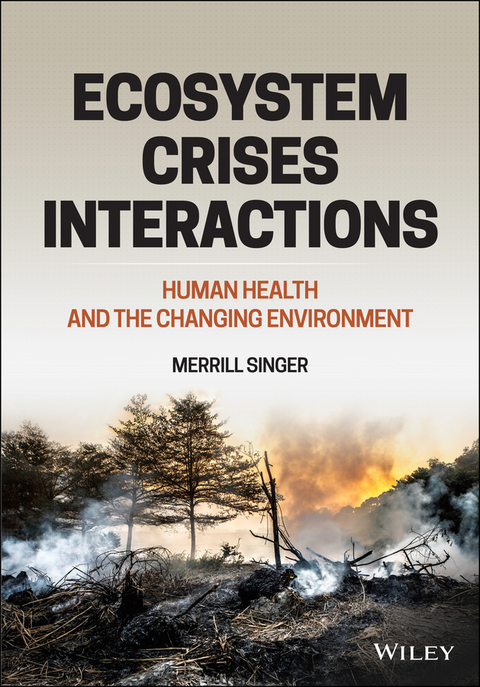
Ecosystem Crises Interactions (eBook)
Explores the human impacts on environment that lead to serious ecological crises, an innovative resource for students, professionals, and researchers alike
Ecosystem Crises Interaction: Human Health and the Changing Environment provides a timely and innovative framework for understanding how negative human activity impacts the environment, and how seemingly disparate factors connect to, and magnify, hazardous consequences under a changing climate. Presenting a coherent, holistic perspective to the subject, this compelling textbook and reference examines the diverse, often unexpected links that connect our complex world in context of global climate change.
The text illustrates how eco-crisis interaction-the synergistic interface of two or more environmental events or pollutants-can multiply to produce harmful health effects that are greater than their additive impact. This concept is highlighted through numerous real and relatable examples, from the use of sediment rock in hydraulic and drinking water filtration systems, to the connections between human development and crises such as deforestation, emergent infectious diseases, and global food insecurity. Throughout the text, specific examples present opportunities to consider broader questions about the extinction of species, populations, and ways of life. Presenting a balanced investigation of the interaction of contemporary ecological dangers, human behavior, and health, this unique resource:
- Explores how complex interactions between global warming and anthropogenic impairments magnify the diverse ecological perils and threats?facing humans and other species
- Discusses roadblocks to addressing environmental risk, such as global elite polluters, the organized denial of climate change, and deliberate environmental disruption for financial gain
- Describes how the production and use of fossil fuels?are driving a significant rise in carbon dioxide and other pollutants in the atmosphere and in the oceans
- Illustrates how industrial production is contributing to an array of environmental crises, including fuel spills, waste leakages, and loss of biodiversity
- Examines the critical ecosystems that are at risk from interacting stressors of human origin
Ecosystem Crises Interaction: Human Health and the Changing Environment is an ideal textbook for advanced?undergraduate and graduate students in courses including?public and allied health, environmental studies, medical ecology, medical anthropology, and geo-health, and a valuable reference?for researchers, practitioners, and policy makers in fields such as?environmental health, global and planetary health, public health, climate change, and medical social science.
Merrill Singer, Professor Emeritus, Departments of Anthropology and Community Medicine, University of Connecticut; Senior Research Scientist, Center for Health, Intervention and Prevention, University of Connecticut.
Explores the human impacts on environment that lead to serious ecological crises, an innovative resource for students, professionals, and researchers alike Ecosystem Crises Interaction: Human Health and the Changing Environment provides a timely and innovative framework for understanding how negative human activity impacts the environment, and how seemingly disparate factors connect to, and magnify, hazardous consequences under a changing climate. Presenting a coherent, holistic perspective to the subject, this compelling textbook and reference examines the diverse, often unexpected links that connect our complex world in context of global climate change. The text illustrates how eco-crisis interaction the synergistic interface of two or more environmental events or pollutants can multiply to produce harmful health effects that are greater than their additive impact. This concept is highlighted through numerous real and relatable examples, from the use of sediment rock in hydraulic and drinking water filtration systems, to the connections between human development and crises such as deforestation, emergent infectious diseases, and global food insecurity. Throughout the text, specific examples present opportunities to consider broader questions about the extinction of species, populations, and ways of life. Presenting a balanced investigation of the interaction of contemporary ecological dangers, human behavior, and health, this unique resource: Explores how complex interactions between global warming and anthropogenic impairments magnify the diverse ecological perils and threats facing humans and other species Discusses roadblocks to addressing environmental risk, such as global elite polluters, the organized denial of climate change, and deliberate environmental disruption for financial gain Describes how the production and use of fossil fuels are driving a significant rise in carbon dioxide and other pollutants in the atmosphere and in the oceans Illustrates how industrial production is contributing to an array of environmental crises, including fuel spills, waste leakages, and loss of biodiversity Examines the critical ecosystems that are at risk from interacting stressors of human origin Ecosystem Crises Interaction: Human Health and the Changing Environment is an ideal textbook for advanced undergraduate and graduate students in courses including public and allied health, environmental studies, medical ecology, medical anthropology, and geo-health, and a valuable reference for researchers, practitioners, and policy makers in fields such as environmental health, global and planetary health, public health, climate change, and medical social science.
Merrill Singer, Professor Emeritus, Departments of Anthropology and Community Medicine, University of Connecticut; Senior Research Scientist, Center for Health, Intervention and Prevention, University of Connecticut.
Preface
Chapter 1. Introduction: Public Health, Ecohealth, Planetary Health and You
From Individual to Public Health
Ecohealth: How changes in Earth's Ecosystems Affect Health
From Global to Planetary Health
Introducing Ecocrisis Interaction and Health
Age of the Anthropocene
The Hottest Year on Record
Organization of this Book
Section I: Impact on Ecosystems
Chapter 2. Intricacies of Ecosystems
Developing an Historic Understanding of Ecology and Ecosystems
Modern Ecology
Chapter 3. The Social, Economic, and Technological Making of Environmental Crisis
The Longue Durée and the Rise and Development of Capitalism
Polluting Elites
The Anthropocene or the Capitolocene?
The Capitalist Global Environment and the Future of "Eaarth"
Chapter 4 Engaging Catastrophe
Chapter 5 A Home in Peril: Major Contemporary Environmental Crises
Chapter 6. The Threat of Eco-crisis Interaction
Multiplying Risk
Impact: Case Studies of Ecocrisis Interaction
Section II: Environmental Crisis
Chapter 7. Beyond Single Threats: Mechanisms and Pathways of Interaction
Conventional Single-Threat Approaches
Mounting Number of Contemporary Threats and Interactions
The Complexities of Adverse Interaction
Chapter 8. Climate Change, Crisis Enhancement
Breaking Records: Current Climate Change
Climate Change and Ecosystem Understanding
Climate Change, the Primary Driver of Perilous Interaction
Chapter 9. Business as Deadly Usual: Resisting Environmental Science
A Time of Questioning Environmental Science
Deadly Business: Making and Denying Climate Change
Financing Climate Change Denial
The Politics of Climate Change Denial
Public Attitudes about Climate Change
Section III: Human Health Risks with Changing Environment
Chapter 10. Crossing Thresholds
Key Biogeochemical and Biophysical Earth System Processes
Are there Planetary Boundaries?
When Boundaries are Traversed
Chapter 11. Time for Change? Toward Sustainability, Toward Life
Mitigation and Adaptation
Glossary
1
Introduction: public health, EcoHealth, planetary health, and you
For decades, many of us have turned a blind eye to what is happening to the planet. But now, given that Earth [as we know it] may well be dying, we may be ready to stand up to protect what we love. An extraordinary alchemy can take place when people follow their inner directives to stand up and face squarely the dire odds of biosphere survival. These actions involve extraordinary outer and inner courage, which can nurture a profound activism.
Dahr Jamail (2019)
1.1 Connections
This book is about connections, often unexpected links in a complex world. It brings together detailed information about seemingly disparate subjects. In the process, the growing air traffic of Miami International Airport is shown to be connected to the city’s low‐lying status in the ocean, to the use of sediment rock in the area’s hydraulic and drinking water filtration systems, and to king and red tides. Elsewhere, the connections are examined between the climate of Earth and human evolution, the peopling of the world, and the historic development of modern society. Also of concern are the multiple ways national and international development under capitalism are entwined with deforestation, coral die‐off, emergent infectious disease, and mounting food insecurity around the world. This list could go on, but the basic point is that a holistic perspective on diverse issues is needed in the investigation of the interaction of contemporary ecological dangers, human behavior, and health.
In visiting ecocrises around the globe, from U.S. nuclear waste buried below the melting glaciers of Iceland to the deteriorating asbestos cement used to construct homes in Australia, and many other catastrophes in many places in between, a considerable amount of detail is offered. Why such a thoroughgoing approach to cases and examples? Because, while there are redundancies reflective of the unfortunate fact that in countless ways adverse elements of environmental history repeat themselves, it is by knowing a multitude of events that the patterns and their determinants are brought into sight. In this way, we begin to see the forest through the trees. It is a critical moment for this task, as the logger’s saw, intensifying wildfires, climate change‐induced pest invasions, drought, global warming, and over‐extraction conspire to denude the planet of oxygen‐generating forests, depopulate the oceans, melt the cryosphere, and put human well‐being at risk.
1.2 Is this a dangerous book?
In an essay entitled “The Danger of Environmentalism,” Michael Berliner (2020), senior advisor to the Ayn Rand Archives, writes: “Earth Day approaches, and with it a grave danger faces mankind. The danger is not from acid rain, global warming, smog, or the logging of rain forests, as environmentalists would have us believe. The danger to mankind is from environmentalism.” The perception, by some, of the danger inherent in being concerned about the industrial destruction of the environment is what has led covering the environment to be one of the most risky assignments in journalism. It is estimated that 40 reporters around the world died between 2005 and 2016 because of their environmental reporting. This is more than were killed covering the U.S. war in Afghanistan. Notes journalist Saul Elbein (quoted in Warren 2016): “In Cambodia and in remote forests elsewhere, a rising boom in the illegal sale of wood, land and minerals has turned the environmental beat into a new sort of conflict journalism. The dead have overwhelmingly been local reporters, covering illegal mining or logging. They are largely independent, poorly educated, untrained and despised by their nations’ establishment media. Reporting on a violent, corrupt frontier, they are never sure when they’ll cross a line and end up dead. Their lives in their hands, they head into the woods.” Newsworthy environmental controversies often involve powerful business and economic interests, explosive political clashes, criminal gangs, anti‐government rebels, or outright corruption. Often, they focus on struggles between elites and local people over indigenous rights to land and natural resources. In wealthy and developing countries alike, journalists covering environment issues find themselves the targets of attack by military, police, and paramilitary forces. In 2013, for example, independent journalist Miles Howe was assigned to cover protests by the Elsipotog First Nation in New Brunswick, Canada against hydraulic fracturing for natural gas. In his reporting, Howe sought to highlight unreported and underreported incidents. He recalls (quoted in Freedman 2018): “Many times I was the only accredited journalist witnessing rather violent arrests, third‐trimester pregnant women being locked up, guys tackled to the ground.” On one occasion, a member of the Royal Canadian Mounted Police pointed at him and shouted, “He’s with them!” His equipment was taken and the police searched his home. In addition, they offered to pay him to spy on the protesters—an offer that he rejected. In 2014, the body of Taing Try, a journalist covering the illegal logging of the forests of Cambodia, was found by local farmers in Kratie Province. He was lying face down in the mud on a logging road, a bullet in the back of his head. Try’s fate was not his alone. In 2008, Mikhail Beketov, a Russian journalist who wrote about the destruction of the Khimki Forest, part of the green belt surrounding Moscow, to make way for the Moscow–Saint Petersburg motorway, died of injuries suffered several years earlier after unknown attackers crushed his skull, broke his legs, and left him for dead in his own front yard. Similarly, in 2012, Chandrika Rai, an Indian reporter for the Hindi‐language newspaper Navbharat and the English‐language The Hitavada, who covered illegal coal mining, was bludgeoned to death along with his wife and their two teenage children in their home in Umaria, a small city in Madhya Pradesh state in central India. In 2017, Colombian radio journalist Efigenia Vásquez Astudillo was shot to death while covering the emergence of an indigenous movement to reclaim ancestral land that had been stolen and converted to large farms, resorts, and sugar plantations (Elbein 2016; Freedman 2018). The list goes on. Environmental reporters are often put at risk because they stand between the public and its need to know about environmental destruction and business interests or corrupt and criminal organizations intent on profit or personal gain. Degraders of the environment have a great deal invested in preventing the public from knowing the truth, or from knowing that is unencumbered by corporate spin (Conway 2018).
While environmental journals have been subjected to the most brutal forms of violence, environmental scientists—especially climate scientists—have been the targets of violent intimidation. The Climate Science Legal Defense Fund (2019), which has assisted numerous researchers who have been harassed and attacked through email, social media, and other online platforms or subjected to more explicit politically motivated personal threats, notes that:
Vicious hate mail and death threats are common occurrences for climate scientists: One was the victim of an anthrax scare. Another had a dead animal dropped on their doorstep—while their child was at home. There are websites devoted to publishing scientists’ contact information, a practice known as doxxing, so that the followers of these sites can flood scientists’ inboxes with threatening messages. Other internet harassment tactics involve posting private details about researchers, such as the names of their family members or home addresses, for harassers to use against them.
These forms of intimidation have also been directed at other kinds of scholars who have written about climate change. A founding member and current board member of the Climate Science Legal Defense Fund, Naomi Oreskes, a science historian at Harvard University, became a target of the anti‐climate science movement in 2004 when she published an article in Science documenting the broad scientific agreement on climate change. Based on an analysis of 928 scientific abstracts with the keywords “global climate change,” she concluded that “there is a scientific consensus on the reality of anthropogenic climate change. Climate scientists have repeatedly tried to make this clear. It is time for the rest of us to listen” (Oreskes 2004, p. 1686). In response to her publication, Oreskes began receiving hate mail, and extremely hostile letters were sent to Science. Many of the letters to the journal were penned by economists and others affiliated with pro‐free market think tanks, such as the Competitive Enterprise Institute. James Inhofe (R‐Oklahoma), a recipient of significant campaign funding from the fuel industry and a science denier who has called global warming a “hoax,” attacked Oreskes by name on the floor of the U.S. Senate. He cited Benny Peiser, a British social scientist, who claimed that his own review showed that fewer than 2 percent of climate studies endorsed the so‐called “consensus view” that human activity is driving global warming, and some actually opposed it. Inhofe was unaware of or failed to acknowledge the fact that Peiser later admitted he could only find one...
| Erscheint lt. Verlag | 11.3.2021 |
|---|---|
| Sprache | englisch |
| Themenwelt | Studium ► Querschnittsbereiche ► Prävention / Gesundheitsförderung |
| Naturwissenschaften ► Biologie ► Ökologie / Naturschutz | |
| Naturwissenschaften ► Geowissenschaften | |
| Schlagworte | Allg. Public Health • Anthropologie • Anthropology • climate change health risks • Climate change impacts • Climate change risks • climate change textbook • eco-crisis climate change • eco-crisis human health • eco-crisis reference • eco-crisis textbook • ecosystem climate change • Environmental change • environmental crisis textbook • Environmental Studies • Gesundheits- u. Sozialwesen • Health & Social Care • Medical Anthropology • Medizinische Anthropologie • Public Health • Public Health General • Umwelt • Umweltforschung • Umweltveränderungen |
| ISBN-13 | 9781119570011 / 9781119570011 |
| Informationen gemäß Produktsicherheitsverordnung (GPSR) | |
| Haben Sie eine Frage zum Produkt? |
 EPUB (Adobe DRM)
Kopierschutz: Adobe-DRM
Adobe-DRM ist ein Kopierschutz, der das eBook vor Mißbrauch schützen soll. Dabei wird das eBook bereits beim Download auf Ihre persönliche Adobe-ID autorisiert. Lesen können Sie das eBook dann nur auf den Geräten, welche ebenfalls auf Ihre Adobe-ID registriert sind.
Details zum Adobe-DRM
Dateiformat: EPUB (Electronic Publication)
EPUB ist ein offener Standard für eBooks und eignet sich besonders zur Darstellung von Belletristik und Sachbüchern. Der Fließtext wird dynamisch an die Display- und Schriftgröße angepasst. Auch für mobile Lesegeräte ist EPUB daher gut geeignet.
Systemvoraussetzungen:
PC/Mac: Mit einem PC oder Mac können Sie dieses eBook lesen. Sie benötigen eine
eReader: Dieses eBook kann mit (fast) allen eBook-Readern gelesen werden. Mit dem amazon-Kindle ist es aber nicht kompatibel.
Smartphone/Tablet: Egal ob Apple oder Android, dieses eBook können Sie lesen. Sie benötigen eine
Geräteliste und zusätzliche Hinweise
Buying eBooks from abroad
For tax law reasons we can sell eBooks just within Germany and Switzerland. Regrettably we cannot fulfill eBook-orders from other countries.
aus dem Bereich