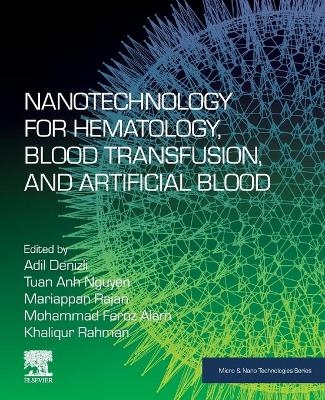
Nanotechnology for Hematology, Blood Transfusion, and Artificial Blood
Elsevier Science Publishing Co Inc (Verlag)
978-0-12-823971-1 (ISBN)
For artificial blood, the nanotechnological approach can fabricate artificial red blood cells, platelet substitutes, and white blood cell substitutes with their inherent enzyme and other supportive systems. In addition, nanomaterials can promote blood vessel growth and reserve red blood cells at a positive temperature.
Adil Denizli is Professor at Hacettepe University, Department of Chemistry, Ankara, Turkey. His main research fields are molecular imprinting technologies, purification of biomolecules by chromatographic methods, detection of molecules by sensors, production of polymers with different surface and bulk properties, shape and geometries, and application of these polymers in different applications. Mariappan Rajan is currently working as an Assistant Professor in the Department of Natural Products Chemistry, School of Chemistry, Madurai Kamaraj University, India. He is an experienced researcher and is mainly interested in the development of biodegradable polymeric nanocarrier systems, nanogels, nanoparticles, nanocomposite scaffolds, bio-ceramic materials and mineral substituted scaffold for Tissue engineering, Drug Delivery and Wound Dressing applications. Mohammad Feroz Alam M.D (Pathology) is an Assistant Professor at J.N Medical College, AMU. He has an experience of nearly 16 years in Teaching and Research work.His areas of interest are Hematology, Histopathology, Cancer research and Nanomedicine Khaliqur Rahman is an Associate Professor in the Hematology Laboratory at Sanjay Gandhi Post Graduate Institute of Medical Sciences, Lucknow, India. His areas of research are molecular diagnostic of hematolymphoid neoplasm and advancement in flow cytometric immunophenotyping and minimal residual disease evaluation. Tuan Anh Nguyen is a Senior Principal Research Scientist at the Institute for Tropical Technology, Vietnam Academy of Science and Technology, Hanoi, Vietnam. He received a BS in physics from Hanoi University in 1992, a BS in economics from Hanoi National Economics University in 1997, and a PhD in chemistry from the Paris Diderot University, France, in 2003. He was a Visiting Scientist at Seoul National University, South Korea, in 2004, and the University of Wollongong, Australia, in 2005. He then worked as a Postdoctoral Research Associate and Research Scientist at Montana State University, United States in 2006-09. In 2012 he was appointed as the Head of the Microanalysis Department at the Institute for Tropical Technology. His research areas of interest include smart sensors, smart networks, smart hospitals, smart cities, complexiverse, and digital twins. He has edited more than 74 books for Elsevier, 12 books for CRC Press, 1 book for Springer, 1 book for RSC, and 2 books for IGI Global. He is the Editor-in-Chief of Kenkyu Journal of Nanotechnology & Nanoscience.
PART 1: FUNDAMENTALS
1. Blood-nano interface: an introduction
2. Blood- nanomaterials interactions
3. Immune system - nanomaterials interactions
4. Uptake by reticuloendothelial system (RES) of the injected nanoparticles
5. Biomimetic nanomedicine: an introduction
6. Transport of nanoparticles in blood flow: Mathematical simulation
7. Effect of nanoparticle on the blood coagulation system (Nanoparticle interface with the blood coagulation system)
8. Toxicity/risk assessment of nanomaterials when used in hematology, blood transfusion and artificial blood
PART 2: HEMATOLOGY
9. Lab-on-a-chip (Lab-on-a-phone) for analysis of blood (diagnosis of blood diseases)
10. Nanotechnology for blood test to predict the blood diseases or blood disorders
11. Nanopharmacology in translational hematology and oncology (Nanotechnology applications in hematological malignancies)
12. Target-specific ligands loaded nanomagnets for blood purification (removal of pathogens without fouling of filter membranes)
13. Nanomaterials- based circulating artificial bioreactor for replacement of blood components
14. Drug delivery systems based on blood cells
PART 3: BLOOD TRANSFUSION
15. Smart blood transfusion: An introduction
16. Nanofiltration
17. Nanotechnology for the preservation of red blood cells
18. Nanotechnology for destroying blood clots
PART 4: ARTIFICIAL BLOOD
19. Artificial red blood cells
20. Platelet substitutes
21. WBC substitutes
22. Future scope
| Erscheinungsdatum | 02.09.2021 |
|---|---|
| Reihe/Serie | Micro & Nano Technologies |
| Sprache | englisch |
| Maße | 191 x 235 mm |
| Gewicht | 1040 g |
| Themenwelt | Medizinische Fachgebiete ► Innere Medizin ► Hämatologie |
| Technik ► Maschinenbau | |
| ISBN-10 | 0-12-823971-9 / 0128239719 |
| ISBN-13 | 978-0-12-823971-1 / 9780128239711 |
| Zustand | Neuware |
| Informationen gemäß Produktsicherheitsverordnung (GPSR) | |
| Haben Sie eine Frage zum Produkt? |
aus dem Bereich