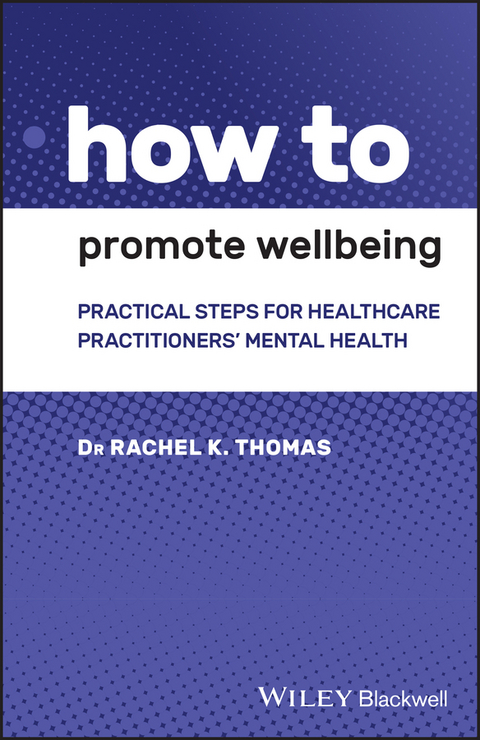
How to Promote Wellbeing (eBook)
John Wiley & Sons (Verlag)
978-1-119-61440-1 (ISBN)
How to Promote Wellbeing is a timely resource designed to help all healthcare practitioners promote and protect their own and their patients' wellbeing and mental health. Focusing on practical strategies and guidance, this much-needed book explores approaches for reducing burnout, managing stress, coping with pressure in healthcare settings, recognising signs of impaired decision-making, and much more.
Written specifically for busy healthcare practitioners, the book offers focused and succinct chapters on topics ranging from behaviours to improve resilience and mindfulness, to approaches for maintaining work-life balance when confronted with excessive workloads and organisational pressures. Throughout the text, evidence-based tools and techniques are provided to improve the practitioner's health and facilitate the delivery of high-quality care. Covering a wide range of clinical situations and important issues, this book:
- Examines global, organisational, and individual problem factors affecting mental health and wellbeing
- Discusses the impacts of chronic stress, burnout, technological and environmental factors, work-associated trauma, and sources of wellbeing strain
- Identifies factors that negatively affect patients' wellbeing in hospital, clinic, and outpatient settings
- Offers guidance for emergencies and available resources for those in personal crisis
- Includes a mental health and wellbeing toolkit, including assessments and strategies
How to Promote Wellbeing is indispensable reading for doctors, nurses, dentists, therapists, counsellors, and other clinicians and health professionals.
RACHEL K. THOMAS is a practicing doctor, award-winning author and leading healthcare innovator with a special interest in mental wellbeing, resilience and progressive medicine.
How to Promote Wellbeing is a timely resource designed to help all healthcare practitioners promote and protect their own and their patients' wellbeing and mental health. Focusing on practical strategies and guidance, this much-needed book explores approaches for reducing burnout, managing stress, coping with pressure in healthcare settings, recognising signs of impaired decision-making, and much more. Written specifically for busy healthcare practitioners, the book offers focused and succinct chapters on topics ranging from behaviours to improve resilience and mindfulness, to approaches for maintaining work-life balance when confronted with excessive workloads and organisational pressures. Throughout the text, evidence-based tools and techniques are provided to improve the practitioner's health and facilitate the delivery of high-quality care. Covering a wide range of clinical situations and important issues, this book: Examines global, organisational, and individual problem factors affecting mental health and wellbeing Discusses the impacts of chronic stress, burnout, technological and environmental factors, work-associated trauma, and sources of wellbeing strain Identifies factors that negatively affect patients wellbeing in hospital, clinic, and outpatient settings Offers guidance for emergencies and available resources for those in personal crisis Includes a mental health and wellbeing toolkit, including assessments and strategies How to Promote Wellbeing is indispensable reading for doctors, nurses, dentists, therapists, counsellors, and other clinicians and health professionals.
RACHEL K. THOMAS is a practicing doctor, award-winning author and leading healthcare innovator with a special interest in mental wellbeing, resilience and progressive medicine.
Chapter 1: General problem factors affecting global mental health and wellbeing
Chapter 2: Problem factors affecting healthcare practitioner mental health and wellbeing
Chapter 3: Problem and protective factors affecting patients' mental health and wellbeing
Chapter 4: Protective factors for organisational implementation
Chapter 5: Protective factors for individual implementation
Chapter 6: Protective factors for individual trainee/student implementation
Chapter 7: Emergencies in mental health and wellbeing
Chapter 8: Mental health and wellbeing toolkit
"In 'How to Promote Wellbeing', Dr Rachel Thomas has produced a timely resource designed to help all healthcare practitioners promote and protect their own wellbeing and mental health. From her own clinical medical background of neuroscience and the psychology of mental health, she provides practical strategies and guidance: by providing care to another human being, she explores how this can affect the carer ... This mental health first aid tool should be in your department's library and in the hands of those with an educational or leader's role, caring for staff welfare and your wellbeing." - Journal of Perioperative Practice
Introduction
As clinicians, we are trained to focus on improving the health of our patients. However, this focus, due to numerous reasons, can become so singular that we neglect to look after ourselves.
Healthcare is an extremely rewarding profession. Its capacity to be varied, intense, and emotional offers challenge and high personal satisfaction. The opportunity to help a fellow human at their most vulnerable is a great honour.
However, being a clinician also comes with stress and pressure. The pressures of such a job – and really, for many of us, it becomes more than just a ‘job’ – come from endless sources. Some pressures are due to systemic, institutional, and organisational aspects, baked into the hospital infrastructure, such as rota hours. Some are cultural, such as the stigma still remaining of mentioning our own mental health issues, where we are part of a profession many people assume is immune from such problems. Education and awareness may be sources of pressure, when appropriate resources are not clear, or even available. In times of crisis, the stress may be operational, such as an increased stretching of teams, inadequate support, or inadequate supplies of personal protective equipment (PPE). Hence, while, unfortunately, many areas may cause stress and pressure, these fortunately also provide many opportunities to improve the situation.
It is not surprising, then, that the accumulation of these factors, compounded by our inherent obligation of responsibility for other people’s lives on a daily basis, leads to a profession in which there are high rates of burnout and mental distress.
The impact of burnout and mental distress can lead to immeasurable cost, not only to our own health but, ironically, also to the health of those we are aiming to help. In many studies, clinicians’ decreased wellbeing is associated with poorer patient outcomes. Poorer patient outcomes are associated with decreased job enjoyment – which ultimately may lead to more clinicians leaving due to burnout. This leads to fewer clinicians, and it is not hard to see that this can then lead to a compounding effect with even greater stretching of resources and fewer clinicians available. So, in being too devoted to our profession, we may instead actually be undercutting our main priority – our commitment to helping our patients.
This book addresses issues in a direct, practical way, since we, as clinicians, are generally time‐poor. In the first half of the book we analyse and highlight problem factors that potentially affect our mental health and wellbeing. Given that our own mental health and wellbeing has the potential to impact on the outcomes of our patients, we then consider the problem factors and protective factors relevant to the mental health and wellbeing specifically of our patients. This is in no way intended to be a complete analysis of this huge area. It is just intended to highlight some areas, and to propose some protective factors that may be of benefit to our patients. The second half of the book provides information on protective factors for clinicians, for preserving our own mental health and wellbeing. Evidence‐based tools and techniques are included, for use to not only promote and protect our own wellbeing, but in the process, to enable the continued delivery of optimum levels of care to our patients.
Learning outcomes
- Increased understanding of:
- global problems affecting mental health and wellbeing
- organisational problem factors affecting mental health and wellbeing
- individual problem factors affecting mental health and wellbeing
- the impacts of chronic stress
- the impacts of burnout
- protective factors affecting mental health and wellbeing
- Increased ability to recognise the signs of burnout
- Increased awareness of:
- protective factors for promoting organisational resilience
- protective factors for promoting individual resilience
- the need for recovery behaviours, and potentially suitable behaviours.
Reading this book and then appropriately reflecting on aspects such as the above learning outcomes may qualify as being eligible for Continuing Professional Development (CPD) points. It is also important to note that this book is not intended as a support for us when we are in acute phases of distress or suffering with a mental health condition. The resources in Chapter 7 provide sources of help in any acute instance, as this book is not intended as an exclusive treatment or diagnostic tool. In situations where we are unsure whether we need further help, a conversation with a trusted colleague, local General Practitioner (GP), friend, or family member is a helpful first step.
Why should we be concerned about our own wellbeing?
Healthcare is evidence‐based. We use evidence to decide the best treatments and courses of actions for our patients. Why should we not apply the same standard to look after our own wellbeing? Looking at the evidence – as we do in other areas of healthcare – there is plenty to support the fact that we are in the best position to look after our patients when we also look after our own wellbeing.
Grim statistics highlight what happens when we don’t.
In the UK, it is estimated that, per year, errors cost the NHS over 1 billion GBP in litigation, and 2 billion GBP due to bed delays.1 The human cost – grief, pain, and suffering by those at both ends of the error – is, of course, inestimable.
Even if we think we do not have time to care for our own wellbeing, or that it is ‘optional’, clinician codes of conduct make it clear that maintaining our own wellbeing is essentially a requirement.
Professional codes for different healthcare practitioners cover aspects of practice, and these can be interpreted to either explicitly or implicitly direct us to ensure our own health and wellbeing is adequate.
The General Medical Council (GMC) provides guidelines on ethical guidance and good medical practice.2 Patient care is the first concern under ‘Knowledge, Skills, and Performance’. Associated with ‘providing a good standard of practice and care’ is the recognition that we work within our own competence and its limitations.3
It even explicitly covers ‘risks posed by your health’.4 Knowing, or even suspecting, that our performance and/or our judgement could be impacted by a condition requires us to consult with a suitably qualified colleague. While at times we may not be fully aware of how our wellbeing is impacting on us, usually we have at least some degree of insight and self‐awareness which means we at least do ‘have a hunch’ that we may be in need of help.
Taking this a step further means that we should, in all likelihood, take as many steps as possible to protect our mental wellbeing.
The GMC’s guide for ‘Good Medical Practice’ emphasises that our first concern is the patient’s care, and that we should act promptly if we feel this may be compromised. We must monitor the quality of our work, and ensure that we work within the limitations of our competence (Figure 0.1).
Figure 0.1 Duties of a doctor registered with the GMC.3
The Nursing and Midwifery Council (NMC) outlines professional requirements and standards for nurses in the UK.5 Nurses joining this register are required to commit to uphold the standards it outlines. The register clearly states that ‘nurses, midwives, and nursing associates are expected to work within the limits of their competence’.5
The register also clearly states there is a requirement to:
- ‘pay special attention to promoting wellbeing, preventing ill health, and meeting the changing health and care needs of people during all life stages
- be supportive of colleagues who are encountering health or performance problems. However, this support must never compromise or be at the expense of patient or public safety
- take account of your own personal safety as well as the safety of people in your care
- take all reasonable personal precautions necessary to avoid any potential health risks to colleagues, people receiving care, and the public
- maintain the level of health you need to carry out your professional role
- support any staff you may be responsible for to follow the Code at all times. They must have the knowledge, skills, and competence for safe practice; and understand how to raise any concerns linked to any circumstances where the Code has, or could be, broken.’5
It can clearly be seen that these, and additional, areas of the code highlight that there is a professional requirement to maintain our own wellbeing. It is not only doctors and nurses who are bound by these requirements. Other healthcare professionals may have similar codes, highlighting the need to ensure and maintain personal wellbeing.
The practice standards are clear for all Allied Health professionals, for example Speech and Language Pathologists, Occupational therapists, Physiotherapists, Physical Therapists, Chiropodists, Audiologists, Diagnostic Imaging Technologists, Specialist Diagnostic Imaging Technologists, Medical Laboratory Technicians, Emergency Medicine Technicians, Addiction Counsellors, and Dietitians.6
In the...
| Erscheint lt. Verlag | 18.2.2021 |
|---|---|
| Reihe/Serie | HOW - How To |
| HOW - How To | How To |
| Sprache | englisch |
| Themenwelt | Medizin / Pharmazie ► Gesundheitsfachberufe |
| Medizin / Pharmazie ► Medizinische Fachgebiete ► Psychiatrie / Psychotherapie | |
| Medizin / Pharmazie ► Pflege | |
| Schlagworte | burnout in healthcare • Gesundheits- u. Sozialwesen • Health & Social Care • healthcare occupational mental health • healthcare occupational wellbeing • Krankenpflege • Krankenpflege i. d. Psychologie • Medical Science • Medizin • Mental Health • mental health for clinicians • mental health for doctors • mental health for practitioners • Mental Health Nursing • nursing • Psychiatrie • Psychiatry • Psychische Gesundheit • stress management healthcare • wellbeing for clinicians • wellbeing for doctors • wellbeing for healthcare professionals |
| ISBN-10 | 1-119-61440-6 / 1119614406 |
| ISBN-13 | 978-1-119-61440-1 / 9781119614401 |
| Informationen gemäß Produktsicherheitsverordnung (GPSR) | |
| Haben Sie eine Frage zum Produkt? |
 EPUB (Adobe DRM)
Kopierschutz: Adobe-DRM
Adobe-DRM ist ein Kopierschutz, der das eBook vor Mißbrauch schützen soll. Dabei wird das eBook bereits beim Download auf Ihre persönliche Adobe-ID autorisiert. Lesen können Sie das eBook dann nur auf den Geräten, welche ebenfalls auf Ihre Adobe-ID registriert sind.
Details zum Adobe-DRM
Dateiformat: EPUB (Electronic Publication)
EPUB ist ein offener Standard für eBooks und eignet sich besonders zur Darstellung von Belletristik und Sachbüchern. Der Fließtext wird dynamisch an die Display- und Schriftgröße angepasst. Auch für mobile Lesegeräte ist EPUB daher gut geeignet.
Systemvoraussetzungen:
PC/Mac: Mit einem PC oder Mac können Sie dieses eBook lesen. Sie benötigen eine
eReader: Dieses eBook kann mit (fast) allen eBook-Readern gelesen werden. Mit dem amazon-Kindle ist es aber nicht kompatibel.
Smartphone/Tablet: Egal ob Apple oder Android, dieses eBook können Sie lesen. Sie benötigen eine
Geräteliste und zusätzliche Hinweise
Buying eBooks from abroad
For tax law reasons we can sell eBooks just within Germany and Switzerland. Regrettably we cannot fulfill eBook-orders from other countries.
aus dem Bereich