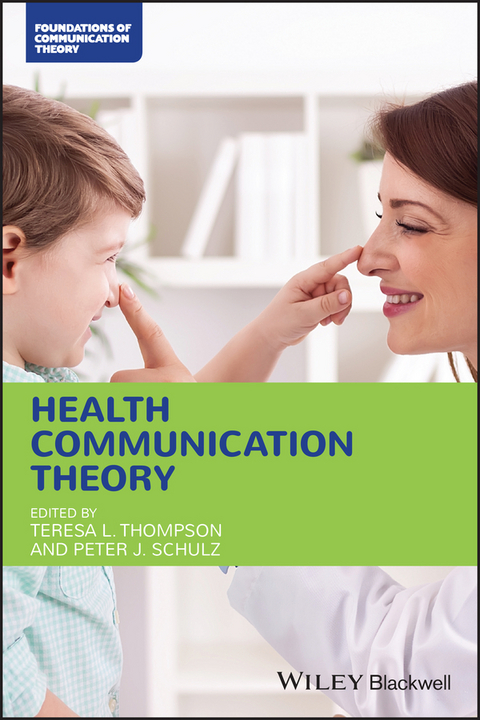
Health Communication Theory (eBook)
John Wiley & Sons (Verlag)
978-1-119-57450-7 (ISBN)
Assembles the most important theories in the field of health communication in one comprehensive volume, designed for students and practitioners alike
Health Communication Theory is the first book to bring together the theoretical frameworks used in the study and practice of creating, sending, and receiving messages relating to health processes and health care delivery. This timely volume provides easy access to the key theoretical foundations on which health communication theory and practice are based. Students and future practitioners are taught how to design theoretically-grounded research, interventions, and campaigns, while established scholars are presented with new and developing theoretical frameworks to apply to their work.
Divided into three parts, the volume first provides a summary and history of the field, followed by an overview of the essential theories and concepts of health communication, such as Problematic Integration Theory and the Cultural Variance Model. Part Two focuses on interpersonal communication and family interaction theories, provider-patient interaction frameworks, and public relations and organizational theories. The final part of the volume centers on theories relevant to information processing and cognition, affective impact, behavior, message effects, and socio-psychology and sociology. Edited by two internationally-recognized experts with extensive editorial and scholarly experience, this first-of-its-kind volume:
- Provides original chapters written by a group of global scholars working in health communication theory
- Covers theories unique to interpersonal and organizational contexts, and to health campaigns and media issues
- Emphasizes the interdisciplinary and collaborative nature of health communication research
- Includes overviews of basic health communication theory and application
- Features commentary on future directions in health communication theory
Health Communication Theory is an indispensable resource for advanced undergraduate and graduate students studying health communication, and for both new and established scholars looking to familiarize themselves with the area of study or seeking a new theoretical frameworks for their research and practice.
Teresa L. Thompson is Professor Emerita of Communication at the University of Dayton, Ohio. She has been the Editor of the journal Health Communication for more than 33 years, and has edited the Routledge Handbook of Health Communication and Sage Encyclopedia of Health Communication. Dr. Thompson is esteemed for both her contributions to the field and for her proficiency in coordinating the work of other scholars and editorial staff.
Peter J. Schulz is Professor at the University of Lugano, Switzerland, where he is Director of the Institute of Communication and Health. Together with Paul Cobley, London, he is Editor of the Series Handbooks of Communication Science (HoCS, 42 volumes, Berlin: DeGruyter & Mouton). Since 2017 he is also Honorary Professor at ANU (Australian National University, Canberra).
Assembles the most important theories in the field of health communication in one comprehensive volume, designed for students and practitioners alike Health Communication Theory is the first book to bring together the theoretical frameworks used in the study and practice of creating, sending, and receiving messages relating to health processes and health care delivery. This timely volume provides easy access to the key theoretical foundations on which health communication theory and practice are based. Students and future practitioners are taught how to design theoretically-grounded research, interventions, and campaigns, while established scholars are presented with new and developing theoretical frameworks to apply to their work. Divided into three parts, the volume first provides a summary and history of the field, followed by an overview of the essential theories and concepts of health communication, such as Problematic Integration Theory and the Cultural Variance Model. Part Two focuses on interpersonal communication and family interaction theories, provider-patient interaction frameworks, and public relations and organizational theories. The final part of the volume centers on theories relevant to information processing and cognition, affective impact, behavior, message effects, and socio-psychology and sociology. Edited by two internationally-recognized experts with extensive editorial and scholarly experience, this first-of-its-kind volume: Provides original chapters written by a group of global scholars working in health communication theory Covers theories unique to interpersonal and organizational contexts, and to health campaigns and media issues Emphasizes the interdisciplinary and collaborative nature of health communication research Includes overviews of basic health communication theory and application Features commentary on future directions in health communication theory Health Communication Theory is an indispensable resource for advanced undergraduate and graduate students studying health communication, and for both new and established scholars looking to familiarize themselves with the area of study or seeking a new theoretical frameworks for their research and practice.
Teresa L. Thompson is Professor Emerita of Communication at the University of Dayton, Ohio. She has been the Editor of the journal Health Communication for more than 33 years, and has edited the Routledge Handbook of Health Communication and Sage Encyclopedia of Health Communication. Dr. Thompson is esteemed for both her contributions to the field and for her proficiency in coordinating the work of other scholars and editorial staff. Peter J. Schulz is Professor at the University of Lugano, Switzerland, where he is Director of the Institute of Communication and Health. Together with Paul Cobley, London, he is Editor of the Series Handbooks of Communication Science (HoCS, 42 volumes, Berlin: DeGruyter & Mouton). Since 2017 he is also Honorary Professor at ANU (Australian National University, Canberra).
Part I: Perspectives on the Field of Health Communication
Ch. 1: Basics of Health Communication Theory
Teresa Thompson and James D. Robinson
Ch. 2: Segmenting Priority Audiences Employing Individual Difference Variables to Improve Health Promotion Efforts
Brian Quick, Tobias Reynolds-Tylus, Salah H. Al-Ghaithi, and Michael Mackert
Ch. 3: When Theory and Methods Intertwine
Jill Yamasaki
Part II: Perspectives on Dyads and Groups
Ch. 4: Interpersonal Health Communication Theories
Maria Brann, Jennifer Bute, Maureen Keeley, Sandra Petronio, Rachyl Pines, and Bernadette Watson
Ch. 5: Families Interacting in the Health Care Context
Maureen Keeley and Hannah Jones
Ch. 6: Theoretical Frameworks of Provider-Patient Interaction
Peter J. Schulz and Shaohai Jiang
Part III: Perspectives on Influence Processes
Ch. 7: Information-Processing and Cognitive Theories
Monique Mitchell Turner, Youjin Jang, and Shawn Turner
Ch. 8: Theories of Affective Impact
Robin Nabi
Ch. 9: Theories of Behavior
Marco Yzer and Rebekah Nagler
Ch. 10: Theories of Message Effects
James Robinson, Yan Tian, and Jeanine Warisse-Turner
Part IV: Perspectives on Organisations and Society
Ch. 11: Social Psychological Influences on Health Communication: An Examination of Four Theories
Yanqin Liu and Anthony Roberto
Ch. 12: Theories of Public Relations
Arunima Krishna
Ch. 13: Theories of Uncertainty
Austin S. Babrow, Marianne S. Matthias, Sarah M. Parsloe, and Anne M. Stone
Ch. 14: Cultural Theories of Health Communication
Evelyn Ho and Barbara Sharf
Ch. 15: Effects of Digital Media Technology on Health Communication
Shyam Sundar and Maria D. Molinar
Part V: Perspectives on the Future
Ch. 16: Directions in Health Communication Theory
Dannielle Kelley and Brian Southwell
1
The Basics of Health Communication Theory
Teresa L. Thompson and James D. Robinson
Health problems are prevalent all over the world, and communication processes play essential roles in addressing these health problems. From Ebola, MERS, Zika, and COVID‐19 to vaping and the opioid epidemic, various health crises must be confronted across the world on a constant basis. The area of study that has come to be called “health communication” is crucial as practitioners and scholars attempt to alleviate and minimize a multitude of health problems and improve health care delivery. Effective and useful health communication is foundational as we attempt to control the spread of disease and health problems.
Do message strategies that encourage people to manage their diet to control diabetes also inspire them to look more closely at vaccination decisions? In other words, can we generalize what we learn about health communication regarding one health problem to other health issues? Does the study of patient‐centered communication have implications for mental health as well as physical health and illness? Does message targeting or tailoring allow the effective adaptation of anti‐vaping messages to different audiences? These and other questions are conceptual and theoretical concerns that underlie health promotion and a broader understanding of health communication processes. Through health communication research one may understand not only how communication operates in relation to a particular health issue, but how health communication functions more broadly. Indeed, the ultimate hope is an increased understanding of communication processes across contexts and a healthier world.
As is evident in the title of this volume, the focus of this book is on the theories that we use to study health‐related processes. Our goal is to help students, scholars, and practitioners more adequately examine health communication concerns by grounding their work in solid theory. We thus begin the volume by briefly defining health communication, health, health care delivery, and theory. We then talk about why theory is important in the study of health communication. We follow this with brief discussions of the traditions of health communication theory and generative tensions in health communication scholarship. This chapter concludes with a preview of the remainder of the book and a discussion of ethical concerns.
What is Health Communication?
It is frequently noted that the area of study that has become known as health communication began to emerge from research in the 1940s that looked at the persuasive impact of health information and promotion, although Salmon and Poorisat (2019) point to even earlier traditions from the field of public health. This work goes back to the development of germ theory and can be traced to the beginning of the twentieth century. Starting with newspapers and then moving to film, radio, and television, media campaigns about health issues began to appear. The emergence and refinement of social science research methods, including the development of Thurstone and Likert‐type scales and sampling techniques à la George Gallup, was another central factor in the progress that was made during earlier decades of the twentieth century. Salmon and Poorisat (p. 1) identify four key factors that influenced and characterized this growth:
- the early use of mass communication for public health campaigns (1900–1910s);
- the search for effects (1920–1930s);
- the search for explanation from interdisciplinary perspectives (1940–1950s); and
- the formal recognition of health communication as a distinct and valuable field of practice and research (1960s).
The reader will see these influences reflected in the theories and chapters that follow.
The Stanford Heart Disease Prevention Program, which began in 1971, was also an important development in the history of health communication. During the early 1970s scholars such as Barbara Korsch and her colleagues (e.g. Korsch and Negrete, 1972) conducted work that served as the foundation of research on physician–patient communication. This work, published in such prestigious outlets as Scientific American, created interest within the broader field of communication. Some of this work was labeled “medical communication.” Simultaneously, scholars building on the interactional view articulated in Watzlawick, Beavin, and Jackson’s (1967) Pragmatics of Human Communication and further developing the conceptualization of communication processes offered by Gregory Bateson (1972) focused on what was called “therapeutic communication.” These traditions came together beginning in the early‐1970s to prompt the development of the new area of study called “health communication.” The inception of the Health Communication Division of the International Communication Association in 1975 (following the founding of the Health Communication Interest Group in 1972) most clearly demarcated this new area of study. The movement within medicine, public health, and the social sciences from a biomedical approach to a biopsychosocial view was simultaneously occurring (see Ho and Sharf, Chapter 14 in this volume, for more discussion of this).
The area of health communication did not take long to develop. Books on the topic, most notably Kreps and Thornton’s (1982) Health Communication: Theory and Practice, began to emerge in the early 1980s. By 1986, enough work was being conducted in the area that the publisher Lawrence Erlbaum Associates expressed interest in a journal on health communication. The first author of the present chapter, who is also the editor of the journal Health Communication, began soliciting submissions in 1987, and the first issue of the journal came out in January of 1989. The journal originally published four issues a year, but at the time of the writing of this chapter is publishing 14 lengthy issues a year. During 2019, the journal processed 776 submissions. Two hundred and nine issues of the journal have now been published. Health Communication was shortly followed by The Journal of Health Communication: International Perspectives, Patient Education and Counseling, Journal of Communication in Healthcare, Communication and Medicine, and several other outlets. The Journal of Health Communication began publishing in 1996. The first edition of the Handbook of Health Communication (chapters of which were translated into Korean) was published in 2003, and the second edition, The Routledge Handbook of Health Communication was published in 2011. The third edition of the handbook is in press at the time of the writing and will be published in 2021. The Sage Encyclopedia of Health Communication came out in 2014. All of these publications are evidence of the rapid growth of this area of study.
International interest in health communication has also increased notably over the last three decades. This is reflected in the subtitle of the Journal of Health Communication: International Perspectives, but is really reflected in the work published in all the health communication outlets. The journals all receive and publish submissions from a variety of countries. As continents, Europe, Oceania (Australia and New Zealand), and Asia are particularly active in health communication scholarship, as is North America. Within Europe, scholars in the Netherlands, Switzerland, and the UK are highly involved in health communication research. The Asian countries of Korea, China, Taiwan, and Singapore are also replete with active health communication researchers. In North America, health communication research is conducted in both the US and Canada.
The initial issue of Health Communication included many invited pieces by such important scholars as Barbara Korsch, Gary Kreps, David Smith, and Jon Nussbaum. These pieces attempted to set the agenda for the field – and they did, continuing to be cited during subsequent decades. Several articles in the 100th issue of the journal referred back to these articles and identified the progress that had been made over the last 100 issues. Much advancement was, indeed, apparent. Many of the directions suggested by these scholars have now been actualized.
Early submissions to and publications in Health Communication tended to be atheoretical and offered relatively simplistic views on communicative processes, although not as simplistic as those that are still apparent in the research conducted today by submitters without a background in the social sciences. The quality and focus of most of the work that is now submitted to the journal has changed substantially in the 30‐some years in which the journal has been publishing, and work is rarely accepted for publication without a guiding theoretical foundation.
As is the case with any area of study or phenomenon, varying definitions of health communication have been offered. The process of communication focuses on simultaneous, transactional message co‐creation of meaning through interaction. Health communication focuses on such processes as they relate to and impact health and health care delivery. The primary areas of study that are the foci of health communication work include provider–patient communication, health campaigns and other types of health promotion, health information in the media, eHealth and mHealth, health risk communication, communicative...
| Erscheint lt. Verlag | 10.2.2021 |
|---|---|
| Reihe/Serie | Blackwell Foundations of Communication Theory Series |
| Blackwell Foundations of Communication Theory Series | Foundations of Communication Theory Series |
| Sprache | englisch |
| Themenwelt | Medizin / Pharmazie ► Allgemeines / Lexika |
| Sozialwissenschaften ► Kommunikation / Medien | |
| Sozialwissenschaften ► Politik / Verwaltung | |
| Sozialwissenschaften ► Soziologie | |
| Schlagworte | Communication & Media Studies • Communication Studies • Communication theory • Gesundheits- u. Sozialwesen • Health & Health Care Special Topics • Health & Social Care • health campaign communications • Health Communication • Health Communication Campaigns • health communication in media • health training communications • interpersonal health communication • Kommunikationstheorie • Kommunikationswissenschaft • Kommunikation u. Medienforschung • organizational health communication • Spezialthemen Gesundheitswesen |
| ISBN-10 | 1-119-57450-1 / 1119574501 |
| ISBN-13 | 978-1-119-57450-7 / 9781119574507 |
| Informationen gemäß Produktsicherheitsverordnung (GPSR) | |
| Haben Sie eine Frage zum Produkt? |
 EPUB (Adobe DRM)
Kopierschutz: Adobe-DRM
Adobe-DRM ist ein Kopierschutz, der das eBook vor Mißbrauch schützen soll. Dabei wird das eBook bereits beim Download auf Ihre persönliche Adobe-ID autorisiert. Lesen können Sie das eBook dann nur auf den Geräten, welche ebenfalls auf Ihre Adobe-ID registriert sind.
Details zum Adobe-DRM
Dateiformat: EPUB (Electronic Publication)
EPUB ist ein offener Standard für eBooks und eignet sich besonders zur Darstellung von Belletristik und Sachbüchern. Der Fließtext wird dynamisch an die Display- und Schriftgröße angepasst. Auch für mobile Lesegeräte ist EPUB daher gut geeignet.
Systemvoraussetzungen:
PC/Mac: Mit einem PC oder Mac können Sie dieses eBook lesen. Sie benötigen eine
eReader: Dieses eBook kann mit (fast) allen eBook-Readern gelesen werden. Mit dem amazon-Kindle ist es aber nicht kompatibel.
Smartphone/Tablet: Egal ob Apple oder Android, dieses eBook können Sie lesen. Sie benötigen eine
Geräteliste und zusätzliche Hinweise
Buying eBooks from abroad
For tax law reasons we can sell eBooks just within Germany and Switzerland. Regrettably we cannot fulfill eBook-orders from other countries.
aus dem Bereich