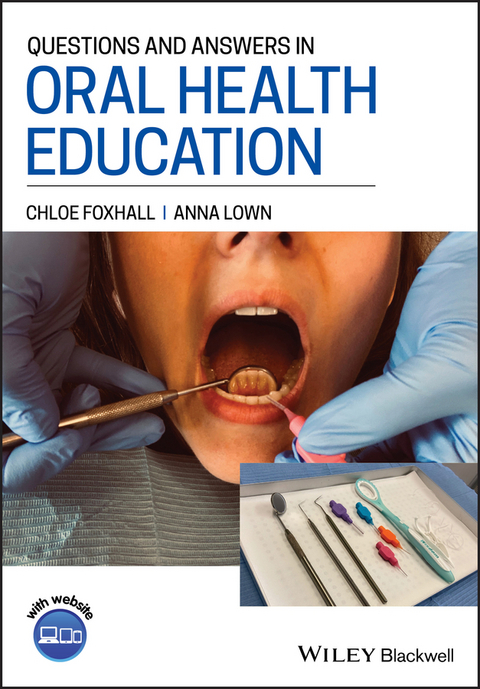
Ideal study aid for the NEBDN Certificate in Oral Health Education
Questions and Answers in Oral Health Education comprehensively and efficiently prepares students for the National Examining Board for Dental Nurses (NEBDN) Certificate in Oral Health. Written by a dental tutor and course administrator, as well as a certified NEBDN examiner, this revision guide includes tips and techniques to help students with the test. It also includes examples of mock examination questions along with answers and explanations to further students' understanding of the material contained within.
Presented in question-and-answer format to aid with retention and learning, Questions and Answers in Oral Health Education contains the most up-to-date regulations, policies, and oral health guidance.
Full of useful information to better cater to each student's unique style of learning, it features:
- An introduction to the exam process and exam structure, including the style of questions a test-taker is likely to see
- A discussion of legislation and General Dental Council standards and guidance
- A summary of the material contained within the book along with website links for further, supplementary study
- Treatments of a wide variety of topics, including plaque, sugars, erosion, fluoride, and more
Questions and Answers in Oral Health Education is perfect for qualified dental nurses seeking to extend their duties with a post-registration qualification like the NEBDN Certificate in Oral Health Education.
About the Authors
CHLOE FOXHALL is an NEBDN qualified dental nurse and holds post graduate certificates. She is also a dental tutor and course administrator at Smiles Dental Training LTD.
ANNA LOWN is an NEBDN qualified dental nurse and holds post graduate certificates. She is also a NEBDN Examiner and Founder of Smiles Dental Training LTD.
Ideal study aid for the NEBDN Certificate in Oral Health Education Questions and Answers in Oral Health Education comprehensively and efficiently prepares students for the National Examining Board for Dental Nurses (NEBDN) Certificate in Oral Health. Written by a dental tutor and course administrator, as well as a certified NEBDN examiner, this revision guide includes tips and techniques to help students with the test. It also includes examples of mock examination questions along with answers and explanations to further students understanding of the material contained within. Presented in question-and-answer format to aid with retention and learning, Questions and Answers in Oral Health Education contains the most up-to-date regulations, policies, and oral health guidance. Full of useful information to better cater to each student s unique style of learning, it features: An introduction to the exam process and exam structure, including the style of questions a test-taker is likely to see A discussion of legislation and General Dental Council standards and guidance A summary of the material contained within the book along with website links for further, supplementary study Treatments of a wide variety of topics, including plaque, sugars, erosion, fluoride, and more Questions and Answers in Oral Health Education is perfect for qualified dental nurses seeking to extend their duties with a post-registration qualification like the NEBDN Certificate in Oral Health Education.
About the Authors CHLOE FOXHALL is an NEBDN qualified dental nurse and holds post graduate certificates. She is also a dental tutor and course administrator at Smiles Dental Training LTD. ANNA LOWN is an NEBDN qualified dental nurse and holds post graduate certificates. She is also a NEBDN Examiner and Founder of Smiles Dental Training LTD.
Acknowledgements ix
About the Authors x
Introduction xi
How to use Question and Answers in Oral Health Education xii
About the Companion Website xiv
Roles and Responsibilities xv
General Dental Council xxxvii
Revision 1
Revision 1: Acronyms and Abbreviations 2
Revision 2: Methods of Retaining Information 5
Revision 3: Caries 7
Revision 4: Fluoride 11
Revision 5: Visual Aids 17
Revision 6 Muscles of Mastication 24
Revision 7: Oral Conditions 25
Revision 8: Oral Hygiene Aids 32
Revision 9: Plaque 37
Revision 10: Sugars 43
Revision 11: Toothbrushing Techniques 48
1 Oral Health Messages 50
2 Eruption 56
3 Anatomy and the Oral Mucosa 61
4 Saliva 69
5 Periodontal Disease and Plaque 75
6 Caries 82
7 Sugar 88
8 Tooth Surface Loss 94
9 Visual Aids 100
10 Aims and Objectives 104
11 Lesson Preparation and Communication 110
12 Socio-Economic Classification, Class, and Socialisation 119
13 Fluoride and Fissure Sealants 124
14 Oral Conditions and Oral Cancers 130
15 Legislation and GDC Standards 135
16 Screening, Surveys, Indices, Epidemiology, Prevalence, and Incidence 140
17 General Health 144
18 Medical Emergencies 154
Roles and Responsibilities
In a dental practice there are many people that make up a team in order to have a well functioning unit. This includes dentists, hygienists, therapists, and dental nurses. Clinicians are able to take on further studies and become specialists in various other fields, such as oral surgery or endodontics. Dental Care Professionals (DCPs) are now able to study to hold extended duties. Some examples of these are oral health education, radiography, sedation nursing, impression taking, or implant nursing.
Dentist
A student spends five years completing undergraduate training at a university dental school. When the final examinations are completed, the students are awarded a Bachelor of Dental Surgery (BDS) which then allows them to enrol onto the dentist register with the General Dental Council (GDC). The register is held by the GDC and contains the dentist's full name, GDC number, and qualifications; the register is made public so patients can access these details.
Dentists that are registered have many opportunities to progress in the profession depending on their interests. Some of the options they have depending on location are:
- general practice, either NHS or private
- community dental services
- educational services
- armed forces
- hospital services.
Dental Nurse
A dental nurse is trained to work alongside the dentist and support them while servicing patients in whichever area they decide to work; this could be in a general practice, NHS, or private, community dental services, armed forces, or hospital services. Before 2008, dental nurses were not classed as a registered profession. A dental nurse at that time could be recruited and work without any education or professional qualification. Now, a dental nurse – on completing their qualification with an accredited course provider – must register with the GDC in order to continue working. This registration is then renewed every year in order to continue working in the profession.
A dental nurse role should include, but is not limited to, the following:
- Performing chairside assistance to a dentist, hygienist, or therapist throughout all procedures safely and effectively and in accordance to the GDCS scope of practice and your level of training.
- Following practice policies and procedures.
- Maintaining indemnity and registration with the GDC.
- Undertaking CPD in line with the GDC guidelines for E‐CPD.
- Maintaining and promoting productive working relationships with colleagues.
- Assisting any trainee dental nurses within the practice.
- Assisting with any reception or other clerical duties as required.
- Following health and safety guidelines to ensure safety for all members of the dental team.
- Complying with all guidelines, such as: PPE, COSHH, mercury handling, infection control, and waste disposal.
- Acting in accordance to all practice rules and codes of conduct.
Key tasks for a dental nurse could be, but are not limited to:
- Following the practice procedures for infection prevention and control.
- Setting up and preparing treatment rooms for each patient's appointment.
- Preparing necessary materials and instruments, making sure that equipment and instruments are in safe working order.
- Disposing of waste in the correct bins, such as clinical waste, special waste, and normal waste.
- Assisting during taking and development of radiographs to your level of training.
- Having relevant paperwork ready on reception, in surgery, or for a patient if requested.
- Preparing and sending referrals to your level of training.
- Maintaining and decontaminating equipment as per manufacturer's instructions.
- Providing chairside support to the dentist, hygienist, or therapist during treatments.
- Preparing materials and equipment.
- Assisting in keeping full, accurate, and contemporaneous clinical notes for each patient.
- Monitoring, supporting, and reassuring patients.
- Supporting colleagues if there is a medical emergency.
- Following all compliance rules set out by your practice.
Oral Health Educator
An oral health educator has an important role within the dental setting to help prevent oral disease and promote good oral healthcare. Working as an educator means you have to hold a session, seeing patients on a one‐to‐one basis and promoting good oral health. These sessions could be held with a range of patients from children right the way through to senior patients. You may even be required to work within the community, meeting at schools and providing group sessions offering advice to children and their parents. As an oral health educator, you may want to expand your knowledge onto further areas such as:
- diet and nutrition
- impression taking
- fluoride application
- smoking cessation.
Working as an oral health educator, you are aiming to:
- Reduce the patient's risk of dental caries, periodontal disease, and oral cancer.
- Improve the patient's quality of life, including social and mental wellbeing.
- Improve the patient's education on how to care for their oral health.
To complete the aims outlined above, you may be asked to:
- Give advice to patients within a dental practice setting on referral from a dentist or orthodontist.
- Travel out into the community to visit schools, care homes, foster homes, etc.
- Provide group educational sessions to a certain target group.
- Provide oral health instructions while working under supervision of a dentist.
- Support clinical public health programmes/projects.
- Participate in the design, development, and maintenance of oral health education materials, equipment, and visual aids.
- Deliver in‐service training for healthcare/multiagency staff and to the staff in educational establishments.
Standards for the Dental Team – GDC
The GDC created the Standards for the Dental Team in 2013. They were put in place so dental care professionals have a strong understanding of what is expected of them within their role. The document contains nine principles; each principle outlines the patient's expectation, and the standards and the guidance on how this should be achieved and maintained day to day. The document clearly states that the nine principles are not placed in order of importance or priority. The standards that fall under each principle are what must be followed. The guidance is given to help meet the standards. All dental care professionals are expected to follow the guidance to provide professional judgements where necessary; if judgement is made, it should be easily justifiable if it is not in line with the guidance given. Within the document, anything that should be applied, may not apply to every situation through exceptional circumstances – which is when your judgement on how to handle the situation would be taken into account.
Principle 1 – Put Patients' Interests First
Patient expectation:
- To be able to explain preferences or concerns to a professional who will listen and take all information into consideration.
- To be able to express their cultures and values within the practice and be respected as an individual.
- That all professionals will work honestly and with integrity.
- To receive treatment from a plan that has been created for the individual in accordance with the patient's health and wellbeing.
- That the environment is clean and safe.
- To be able to access the practice by reasonable adjustment if the patient has a disability.
- That financial gain will not be the top priority and the patient's needs will always be put first.
- If any harm is suffered during dental treatment, then the staff will redress this.
- That any pain or anxiety that could be experienced will be managed as required.
The following information has been extracted from the GDC Standards for the Dental Team document.
Standard 1.1 Listen to your patients
1.1.1 You must provide the patient with a full discussion on the treatment options and listen carefully to anything the patient may disclose. Welcome questions from the patient.
Standard 1.2 Treat every patient with dignity and respect at all times
1.2.1 Your body language and tone of voice should be considered on how it may be perceived.
1.2.2 You should take patients' preferences into account and be sensitive to their individual needs and values.
1.2.3 You must treat patients with kindness and compassion.
1.2.4 You should manage patients' dental pain and anxiety appropriately, to ensure the comfort of the patient being treated.
Standard 1.3 Be honest and act with integrity
1.3.1 You must justify the trust that patients, the public, and your colleagues place in you by always acting honestly and fairly in your dealings with them. This applies to any business or education activities in which you are involved as well as to your professional dealings.
1.3.2 You must make sure you do not bring the profession to disrepute.
1.3.3 You must make sure that any advertising, promotional material, or other information that you produce is accurate and not misleading and...
| Erscheint lt. Verlag | 22.1.2021 |
|---|---|
| Sprache | englisch |
| Themenwelt | Medizin / Pharmazie ► Allgemeines / Lexika |
| Medizin / Pharmazie ► Zahnmedizin | |
| Schlagworte | certificate in oral health education • certificate in oral health education exam • Community Dentistry & Public Health • Dental Hygiene & Therapy • Dental Nursing • dentistry • <p>NEBDN • Mundhygiene • National Examining Board for Dental Nurses • oral health education guide</p> • oral health education prep • oral health education study guide • oral health education test • Praxis • Praxis der Zahnarzthelferin • Zahnheilkunde • Zahnheilkunde u. Gesundheitswesen • Zahnmedizin • Zahn- u. Mundhygiene u. Therapie |
| ISBN-10 | 1-119-64730-4 / 1119647304 |
| ISBN-13 | 978-1-119-64730-0 / 9781119647300 |
| Informationen gemäß Produktsicherheitsverordnung (GPSR) | |
| Haben Sie eine Frage zum Produkt? |
 EPUB (Adobe DRM)
Kopierschutz: Adobe-DRM
Adobe-DRM ist ein Kopierschutz, der das eBook vor Mißbrauch schützen soll. Dabei wird das eBook bereits beim Download auf Ihre persönliche Adobe-ID autorisiert. Lesen können Sie das eBook dann nur auf den Geräten, welche ebenfalls auf Ihre Adobe-ID registriert sind.
Details zum Adobe-DRM
Dateiformat: EPUB (Electronic Publication)
EPUB ist ein offener Standard für eBooks und eignet sich besonders zur Darstellung von Belletristik und Sachbüchern. Der Fließtext wird dynamisch an die Display- und Schriftgröße angepasst. Auch für mobile Lesegeräte ist EPUB daher gut geeignet.
Systemvoraussetzungen:
PC/Mac: Mit einem PC oder Mac können Sie dieses eBook lesen. Sie benötigen eine
eReader: Dieses eBook kann mit (fast) allen eBook-Readern gelesen werden. Mit dem amazon-Kindle ist es aber nicht kompatibel.
Smartphone/Tablet: Egal ob Apple oder Android, dieses eBook können Sie lesen. Sie benötigen eine
Geräteliste und zusätzliche Hinweise
Buying eBooks from abroad
For tax law reasons we can sell eBooks just within Germany and Switzerland. Regrettably we cannot fulfill eBook-orders from other countries.
aus dem Bereich