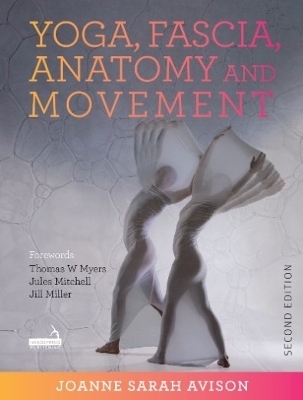
Yoga, Fascia, Anatomy and Movement, Second edition
Handspring Publishing Limited (Verlag)
978-1-913426-04-0 (ISBN)
This is a must read for all movement teachers, practitioners and all curious about the human body!" Reader review ⭐⭐⭐⭐⭐
"I am exuberant about this book. It is stunning in its depth, including an historical perspective of anatomy as well as clearly written exposition about the intricacies of human posture and movement. I especially like the exercises for practice that help to bring the text alive. I couldn't be more pleased with this articulate, readable anatomy and movement book. I predict it will become a sourcebook for yoga teachers and other health professionals for years to come."
Judith Hanson, yoga teacher
"From Anatomy to Architecture, from Biomechanical to Biomotional and from Classical to Connected "- speaks to all bodies, in all modalities; in a world seeking unity and connection more than ever.
Yoga, Fascia, Anatomy and Movement was written partly as an appeal for Yoga Teachers to appreciate the depth and breadth of Yoga as a science, a movement practice and a philosophy that fundamentally espouses "wholeness" as the basis of living anatomy and form. Yoga calls for unifying who and how we are; and as teachers - how we can help our clients (who are all different) move better.
Classical Anatomy (in the West) divides the body down into its component parts and traditionally (unchanged for 400 years) reduces its functionality to those parts; usually described in a 2D iconic forms and founded in lever-based mechanics. In the East, such reductionism was never espoused and Yoga, Fascia, Anatomy and Movement covers two huge bases to bridge the difference and upgrade understanding of Yoga, to 21st Century anatomy:
The first is to recognise that the leading edge of Fascia Science changes all those reductionist views (anatomically and biomechanically). It is carefully explained in the first part of the book and shows how the New Science of Body Architecture actually makes perfect sense of yogic philosophy of union and wholeness.
The second is to take this paradigm shift and apply it in practice, to the subtle understanding of the fascial architecture and how that helps us move better. Yoga, Fascia, Anatomy and Movement attempts to ask questions, find suitable research and make all this practical and applicable to teachers and practitioners of all types. (Indeed, it teaches "posture profiling" and creating Class Mandalas, to support this). It is a contemporary yoga teacher's bible.
This book is for those who want to integrate scientific knowledge with practical application in yoga and movement disciplines, as well as yoga therapists and teacher, yoga instructors, bodyworkers, manual therapists, movement educators, anatomy and physiology students, somatic practitioners, fascia enthusiasts.
Joanne's newest book Myofascial Magic in Action: A Movement Practitioner's Guide to How the Body Really Moves (Understanding Fascia) publishes in December 2024.
Dr Joanne Avison is an international teacher of movement and manual therapy, teaching applied structural anatomy for movement and manual practitioners in a variety of fields. As an advanced Yoga Practitioner and Certified Yoga Therapist, C-IAYT (Certified by International Association of Yoga Therapists), Joanne appreciates the art, craft and science of yoga and subtle body architecture. Her doctorate degree in Spiritual Sciences has deepened her understanding of yoga and the philosophy behind it - and how the being animates the body, whatever the physical practice, performance or ability. She lives in Brighton, UK.
Dedication/About the Author/Foreword to first edition by Thomas Myers/Foreword to second edition by Jill Miller/Foreword to second edition by Jules Mitchell/Acknowledgements
PART A From Anatomy to Animated Architecture
Chapter 1 The Art of Contemporary Yoga
Chapter 2 Ancient Wisdom and New Knowledge
Chapter 3 From Anatomy to Architecture
Chapter 4 The Remarkable Human Blueprint
Chapter 5 Sensory Architecture
Chapter 6 Living Tensegrity Structures
Chapter 7 The Fascial Architexture
PART B From Biomechanics to Biomotional Beings
Chapter 8 From Biomechanics to Biomotional Beings
Chapter 9 Curved is the New Straight
Chapter 10 The Elastic Body
Chapter 11 The Elastic Breath
Chapter 12 Archetypal Geometries
PART C Classical to Connected
Introduction to Part C: The Compound Essence of Time
Chapter 13 Classroom Connections 1: The Basics: Sitting Up Curved
Chapter 14 Classroom Connections 2: A Simple Practice
Chapter 15 Classroom Connections 3: A Subtle Practice
Chapter 16 Classroom Connections 4: Class Mandalas
Chapter 17 Classroom Connections 5: Assessment and Adjustment Skills
Chapter 18 Classroom Connections 6: Maps: Anatomy Trains™
Appendix A Discovering The Interstitium - Neil Theise, Physician and Scientist
Appendix B Stretching; The Faux Amis of Yoga - John Sharkey, Clinical Anatomist, Exercise Physiologist
| Erscheinungsdatum | 21.06.2021 |
|---|---|
| Zusatzinfo | 263 illustrations and photographs |
| Sprache | englisch |
| Maße | 188 x 246 mm |
| Gewicht | 1260 g |
| Themenwelt | Medizin / Pharmazie ► Naturheilkunde |
| Medizin / Pharmazie ► Physiotherapie / Ergotherapie ► Rehabilitation | |
| ISBN-10 | 1-913426-04-1 / 1913426041 |
| ISBN-13 | 978-1-913426-04-0 / 9781913426040 |
| Zustand | Neuware |
| Informationen gemäß Produktsicherheitsverordnung (GPSR) | |
| Haben Sie eine Frage zum Produkt? |
aus dem Bereich