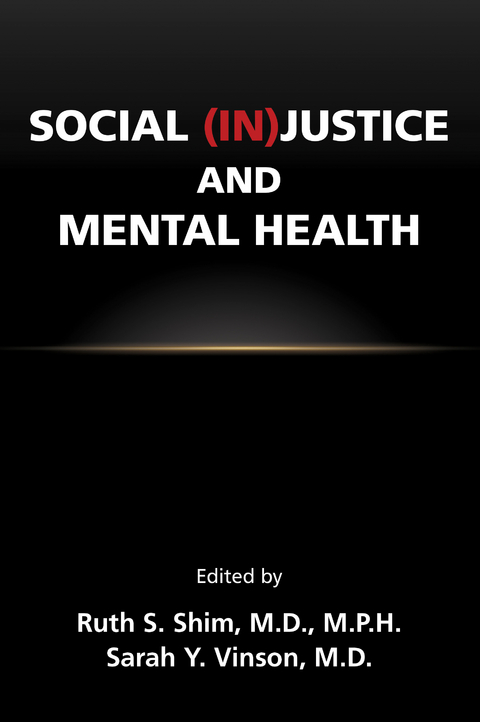
Social justice entails equal access to liberties, rights, and opportunities, as well as care for the least advantaged members of society. The paradigm-shifting new book Social (In)Justice and Mental Health addresses the ways in which society's failure to deliver on that humane ideal harms people with mental illness. The editors, at the forefront of the effort to make psychiatry responsive to critiques of institutional racism, argue that in the United States, a perfect storm of unfair and unjust policies and practices, bolstered by deep-seated beliefs about the inferiority of some groups, has led to a small number of people having tremendous advantages, freedoms, and opportunities, while a growing number are denied those liberties and rights. Mental health clinicians bear a special responsibility to be aware of these structural inequities, to question their own biases, to intervene on behalf of patients and their families, and to advocate for mental health equity. To that end, the book provides a framework for thinking about why these inequities exist and persist and provides clinicians with a road map to address these inequalities as they relate to racism, the criminal justice system, and other systems and diagnoses.The book is hands-on, with topics mental health clinicians will find timely and relevant: * The role of social injustice and specific diagnoses and conditions, including substance use disorders, schizophrenia, personality disorders, and child trauma, is covered. For example, research has shown that white psychiatrists are more likely to over diagnose schizophrenia in Black patients, and this diagnostic bias may partly account for Black men being involuntarily committed to mental institutions in higher numbers.* The authors advocate for research that prioritizes the needs of participants and communities, rather than the needs of institutions, and focuses on structural, not individual-level, differences.* Accompaniment, an important strategy for infusing social justice into clinical practice, is described and modeled. This process of radical empathy -- of trying to minimize power dynamics in clinical relationships by listening, witnessing, and advocating with patients -- is critically important in confronting mental health inequities. * The inadequacy of current medical and mental health education and training in countering the powerful forces of social injustice in mental health is discussed in detail. The authors emphasize that change requires adopting an active practice of self-study and self-reflection, and accordingly, a list of self-study resources, consisting of books, documentaries, podcasts, and TED talks, is provided to further the reader's knowledge and awareness. * Of further assistance are the chapter-ending "e;Questions for Self-Reflection,"e; which challenge mental health clinicians to examine their own attitudes and preconceived ideas about race, poverty, disabilities, and privilege. Social (In)Justice and Mental Health addresses the context in which mental health care is delivered, strategies for raising consciousness in the mental health profession, and ways to improve treatment while redressing injustice. Clinicians owe it to themselves, their patients, and their profession to read -- and heed -- this important work.
 EPUB (Adobe DRM)
Kopierschutz: Adobe-DRM
Adobe-DRM ist ein Kopierschutz, der das eBook vor Mißbrauch schützen soll. Dabei wird das eBook bereits beim Download auf Ihre persönliche Adobe-ID autorisiert. Lesen können Sie das eBook dann nur auf den Geräten, welche ebenfalls auf Ihre Adobe-ID registriert sind.
Details zum Adobe-DRM
Dateiformat: EPUB (Electronic Publication)
EPUB ist ein offener Standard für eBooks und eignet sich besonders zur Darstellung von Belletristik und Sachbüchern. Der Fließtext wird dynamisch an die Display- und Schriftgröße angepasst. Auch für mobile Lesegeräte ist EPUB daher gut geeignet.
Systemvoraussetzungen:
PC/Mac: Mit einem PC oder Mac können Sie dieses eBook lesen. Sie benötigen eine Adobe-ID und die Software Adobe Digital Editions (kostenlos). Von der Benutzung der OverDrive Media Console raten wir Ihnen ab. Erfahrungsgemäß treten hier gehäuft Probleme mit dem Adobe DRM auf.
eReader: Dieses eBook kann mit (fast) allen eBook-Readern gelesen werden. Mit dem amazon-Kindle ist es aber nicht kompatibel.
Smartphone/Tablet: Egal ob Apple oder Android, dieses eBook können Sie lesen. Sie benötigen eine Adobe-ID sowie eine kostenlose App.
Geräteliste und zusätzliche Hinweise
Buying eBooks from abroad
For tax law reasons we can sell eBooks just within Germany and Switzerland. Regrettably we cannot fulfill eBook-orders from other countries.