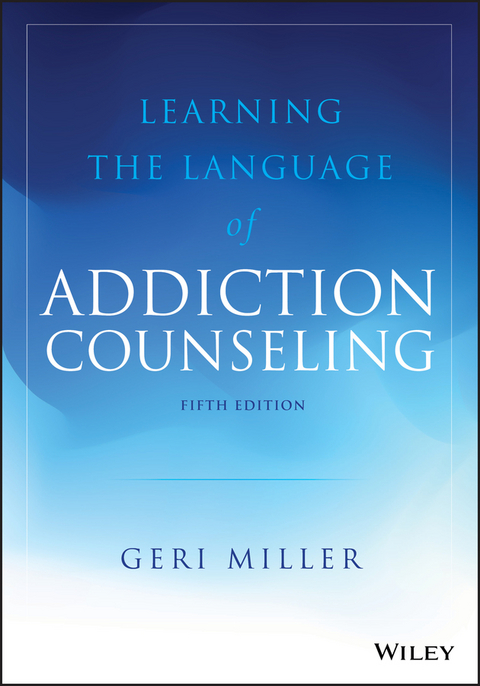
Learning the Language of Addiction Counseling (eBook)
John Wiley & Sons (Verlag)
978-1-119-43306-4 (ISBN)
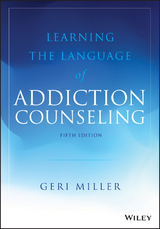
FULLY REVISED, COMPREHENSIVE, AND PRACTICAL BOOK OF THE THEORY AND PRACTICE OF ADDICTION COUNSELING
Learning the Language of Addiction Counseling, Fifth Edition introduces mental health professionals and students to the field of addiction counseling and helps them acquire the knowledge and develop the skills needed to counsel individuals who are caught in the destructive cycle of addiction.
Drawing from her years of experience in working in the addiction counseling field as a counselor, trainer and educator, Geri Miller provides an engaging, balanced overview of the major theoretical foundations and clinical best practices in the field.
Fully updated, the fifth edition offers a compassionate accountability, practice-oriented counseling framework and features:
- A research-based clinical application approach to addiction counseling that practitioners can turn to for fundamental, practical, clinical guidelines.
- Revised chapters that reflect important changes in research and practice, including new assessment instruments and new and expanded treatments.
- Additional case studies, interactive exercises, key points and other resources that facilitate the integration of knowledge into practice.
- A new chapter of 'Supervision and Mentoring'.
- Revised 'Personal Reflections' section at the beginning of each chapter that provide an invaluable, unique perspective on the author's view of addiction counseling.
- Updated and expanded Instructor Resources that include brief video clips, PowerPoint slides, test bank questions for each chapter, and sample syllabi.
From assessment and diagnosis of addiction to preparing for certification and licensure as an addiction counseling professional, this comprehensive book covers essential components required to work as a professional in the field of addiction counseling.
GERI MILLER, PHD, is a Diplomate in Counseling Psychology, American Board of Professional Psychology (ABPP); Licensed Psychologist (LP); Licensed Clinical Mental Health Counselor (LCMHC); Master Addiction Counselor (MAC) (NCCAP); NCASPPB Licensed Clinical Addictions Specialist (LCAS) and Certified Clinical Supervisor (CCS). She is a Professor in the Department of Human Development and Psychological Counseling at Appalachian State University. Dr. Miller has worked in the mental health counseling profession since 1976 and in the addiction counseling field since 1979. She has published and presented research related to mental health and addiction counseling. She has also presented extensively to mental health counselors and addiction counselors.
Fully revised, Learning the Language of Addiction Counseling, Fourth Edition introduces students and mental health professionals to the field of addiction counseling and helps them develop the knowledge, understanding, and skills needed to counsel people who are caught in the destructive cycle of addiction. Drawing from her years of experience working in the addiction-counseling field, Geri Miller provides an engaging, balanced overview of the major theoretical underpinnings and clinical practices in the field. From assessment and diagnosis of addiction to preparing for certification and licensure as an addiction professional, this comprehensive book covers all of the essentials.
GERI MILLER, PHD, is a Diplomate in Counseling Psychology, American Board of Professional Psychology (ABPP); Licensed Psychologist (LP); Licensed Clinical Mental Health Counselor (LCMHC); Master Addiction Counselor (MAC) (NCCAP); NCASPPB Licensed Clinical Addictions Specialist (LCAS) and Certified Clinical Supervisor (CCS). She is a Professor in the Department of Human Development and Psychological Counseling at Appalachian State University. Dr. Miller has worked in the mental health counseling profession since 1976 and in the addiction counseling field since 1979. She has published and presented research related to mental health and addiction counseling. She has also presented extensively to mental health counselors and addiction counselors.
CHAPTER 1
INTRODUCTION
PERSONAL REFLECTIONS
As we approach addiction counseling, it is important that we as clinicians have as clear as possible an understanding of who we are personally and professionally in relation to addiction. We need to be brave enough to examine our own experiences with addictive tendencies, within ourselves and our loved ones as well as in our professional experiences with addicts. These experiences color and shape our work with our addicted clients. If we engage in a thorough self-exploration, we can begin our encounters with addicts using a clear, balanced approach and avoid being thrown off-balance by the intense force of addiction as it has expressed itself in our clients’ lives. Such self-examination will also assist us in anchoring our work in the philosophy of this book: “compassionate accountability.” In this philosophy, we have compassion for the person's story of addiction (i.e., how they became addicted) and yet we hold them accountable for their behavior.
I also need to comment on the terminology I have chosen to use throughout the text to describe those clients who struggle with addiction. I use the term addicts or addicted clients even though some readers may prefer other terms such as person(s) with substance use disorders in order to emphasize the “personhood” of the client (see Appendix 1A). I have chosen these terms because, in my addiction counseling experience, these terms clearly “name” the problem, “name the disease.” By no means is the term meant to be disrespectful to the client. For example, in clinical meetings, I always insist that the person's name be used before their disorder is discussed because, as I tell my students, “They were a person before they developed the disease and their name is important. They are not their disease.” My hope is that I do not offend the reader with my choice of terminology; rather, I encourage the reader to choose a term to discuss the addicted client that they believe is most respectful to their population. Our clients may not be aware of traumatizing terms, but they also may not care about the label—that is why counselors need to approach the discussion of client labels in an exploratory, respectful manner that encourages dialogue. Appendix 1A is a good example of the current controversies with language used in the field. Reactions to the Language of Recovery will vary on a continuum of responses from some professionals believing in the use of each of the alternative recovery terms to other professionals who believe in using none of them. During my years of working in the addiction counseling field, I have watched and participated in various “terminology debates.” The current controversies of language are important; however, they are not new to the field. Therefore, the reader is encouraged to enter into these ongoing debates regarding language use in professional arenas (meetings, workshops, conferences, etc.) and choose terminology from a balanced perspective. That applies to this text in that I also hope that you will work with the language of this book as it describes the disease (“addiction”) and the individuals it affects (“addicts”) translating the language I use to the language that is most comfortable for your individual client, thereby serving their best interest. I believe that what is important, so critical and so necessary, is that we find terminology and an approach that powerfully invites our clients and their loved ones to heal from the destructive force of addiction.
Finally, a comment to the reader about my rationale for the inclusion of references throughout this book. I carefully chose references that I believe are helpful to the clinician; this means that references, on the surface, may appear to be outdated and unnecessary. However, the choice I made for reference inclusion throughout the book was oriented more clinically than academically. For example, the clinical choice for a reference dated in the 1980s was made for inclusion because I believe the information is still important in its historical anchoring clinically. Had I made a more academically oriented choice, I would have eliminated this important historical work.
I encourage you as a reader of this text to: (1) check with NIDA, NIAAA, and SAMHSA as well as your professional organizations to obtain the more current statistics and counseling approaches regarding the population with which you work, and (2) be aware that your own biases/wounds may be stirred in reading about these topics resulting in an emotionally charged reaction to information presented. I encourage you to only take information from this text that makes sense to you clinically and that fits your population.
My hope in this book is twofold: (1) that I have provided a broad, clinically useful overview of the topics, and (2) that I have been humane and compassionate to these populations of addicted individuals who already experience inhumane treatment.
OBJECTIVES
- To learn the historical development of the field as well as the current issues regarding language use.
- To understand the history of five influences on addiction counseling.
- To explore how one's own models of addiction and understanding of influences impact the view of the addicted client, the cause of addiction, and treatment approaches.
Current statistics support the concern for alcohol and drug use in America. The 2016 National Survey on Drug Use and Health (Substance Abuse and Mental Health Services Administration [SAMHSA]) found that 136.7 million Americans over age 12 drank alcohol, with 65.3 million people having a binge drinking experience at least once in the previous month. and 16.3 million reported being heavy drinkers in the last month. The survey also found that approximately 28.6 million Americans over age 12 had used an illicit drug during the month before being interviewed-this use consists primarily of marijuana and prescription pain reliever misuse.
Marijuana was the most common illicit drug used by individuals aged 12 or older (24.0 million)—higher than percentages from 2002 to 2015—especially in the age group of 26 or older. Another area of concern is opioid misuse (prescription opioid relievers or heroin); of the 11.8 million misusing opioids in 2016, 11.5 million were misusing pain relievers and 948,000 using heroin. For those age 12 or older, 6 people out of 10 misused them to relieve physical pain and approximately half of those individuals received their last pain relievers from a friend or relative.
The Centers for Disease Control and Prevention (2013) reported that in 2010, the amount of prescribed painkiller medication could result in every American being medicated through an entire day for one month; while they were prescribed for medical reasons, they were misused or abused by others. Overdoses of the prescription painkillers (opioid or narcotic) have tripled in the past 20 years in the United States (SAMSHA, 2010, 2011). Their abuse/misuse has doubled in emergency room visits (SAMSHA, 2010) and teens and adults use them to experience a “high” or use them for other nonmedical reasons (SAMSHA, 2011).
These statistics underscore the importance of understanding the dynamics of alcohol and drug abuse and addiction. The high number of individuals using alcohol and drugs in the United States also supports the need for counselors to understand the dynamics of addiction; it is highly likely that a counselor will work with individuals who are abusing alcohol or drugs in any counseling setting. Understanding the dynamics of addiction can help the mental health professional more effectively meet the needs of the client.
Working with the substance-abusing population, however, can be difficult. Mental health workers, both historically and currently, have not always liked working with alcoholics and addicts for at least two reasons: (1) the difficulty in treating them because of factors such as relapses, poor impulse control, emotional reactivity, and/or lying to protect their addiction; and (2) the lack of knowledge (techniques) on how best to treat them.
However, openness to treating addicts grew as information on how to treat addicts emerged and as additional funding for treatment became available. For example, because addicts commonly deny the consequences of their usage to themselves and others (Levinthal, 1996), it became easier for counselors to deal with denial when the technique of intervention was introduced (Fields, 1995).
Counselors also have potential issues with countertransference. Counselors may not be different from the American tendency, as pointed out by Greenbaum (2019), to view addiction as both a disease and a moral failing. Many helping professionals have negative personal as well as professional experiences working with addicted individuals. This may cause them to avoid or hesitate to work with this population. When working with addicts, counselors may be caught in familiar patterns of enabling or judging the addicted individual and their loved ones based on their own personal or professional experiences. Also, professionals can have concern they are being conned by addicts to enable their addiction and, as a result, may approach the addicted person in a manner that invites anger and manipulation from the client (Compton, 1999). Finally, countertransference may arise in the language the professional uses. Thombs and Osborn (2019) provide an overview of current concerns with regard to language usage. The...
| Erscheint lt. Verlag | 2.12.2020 |
|---|---|
| Sprache | englisch |
| Themenwelt | Geisteswissenschaften ► Psychologie ► Sucht / Drogen |
| Medizin / Pharmazie ► Allgemeines / Lexika | |
| Schlagworte | addiction • addiction comorbidities • addiction counseling exercises • addiction counseling handbook • addiction group therapy • Addictions • addiction therapy • addiction therapy textbook • approaches to addiction • counseling program planning • counselor's guide to addiction • Drogenabhängigkeit • Drug Addiction • DSM-5 • effective addiction treatment methods • evidence-based addiction treatment • Geri Miller • Gesundheits- u. Sozialwesen • Health & Social Care • Klinische Psychologie • Language of Addiction Counseling, 4th Edition • professional addiction treatment • Psychologie • Psychology • Substance Abuse Counseling • Sucht • Suchtforschung • treating addiction |
| ISBN-10 | 1-119-43306-1 / 1119433061 |
| ISBN-13 | 978-1-119-43306-4 / 9781119433064 |
| Informationen gemäß Produktsicherheitsverordnung (GPSR) | |
| Haben Sie eine Frage zum Produkt? |
 EPUB (Adobe DRM)
Kopierschutz: Adobe-DRM
Adobe-DRM ist ein Kopierschutz, der das eBook vor Mißbrauch schützen soll. Dabei wird das eBook bereits beim Download auf Ihre persönliche Adobe-ID autorisiert. Lesen können Sie das eBook dann nur auf den Geräten, welche ebenfalls auf Ihre Adobe-ID registriert sind.
Details zum Adobe-DRM
Dateiformat: EPUB (Electronic Publication)
EPUB ist ein offener Standard für eBooks und eignet sich besonders zur Darstellung von Belletristik und Sachbüchern. Der Fließtext wird dynamisch an die Display- und Schriftgröße angepasst. Auch für mobile Lesegeräte ist EPUB daher gut geeignet.
Systemvoraussetzungen:
PC/Mac: Mit einem PC oder Mac können Sie dieses eBook lesen. Sie benötigen eine
eReader: Dieses eBook kann mit (fast) allen eBook-Readern gelesen werden. Mit dem amazon-Kindle ist es aber nicht kompatibel.
Smartphone/Tablet: Egal ob Apple oder Android, dieses eBook können Sie lesen. Sie benötigen eine
Geräteliste und zusätzliche Hinweise
Buying eBooks from abroad
For tax law reasons we can sell eBooks just within Germany and Switzerland. Regrettably we cannot fulfill eBook-orders from other countries.
aus dem Bereich