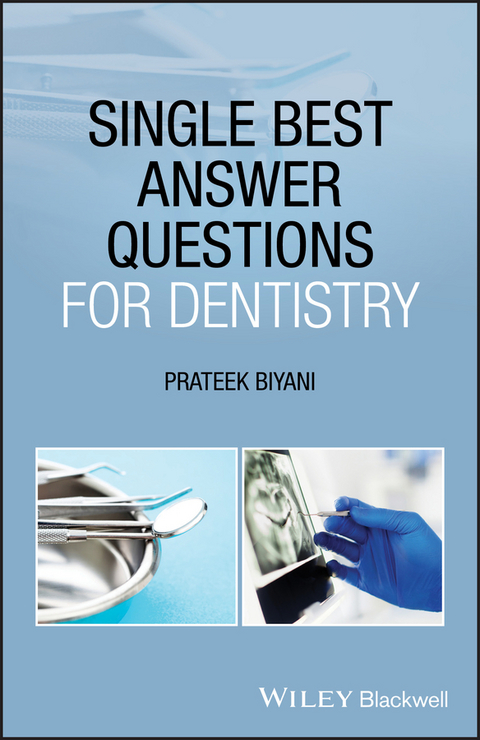
Single Best Answer Questions for Dentistry (eBook)
John Wiley & Sons (Verlag)
978-1-119-70237-5 (ISBN)
A must-have resource for those preparing for the MJDF, MFDS, ORE, and other dental examinations
Single best answer (SBA) questions are widely used in dental examinations including the Membership of the Joint Dental Faculties (MJDF), Member of the Faculty of Dental Surgery (MFDS), and the Overseas Registration Exam (ORE). Single Best Answer Questions for Dentistry is a comprehensive revision tool designed to help dental students be thoroughly prepared on exam day.
Each clearly written SBA question is accompanied by an accurate answer and a full explanation, providing students with a quick and easy-to-access way to revise. The SBAs cover a broad range of specialties within dentistry such as restorative dentistry, oral surgery, oral pathology, paediatric dentistry and orthodontics, periodontology, oral medicine, and more. All terms throughout the book conform to the latest evidence and guidelines, such as the most recent classification of periodontal disease, and match the level of knowledge required for success on current dental examinations. Written by a leading dental practitioner, this valuable resource:
- Comprises 10 chapters, organised by specialty, each containing 20 to 30 SBAs with their associated answers and explanations
- Covers various dental specialties and topics including restorative dentistry, radiology, pharmacology, human disease, and dental materials
- Presents a simple and efficient question-and-answer format that is ideal for exam revision
- Helps strengthen students' skills in clinical problem solving and decision making
Containing more than 280 questions of varying difficulty levels as well as numerous high-quality images and radiographs, Single Best Answer Questions for Dentistry is essential reading for all dental students and a useful tool for practicing dentists wanting to test or refresh their knowledge.
About the Author
PRATEEK BIYANI, BDS (Hons.), MFDS RCPS(Glasg.), Cert Med Ed is a Specialty Doctor in Oral and Maxillofacial Surgery at Chesterfield Royal Hospital, Chesterfield, UK, and an Associate Dentist at Sandygate Dental Practice, Sheffield, UK. Prateek is passionate about education and sharing knowledge, which is demonstrated through websites like dentalnotebook, apps like Tooth Morphology and completion of his Certificate in Medical Education with Merit.
A must-have resource for those preparing for the MJDF, MFDS, ORE, and other dental examinations Single best answer (SBA) questions are widely used in dental examinations including the Membership of the Joint Dental Faculties (MJDF), Member of the Faculty of Dental Surgery (MFDS), and the Overseas Registration Exam (ORE). Single Best Answer Questions for Dentistry is a comprehensive revision tool designed to help dental students be thoroughly prepared on exam day. Each clearly written SBA question is accompanied by an accurate answer and a full explanation, providing students with a quick and easy-to-access way to revise. The SBAs cover a broad range of specialties within dentistry such as restorative dentistry, oral surgery, oral pathology, paediatric dentistry and orthodontics, periodontology, oral medicine, and more. All terms throughout the book conform to the latest evidence and guidelines, such as the most recent classification of periodontal disease, and match the level of knowledge required for success on current dental examinations. Written by a leading dental practitioner, this valuable resource: Comprises 10 chapters, organised by specialty, each containing 20 to 30 SBAs with their associated answers and explanations Covers various dental specialties and topics including restorative dentistry, radiology, pharmacology, human disease, and dental materials Presents a simple and efficient question-and-answer format that is ideal for exam revision Helps strengthen students skills in clinical problem solving and decision making Containing more than 280 questions of varying difficulty levels as well as numerous high-quality images and radiographs, Single Best Answer Questions for Dentistry is essential reading for all dental students and a useful tool for practicing dentists wanting to test or refresh their knowledge.
About the Author PRATEEK BIYANI, BDS (Hons.), MFDS RCPS(Glasg.), Cert Med Ed is a Specialty Doctor in Oral and Maxillofacial Surgery at Chesterfield Royal Hospital, Chesterfield, UK, and an Associate Dentist at Sandygate Dental Practice, Sheffield, UK. Prateek is passionate about education and sharing knowledge, which is demonstrated through websites like dentalnotebook, apps like Tooth Morphology and completion of his Certificate in Medical Education with Merit.
Preface vii
1 Restorative Dentistry 1
2 Oral Medicine 17
3 Oral Surgery 33
4 Oral Pathology 49
5 Paediatric Dentistry and Orthodontics 65
6 Periodontics 81
7 Pharmacology and Human Disease 97
8 Dental Materials 111
9 Radiology 125
Index 143
CHAPTER 2
Oral Medicine
- Which of the following is a common differential diagnosis of a pyogenic granuloma?
- Peripheral giant cell granuloma
- Fibrous polyp
- Lipoma
- Dental abscess
- Squamous cell papilloma
- Which of the following drugs is not associated with gingival hyperplasia?
- Nifedipine
- Phenytoin
- Ciclosporin
- Aspirin
- Amlodipine
- Which of the following is not a common cause of angular cheilitis?
- Candidal infection
- Hypothyroidism
- Vitamin B12 deficiency
- Folate deficiency
- Iron deficiency
- A 50‐year‐old man presents with multiple crusting lesions and ulcers on the left side of his face. He noticed a tingling sensation beforehand and the rash has been present for a week. Which virus is a potential cause?
- Herpes simplex I
- Herpes zoster
- Cytomegalovirus
- Coxsackie A
- Epstein–Barr
- Which virus is associated with development of hairy leukoplakia?
- Human papillomavirus
- Herpes simplex I
- Hepatitis B
- Epstein–Barr
- Cytomegalovirus
1.a
Both are characterised as highly vascular lesions with very similar clinical presentations, typically presenting on the gingivae.
2.d
Aspirin has not been associated with gingival hyperplasia. All the other drugs are common causes.
3.b
Iron, B12 and folate deficiency are common causes of angular cheilitis. Often there is an associated candidal/Staphylococcus aureus infection.
4.b
This is most likely shingles caused by reactivation of the varicella zoster virus. It most often presents in older patients, along one or more divisions of the trigeminal nerve on the face. It generally stops at the midline and lasts 2–3 weeks.
5.d
Epstein–Barr is associated with development of hairy leukoplakia, which usually presents in HIV/AIDS patients. It is also associated with infectious mononucleosis, Burkitt's lymphoma and nasopharyngeal carcinoma.
- What type of lesion would acute pseudomembranous candidiasis present as?
- Erythematous patches
- Circular ulcers
- White plaques that can be removed
- White plaques that cannot be removed
- Vesicular lesions
- Which form of candidal infection has a risk of becoming malignant?
- Acute pseudomembranous candidiasis
- Acute atrophic candidiasis
- Chronic atrophic candidiasis
- Chronic hyperplastic candidiasis
- Median rhomboid glossitis
- Pemphigus is an example of which type of hypersensitivity?
- Type I hypersensitivity
- Type II hypersensitivity
- Type III hypersensitivity
- Type IV hypersensitivity
- Type V hypersensitivity
- Target lesions are commonly seen in which of the following conditions?
- Pemphigus
- Pemphigoid
- Lichen planus
- Erythema multiforme
- Lichenoid reactions
- Which of the following features is not common in minor recurrent aphthous stomatitis (RAS)?
- Occurs mainly on non‐keratinised mucosa
- Usually present at the front of the mouth
- Last up to two weeks in duration
- Ulcers up to 3 cm in size
- Heal without scarring
6.c
Acute pseudomembranous candidiasis is one of the most common forms of candidal infection. White plaques form and their removal reveals an erythematous background.
7.d
This is the only form of candidal infection that has a risk of becoming malignant. It usually forms a red/white patch that cannot be rubbed off. It is commonly seen in smokers, at the oral commissures, and biopsy is crucial.
8.b
Pemphigus is an example of type II hypersensitivity. Another example is pemphigoid.
9.d
Target lesions are common in erythema multiforme. This is often combined with oral lesions and ocular problems. It is commonly an acute type III hypersensitivity reaction and can occur in response to medications. Treatment usually involves a short course of steroids.
10.d
Ulcers in minor RAS tend to be smaller (up to 1 cm) in size. Larger ulcers are a more common feature of major RAS.
- Shilling’s test can be used to diagnose which of the following deficiencies?
- Iron
- Folate
- Vitamin B12
- Vitamin C
- Vitamin D
- What is the peak incidence age for erythema multiforme?
- 10–15 years
- 10–20 years
- 20–30 years
- 30–40 years
- 40–50 years
- Which of the following is not a precancerous condition?
- Actinic keratosis
- Lichen planus
- Submucous fibrosis
- Chronic hyperplastic candidiasis
- Pemphigus
- A 14‐year‐old presents with bilateral, painful enlargement of the parotid glands. What is the likely diagnosis?
- Mumps
- Bacterial sialadenitis
- Recurrent parotitis
- Radiation sialadenitis
- Parotid abscess
- Where do mucous extravasation cysts most commonly occur?
- Hard palate
- Soft palate
- Upper lip
- Lower lip
- Tongue
11.c
Shilling's test can be done to identify vitamin B12 deficiency. Fasting is required before the test and involves administration of radiolabelled vitamin B12, with further monitoring.
12.c
Peak incidence for erythema multiforme is usually 20–30 years of age. It usually has an acute onset and lasts around 2–3 weeks.
13.e
A precancerous condition is a generalised state associated with an increased risk of cancer development. Pemphigus is not associated with cancer development.
14.a
This childhood infection is caused by a paramyxovirus and is prevented by the MMR vaccine. Bacterial sialadenitis will generally present as a unilateral swelling.
15.d
Mucous extravasation cysts commonly occur due to trauma to the lower lip. They are often found in younger patients and they may recur. Mucous retention cysts tend to occur in older patients due to blockage of salivary ducts.
- Which of the following unstimulated salivary flow rates would indicate a problem?
- <1.5 mL in 5 minutes
- <5 mL in 5 minutes
- <1.5 mL in 15 minutes
- <5 mL in 15 minutes
- <0.5 mL in 15 minutes
- Which of the following is not strongly associated with human immunodeficiency virus (HIV) infection?
- Candidiasis
- Hairy leukoplakia
- Kaposi's sarcoma
- Linear gingival erythema
- Melanotic hyperpigmentation
- Kaposi’s sarcoma is associated with which virus?
- HHV4
- HHV7
- HHV8
- HHV1
- HHV5
- Which of the following is a symptom of trigeminal neuralgia?
- Brief stabbing pain
- Long‐lasting stabbing pain
- Affecting branches of the facial nerve
- Short aching pain
- Long‐lasting ache
- What is the first‐line drug of choice for trigeminal neuralgia?
- Phenytoin
- Paracetamol
- Valproate
- Baclofen
- Carbamazepine
16.c
This would indicate reduced function. For a stimulated salivary flow rate, anything less than 5 mL in 5 minutes would indicate reduced function.
17.e
Melanotic hyperpigmentation is only possibly associated with HIV. The other conditions are all strongly associated and are often first presentations of these patients.
18.c
HHV8 is responsible for Kaposi's sarcoma development. It most commonly presents on the hard palate and the gingivae, often looking similar to a pyogenic granuloma.
19.a
Trigeminal neuralgia is characterised by a brief stabbing pain. It is typically unilateral and in the distribution of the trigeminal nerve. The mandibular branch is the most commonly impacted branch.
20.e
Carbamazepine is the usual drug of choice for trigeminal neuralgia. It is a sodium channel blocker. The other drugs are potential options for pain management.
- Which blood test should be done to monitor the drug in Question 20?
- Platelet count
- Full blood count
- Liver function tests
- B12 levels
- Iron levels
- Temporal arteritis will lead to which of the following if left untreated?
- Blindness
- Deafness
- Long‐term headache
- Tinnitus
- Blocked nose
- Which of the following is not seen in Gorlin–Goltz syndrome?
- Multiple basal cell carcinomas
- Multiple odontogenic keratocysts
- Calcification...
| Erscheint lt. Verlag | 9.11.2020 |
|---|---|
| Sprache | englisch |
| Themenwelt | Medizin / Pharmazie ► Gesundheitsfachberufe |
| Medizin / Pharmazie ► Medizinische Fachgebiete | |
| Medizin / Pharmazie ► Zahnmedizin | |
| Schlagworte | Berufspraxis i. d. Zahnmedizin • Dental Professional Practice • dental student exam prep • dental student mcq • dental student revision guide • dental student study guide • dentistry • dentistry exam questions</p> • Einführung i. d. Zahnmedizin • Introductions to Dentistry • <p>dental student sba questions • MFDS exam prep • MFDS revision • MJDF exam prep • MJDF revision • ORE prep • ORE revision • single best answer questions • Zahnmedizin |
| ISBN-10 | 1-119-70237-2 / 1119702372 |
| ISBN-13 | 978-1-119-70237-5 / 9781119702375 |
| Informationen gemäß Produktsicherheitsverordnung (GPSR) | |
| Haben Sie eine Frage zum Produkt? |
 EPUB (Adobe DRM)
Kopierschutz: Adobe-DRM
Adobe-DRM ist ein Kopierschutz, der das eBook vor Mißbrauch schützen soll. Dabei wird das eBook bereits beim Download auf Ihre persönliche Adobe-ID autorisiert. Lesen können Sie das eBook dann nur auf den Geräten, welche ebenfalls auf Ihre Adobe-ID registriert sind.
Details zum Adobe-DRM
Dateiformat: EPUB (Electronic Publication)
EPUB ist ein offener Standard für eBooks und eignet sich besonders zur Darstellung von Belletristik und Sachbüchern. Der Fließtext wird dynamisch an die Display- und Schriftgröße angepasst. Auch für mobile Lesegeräte ist EPUB daher gut geeignet.
Systemvoraussetzungen:
PC/Mac: Mit einem PC oder Mac können Sie dieses eBook lesen. Sie benötigen eine
eReader: Dieses eBook kann mit (fast) allen eBook-Readern gelesen werden. Mit dem amazon-Kindle ist es aber nicht kompatibel.
Smartphone/Tablet: Egal ob Apple oder Android, dieses eBook können Sie lesen. Sie benötigen eine
Geräteliste und zusätzliche Hinweise
Buying eBooks from abroad
For tax law reasons we can sell eBooks just within Germany and Switzerland. Regrettably we cannot fulfill eBook-orders from other countries.
aus dem Bereich