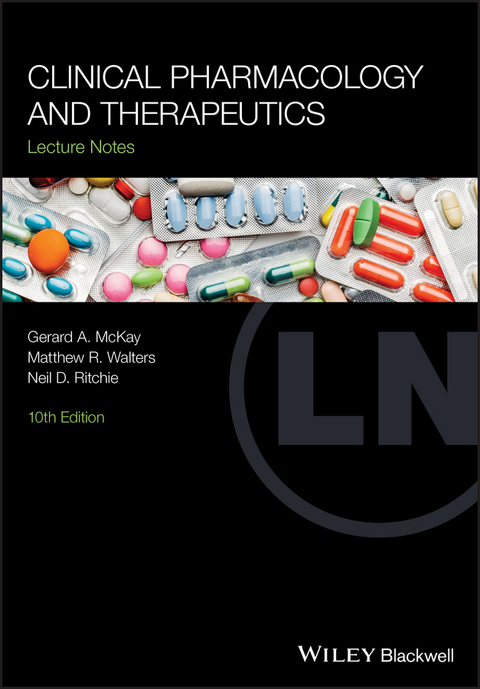
Clinical Pharmacology and Therapeutics (eBook)
John Wiley & Sons (Verlag)
978-1-119-59997-5 (ISBN)
A must-have companion for medical students and junior doctors for almost four decades, Lecture Notes: Clinical Pharmacology and Therapeutics provides concise yet thorough coverage of the principles of clinical pharmacology, the major characteristics of therapeutics, and the practical aspects of prescribing drugs to alleviate symptoms and to treat disease.
Whether you are preparing for examinations or prescribing to patients, the tenth edition offers readers current and authoritative insight into the essential practical and clinical knowledge. Logically organised chapters allow for rapid location of key information, while examples of commonly encountered scenarios illustrate how and when to use drugs in clinical situations. Throughout the text, practice questions, prescribing guidelines, and self-assessment tests clarify and reinforce the principles that inform appropriate clinical decision-making.
- Presents an up-to-date review of drug use across?all major clinical disciplines
- Offers a timely overview of clinical drug trials and development
- Provides new clinical scenarios to relate chapter content to real-life application
- Contains colour-coded 'Key Points' and 'Prescribing Points' to highlight important information
- Includes chapter introductions and summaries, and numerous figures, tables, and colour illustrations
Lecture Notes: Clinical Pharmacology and Therapeutics, Tenth Edition, is an essential resource for medical students, junior doctors, and other prescribers looking for an up-to-date reference on pharmacological principles, prescribing, and therapeutics.
Gerard A. McKay is Consultant Physician, Glasgow Royal Infirmary, Honorary Clinical Associate Professor, University of Glasgow, and Visiting Professor, University of Strathclyde, UK.
Matthew R. Walters is Head of the School of Medicine, Dentistry & Nursing and Professor of Clinical Pharmacology, University of Glasgow, UK.
Neil D. Ritchie is Honorary Senior Lecturer, School of Medicine, Dentistry & Nursing, University of Glasgow, UK.
Gerard A. McKay is Consultant Physician, Glasgow Royal Infirmary, Honorary Clinical Associate Professor, University of Glasgow, and Visiting Professor, University of Strathclyde, UK. Matthew R. Walters is Head of the School of Medicine, Dentistry & Nursing and Professor of Clinical Pharmacology, University of Glasgow, UK. Neil D. Ritchie is Honorary Senior Lecturer, School of Medicine, Dentistry & Nursing, University of Glasgow, UK.
Preface vi
Contributors vii
Part 1 Principles of clinical pharmacology
1 Pharmacodynamics and pharmacokinetics 3
2 Clinical trials and drug development 29
3 Pharmacoeconomics: the economic evaluation of new drugs 35
4 Practical prescribing 42
Part 2 Aspects of prescribing
5 Gastrointestinal system 51
6 Cardiovascular system: Management of coronary artery disease and its complications 63
7 Respiratory system 102
8 Nervous system 113
9 Infection 142
10 Drugs and endocrine disease 175
11 Genitourinary system 196
12 Malignant disease 211
13 Drugs and the blood 221
14 Musculoskeletal system 236
15 Immunopharmacology 242
16 Travel medicine 255
17 Analgesia and anaesthesia 266
18 Poisoning and drug overdose 281
Index 295
1
Pharmacodynamics and pharmacokinetics
Clinical scenario
A 50‐year‐old obese man with type 2 diabetes, hypertension and hyperlipidaemia has made arrangements to see his general practitioner to review his medications. He is on three different drugs for his diabetes, four different anti‐hypertensives, a statin for his cholesterol and a dispersible aspirin. These medications have been added over a period of 2 years despite him not having any symptoms and he feels that if anything they are giving him symptoms of fatigue and muscle ache. He has also read recently that aspirin may actually be bad for patients with diabetes. He is keen to know why he is on so many medications, if the way he is feeling is due to the medications and whether they are interfering with the action of each other. What knowledge might help the general practitioner deal with this?
Introduction
A basic knowledge of the mechanism of action of drugs and how the body deals with drugs allows the clinician to prescribe safely and effectively. Prior to the twentieth century, prescribing medication was based on intelligent observation and folklore with medical practices depending largely on the administration of mixtures of natural plant or animal substances. These preparations contained a number of pharmacologically active agents in variable amounts (e.g. powdered bark from the cinchona tree, now known to contain quinine, being used by natives of Peru to treat ‘fevers’ caused by malaria).
During the last 100 years, an increased understanding has developed of biochemical and pathophysiological factors that influence disease. The chemical synthesis of agents with well‐characterised and specific actions on cellular mechanisms has led to the introduction of many powerful and effective drugs. Additionally, advances in the detection of these compounds in body fluids have facilitated investigation into the relationships between the dosage regimen, the profile of drug concentration against time in body fluids, notably the plasma, and corresponding profiles of clinical effect. Knowledge of this concentration–effect relationship, and the factors that influence drug concentrations, underpin early stages of the drug development process.
KEY POINTS – PHARMACODYNAMICS AND PHARMACOKINETICS
- The variability in the relationship between dose and response is a measure of the sensitivity of a patient to a drug. This has two components: dose–concentration (pharmacokinetics) and concentration–effect (pharmacodynamics)
- Pharmacokinetics describes the processes of drug absorption, distribution, metabolism and excretion
- Clinical pharmacology seeks to explore the factors that underlie variability in pharmacodynamics and pharmacokinetics for the optimization of drug therapy in individual patients
More recently, the development of genomics and proteomics has provided additional insights and opportunities for drug development with new and more specific targets. Such knowledge will replace the concept of one drug and/or one dose fitting all.
Principles of drug action (pharmacodynamics)
Pharmacological agents are used in therapeutics to:
- Alleviate symptoms, for example:
- Paracetamol for pain
- GTN spray for angina
- Improve prognosis – this can be measured in a number of different ways – usually measured as a reduction in morbidity or mortality, for example:
- Prevent or delay end‐stage consequences of disease, e.g. anti‐hypertensive medication and statins in cardiovascular disease, levodopa in Parkinson's disease
- Replace deficiencies, e.g. levothyroxine in hypothyroid
- Cure disease, e.g. antibiotics, chemotherapy
Some drugs will both alleviate symptoms and improve prognosis, e.g. beta‐blockers in ischaemic heart disease. If a prescribed drug is doing neither, one must question the need for its use and stop it. Even if there is a clear indication for use, the potential for side effects and interactions with any other drugs the patient is on also needs to be taken into account.
Mechanism of drug action
Action on a receptor
A receptor is a specific macromolecule, usually a protein, situated either in cell membranes or within the cell, to which a specific group of ligands, drugs or naturally occurring substances (such as neurotransmitters or hormones) can bind and produce pharmacological effects. There are three types of ligands: agonists, antagonists and partial agonists.
An agonist is a substance that stimulates or activates the receptor to produce an effect, e.g. salbutamol at the β2‐receptor.
An antagonist prevents the action of an agonist but does not have any effect itself, e.g. losartan at the angiotensin II receptor.
A partial agonist stimulates the receptor to a limited extent, while preventing any further stimulation by naturally occurring agonists, e.g. aripiprazole at the D2 and 5‐HT1a receptors.
The biochemical events that result from an agonist–receptor interaction to produce an effect are complex. There are many types of receptors and in several cases subtypes have been identified which are also of therapeutic importance, e.g. α‐ and β‐adrenoceptors and nicotinic and muscarinic cholinergic receptors.
Action on an enzyme
Enzymes, like receptors, are protein macromolecules with which substrates interact to produce activation or inhibition. Drugs in common clinical use which exert their effect through enzyme action generally do so by inhibition, for example:
- Aspirin inhibits platelet cyclo‐oxygenase
- Ramipril inhibits angiotensin‐converting enzyme
Drug receptor antagonists and enzyme inhibitors can act as competitive, reversible antagonists or as non‐competitive, irreversible antagonists. Effects of competitive antagonists can be overcome by increasing the dose of endogenous or exogenous agonists, while effects of irreversible antagonists cannot usually be overcome, resulting in a longer duration of the effect.
Action on membrane ionic channels
The conduction of impulses in nerve tissues and electromechanical coupling in muscle depend on the movement of ions, particularly sodium, calcium and potassium, through membrane channels. Several groups of drugs interfere with these processes, for example:
- Nifedipine inhibits the transport of calcium through the slow channels of active cell membranes
- Furosemide inhibits Na/K/Cl co‐transport in the ascending limb of the loop of Henle
Cytotoxic actions
Drugs used in cancer or in the treatment of infections may kill malignant cells or micro‐organisms. Often the mechanisms have been defined in terms of effects on specific receptors or enzymes. In other cases, chemical action (alkylation) damages DNA or other macromolecules and results in cell death or failure of cell division.
Dose–response relationship
Dose–response relationships may be steep or flat. A steep relationship implies that small changes in dose will produce large changes in clinical response or adverse effects, while flat relationships imply that increasing the dose will offer little clinical advantage (Figure 1.1).
In clinical practice, the maximum therapeutic effect may often be unobtainable because of the appearance of adverse or unwanted effects: few, if any, drugs cause a single pharmacological effect.
The concentration–adverse response relationship is often different in shape and position to that of the concentration–therapeutic response relationship. The difference between the concentration that produces the desired effect and the concentration that causes adverse effects is called the therapeutic index and is a measure of the selectivity of a drug (Figure 1.2).
The shape and position of dose–response curves for a group of patients is variable because of genetic, environmental and disease factors. However, this variability is not solely an expression of differences in response to drugs. It has two important components: the dose–plasma concentration relationship and the plasma concentration–effect relationship.
With the development of specific and sensitive chemical assays for drugs in body fluids, it has been possible to characterise dose–plasma concentration relationships so that this component of the variability in response can be taken into account when drugs are prescribed for patients with various disease states. For drugs with a narrow therapeutic index, it may be necessary to measure plasma concentrations to assess the relationship between dose and concentration in individual patients (see Section ‘Therapeutic drug monitoring’ later).
Figure 1.1 Schematic examples of a drug (a) with a steep dose– (or concentration–) response relationship in the therapeutic range, e.g. warfarin an oral anticoagulant; and (b) a flat dose– (or concentration–) response relationship within the therapeutic range, e.g. thiazide diuretics in hypertension.
| Erscheint lt. Verlag | 9.11.2020 |
|---|---|
| Reihe/Serie | Lecture Notes |
| Lecture Notes | Lecture Notes |
| Sprache | englisch |
| Themenwelt | Medizin / Pharmazie ► Gesundheitsfachberufe |
| Medizin / Pharmazie ► Medizinische Fachgebiete ► Pharmakologie / Pharmakotherapie | |
| Medizin / Pharmazie ► Pflege | |
| Medizin / Pharmazie ► Pharmazie ► PTA / PKA | |
| Schlagworte | Basic Pharmacology • clinical drug use • Clinical Pharmacology & Therapeutics • clinical pharmacology guide • clinical pharmacology principles • clinical pharmacology reference • clinical therapeutics guide • drug prescribing guide • Grundlagen der Pharmakologie • Klinische Pharmakologie • Klinische Pharmakologie u. Therapie • Medical Science • Medizin • Pharmacology & Pharmaceutical Medicine • pharmacology principles • pharmacology study guide • Pharmakologie u. Pharmazeutische Medizin • therapeutics prescribing guide |
| ISBN-10 | 1-119-59997-0 / 1119599970 |
| ISBN-13 | 978-1-119-59997-5 / 9781119599975 |
| Informationen gemäß Produktsicherheitsverordnung (GPSR) | |
| Haben Sie eine Frage zum Produkt? |
 EPUB (Adobe DRM)
Kopierschutz: Adobe-DRM
Adobe-DRM ist ein Kopierschutz, der das eBook vor Mißbrauch schützen soll. Dabei wird das eBook bereits beim Download auf Ihre persönliche Adobe-ID autorisiert. Lesen können Sie das eBook dann nur auf den Geräten, welche ebenfalls auf Ihre Adobe-ID registriert sind.
Details zum Adobe-DRM
Dateiformat: EPUB (Electronic Publication)
EPUB ist ein offener Standard für eBooks und eignet sich besonders zur Darstellung von Belletristik und Sachbüchern. Der Fließtext wird dynamisch an die Display- und Schriftgröße angepasst. Auch für mobile Lesegeräte ist EPUB daher gut geeignet.
Systemvoraussetzungen:
PC/Mac: Mit einem PC oder Mac können Sie dieses eBook lesen. Sie benötigen eine
eReader: Dieses eBook kann mit (fast) allen eBook-Readern gelesen werden. Mit dem amazon-Kindle ist es aber nicht kompatibel.
Smartphone/Tablet: Egal ob Apple oder Android, dieses eBook können Sie lesen. Sie benötigen eine
Geräteliste und zusätzliche Hinweise
Buying eBooks from abroad
For tax law reasons we can sell eBooks just within Germany and Switzerland. Regrettably we cannot fulfill eBook-orders from other countries.
aus dem Bereich