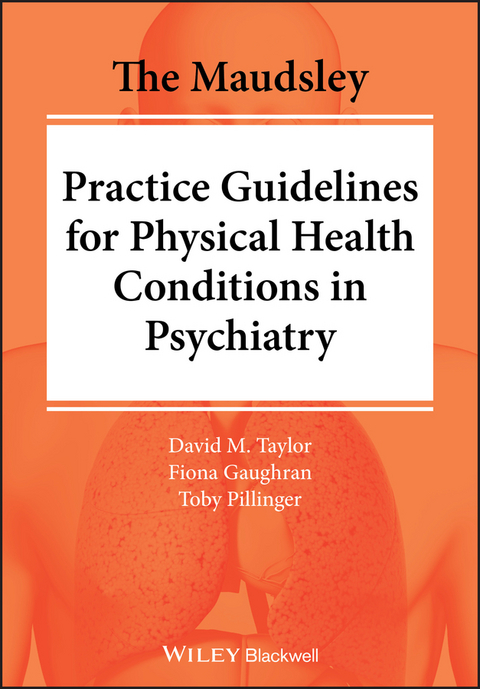
The Maudsley Practice Guidelines for Physical Health Conditions in Psychiatry (eBook)
John Wiley & Sons (Verlag)
978-1-119-55424-0 (ISBN)
Learn to improve your assessment, investigation, and management of physical health conditions in people with severe mental illness
The Maudsley Practice Guidelines for Physical Health Conditions in Psychiatry offers psychiatric and general practitioners an evidence-based and practical guide for the appropriate assessment, investigation, and management of common physical health conditions seen in people with severe mental illness. Written by a renowned team of respected experts in medicine, surgery, pharmacy, dietetics, physiotherapy, and psychiatry, the book bridges the gap between psychiatric and physical health services for the severely mentally ill.
The Maudsley Practice Guidelines for Physical Health Conditions in Psychiatry also provides practitioners with expert guidance on making effective referrals to other medical and surgical subspecialties, telling readers what information subspecialties would expect to receive. Its use will improve the quality of clinical care received by mentally ill patients and, by promoting a holistic approach to treatment that considers both body and mind, will enhance the therapeutic relationship between patient and practitioner.
The Maudsley Practice Guidelines for Physical Health Conditions in Psychiatry covers the following:
- Guidance on assessment and management of well over a hundred different medical and surgical presentations commonly seen in people with serious mental illness
- Management of physical health emergencies in a psychiatric setting
- Evidence-based approaches to management of physical side effects of psychiatric medications
- Advice on approaches to promote a healthy lifestyle in people with serious mental illness, such as smoking cessation and changes to diet and physical activity
Perfect for both psychiatrists and general practitioners who wish to improve the quality of care they provide to people with serious mental illness, The Maudsley Practice Guidelines for Physical Health Conditions in Psychiatry will be of use to anyone setting out to navigate the divide between the treatment of psychiatric and physical health conditions.
David M. Taylor, BSc, MSc, PhD, FCMHP, FFRPS, FRPharmS, FRCP (Edin), is Director of Pharmacy and Pathology at the Maudsley Hospital; Professor of Psychopharmacology at King's College, London, UK.
Fiona Gaughran, MD, FRCP(I), FRCP (Lon), FRCP (Edin), FRCPsych, FHEA, is Director of Research and Development at South London and Maudsley NHS Foundation Trust, where she is Lead Consultant for the National Psychosis Service; Reader in Psychopharmacology and Physical Health at King's College, London, UK.
Toby Pillinger, MA (Oxon), BM BCh, MRCP, PhD, is an Academic Clinical fellow at the Institute of Psychiatry, Psychology and Neuroscience, King's College, London; South London and Maudsley NHS Foundation Trust, London, UK.
Learn to improve your assessment, investigation, and management of physical health conditions in people with severe mental illness The Maudsley Practice Guidelines for Physical Health Conditions in Psychiatry offers psychiatric and general practitioners an evidence-based and practical guide for the appropriate assessment, investigation, and management of common physical health conditions seen in people with severe mental illness. Written by a renowned team of respected experts in medicine, surgery, pharmacy, dietetics, physiotherapy, and psychiatry, the book bridges the gap between psychiatric and physical health services for the severely mentally ill. The Maudsley Practice Guidelines for Physical Health Conditions in Psychiatry also provides practitioners with expert guidance on making effective referrals to other medical and surgical subspecialties, telling readers what information subspecialties would expect to receive. Its use will improve the quality of clinical care received by mentally ill patients and, by promoting a holistic approach to treatment that considers both body and mind, will enhance the therapeutic relationship between patient and practitioner. The Maudsley Practice Guidelines for Physical Health Conditions in Psychiatry covers the following: Guidance on assessment and management of well over a hundred different medical and surgical presentations commonly seen in people with serious mental illness Management of physical health emergencies in a psychiatric setting Evidence-based approaches to management of physical side effects of psychiatric medications Advice on approaches to promote a healthy lifestyle in people with serious mental illness, such as smoking cessation and changes to diet and physical activity Perfect for both psychiatrists and general practitioners who wish to improve the quality of care they provide to people with serious mental illness, The Maudsley Practice Guidelines for Physical Health Conditions in Psychiatry will be of use to anyone setting out to navigate the divide between the treatment of psychiatric and physical health conditions.
David M. Taylor, BSc, MSc, PhD, FCMHP, FFRPS, FRPharmS, FRCP (Edin), is Director of Pharmacy and Pathology at the Maudsley Hospital; Professor of Psychopharmacology at King's College, London, UK. Fiona Gaughran, MD, FRCP(I), FRCP (Lon), FRCP (Edin), FRCPsych, FHEA, is Director of Research and Development at South London and Maudsley NHS Foundation Trust, where she is Lead Consultant for the National Psychosis Service; Reader in Psychopharmacology and Physical Health at King's College, London, UK. Toby Pillinger, MA (Oxon), BM BCh, MRCP, PhD, is an Academic Clinical fellow at the Institute of Psychiatry, Psychology and Neuroscience, King's College, London; South London and Maudsley NHS Foundation Trust, London, UK.
Chapter 1
Tachycardia
Guy Hindley, Eromona Whiskey, Nicholas Gall
In adults, tachycardia is defined as a heart rate faster than 100 beats per minute (bpm). This may represent a normal physiological response, a sign of systemic illness, or primary cardiac pathology [1]. There are several possible cardiac rhythms associated with tachycardia. Identifying the underlying rhythm is central to the diagnostic process and directs management. Classifying these rhythms according to the width of the QRS complex and the regularity of the rhythm (as seen on an ECG) helps to simplify this process (Table 1.1) [2].
SINUS TACHYCARDIA
Sinus tachycardia is the most commonly encountered rhythm disturbance. In the majority of cases, this is an appropriate physiological response mediated by the sympathetic nervous system to an identifiable cause, which may be benign or pathological (Box 1.1) [3]. In the context of mental health, sinus tachycardia may be experienced during episodes of agitation, anxiety or panic. Sympathomimetic and anticholinergic drugs are also important causes to consider, including clozapine which causes a transient sinus tachycardia in 25% of patients, usually limited to the first six weeks of treatment [4]. Among pathological causes, people with serious mental illness (SMI) are at higher risk of sepsis [5] and pulmonary embolism [5,6], while sinus tachycardia is also associated with clozapine‐induced myocarditis [7], neuroleptic malignant syndrome, and serotonin syndrome [8]. Hyperthyroidism and, more rarely, phaeochromocytoma may present with both psychiatric symptoms and sinus tachycardia [9,10]. The reader is directed to other chapters for detailed information on sepsis (Chapter 72), venous thromboembolism (Chapter 18), myocarditis (Chapter 8), neuroleptic malignant syndrome (Chapter 85), serotonin syndrome (Chapter 86), and hyperthyroidism (Chapter 79).
Table 1.1 Differential diagnosis of tachycardia according to the length of the QRS complex and regularity of rhythm [2].
| Narrow QRS (≤120 ms) | Broad QRS (>120 ms) |
|---|
| Regular | Sinus tachycardia Supraventricular tachycardia Atrioventricular re‐entrant tachycardia (AVRT) Atrioventricular nodal re‐entrant tachycardia (AVNRT) Atrial flutter (with regular atrioventricular block) Focal atrial tachycardia | Monomorphic ventricular tachycardia (VT) Any regular narrow‐complex tachycardia with aberrant conduction (e.g. bundle branch block/accessory pathway) |
| Irregular | Atrial fibrillation (AF) Atrial flutter with varying atrioventricular block Multifocal atrial tachycardia | Torsade de pointes Polymorphic VT Ventricular fibrillation AF with aberrant conduction (bundle branch block/accessory pathway) |
ATRIAL FIBRILLATION
Atrial fibrillation (AF) is the second most prevalent rhythm disturbance, occurring in 0.4–1% of adults [11]. Risk increases significantly with age [11]. Alcohol and stimulant use, hyperthyroidism, heart failure, hypertension, and chronic lung disease are associated with AF, all of which are more prevalent in patients with SMI (Table 1.2) [12]. AF can cause acute cardiac decompensation presenting as pulmonary oedema or myocardial ischaemia (see Chapters 67 and 68), as well as longer‐term complications such as thromboembolic disease (e.g. stroke; see Chapter 82) [13].
SUPRAVENTRICULAR TACHYCARDIA
Conventionally, supraventricular tachycardia (SVT) refers to any tachycardia other than AF that originates above the level of the ventricles, i.e. involving the atria, the atrioventricular node, or the bundle of His [2]. Atrioventricular nodal re‐entrant tachycardia (AVNRT), atrioventricular re‐entrant tachycardia (AVRT), atrial flutter, and focal atrial tachycardia are the most common forms of SVT and each is associated with its own distinct pathophysiology and management [14]. Among people with SMI, alcohol and stimulant use may precipitate SVT (see Box 1.1) [15]. Ischaemic heart disease is also an important risk factor [16], the incidence of which is higher in people with SMI [17]. Among the general population, SVT rates are higher in women and those older than 65, although in the absence of ischaemic heart disease, SVT tends to present in younger people with a mean age of 37 [16].
Box 1.1 Common or important causes of tachycardia: those associated with serious mental illness are highlighted in italic
Sinus tachycardia
Emotional/physical arousal: anxiety/panic/agitation
Pain
Circulatory compromise:
- Sepsis
- Pulmonary embolism
- Hypovolaemia including haemorrhage
Heart failure
Myocardial ischaemia
Anaemia
Hyperthyroidism
Electrolyte disturbance (hypokalaemia, hypomagnesaemia)
Pregnancy
Postural orthostatic tachycardia syndrome
Inappropriate sinus tachycardia
Orthostatic intolerance
Alcohol/opiate/benzodiazepine withdrawal
Serotonin syndrome
Neuroleptic malignant syndrome
Drugs:
- Salbutamol
- Caffeine
- Cocaine
- Amphetamine
- Cannabis
- Clozapine
- Tricyclic antidepressants
- Carbamazepine
- Methylphenidate
Supraventricular tachycardia [2,15,16]
Wolff–Parkinson–White syndrome (AVRT)
Electrolyte disturbances (hypokalaemia/hyperkalaemia, hypomagnesaemia)
Ischaemic heart disease
Drugs:
- Alcohol
- Cocaine
- Amphetamine
- Caffeine
Atrial fibrillation [12]
Older age
Sepsis
Pulmonary embolism
Heart failure
Valvular heart disease
Hypertension
Chronic lung disease and lung cancer
Hyperthyroidism
Electrolyte disturbance (hypokalaemia, hypomagnesaemia)
Drugs:
- Atropine
- Alcohol
- Caffeine
- Cocaine
- Amphetamine
Ventricular tachycardia [2,15,16]
Myocardial infarction
Cardiomyopathy
Structural heart disease
Electrolyte disturbances (hypokalaemia/hyperkalaemia, hypomagnesaemia)
Prolonged QTc interval (congenital or acquired)
Brugada syndrome (phenotype associated with antipsychotics)
Eating disorders
Drugs:
- Cocaine
- Amphetamines
- Tricyclic antidepressants
- QTc prolonging medication including antipsychotics (see Chapter 3)
- Digoxin
VENTRICULAR TACHYCARDIA
Ventricular tachycardia (VT) is less common but is associated with high mortality and is the leading cause of sudden cardiac death [18]. The majority of cases are experienced in the context of structural heart disease, myocardial infarction or cardiomyopathy (both ischaemic and non‐ischaemic) [19]. Although a specific association between VT and SMI has not been investigated, sudden cardiac death is significantly more prevalent in the psychiatric population and particularly among those taking antipsychotic medication and people with eating disorders [20,21]. Torsades de pointes (TdP), an irregular polymorphic VT, is of particular relevance due to its association with many antipsychotics and other psychotropic medications that prolong the QT interval (see Chapter 3). Despite this, TdP is still relatively rare, with an annual incidence of 0.16% in general hospital inpatients [22].
DIAGNOSTIC PRINCIPLES
History
- Define cardiac symptoms.
- Palpitations (Box 1.2): if these are paroxysmal (i.e. intermittent), ask the patient to tap out the rhythm; this may provide information on the rate and the regularity of the heartbeat during the palpitations (if irregularly irregular, strongly suggestive of paroxysmal AF).
Box 1.2 Clinical assessment of paroxysmal palpitations
- Palpitations are defined as the abnormal sensation of one’s own heartbeat.
- They may be associated with tachyarrhythmias but can also be experienced during other abnormal cardiac rhythms such as ectopic beats or bradyarrhythmias (see Chapter 1.2) [28].
- Common causes include anxiety and somatisation (31%), paroxysmal atrial fibrillation (16%), and paroxysmal supraventricular tachycardia (10%) [29].
- Although psychiatric symptoms are an important risk factor for a non‐cardiac cause of palpitations, 13% of such patients have an underlying cardiac abnormality and so further investigation may be warranted in the presence of other cardiac symptoms or red flag features [30].
- Symptoms of haemodynamic compromise, e.g. chest pain, shortness of...
- Palpitations (Box 1.2): if these are paroxysmal (i.e. intermittent), ask the patient to tap out the rhythm; this may provide information on the rate and the regularity of the heartbeat during the palpitations (if irregularly irregular, strongly suggestive of paroxysmal AF).
| Erscheint lt. Verlag | 14.10.2020 |
|---|---|
| Reihe/Serie | The Maudsley Prescribing Guidelines Series | The Maudsley Prescribing Guidelines Series |
| Sprache | englisch |
| Themenwelt | Medizin / Pharmazie ► Gesundheitsfachberufe |
| Medizin / Pharmazie ► Medizinische Fachgebiete ► Psychiatrie / Psychotherapie | |
| Schlagworte | asthma mental illness • Clinical psychology • diabetes mental illness • hypertension mental illness </p> • Klinische Psychologie • <p>Severe mental illness • Medical Science • Medizin • Pharmacy • Pharmazie • physical co-morbid • physical co-morbidity • physical conditions SMI • physical SMI • psychiatric co-morbid • Psychiatric co-morbidity • Psychiatrie • Psychiatry • Psychologie • Psychology • SMI • SMI referral |
| ISBN-10 | 1-119-55424-1 / 1119554241 |
| ISBN-13 | 978-1-119-55424-0 / 9781119554240 |
| Informationen gemäß Produktsicherheitsverordnung (GPSR) | |
| Haben Sie eine Frage zum Produkt? |
 EPUB (Adobe DRM)
Kopierschutz: Adobe-DRM
Adobe-DRM ist ein Kopierschutz, der das eBook vor Mißbrauch schützen soll. Dabei wird das eBook bereits beim Download auf Ihre persönliche Adobe-ID autorisiert. Lesen können Sie das eBook dann nur auf den Geräten, welche ebenfalls auf Ihre Adobe-ID registriert sind.
Details zum Adobe-DRM
Dateiformat: EPUB (Electronic Publication)
EPUB ist ein offener Standard für eBooks und eignet sich besonders zur Darstellung von Belletristik und Sachbüchern. Der Fließtext wird dynamisch an die Display- und Schriftgröße angepasst. Auch für mobile Lesegeräte ist EPUB daher gut geeignet.
Systemvoraussetzungen:
PC/Mac: Mit einem PC oder Mac können Sie dieses eBook lesen. Sie benötigen eine
eReader: Dieses eBook kann mit (fast) allen eBook-Readern gelesen werden. Mit dem amazon-Kindle ist es aber nicht kompatibel.
Smartphone/Tablet: Egal ob Apple oder Android, dieses eBook können Sie lesen. Sie benötigen eine
Geräteliste und zusätzliche Hinweise
Buying eBooks from abroad
For tax law reasons we can sell eBooks just within Germany and Switzerland. Regrettably we cannot fulfill eBook-orders from other countries.
aus dem Bereich