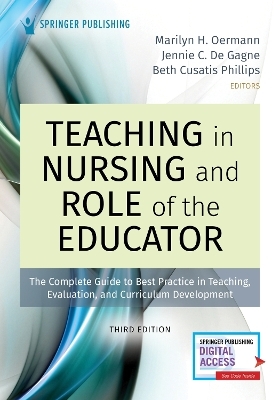
Teaching in Nursing and Role of the Educator, Third Edition
Springer Publishing Co Inc (Verlag)
978-0-8261-5262-6 (ISBN)
- Titel erscheint in neuer Auflage
- Artikel merken
All the information you need in one textbook!
This all-inclusive text for Nurse Educators delivers comprehensive, evidence-based guidance on the essential components of teaching, including learning theories, teaching methods, new technologies for teaching, curriculum development, evaluation and testing, and accreditation. The text delivers the full scope of knowledge necessary for novice and experienced faculty to become competent teachers in nursing.
This third edition features new content on the transition from clinician to educator. There is also a new chapter on nursing professional development and teaching in clinical settings and updated teaching strategies for active learning, clinical judgment, and online teaching. The text is designed to help educators prepare for the certification exams.
The text also addresses varied learning styles and how to accommodate them, new developments in simulation, standardized patients, OSCEs, clinical teaching, interprofessional education, and evidence-based teaching.
New to the Third Edition:
Chapter on the transition from clinician to educator, plus expanded content throughout on becoming a nurse educator
Addresses inclusivity and developing an inclusive learning environment for people with different learning styles
Strategies to promote active learning, clinical judgment, and higher level learning, and teaching online
Updated content on simulations, the use of standardized patients, OSCEs, clinical teaching, and clinical evaluation
Chapter on accreditation of nursing programs and developing a systematic program evaluation plan
Chapter on nursing professional development and teaching in a clinical setting
Key Features:
Written by experts who seamlessly integrate evidence-based research and practical strategies
Serves as a thorough study guide for nurse educator certification exams
Covers practical teaching strategies, simulation, online education, technology, interprofessional education, clinical teaching and evaluation, and test construction
Includes case examples and other examples to support content and “how-to” tips
Includes a high quality online course ready for an instructor’s use: sample syllabus, PowerPoints, and a complete 20-module online course
Purchase includes digital access for use on most mobile devices or computers
Marilyn H. Oermann, PhD, RN, ANEF, FAAN, is the Thelma M. Ingles Professor of Nursing at Duke University School of Nursing, Durham, North Carolina. She is the author or coauthor of 35 books and many articles on evaluation, teaching in nursing, and studies of the nursing literature. She is the Editor-in-Chief of Nurse Educator. Dr. Oermann received the National League for Nursing (NLN) Award for Excellence in Nursing Education Research, the Sigma Theta Tau International Elizabeth Russell Belford Award for Excellence in Education, the American Association of Colleges of Nursing Scholarship of Teaching and Learning Excellence Award, the Margaret Comerford Freda Award for Editorial Leadership in Nursing from the International Academy of Nursing Editors, and the NLN President’s Award. The NLN established an award in her honor, the Marilyn H. Oermann Award for Distinguished Research in Nursing Education, to recognize an individual or team who has generated an evidentiary base for the science of nursing education. Jennie C. De Gagne, PhD, DNP, RN, NPD-BC, CNE, ANEF, FAAN, is a Professor of Nursing and Director of the Nursing Education Specialty at Duke University School of Nursing. With extensive experience in nursing education, she has provided consultation to nursing schools worldwide, including in South Korea, Ghana, India, Tanzania, Saudi Arabia, Oman, and Lebanon, focusing on curriculum and faculty development. Dr. De Gagne is an expert in educational technology and online education, particularly in the effective use of instructional technology and cybercivility across the curriculum. She has authored or coauthored over 200 publications, including more than 120 peer-reviewed journal articles, and has presented at nearly 150 national and international conferences, establishing herself as a thought leader in the nursing education community. Beth Cusatis Phillips, PhD, RN, CNE, CHSE, is an associate professor and the Director of the Institute for Educational Excellence at Duke University School of Nursing.
Contents
Contributors
Contributors to Earlier Editions
Preface
SECTION I: NURSING EDUCATION: ROLES OF TEACHER AND LEARNER
1. Role of the Nurse Educator
Marilyn H. Oermann
2. The Transition from Clinician to Educator
Anne M. Schoening
3. Learning Theories
Beth Cusatis Phillips
4. Understanding the Learner
Beth Cusatis Phillips
SECTION II: TEACHING IN NURSING
5. Learning Environment and Teaching Methods
Debra Hagler and Brenda Morris
6. Integrating Technology in Education
Jennie C. De Gagne
7. Teaching in Online Learning Environments
Jennie C. De Gagne
8. Simulations in Nursing Education: Overview, Essentials, and the Evidence
Pamela R. Jeffries, Kristina T. Dreifuerst, and Katie A. Haerling
9. Weaving Interprofessional Education into Nursing Curricula
Karen T. Pardue, Shelley Cohen Konrad, and Dawne Marie Dunbar
SECTION III: TEACHING IN A LEARNING LABORATORY AND CLINICAL SETTING
10. Learning Laboratories as a Foundation for Nursing Excellence
Carol F. Durham and Darlene E. Baker
11. Clinical Teaching in Nursing
Lisa K. Woodley and Joan M. Stanek
12. Partnerships With Clinical Settings: Roles and Responsibilities of Nurse Educators
Karen L. Gorton
SECTION IV: ASSESSMENT AND EVALUATION
13. Assessment Methods
Marilyn H. Oermann
14. Developing and Using Tests
Kathleen B. Gaberson
15. Clinical Evaluation
Marilyn H. Oermann
SECTION V: CURRICULUM DEVELOPMENT AND EVALUATION OF NURSING PROGRAM
16. Curriculum Development in Nursing
Stephanie Stimac DeBoor
17. Curriculum Models and Course Development
Theresa M. “Terry” Valiga
18. Program Evaluation and Accreditation
Marilyn H. Oermann
SECTION VI: ROLE OF NURSE EDUCATOR AS SCHOLAR
19. Evidence-Based Teaching in Nursing
Marilyn H. Oermann
20. Becoming a Scholar in Nursing Education
Marilyn H. Oermann
SECTION VII: ROLE OF THE EDUCATOR IN PROFESSIONAL DEVELOPMENT AND GLOBAL EDUCATION
21. Nursing Professional Development Practitioner in a Clinical Practice Setting
Joan Such Lockhart and Denise M. Petras
22. Preparing Students for Interprofessional Work in the Global Village: The Role of Nurse Educators
Ann Gakumo, Sabreen A. Darwish, and Martha A. Dawson
Appendices
Appendix A: Nursing and Higher Education Organizations
Appendix B: Debriefing Interprofessionally: Recognition & Reflection (DIPRR) Instrument
Appendix C: Selected Organizations, Journals, and Educational Conferences of Interest for Nursing Professional Development Practitioners
Appendix D: Global Health Educational Resources
Index
| Erscheinungsdatum | 24.08.2020 |
|---|---|
| Zusatzinfo | 10 Illustrations |
| Verlagsort | New York |
| Sprache | englisch |
| Maße | 178 x 254 mm |
| Gewicht | 907 g |
| Themenwelt | Pflege ► Fachpflege ► Anästhesie / Intensivmedizin |
| Pflege ► Studiengänge ► Pflegewissenschaft | |
| ISBN-10 | 0-8261-5262-7 / 0826152627 |
| ISBN-13 | 978-0-8261-5262-6 / 9780826152626 |
| Zustand | Neuware |
| Informationen gemäß Produktsicherheitsverordnung (GPSR) | |
| Haben Sie eine Frage zum Produkt? |
aus dem Bereich