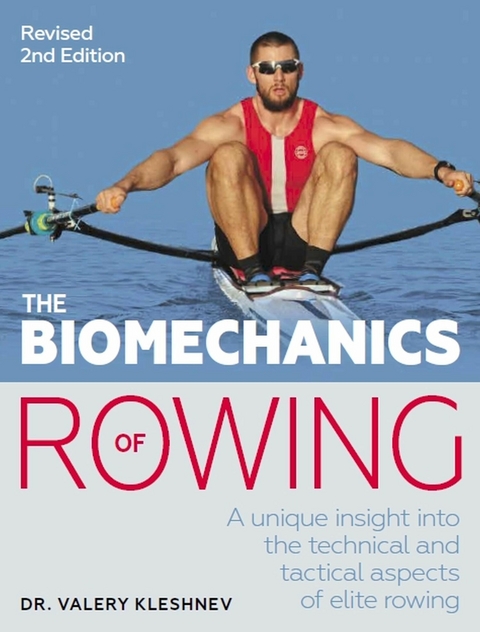
Biomechanics of Rowing (eBook)
373 Seiten
Crowood (Verlag)
978-1-78500-778-1 (ISBN)
Dr Valery Kleshnev spent ten years as a member of the USSR National Rowing team, where he won a gold medal at the junior World Championships in 1975, a silver Olympic medal in 1980 and a bronze at the World Championships in 1982. After graduating in physical education in 1984, Valery was awarded a PhD in rowing biomechanics from the Saint-Petersberg Sport Institute, Russia, in 1991. In 1998 he was employed by the Australian Institute of Sport and moved to Canberra, where he worked with the world's best rowing coaches and crews. In 2005 Valery took a position of National Biomechanics Lead at the English Institute of Sport and moved to Britain, and helped the British rowing team to win two gold and four other medals at the 2008 Olympic Games in Beijing. Since 2009, Valery has run his own company BioRow Ltd, carrying out research and development in rowing biomechanics. He now works with rowers and coaches from countries all over the world. His clients won four gold and seven other medals at the 2012 London Olympics.
In rowing, races are often won despite, not because of, technique and many misconceptions still preoccupy both rowers and coaches. This book explains the facts about rowing techniques and will help you find the right way to achieve your best performance. In this new edition, comprehensively updated to take account of the most recent developments in the sport The Biomechanics of Rowing offers a unique insight into the technical and tactical aspects of rowing, based on over twenty-five years experience of working with the best rowers and coaches all around the globe, a careful analysis of millions of data samples, and comprehensive biomechanical modelling with the aim of finding an optimal balance of variables. Topics covered include measurement; performance analysis; technique; ergometer rowing and, finally, rowing equipment and rigging.
Dr Valery Kleshnev spent ten years as a member of the USSR National Rowing team, where he won a gold medal at the junior World Championships in 1975, a silver Olympic medal in 1980 and a bronze at the World Championships in 1982. After graduating in physical education in 1984, Valery was awarded a PhD in rowing biomechanics from the Saint-Petersberg Sport Institute, Russia, in 1991. In 1998 he was employed by the Australian Institute of Sport and moved to Canberra, where he worked with the world's best rowing coaches and crews. In 2005 Valery took a position of National Biomechanics Lead at the English Institute of Sport and moved to Britain, and helped the British rowing team to win two gold and four other medals at the 2008 Olympic Games in Beijing. Since 2009, Valery has run his own company BioRow Ltd, carrying out research and development in rowing biomechanics. He now works with rowers and coaches from countries all over the world. His clients won four gold and seven other medals at the 2012 London Olympics.
CHAPTER 1
INTRODUCTION
This book is intended for rowers and coaches who want to improve their rowing technique, row faster and maximize their results in regattas, given their physical conditioning. Here I have tried to summarize my knowledge of rowing biomechanics, which was obtained from nearly thirty years of working with thousands of rowers and coaches from all around the world: from Europe to Australia, from China to the USA and Brazil. Many of them ended up being Olympic and World champions and I have learned a lot from them. This knowledge didn’t come as a divine revelation but is a product of extensive measurements and analysis, continuous attempts to solve many puzzles and exhaustive studies of the efficiency techniques of winning crews. Though inspiration is still important, I believe the only way to achieve it is through hard work and continuous thought.
I can say that my understanding of rowing biomechanics and technique is completely different now from that in 1986, which is when I finished my fourteen-year rowing career and started pursuing sport science. It was a very steep learning curve. In the beginning I had very limited instrumentation and had to rely on experts and literature, which mainly emphasized the importance of ‘smooth boat velocity’ and so on. If someone had asked me at the time ‘How should the best force curve look?’ my answer would have been quite evasive: ‘It is possible to win with various force curves.’ I just didn’t know. Now I realize how many mistakes we made at that time.
The logical question that I always ask myself is ‘Are you sure now that all these conclusions are true?’ The answer I give is: ‘They should be correct, on the basis of all the available evidence and its analysis. However, if new facts contradicting the theory should be found, or someone finds an error in the analysis, I have to revise it and develop a new theory.’ Of course, misconceptions are always possible, but at least I try to be open-minded.
For example, a few years ago I thought that a pair of horizontal forces at the handle and the stretcher might create a torque, which could lift the whole rower-boat system out of the water and decrease drag resistance. My colleague and friend Prof. Volker Nolte from Canada had an opposite opinion and counted only a rower’s vertical accelerations, but I was still hoping that a true lift force might exist. After a few quite sophisticated experiments (see Chapter 2.5.4), I have found that Volker was right: horizontal forces cannot be converted into vertical forces in the way I thought, but some data still remained unexplained. Suddenly, a solution came not from a sport scientist, but from a master rower and engineer, Tor Anderson from California, who suggested an effect of centripetal force, which we had both overlooked.
Very often, the reason for changing the concept is not a fault or mistake but due to new data being obtained when new instrumentation becomes available. For example, a few years ago the dominating winning race strategy was one that encouraged the fastest start. Now we can see a change in this trend, where more and more winners use a more even distribution of effort during the race.
Most of the information in this book could be found in the Rowing Biomechanics Newsletter (RBN), which I write and publish, and have done so monthly since 2001. My original reason to start this project was to keep my brain active in my speciality. Later it became a great tool not only for sharing ideas but also for their discussion and verification. Many thanks to all the contributors whose comments were very valuable in correcting errors and mistakes, obtaining new ideas and making the advance in rowing biomechanics possible. However, this book is not a simple compilation of newsletters. All the information was revised and structured and many contradictions accumulated over the years were corrected.
Quite a common approach as a way of improving rowing technique is to look at winning crews in an attempt to copy them, without considering why they are fast. However, nothing that’s worthwhile is ever easy, especially in rowing. Some crews are not winning just because they are; they win in spite of their technique by means of higher physiological power and stronger, better motivation. A large variety of rowing techniques could be found in winners of Elite regattas, so which one should you copy? Remember, a copy is always going to be worse than the original.
I propose a different approach, which is not as easy; it requires some extra efforts and brain power but will help you produce much more consistent and reliable results. What this book can offer you is an understanding of ‘how it works’, and why. This is a sort of mosaic, a completed puzzle, where the bits and pieces of rowing technique are placed in an organized manner and bound together through mechanical principles. This is not a simple system, and is sometimes controversial. You may try to improve one efficiency component, but lose more on another one. Therefore, using common sense is the rule of thumb here, and all ideas must always be verified empirically with actual rowing results.
This book is also for sport scientists: for people who want to measure numbers in rowing, relate them to technique and give specific advice to coaches and rowers. In general, sport biomechanics is a very specific science, much more than physiology, psychology or nutrition. Sporting technique is completely different in various sports, for example between rowing and swimming, canoeing and athletics, so there are very different analytical models and criteria of effectiveness, measurement methods and equipment. The biomechanical equipment is usually custom-made, and we can’t, as it were, ‘go and buy it in a shop’, unlike the skills of other sport scientists. It takes many years for a biomechanic scientist to obtain professional expertise in a specific area, and they usually can’t work across many sports and switch between them quickly, as other sport scientists can do.
Biomechanical models can be very complicated, with many important unknown variables. Sometimes, if you blindly follow an incorrect model, the outcome could even be counter-productive and decrease performance instead of improving it. Again, common sense and continuous verification of your ideas with practical results are absolutely necessary.
Rowing is a unique sport due to its technical complexity, which is defined by the following factors:
■ Rowing utilizes nearly all the muscles of the human body;
■ Rowing requires complex coordination of the rower’s movements, which is determined by many degrees of freedom: the three-dimensional pivoting oar, the moving seat and an unstable boat;
■ Coordination of the rowing movements becomes even more complex in crew boats, which require synchronization of the rowers’ motions;
■ Rowing is the only sport where the athlete moves backwards, which is not natural human movement and dictates inversion of the muscle sequence.
These factors make rowing a very technical sport and explain why rowing biomechanics is so important for developing an effective technique and achieving good results in this sport. Technique is not the only important component of rowing performance; a high physiological capacity is also compulsory. The top results can be achieved only through a combination of these two main factors together with mental toughness. There was evidence (comparison of erg scores and on-water results) showing that an effective technique could make the boat 3–5 per cent faster (10–15 seconds over a 2km race) at the same physiological power production, which is the difference in speed between gold medallists and sixth-placed B-finalists at Elite regattas.
In addition, rowing is a very productive sport in terms of measurements and science; rowing equipment allows many places where the sensors can be mounted to measure forces, angles, velocities and accelerations of the boat, oars and rower. Therefore, rowing biomechanics has quite a long history, originating at the end of the nineteenth century,13 when sensors were mounted on the oarlock and the rowing force was measured. Since that time, the measurement equipment has been continuously developing. Data acquisition technology is booming these days, since the beginning of the information age in the twenty-first century. However, numbers and curves would be useless without proper understanding of their meaning, how they are related to effective rowing technique and what sort of numbers are required for the best performance.
This book contains eight chapters:
1. This introduction;
2. Measurements – explains technology and meaning of biomechanical methods;
3. Analysis – the core theories behind rowing biomechanics;
4. Technique – practical applications of biomechanical information and knowledge;
5. Ergometer rowing – giving the specifics of using machines;
6. Rowing equipment and rigging;
7. Performance analysis – discusses races and rowing speed analysis;
8. Various cross-disciplinary topics – a brief overview of areas on the borderline of rowing biomechanics with other disciplines.
The purpose of this book is to help rowers and coaches to understand better the main biomechanical principles of effective rowing technique, to relate them to what they can see and what they can measure in rowing, and to show them some ways to...
| Erscheint lt. Verlag | 21.9.2020 |
|---|---|
| Verlagsort | London |
| Sprache | englisch |
| Themenwelt | Sachbuch/Ratgeber ► Sport ► Segeln / Tauchen / Wassersport |
| Studium ► 1. Studienabschnitt (Vorklinik) ► Physiologie | |
| Schlagworte | blade path • Body Mass Index • catch angle • drive sequence • dynamic technique • eRegatta • Ergometer • feathering • finger roll • footstretcher • Gates • Masters • Master’s sculling • maximum heart rate • Nutrition • oar inboard • oarlock • oar outboard • oars • oar tracking • O’Neill test • orthostatic heart rate • power test • pre-drive sequence • Propulsion • race plan • Rake • Randallfoils • Regatta • release angle • Rigging • rowing • rowing coaching • rowing techniques • scull • sculler • sculling boat • sculling system • shoe plate • single scull • slip angle • SpeedCoach • stroke arc • teaching rowing • types of rowing • wash angle • watersports • waterways |
| ISBN-10 | 1-78500-778-5 / 1785007785 |
| ISBN-13 | 978-1-78500-778-1 / 9781785007781 |
| Informationen gemäß Produktsicherheitsverordnung (GPSR) | |
| Haben Sie eine Frage zum Produkt? |
 EPUB (Adobe DRM)
Kopierschutz: Adobe-DRM
Adobe-DRM ist ein Kopierschutz, der das eBook vor Mißbrauch schützen soll. Dabei wird das eBook bereits beim Download auf Ihre persönliche Adobe-ID autorisiert. Lesen können Sie das eBook dann nur auf den Geräten, welche ebenfalls auf Ihre Adobe-ID registriert sind.
Details zum Adobe-DRM
Dateiformat: EPUB (Electronic Publication)
EPUB ist ein offener Standard für eBooks und eignet sich besonders zur Darstellung von Belletristik und Sachbüchern. Der Fließtext wird dynamisch an die Display- und Schriftgröße angepasst. Auch für mobile Lesegeräte ist EPUB daher gut geeignet.
Systemvoraussetzungen:
PC/Mac: Mit einem PC oder Mac können Sie dieses eBook lesen. Sie benötigen eine
eReader: Dieses eBook kann mit (fast) allen eBook-Readern gelesen werden. Mit dem amazon-Kindle ist es aber nicht kompatibel.
Smartphone/Tablet: Egal ob Apple oder Android, dieses eBook können Sie lesen. Sie benötigen eine
Geräteliste und zusätzliche Hinweise
Buying eBooks from abroad
For tax law reasons we can sell eBooks just within Germany and Switzerland. Regrettably we cannot fulfill eBook-orders from other countries.
aus dem Bereich