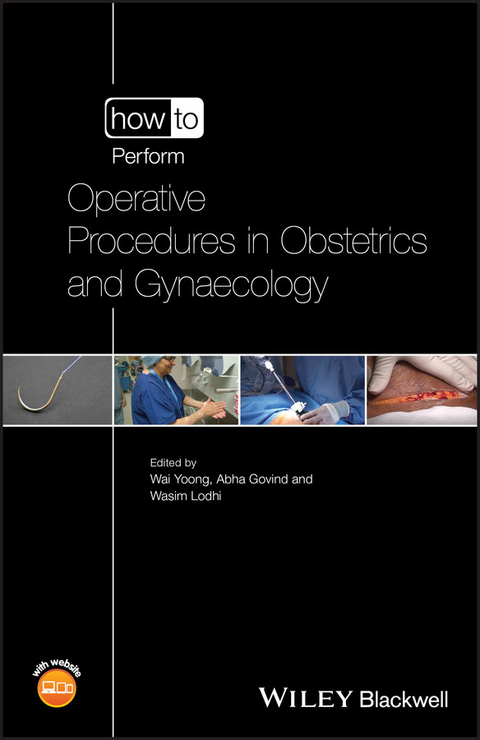
Trainees in Obstetrics and Gynaecology require robust operative skills, yet factors such as the implementation of structured training and increased litigation concerns have significantly limited training time. Whilst conventional textbooks are sufficient for presenting theoretical knowledge, they are inadequate in explaining practical procedures. How to Perform Operative Procedures in Obstetrics and Gynaecology thoroughly describes many key index operations in the Royal College of Obstetricians and Gynaecologists training syllabus, offering an innovative, media-rich approach to the subject.
Written by a team of O&G practitioners, this unique resource combines concise written instructions, full-colour pictures and diagrams, and hours of high-quality video footage of real-life operations, narrated by experienced NHS consultants. Specialty trainees, MRCOG candidates and post-MRCOG doctors are provided clear, easy-to-follow guidance on procedures including assisted vaginal delivery, Caesarean section, abdominal hysterectomy, diagnostic and operative laparoscopy, cone biopsy, rigid cystoscopy and many others.
- Features a companion website containing more than six hours of video tutorials, vignettes and personal experiences
- Includes a colour WHO Surgical Safety Checklist
- Discusses non-technical aspects such as consent and understanding human factors
- Covers surgical instruments, surgical positioning, and sutures and needles
- Offers introductions, overviews, and 'Top Tips' for each procedure to highlight important learning points
An ideal study guide and reference for individual and group work alike, How to Perform Operative Procedures in Obstetrics and Gynaecology is indispensable for specialty trainees and those preparing for MRCOG examinations.
Wai Yoong is a Consultant Obstetrician and Urogynaecologist at North Middlesex University Hospital London, an Honorary Senior Lecturer at University College London, London, UK; and Associate Professor at St George's International School of Medicine, Grenada, West Indies.
Abha Govind is a Consultant Obstetrician and Gynaecologist at North Middlesex University Hospital London, an Honorary Senior Lecturer at University College London, London, UK; and Associate Professor at St George's International School of Medicine, Grenada, West Indies.
Wasim Lodhi is a Consultant Obstetrician and Gynaecologist at North Middlesex University Hospital London, an Honorary Senior Lecturer at University College London, London, UK; and Associate Professor at St George's International School of Medicine, Grenada, West Indies.
Wai Yoong is a Consultant Obstetrician and Urogynaecologist at North Middlesex University Hospital London, an Honorary Senior Lecturer at University College London, London, UK; and Associate Professor at St George's International School of Medicine, Grenada, West Indies. Abha Govind is a Consultant Obstetrician and Gynaecologist at North Middlesex University Hospital London, an Honorary Senior Lecturer at University College London, London, UK; and Associate Professor at St George's International School of Medicine, Grenada, West Indies. Wasim Lodhi is a Consultant Obstetrician and Gynaecologist at North Middlesex University Hospital London, an Honorary Senior Lecturer at University College London, London, UK; and Associate Professor at St George's International School of Medicine, Grenada, West Indies.
Contributors vi
Foreword vii
Editors' Biographies ix
Acknowledgements xi
About the Companion Website xii
Part I Basic 1
1 Consent 3
Abha Govind
2 WHO Surgical Safety Checklist 10
Sophie Relph and Wai Yoong
3 Understanding Human Factors (Non-technical Skills) in Obstetrics and Gynaecology 15
Wai Yoong, Mark Ponnusamy, Roberto De Martino, and Maud Nauta
4 Surgical Instruments 25
Christina Neophytou, Rajvinder Khasriya, and Wai Yoong
5 Surgical Positioning 34
Ciara MacKenzie, Rosalind Aughwane, Wasim Lodhi, and Wai Yoong
6 Sutures and Needles 37
Rosalind Aughwane, Ciara MacKenzie, Wasim Lodhi, and Wai Yoong
Part II Obstetrics 41
7 Assisted Vaginal Delivery 43
Natasha Barbaneagra, Katie Andersen, and Wasim Lodhi
8 Caesarean Section 49
Sayantana Das and Abha Govind
9 Uterine Compression Sutures for Uterine Atony 52
Wai Yoong and Wasim Lodhi
10 Cervical Cerclage 57
Joan Baqer, Dhanuson Dharmasena, and Wai Yoong
Part III Gynaecology, 63
11 Total Abdominal Hysterectomy 65
Abha Govind
12 Open Myomectomy 70
Abha Govind
13 Hysteroscopic Resection of Fibroids 74
Sayantana Das and Wasim Lodhi
14 Diagnostic Laparoscopy 78
Charlotte Austen and Abha Govind
15 Operative Laparoscopy 82
Charlotte Austen and Abha Govind
16 Laparoscopic Salpingectomy for Ectopic Pregnancy 85
Wasim Lodhi
17 Surgery for Vagina Prolapse Using Native Tissue 88
Wai Yoong
18 Vaginal Hysterectomy for Prolapse 91
Jane Ding and Wai Yoong
19 Manchester Repair (Fothergill's Operation) for Cervical Prolapse 95
Dhanuson Dharmasena and Wai Yoong
20 Cone Biopsy 99
Jane Ding and Wai Yoong
21 Rigid Cystoscopy 102
Wai Yoong
22 Manual Vacuum Aspiration and Surgical Management of Miscarriage 105
Abha Govind and Beena Subba
23 Female Sterilisation: The Laparoscopic and Hysteroscopic Approaches 109
Abha Govind
Index 114
1
Consent
Abha Govind
Overview
Obtaining consent and understanding its implications form an important part of a clinician's practice. This chapter discusses aspects of consent typically encountered by a clinician, including the recent Montgomery Ruling.
Introduction
In recent years, great emphasis has been placed on obtaining consent for surgical procedures to avoid litigation. This has become an integral part of clinical risk management and governance. Generally, consent should be obtained before any procedure. It is important to understand that a competent adult has the fundamental right to give, or withhold, consent to examination, investigation or treatment, founded on the moral principle of respect for autonomy. An autonomous person may decide what may or may not be done to her.
In English civil law deliberately touching another person without consent is called battery, which is punishable by law. Equally, patients can take out a civil action for negligence for not receiving enough information about a procedure, particularly if they have not been told enough about the risks. This could result in an action for damages, or even criminal proceedings, and potentially in a finding of a serious professional misconduct by a professional registration body, e.g. the General Medical Council (GMC).
Types of Consent
There are three different types of consent in everyday working practice. Tacit consent is when you tell a patient you want to take a blood test and she holds out her arm whilst you put a needle in and take the blood sample. Verbal consent is when you ask a patient if you can do a vaginal examination and she says yes and allows the procedure. Finally, written consent should be taken for all invasive procedures, those involving risk and where regional or general anaesthesia is required. It is not absolutely necessary to defend an action for assault/battery but it affords documentary evidence. If an action is brought several years after the event, the judge may prefer the patient's evidence over that of the practitioner, if a signed and witnessed consent form cannot be produced.
What Makes Consent Valid?
Consent must be given voluntarily, without coercion, by a woman who is fully informed about the procedure or investigation in question, and who has capacity. It is not valid if she agrees to an operation without full knowledge. If possible, visual or written aids can be used to help, and an interpreter should be used if needed. Consideration also needs to be given to patients with learning difficulties.
When Should You Obtain Consent?
Ideally, well in advance so that the patient has time to ask questions. It is good practice to obtain consent in outpatient clinics, then confirm consent prior to the procedure. In certain cases, women are listed for theatre within days of being seen in clinic (e.g. women with cancer) and in this instance it is important that the woman has been given the opportunity to reflect on the procedure and to ask questions. The GMC recommends an appropriate cooling off period before signing.
How Long Is Consent Valid for?
If a woman consents to a procedure, generally it is assumed that this consent is valid indefinitely. However, in a few situations consent may need to be reconfirmed, e.g. if the patient's condition changes, if there is a long time period between signing and the procedure, or if the procedure has changed or new risks or side effects are known (DOH 2009).
Who Can Obtain Consent?
The responsibility for obtaining consent lies with the clinician performing the operation. Consent may not be valid if obtained by someone with inadequate knowledge of the procedure. If you are a junior trainee in this situation you have a duty to ensure you have the correct knowledge, and if you do not, refer the woman to another practitioner who does.
Fully Informed Consent
Ensure that your patient understands the nature of the condition, intervention and likely benefits and risks of the procedure for which the consent is proposed. She should also be told of the risks of the procedure not being carried out. When using consent forms in the UK, there is a space on the form to document any procedures that your patient would not wish to have done. For example, a person who is a Jehovah's Witness will not accept blood products, or a woman who wishes to retain her cervix with consent only for a subtotal hysterectomy.
Material Risk
These are defined as those to which a reasonable person in the patient's position would be likely to attach significance. It is an aspect of consent which has been contentious in terms of how much information regarding risks is given to patients. Several court cases have led to the current view that as much information as possible should be given to the patient.
The ‘Bolam test’ is a defence to the charge of negligence, when a group of doctors within the same specialty agree that at the time they would have taken the same actions or decisions to the same standard (Bolam v Friern Hospital Management Committee (1957)). In the Sidaway case (Sidaway v Board of Governors of the Bethlem Royal Hospital (1985)), the patient was suffering from symptoms of nerve compression and underwent cord decompression. As a complication she suffered paraplegia, a recognised but uncommon complication (1–2%). This was not included in the consent. The patient reported negligence because of this but the court rejected the argument based on the Bolam test as other practitioners agreed it was not necessary to inform the patient of every risk. However, the House of Lords later concluded that a doctor has a duty to provide to their patients sufficient information for them to reach a balanced judgement. Since the Sidaway case, law courts are more willing to be critical of medical opinion, i.e. a clinician may be held accountable for an action being negligent or harmful, even if a body of professionals felt their action was reasonable according to the Bolam test.
Since the Chester v Afshar case (2004), it is now advised that when obtaining consent, practitioners should inform patients about all significant possible adverse outcomes. In this case, the patient sought advice from a neurosurgeon about their back pain and was advised to have an operation. This operation carried a 1–2% risk of worsening the symptoms, which the patient subsequently suffered but this was not discussed within the consent. Crucially, the court judged that the surgeon breached their duty as although the complication was not because of the surgeon's negligence during the operation, the link between omitting the risk during consent and the complication was causal – the claimant reported if they had been told of this risk they would have sought alternative advice or treatment (Chester v Afshar 2004). It is therefore imperative that practitioners should inform patients about all significant possible adverse outcomes and document this, and advise the patient if any intervention may result in a serious adverse outcome, even if the likelihood is very small (GMC 2008).
The law on consent has progressed from being doctor led to patient focused. When seeking consent to treatment, the question of whether the information given to a patient is adequate is judged from the perspective of a reasonable person in the patient's position. For the purposes of consent, the ruling from Montgomery replaces the previous tests founded in Bolam and refined in Sidaway. Doctors have a duty to take reasonable care to ensure that patients are aware of ‘material risks’.
Montgomery v Lanarkshire Health Board
Mrs Montgomery was a primigravida with type I diabetes who booked under consultant‐led care in 1999. She was noted to have a large baby at her 36‐week scan and was induced at 38 + 5 weeks of gestation. Although she expressed concerns about the size of the baby, the risk of shoulder dystocia (9–10% in diabetic mothers) was never discussed with her. Her consultant, who advised a vaginal delivery, defended her practice saying that in her estimation, ‘the risk of a grave problem for the baby arising as a result of shoulder dystocia was very small (0.1%)’. The baby was delivered by forceps, but this was complicated by shoulder dystocia and there was a delay of 12 minutes between the delivery of the fetal head and body. Her son developed severe dyskinetic cerebral palsy as a result of hypoxia during delivery (Cheung et al. 2016). Her obstetrician had not disclosed the increased risk of this complication in vaginal delivery, despite Montgomery asking if the baby’s size was a potential problem. Montgomery sued for negligence, arguing that, if she had known of the increased risk, she would have requested a Caesarean section. The Supreme Court of the UK announced judgement in her favour in March 2015. The ruling overturned a previous decision by the House of Lords...
| Erscheint lt. Verlag | 15.7.2020 |
|---|---|
| Reihe/Serie | How to Perform |
| How to Perform | How to Perform |
| Sprache | englisch |
| Themenwelt | Medizin / Pharmazie ► Gesundheitsfachberufe ► Hebamme / Entbindungspfleger |
| Medizin / Pharmazie ► Medizinische Fachgebiete ► Chirurgie | |
| Medizin / Pharmazie ► Medizinische Fachgebiete ► Gynäkologie / Geburtshilfe | |
| Medizin / Pharmazie ► Studium | |
| Schlagworte | Geburtshilfe • gynaecological procedures • gynaecology surgery • gynaecology surgery video • Gynäkologie • Gynäkologie u. Geburtshilfe • Hebammenpraxis • Krankenpflege • Medical Science • Medizin • Midwifery • MRCOG exam • MRCOG study guide • MRCOG syllabus • nursing • O&G study guide • O&G trainee guide • O&G video guide • obstetric procedures • Obstetrics • Obstetrics & Gynecology • obstetrics surgery • obstetrics surgery video |
| ISBN-13 | 9781119690870 / 9781119690870 |
| Informationen gemäß Produktsicherheitsverordnung (GPSR) | |
| Haben Sie eine Frage zum Produkt? |
 EPUB (Adobe DRM)
Kopierschutz: Adobe-DRM
Adobe-DRM ist ein Kopierschutz, der das eBook vor Mißbrauch schützen soll. Dabei wird das eBook bereits beim Download auf Ihre persönliche Adobe-ID autorisiert. Lesen können Sie das eBook dann nur auf den Geräten, welche ebenfalls auf Ihre Adobe-ID registriert sind.
Details zum Adobe-DRM
Dateiformat: EPUB (Electronic Publication)
EPUB ist ein offener Standard für eBooks und eignet sich besonders zur Darstellung von Belletristik und Sachbüchern. Der Fließtext wird dynamisch an die Display- und Schriftgröße angepasst. Auch für mobile Lesegeräte ist EPUB daher gut geeignet.
Systemvoraussetzungen:
PC/Mac: Mit einem PC oder Mac können Sie dieses eBook lesen. Sie benötigen eine
eReader: Dieses eBook kann mit (fast) allen eBook-Readern gelesen werden. Mit dem amazon-Kindle ist es aber nicht kompatibel.
Smartphone/Tablet: Egal ob Apple oder Android, dieses eBook können Sie lesen. Sie benötigen eine
Geräteliste und zusätzliche Hinweise
Buying eBooks from abroad
For tax law reasons we can sell eBooks just within Germany and Switzerland. Regrettably we cannot fulfill eBook-orders from other countries.
aus dem Bereich