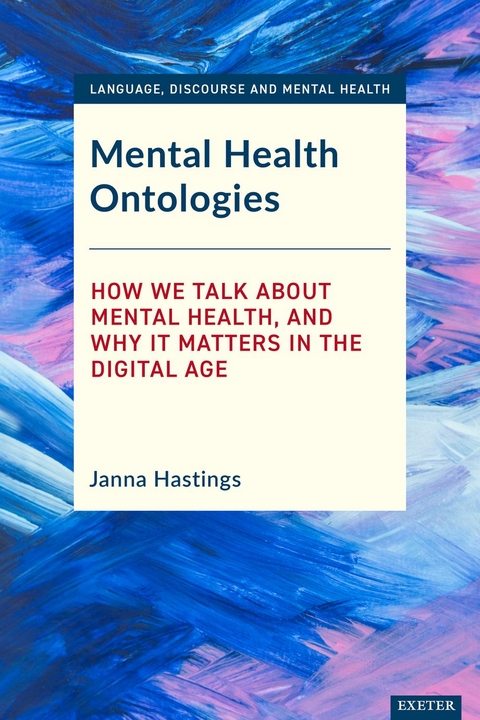
Mental Health Ontologies (eBook)
192 Seiten
University of Exeter Press (Verlag)
978-1-905816-51-4 (ISBN)
This book tackles fragmentation in mental health discourse and in particular the relationship between academic discourse in different disciplinary silos and public discourse in the media. It argues that fragmentation in public discourse does harm, and that an approach is needed that is able to integrate across perspectives holistically.
Mental health presents one of the defining public health challenges of our time. Proponents of different conceptions of what mental illness is wage war for the hearts and minds of patients, practitioners, policy-makers, and the public. Debate and fragmentation around the nature of the entities that feature in the mental health domain divide resources and reduce progress. The way mental health is publicly discussed in the media has tangible effects, in terms of stigma, access to healthcare and resources, and private expectations of recovery.This book explores in detail the sorts of statements that are made about mental health in the media and public reporting of scientific research, grounding them in the wider context of the theoretical frameworks, assumptions and metaphors that they draw from. The author shows how a holistic understanding of the way that different aspects of mental illness are interrelated can be developed from evidence-based interpretation of the latest research findings. She offers some ideas about corrective, integrative approaches to discussing mental health-related matters publicly that may reduce the opposition between conceptualisations while still aiming to reduce stigma, shame and blame. In particular, she emphasises that discourse in the media needs to be anchored to an overview of all the research results across the field and argues that this could be achieved using new technological infrastructures.The author provides an integrative account of what mental health is, together with an improved understanding of the factors driving the persistence of oppositional accounts in the public discourse. The book will be of benefit to researchers, practitioners and students in the domain of mental health.
lt;p>Janna Hastings grew up in Cape Town, South Africa, where she studied Computer Science and Mathematics at the University of Cape Town, before moving to Cambridge, UK. Since 2010 she has been an active researcher in applied ontology, which brings philosophical depth to the problems of knowledge representation in the life sciences.
Preface
Introduction
How Do We Talk About Mental Health?
What Do We Mean When We Say ‘Biological’?
Health and Disease in the Domain of the Mental
How Should We Talk About Mental Health?
How to Talk More About Mental Health
Ontology as an Antidote to Data Disintegration
Conclusion
Notes
References
Index
| Erscheint lt. Verlag | 1.7.2020 |
|---|---|
| Reihe/Serie | ISSN |
| Language, Discourse and Mental Health | Language, Discourse and Mental Health |
| Sprache | englisch |
| Themenwelt | Geisteswissenschaften ► Psychologie |
| Geisteswissenschaften ► Sprach- / Literaturwissenschaft ► Sprachwissenschaft | |
| Medizin / Pharmazie ► Gesundheitswesen | |
| Medizin / Pharmazie ► Medizinische Fachgebiete ► Psychiatrie / Psychotherapie | |
| Schlagworte | discourse • Linguistics • Mental • Mental Health • Mental Illness • Mind • Psychiatry • Psychology • Representation |
| ISBN-10 | 1-905816-51-0 / 1905816510 |
| ISBN-13 | 978-1-905816-51-4 / 9781905816514 |
| Informationen gemäß Produktsicherheitsverordnung (GPSR) | |
| Haben Sie eine Frage zum Produkt? |
 EPUB (Adobe DRM)
Kopierschutz: Adobe-DRM
Adobe-DRM ist ein Kopierschutz, der das eBook vor Mißbrauch schützen soll. Dabei wird das eBook bereits beim Download auf Ihre persönliche Adobe-ID autorisiert. Lesen können Sie das eBook dann nur auf den Geräten, welche ebenfalls auf Ihre Adobe-ID registriert sind.
Details zum Adobe-DRM
Dateiformat: EPUB (Electronic Publication)
EPUB ist ein offener Standard für eBooks und eignet sich besonders zur Darstellung von Belletristik und Sachbüchern. Der Fließtext wird dynamisch an die Display- und Schriftgröße angepasst. Auch für mobile Lesegeräte ist EPUB daher gut geeignet.
Systemvoraussetzungen:
PC/Mac: Mit einem PC oder Mac können Sie dieses eBook lesen. Sie benötigen eine
eReader: Dieses eBook kann mit (fast) allen eBook-Readern gelesen werden. Mit dem amazon-Kindle ist es aber nicht kompatibel.
Smartphone/Tablet: Egal ob Apple oder Android, dieses eBook können Sie lesen. Sie benötigen eine
Geräteliste und zusätzliche Hinweise
Buying eBooks from abroad
For tax law reasons we can sell eBooks just within Germany and Switzerland. Regrettably we cannot fulfill eBook-orders from other countries.
aus dem Bereich