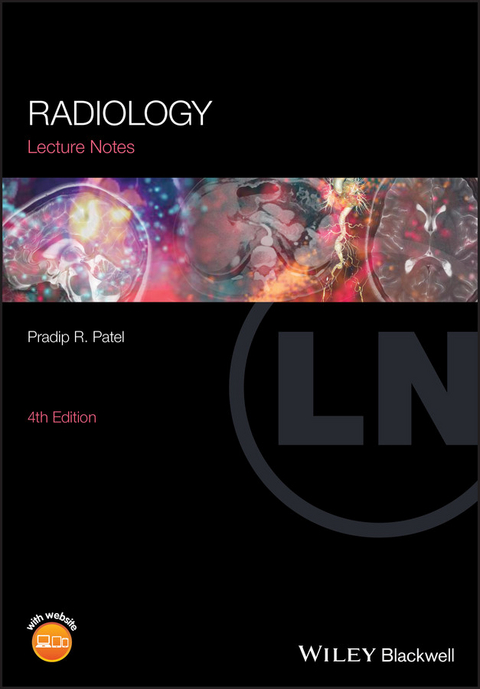
Radiology Lecture Notes is a succinct yet thorough introduction to the essential imaging techniques used in various clinical situations. This fully revised and updated new edition presents the fundamental core knowledge of film interpretation, specialised radiological investigations, and procedures for imaging specific problems. The book explores common diseases and disorders complemented by good quality radiology images and full-colour illustrations. Concise chapters, organised by body systems cover investigations of the respiratory and gastrointestinal tracts, the cardiovascular and musculoskeletal systems, the liver and pancreas, and many others.
Now in its fourth edition, this market-leading guide has been updated to reflect current practices and technologies in the field, featuring new up-to-date content on Computed Tomography (CT) and Magnetic Resonance Imaging (MRI). This practical guide:
- Provides a basic foundation in the principles and techniques of radiology
- Offers new content, including up-to-date CT, MRI and nuclear medicine images
- Features bulleted lists, 'Key Points' boxes, and 'Radiological Investigations' sections throughout the text
Radiology Lecture Notes is an ideal study and revision guide for medical students and junior doctors, and will be a useful aid for specialist nurses, radiographers, and radiology department staff.
Pradip R. Patel is a Consultant Radiologist at Kingston Hospital, London, UK.
Radiology Lecture Notes is a succinct yet thorough introduction to the essential imaging techniques used in various clinical situations. This fully revised and updated new edition presents the fundamental core knowledge of film interpretation, specialised radiological investigations, and procedures for imaging specific problems. The book explores common diseases and disorders complemented by good quality radiology images and full-colour illustrations. Concise chapters, organised by body systems cover investigations of the respiratory and gastrointestinal tracts, the cardiovascular and musculoskeletal systems, the liver and pancreas, and many others. Now in its fourth edition, this market-leading guide has been updated to reflect current practices and technologies in the field, featuring new up-to-date content on Computed Tomography (CT) and Magnetic Resonance Imaging (MRI). This practical guide: Provides a basic foundation in the principles and techniques of radiology Offers new content, including up-to-date CT, MRI and nuclear medicine images Features bulleted lists, Key Points boxes, and Radiological Investigations sections throughout the text Radiology Lecture Notes is an ideal study and revision guide for medical students and junior doctors, and will be a useful aid for specialist nurses, radiographers, and radiology department staff.
Pradip R. Patel is a Consultant Radiologist at Kingston Hospital, London, UK.
List of contributors vii
About the companion website ix
1 Introduction 1
2 Respiratory tract 19
3 Cardiovascular system 47
4 Gastrointestinal tract 65
5 Liver and pancreas 93
6 Urinary tract 113
7 Musculoskeletal system 139
8 Trauma 161
9 Paediatrics 177
10 Obstetrics and gynaecology 187
11 Neuroradiology 199
12 Specific radiological investigations 221
13 Image viewing hints 225
Index 229
1
Introduction
Recent technological advances have produced a bewildering array of complex imaging techniques and procedures. The basic principle of imaging, however, remains the anatomical demonstration of a particular region and related abnormalities, the principal imaging modalities being:
- plain X‐rays: utilizes a collimated X‐ray beam to image the chest, abdomen, skeletal structures, etc.;
- fluoroscopy: a continuous X‐ray beam produces a moving image to monitor examinations such as barium meals, barium enemas, etc.;
- ultrasound (US): employs high‐frequency sound waves to visualize structures in the abdomen, pelvis, neck and peripheral soft tissues;
- computed tomography (CT): obtains cross‐sectional computerized densities and images from an X‐ray beam/detector system;
- magnetic resonance imaging (MRI): exploits the magnetic properties of hydrogen atoms in the body to produce images;
- nuclear medicine (NM): acquires functional as well as anatomical details by gamma radiation detection from injected radioisotopes.
Contrast media
Contrast agents are substances that assist visualization of some structures during the above techniques, working on the basic principle of X‐ray absorption, thereby preventing their transmission through the patient. The most commonly used are barium sulphate to outline the gastrointestinal tract, and organic iodine preparations; the latter widely used intravenously in CT for vascular and organ enhancement. Contrast agents can also be introduced into specific sites, for example:
- arteriography: the arterial system;
- venography: the venous system;
- myelography: spinal theca;
- cholangiography: the biliary system;
- hysterosalpingography: uterus;
- arthrography: joints;
- sialography: salivary glands.
The possibility of an allergic reaction exists with iodinated contrast media, an increased risk noted in those with a history of allergy, bronchospasm and cardiac disease, as well as in the elderly, neonates, diabetics or patients with multiple myeloma.
- Minor reactions: nausea, vomiting, urticarial rash, headache.
- Intermediate reactions: hypotension, bronchospasm.
- Major reactions: convulsions, pulmonary oedema, cardiac arrhythmias, cardiac arrest.
Drug therapy should be readily available to treat reactions, for example:
- urticaria: chlorphenamine or other antihistamines;
- pulmonary oedema: furosemide i.v.;
- convulsions: diazepam i.v.;
- bronchospasm: hydrocortisone i.v. and bronchodilators such as salbutamol;
- anaphylactic reactions: adrenaline s.c. or i.v.
Radiation protection
All individuals receive natural background radiation but diagnostic tests now account for the largest source of exposure and every effort at reduction must be made. Although ionizing radiation is deemed to be potentially hazardous, the risks should be weighed in the context of benefits to the patient.
- Doses should be kept to a minimum and a radiological investigation performed only if management is going to be affected. Consideration should be given to the radiation dose to the patient for each specific investigation. CT, barium and radionuclide studies are high‐dose examinations, whereas plain films of the extremities and chest X‐rays are typically low dose.
- The fetus is particularly sensitive, especially in the first trimester with possible induction of carcinogenesis or fetal malformation. A menstrual history obtained in a woman of reproductive age, and if necessary a pregnancy test, will prevent accidental fetal exposure to radiation.
- Clear requests to the radiology department, with relevant clinical details, aids in the selection of the most appropriate views or investigations.
- Discussion of complex cases with a radiologist may help in choosing the most relevant study or examination.
- Unnecessary examinations should be avoided, for example repeat chest X‐rays for resolution of pneumonic consolidation at less than weekly intervals, or preoperative chest X‐rays in young patients.
- Ultrasound and MRI, because of the lack of ionizing radiation, are the preferred imaging modalities where clinically indicated.
Figure 1.1 Basic principles of plain films and fluoroscopy.
Figure 1.2 Digital plain film and fluoroscopy equipment.
Plain films and fluoroscopy
Conventional radiography
X‐rays are part of the electromagnetic spectrum, emitted as a result of bombardment of a tungsten anode by free electrons from a cathode. Hard copy plain films are produced by their passage through the patient and exposing a radiographic film.
Bone absorbs most radiation, causing least film exposure, thus the developed film appears white. Air absorbs least radiation, causing maximum film exposure, so the film appears black. Between these two extremes a large differential tissue absorption results in a grey‐scale image. The majority of plain films are now performed with digital radiography and conventional plain films are infrequently used.
Digital radiography
In digital radiography, the basic principles are the same but a digital screen replaces the X‐ray film. The tissue absorption characteristics are computer analysed and the image is visualized on a monitor. CT, MRI and ultrasound are already available in digital format; with the rapid introduction of digital plain‐film radiography, radiological departments are now filmless (picture archival and communication system, PACS). The principal advantages of digital radiography are:
- significant reduction in radiation exposure;
- digital enhancement ensures all images are of an adequate quality;
- transfer of images out of the radiology department to other sites;
- elimination of storage problems associated with conventional films;
- no hard copy films;
- rapid retrieval of previous images and reports for comparison;
- ease of availability of examinations to clinicians.
Plain film images are particularly useful for:
- chest;
- abdomen;
- skeletal system: trauma, spine, joints, degenerative, metabolic and metastatic disease.
Fluoroscopy/screening
Fluoroscopy is the term used when a continuous low‐power X‐ray beam is passed through the patient to produce a dynamic image that can be viewed on a monitor. Many different procedures, such as barium studies of the gastrointestinal tract, arteriography and interventional procedures, are monitored and carried out with the aid of fluoroscopy.
Ultrasound
Ultrasound employs high‐frequency sound waves, produced by a piezo‐electric crystal in a transducer. The waves travel through the body, and are reflected back variably, depending on the different types of tissue encountered. The same transducer, as well as transmitting ultrasound, receives the reflected sound and converts the signal into an electric current; this is subsequently processed into a grey‐scale picture. A moving image is obtained as the transducer is advanced across the body (real‐time ultrasound). Sections can be obtained in any plane and viewed on a monitor. Bone and air are poor conductors of sound, thus there may be inadequate visualization, whereas fluid has excellent transmission properties.
Figure 1.3 Basic principles of ultrasound.
Doppler ultrasound
Doppler ultrasound is a technique to examine moving structures in the body. Blood flow velocities are measured using the principle of a shift in reflected sound frequency produced from moving structures. It is utilized for:
- assessment of cardiac chambers and heart valves;
- arterial flow studies, especially carotids and peripheral vascular disease;
- venous flow studies for detection of deep vein thrombosis.
Figure 1.4 Ultrasound machine with differing frequency probes ranging from 5–20 MHz. Specialist ones include transvaginal, transrectal and musculoskeletal probes.
Uses
- Brain: Imaging the neonatal brain.
- Thorax: Confirms pleural effusions and pleural masses.
- Abdomen: Visualizes liver, gallbladder, pancreas, kidneys, etc.
- Pelvis: Useful for monitoring pregnancy, uterus and ovaries.
- Peripheral: Assesses thyroid, testes and soft‐tissue lesions.
Advantages
- Relatively low cost of equipment.
- Non‐ionizing and safe.
- Scanning can be performed in any plane.
- Can be repeated frequently, for example pregnancy follow‐up.
- Detection of blood flow, cardiac and fetal movement.
- Portable equipment can be taken to the bedside for ill patients.
- Aids biopsy and drainage procedures.
Disadvantages
- Operator dependent.
- Inability of sound to cross an interface with either gas or bone causes unsatisfactory...
| Erscheint lt. Verlag | 3.6.2020 |
|---|---|
| Reihe/Serie | Lecture Notes |
| Lecture Notes | Lecture Notes |
| Sprache | englisch |
| Themenwelt | Medizin / Pharmazie ► Gesundheitsfachberufe ► MTA - Radiologie |
| Medizinische Fachgebiete ► Radiologie / Bildgebende Verfahren ► Radiologie | |
| Schlagworte | Interventional Radiology • Invasive Radiologie • <p>radiology guide • Medical Science • Medical Specialty Education • Medizin • Medizinstudium • Medizinstudium / Einzelne Fächer • Radiological imaging • radiological investigations • radiological techniques</p> • Radiologie • Radiologie u. Bildgebende Verfahren • Radiology & Imaging • radiology basics • radiology fundamentals • radiology introduction • radiology medical students • radiology principles • radiology revision • radiology study |
| ISBN-10 | 1-119-55037-8 / 1119550378 |
| ISBN-13 | 978-1-119-55037-2 / 9781119550372 |
| Informationen gemäß Produktsicherheitsverordnung (GPSR) | |
| Haben Sie eine Frage zum Produkt? |
 EPUB (Adobe DRM)
Kopierschutz: Adobe-DRM
Adobe-DRM ist ein Kopierschutz, der das eBook vor Mißbrauch schützen soll. Dabei wird das eBook bereits beim Download auf Ihre persönliche Adobe-ID autorisiert. Lesen können Sie das eBook dann nur auf den Geräten, welche ebenfalls auf Ihre Adobe-ID registriert sind.
Details zum Adobe-DRM
Dateiformat: EPUB (Electronic Publication)
EPUB ist ein offener Standard für eBooks und eignet sich besonders zur Darstellung von Belletristik und Sachbüchern. Der Fließtext wird dynamisch an die Display- und Schriftgröße angepasst. Auch für mobile Lesegeräte ist EPUB daher gut geeignet.
Systemvoraussetzungen:
PC/Mac: Mit einem PC oder Mac können Sie dieses eBook lesen. Sie benötigen eine
eReader: Dieses eBook kann mit (fast) allen eBook-Readern gelesen werden. Mit dem amazon-Kindle ist es aber nicht kompatibel.
Smartphone/Tablet: Egal ob Apple oder Android, dieses eBook können Sie lesen. Sie benötigen eine
Geräteliste und zusätzliche Hinweise
Buying eBooks from abroad
For tax law reasons we can sell eBooks just within Germany and Switzerland. Regrettably we cannot fulfill eBook-orders from other countries.
aus dem Bereich