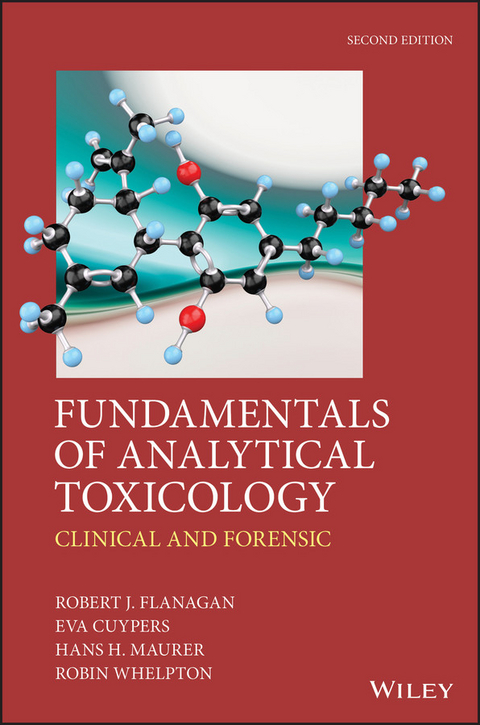
Fundamentals of Analytical Toxicology (eBook)
John Wiley & Sons (Verlag)
978-1-119-12237-1 (ISBN)
Fundamentals of Analytical Toxicology is an integrated introduction to the analysis of drugs, poisons, and other foreign compounds in biological and related specimens. Assuming only basic knowledge of analytical chemistry, this invaluable guide helps trainee analytical toxicologists understand the principles and practical skills involved in detecting, identifying, and measuring a broad range of compounds in various biological samples. Clear, easy-to-read chapters provide detailed information on topics including sample collection and preparation, spectrophotometric and luminescence techniques, liquid and gas-liquid chromatography, and mass spectrometry including hyphenated techniques.
This new edition contains thoroughly revised content that reflects contemporary practices and advances in analytical methods. Expanding the scope of the 1995 World Health Organization (WHO) basic analytical toxicology manual, the text includes coverage of separation science, essential pharmacokinetics, xenobiotic absorption, distribution and metabolism, clinical toxicological and substance misuse testing, therapeutic drug monitoring, trace elements and toxic metals analysis, and importantly the clinical interpretation of analytical results.
Written by a prominent team of experienced practitioners, this volume:- Focuses on analytical, statistical, and pharmacokinetic principles
- Describes basic methodology, including colour tests and immunoassay and enzyme-based assays
- Outlines laboratory operations, such as method validation, quality assessment, staff training, and laboratory accreditation
- Follows IUPAC nomenclature for chemical names and recommended International Non-proprietary Name (rINN) for drugs and pesticides
- Includes discussion of 'designer drugs' (novel pharmaceutical substances NPS)
Fundamentals of Analytical Toxicology: Clinical and Forensic, 2nd Edition is an indispensable resource for advanced students and trainee analytical toxicologists across disciplines, such as clinical science, analytical chemistry, forensic science, pathology, applied biology, food safety, and pharmaceutical and pesticide development.
Robert J Flanagan, Precision Medicine, King's College Hospital NHS Foundation Trust, UK, and Specialised Clinical Chemistry, Sheffield Teaching Hospitals NHS Foundation Trust, UK.
EVA CUYPERS, Maastricht Multimodal Molecular Imaging Institute, University of Maastricht, The Netherlands, and KU Leuven Toxicology and Pharmacology, Belgium.
HANS H. MAURER, Department of Experimental and Clinical Toxicology, Saarland University, Germany.
ROBIN WHELPTON, Formerly School of Biological and Chemical Sciences, Queen Mary University of London, UK.
Fundamentals of Analytical Toxicology is an integrated introduction to the analysis of drugs, poisons, and other foreign compounds in biological and related specimens. Assuming only basic knowledge of analytical chemistry, this invaluable guide helps trainee analytical toxicologists understand the principles and practical skills involved in detecting, identifying, and measuring a broad range of compounds in various biological samples. Clear, easy-to-read chapters provide detailed information on topics including sample collection and preparation, spectrophotometric and luminescence techniques, liquid and gas-liquid chromatography, and mass spectrometry including hyphenated techniques. This new edition contains thoroughly revised content that reflects contemporary practices and advances in analytical methods. Expanding the scope of the 1995 World Health Organization (WHO) basic analytical toxicology manual, the text includes coverage of separation science, essential pharmacokinetics, xenobiotic absorption, distribution and metabolism, clinical toxicological and substance misuse testing, therapeutic drug monitoring, trace elements and toxic metals analysis, and importantly the clinical interpretation of analytical results. Written by a prominent team of experienced practitioners, this volume: Focuses on analytical, statistical, and pharmacokinetic principles Describes basic methodology, including colour tests and immunoassay and enzyme-based assays Outlines laboratory operations, such as method validation, quality assessment, staff training, and laboratory accreditation Follows IUPAC nomenclature for chemical names and recommended International Non-proprietary Name (rINN) for drugs and pesticides Includes discussion of 'designer drugs' (novel pharmaceutical substances NPS) Fundamentals of Analytical Toxicology: Clinical and Forensic, 2nd Edition is an indispensable resource for advanced students and trainee analytical toxicologists across disciplines, such as clinical science, analytical chemistry, forensic science, pathology, applied biology, food safety, and pharmaceutical and pesticide development.
Robert J Flanagan, Precision Medicine, King's College Hospital NHS Foundation Trust, UK, and Specialised Clinical Chemistry, Sheffield Teaching Hospitals NHS Foundation Trust, UK. EVA CUYPERS, Maastricht Multimodal Molecular Imaging Institute, University of Maastricht, The Netherlands, and KU Leuven Toxicology and Pharmacology, Belgium. HANS H. MAURER, Department of Experimental and Clinical Toxicology, Saarland University, Germany. ROBIN WHELPTON, Formerly School of Biological and Chemical Sciences, Queen Mary University of London, UK.
List of Abbreviations
| AA | atomic absorption |
| AACC | American Association for Clinical Chemistry |
| AAFS | American Academy of Forensic Sciences |
| AAG | α1-acid glycoprotein (also AGP) |
| AAS | atomic absorption spectrometry |
| ABC | ATP-binding cassette (transporter) |
| ABPR | automated back-pressure regulator |
| ABTS | 2,2′-azino-bis(3-ethylbenzthiazoline-6-sulfonic acid) |
| AC | alternating current |
| ACB | Association for Clinical Biochemistry and Laboratory Medicine (UK) |
| ACCT | American Academy of Clinical Toxicology |
| ACEI | angiotensinogen-converting enzyme inhibitor |
| ACGIH | American Conference of Governmental Industrial Hygienists |
| AChE | acetylcholinesterase |
| ACOT | acyl-CoA-thioesterase |
| ACT | low-range activated coagulation time |
| ADH | alcohol dehydrogenase |
| ADHD | attention deficit hyperactivity disorder |
| ADME | absorption, distribution, metabolism, and excretion |
| AED | atomic emission detector/detection |
| AES | atomic emission spectroscopy |
| AFID | alkali-flame ionization detector/detection |
| AFS | atomic fluorescence |
| AHFS | American Hospital Formulary Service |
| 2-AI | 2-aminoindane |
| AIC | Akaike information criterion |
| AIDS | acquired immunodeficiency syndrome |
| ALDH | aldehyde dehydrogenase |
| 6-AM | 6-acetylmorphine |
| AMC | Analytical Methods Committee |
| AMDIS | Automated Mass Spectral Deconvolution and Identification System |
| AMS | ambient mass spectrometry |
| ANOVA | analysis of variance |
| AOX | aldehyde oxidase |
| APCI | atmospheric pressure chemical ionization |
| APDC | ammonium pyrrolidine dithiocarbamate |
| API | atmospheric pressure ionization |
| APPI | atmospheric pressure photoionization |
| aps | average particle size |
| AR | analytical reagent |
| ASE | accelerated solvent extraction |
| ASV | anodic stripping voltammetry |
| ATCA | 2-aminothiazoline-4-carboxylic acid |
| ATP | adenosine triphosphate |
| ATR | attenuated total reflection |
| AUC | area under plasma concentration–time curve |
| AV | assigned value |
| BAC | blood alcohol concentration |
| BAN | British Approved Name |
| BBB | blood brain barrier |
| BC | background correction |
| BCRP | breast cancer resistance protein |
| BCSFB | blood–CSF barrier |
| 1,4-BD | 1,4-butanediol |
| BDZ | benzodiazepine |
| BE | benzoylecgonine |
| BEH | bridged ethylsiloxane/silica hybrid |
| BEI | biological exposure index |
| BGE | background electrolyte |
| BHO | butane hash (honey) oil |
| BLT | Toxicological Society of Belgium and Luxembourg |
| BMDMCS | bromomethyldimethyldichlorosilane |
| BP | British Pharmacopoeia |
| BPR | back-pressure regulator |
| BrAC | breath alcohol concentration |
| BRB | blood–retinal barrier |
| BSA | bovine serum albumin |
| BSTFA | N,O-bis(trimethylsilyltrifluoro)acetamide |
| BZP | benzylpiperazine |
| CAD | charged aerosol detector/detection |
| CAS | Chemical Abstracts Service |
| 2C-B | 2,5-dimethoxy-4-bromophenethylamine |
| CBD | cannabidiol |
| CBQCA | 3-(4-carboxybenzoyl)quinoline-2-carboxaldehyde |
| CCD | charge coupled device |
| CCS | collision cross-section |
| CD | circular dichroism |
| CD | cyclodextrin |
| CDER | Center for Drug Evaluation and Research |
| CDM | concentration dependant model |
| CDT | carbohydrate deficient transferrin |
| CE | capillary electrophoresis |
| CEA | chiral eluent additive |
| CEC | capillary electrochromatography |
| CECF | 1-chloroethyl chloroformate |
| CEDIA | cloned enzyme donor immunoassay |
| CER | charge exchange reaction |
| CGE | capillary gel electrophoresis |
| ChE | cholinesterase |
| 4-CHFB | 4-carboxyhexafluorobutyryl |
| 2C-I | 2,5-dimethoxy-4-iodophenethylamine |
| CI | confidence interval |
| CID | collision-induced dissociation |
| CIEF | capillary isoelectric focusing |
| CIP | Cahn–Ingold–Prelog |
| CITP | capillary isotachophoresis |
| CJD | Creutzfeldt–Jakob Disease |
| CL | plasma (whole body) clearance |
| CLEC | chiral ligand exchange chromatography |
| CLD | chemiluminescence detector/detection |
| CLIA | chemiluminescent immunoassay |
| CLND | chemiluminescent nitrogen detector/detection |
| CLSI | Clinical and Laboratory Standards Institute |
| CMC | critical micellar concentration |
| CMDMCS | chloromethyldimethyldichlorosilane |
| CMIA | chemiluminescent magnetic immunoassay |
| CML | chronic myeloid leukaemia |
| CNLSD | condensation nucleation light scattering detector/detection |
| CNS | central nervous system |
| COHb | carboxyhaemoglobin |
| COMT | catechol O-methyl transferase |
| CoR | coefficient of repeatability |
| 2C-P | 2,5-dimethoxy-4-propylphenethylamine |
| CPD | continuing professional development |
| CPHP | 4-(4-chlorophenyl)-4-hydroxypiperidine |
| CPP | chlorophenylpiperazine |
| CPR | chlorophenol red |
| CR | cross reactivity |
| CSF | cerebrospinal fluid |
| CSL | Commonwealth Serum Laboratories |
| CSP | chiral stationary phase |
| CSV | cathodic stripping voltammetry |
| CT | computerized tomography/tomographic |
| CV | coefficient of variation (relative standard deviation, RSD) |
| 2C-X | 2,5-dimethoxy substituted phenylethylamines |
| CYP | cytochrome |
| 2,4-D | 2,4-dichlorophenoxyacetic acid |
| DAD | diode-array detector/detection |
| DART | direct analysis in real time |
| 2,4-DB | 4-(2,4-dichlorophenoxy)butyric... |
| Erscheint lt. Verlag | 27.5.2020 |
|---|---|
| Sprache | englisch |
| Themenwelt | Studium ► 2. Studienabschnitt (Klinik) ► Pharmakologie / Toxikologie |
| Naturwissenschaften ► Chemie ► Analytische Chemie | |
| Recht / Steuern ► Strafrecht ► Kriminologie | |
| Sozialwissenschaften | |
| Schlagworte | Analytical Chemistry • Analytical toxicology • analytical toxicology introduction • analytical toxicology textbook • Analytische Chemie • Chemie • Chemistry • Clinical toxicology • Gas Chromatography • gas-liquid-chromatography • Liquid chromatography • Mass Spectrometry • Medical Science • Medizin • Pharmacokinetics • Pharmacology & Pharmaceutical Medicine • Pharmakologie • Pharmakologie u. Pharmazeutische Medizin • separation science • substance misuse testing • Therapeutic drug monitoring • Toxicology • Toxikologie • trace elements/toxic metals analysis |
| ISBN-10 | 1-119-12237-6 / 1119122376 |
| ISBN-13 | 978-1-119-12237-1 / 9781119122371 |
| Informationen gemäß Produktsicherheitsverordnung (GPSR) | |
| Haben Sie eine Frage zum Produkt? |
 EPUB (Adobe DRM)
Kopierschutz: Adobe-DRM
Adobe-DRM ist ein Kopierschutz, der das eBook vor Mißbrauch schützen soll. Dabei wird das eBook bereits beim Download auf Ihre persönliche Adobe-ID autorisiert. Lesen können Sie das eBook dann nur auf den Geräten, welche ebenfalls auf Ihre Adobe-ID registriert sind.
Details zum Adobe-DRM
Dateiformat: EPUB (Electronic Publication)
EPUB ist ein offener Standard für eBooks und eignet sich besonders zur Darstellung von Belletristik und Sachbüchern. Der Fließtext wird dynamisch an die Display- und Schriftgröße angepasst. Auch für mobile Lesegeräte ist EPUB daher gut geeignet.
Systemvoraussetzungen:
PC/Mac: Mit einem PC oder Mac können Sie dieses eBook lesen. Sie benötigen eine
eReader: Dieses eBook kann mit (fast) allen eBook-Readern gelesen werden. Mit dem amazon-Kindle ist es aber nicht kompatibel.
Smartphone/Tablet: Egal ob Apple oder Android, dieses eBook können Sie lesen. Sie benötigen eine
Geräteliste und zusätzliche Hinweise
Buying eBooks from abroad
For tax law reasons we can sell eBooks just within Germany and Switzerland. Regrettably we cannot fulfill eBook-orders from other countries.
aus dem Bereich