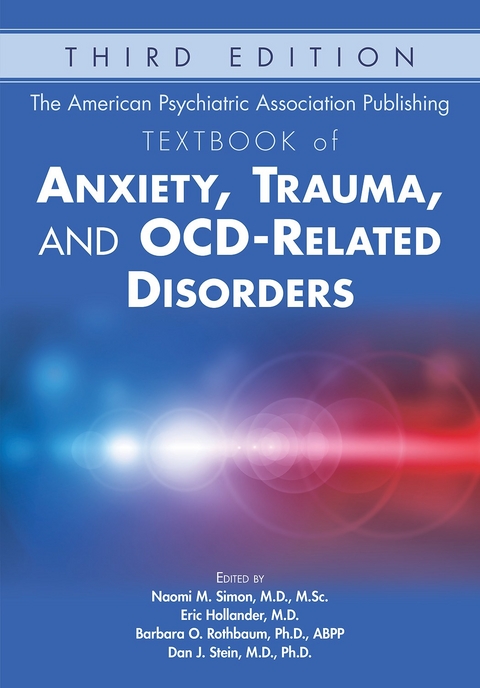
The American Psychiatric Association Publishing Textbook of Anxiety, Trauma, and OCD-Related Disorders (eBook)
754 Seiten
American Psychiatric Publishing (Verlag)
978-1-61537-292-8 (ISBN)
Designed for clinicians at every level, this book addresses the origin, assessment, diagnosis, and treatment of these disorders in a comprehensive, up-to-date, and compelling manner. Following a comprehensive overview of core principles, the book provides detailed coverage of specific DSM-5 diagnoses: generalized anxiety disorder, obsessive-compulsive and related disorders, panic disorder and agoraphobia, social anxiety disorder, specific phobia, and trauma- and stressor-related disorders.
Designed for clinicians at every level, The American Psychiatric Association Publishing Textbook of Anxiety, Trauma, and OCD-Related Disorders addresses the origin, assessment, diagnosis, and treatment of these disorders in a comprehensive, up-to-date, and compelling manner. Fresh voices are everywhere in this authoritative revision of the classic text, as more than 60% of the contributors are new. They join stalwarts from the previous edition -- experts who bring stellar credentials and a discerning eye to the task of revising the text to reflect cutting-edge scholarship and evidence-based clinical knowledge. Following a comprehensive overview of core principles, the book provides detailed coverage of specific DSM-5 diagnoses: generalized anxiety disorder, obsessive-compulsive and related disorders, panic disorder and agoraphobia, social anxiety disorder, specific phobia, and trauma- and stressor-related disorders. Each section presents the latest thinking on phenomenology and pathogenesis, then provides evidence-based clinical recommendations for pharmacotherapy and psychotherapy.
New and noteworthy material includes the following: Two new chapters focus on the features, phenomenology, and course of acute and integrated grief, as well as the epidemiology, clinical features, evaluation, and pathophysiology of complicated grief (CG), which affects a significant minority. Proper treatment of CG is critical, because once it persists beyond 6 months, impairment may last for years, if not a lifetime. Accordingly, a separate chapter is devoted to treatment options, including a hybrid of cognitive-behavioral, interpersonal, motivational interviewing, and psychodynamic methods. The Unified Protocol (UP) for Transdiagnostic Treatment of Emotional Disorders is examined in a fascinating new chapter. The UP is a promising treatment with empirical support for reduction of both symptoms and higher-order temperamental changes, such as changes in neuroticism, an underlying mechanism associated with onset and maintenance of emotional disorders. The chapter on anxiety disorders in late life is completely new and emphasizes the prevalence of anxiety in this population and its likelihood of remaining undetected and untreated. The epidemiology, diagnosis, and treatment of these disorders are examined in detail so that the reader will recognize the clinical features, be able to differentiate them from depression, and can identify appropriate treatment, whether pharmacological or psychotherapeutic. Each chapter features a concise list of key clinical points to help the reader focus on the most important material for study, as well as a list of recommended reading for those who wish to learn more.
Grounded in the latest research, clinically rich, and pedagogically strong, The American Psychiatric Association Publishing Textbook of Anxiety, Trauma, and OCD-Related Disorders is the go-to text for mental health clinicians looking for evidence-based knowledge and support.
Naomi M. Simon, M.D., M.Sc., is Professor of Psychiatry at New York University School of Medicine and Director of the Anxiety and Complicated Grief Program in the Department of Psychiatry at NYU Langone Health in New York, New York.
Eric Hollander, M.D., is Professor of Psychiatry and Behavioral Sciences at the Albert Einstein College of Medicine and Director of the Autism and Obsessive Compulsive Spectrum Program and the Anxiety and Depression Program at Montefiore Medical Center and the Albert Einstein College of Medicine, New York.
Barbara O. Rothbaum, Ph.D., A.B.P.P, is Professor of Psychiatry and Behavioral Sciences at Emory University School of Medicine in Atlanta, Georgia.
Dan J. Stein, M.D., is Professor and Chair of the Department of Psychiatry and Mental Health at the University of Cape Town, South Africa, Director of the South African Medical Research Council's Unit on Anxiety and Stress Disorders, and Visiting Professor at Mt. Sinai Medical School in New York.
Part 1. Approaching Anxiety DisordersChapter 1. Anxiety and Related DisordersChapter 2. Genetic Contributions to Anxiety DisordersChapter 3. Neural Circuits in Fear and AnxietyChapter 4. Cultural and Social AspectsChapter 5. Economic and Social BurdenPart 2. Core Principles for Treating Anxiety DisordersChapter 6. Cognitive-Behavioral Concepts Chapter 7. Psychodynamic Concepts and Treatment Chapter 8. Unified ProtocolChapter 9. Combined Treatment Chapter 10. Core Principles in Pharmacotherapy Part 3. Generalized Anxiety DisorderChapter 11. Phenomenology of GADChapter 12. Pathogenesis of GADChapter 13. Pharmacotherapy for GADChapter 14. Psychotherapy for GADPart 4. Obsessive-Compulsive Disorder/Related DisordersChapter 15. Phenomenology of OCDChapter 16. Pathophysiology of OCDsChapter 17. Pharmacotherapy for OCDChapter 18. Psychological Treatment for OCDChapter 19. Obsessive-Compulsive Spectrum Part 5. Panic Disorder and AgoraphobiaChapter 20. Phenomenology of PanicChapter 21. Pathogenesis of PanicChapter 22. Pharmacotherapy for PanicChapter 23. Psychotherapy for PanicPart 6. Social Anxiety Disorder (Social Phobia)Chapter 24. Phenomenology of Social AnxietyChapter 25. Pathogenesis of Social AnxietyChapter 26. Pharmacotherapy for Social AnxietyChapter 27. Psychotherapy for Social AnxietyPart 7. Specific PhobiaChapter 28. Specific PhobiaPart 8. Trauma- and Stressor-Related DisordersChapter 29. Phenomenology of PTSDChapter 30. Pathogenesis of PTSD and Acute Stress DisorderChapter 31. Pharmacotherapy for PTSDChapter 32. Psychotherapy for PTSDChapter 33. Phenomenology of Persistent GriefChapter 34. Treatment of Persistent GriefPart 9. Anxiety Disorders and ComorbidityChapter 35. Mixed Anxiety-Depressive DisorderChapter 36. Anxiety in Substance Use DisordersChapter 37. Anxiety Disorders in Medical SettingsChapter 38. Anxiety and InsomniaPart 10. Anxiety Disorders in Special PopulationsChapter 39. Childhood Anxiety Chapter 40. Anxiety in Late LifeIndex
| Erscheint lt. Verlag | 2.4.2020 |
|---|---|
| Zusatzinfo | 17 figures, 86 tables |
| Verlagsort | Washington |
| Sprache | englisch |
| Maße | 180 x 180 mm |
| Themenwelt | Medizin / Pharmazie ► Gesundheitsfachberufe |
| Medizin / Pharmazie ► Medizinische Fachgebiete ► Psychiatrie / Psychotherapie | |
| ISBN-10 | 1-61537-292-X / 161537292X |
| ISBN-13 | 978-1-61537-292-8 / 9781615372928 |
| Informationen gemäß Produktsicherheitsverordnung (GPSR) | |
| Haben Sie eine Frage zum Produkt? |
 EPUB (Adobe DRM)
Kopierschutz: Adobe-DRM
Adobe-DRM ist ein Kopierschutz, der das eBook vor Mißbrauch schützen soll. Dabei wird das eBook bereits beim Download auf Ihre persönliche Adobe-ID autorisiert. Lesen können Sie das eBook dann nur auf den Geräten, welche ebenfalls auf Ihre Adobe-ID registriert sind.
Details zum Adobe-DRM
Dateiformat: EPUB (Electronic Publication)
EPUB ist ein offener Standard für eBooks und eignet sich besonders zur Darstellung von Belletristik und Sachbüchern. Der Fließtext wird dynamisch an die Display- und Schriftgröße angepasst. Auch für mobile Lesegeräte ist EPUB daher gut geeignet.
Systemvoraussetzungen:
PC/Mac: Mit einem PC oder Mac können Sie dieses eBook lesen. Sie benötigen eine
eReader: Dieses eBook kann mit (fast) allen eBook-Readern gelesen werden. Mit dem amazon-Kindle ist es aber nicht kompatibel.
Smartphone/Tablet: Egal ob Apple oder Android, dieses eBook können Sie lesen. Sie benötigen eine
Geräteliste und zusätzliche Hinweise
Buying eBooks from abroad
For tax law reasons we can sell eBooks just within Germany and Switzerland. Regrettably we cannot fulfill eBook-orders from other countries.
aus dem Bereich