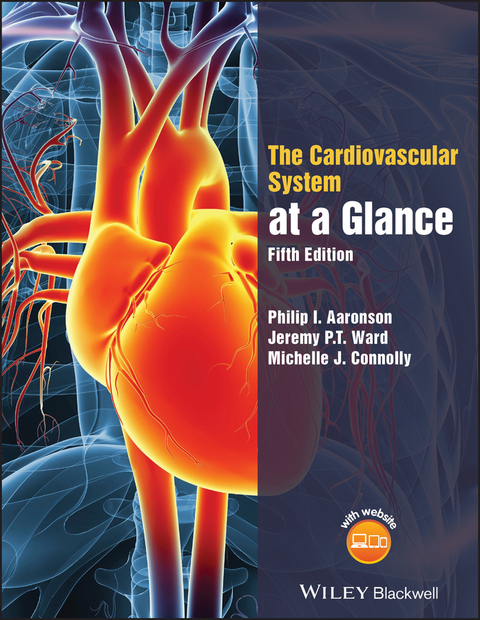
The Cardiovascular System at a Glance (eBook)
John Wiley & Sons (Verlag)
978-1-119-24576-6 (ISBN)
Everything you need to know about the cardiovascular system... at a Glance!
The Cardiovascular System at a Glance is the essential reference guide to understanding all things circulatory. Concise, accessible, and highly illustrated, this latest edition presents an integrated overview of the subject, from the basics through to application. Featuring brand new content on stroke, examination and imaging, heart block and ECGs, and myopathies and channelopathies, The Cardiovascular System at a Glance goes one step further and offers new and updated clinical case studies and multiple-choice questions on a supplementary website.
- Integrates basic science and clinical topics
- Offers bite-size chapters that make topics easy to digest
- Includes coverage of anatomy and histology, blood and haemostasis, cellular physiology, form and function, regulation and integration of cardiovascular function, history, examination and investigations, pathology and therapeutics
- Filled with highly visual, colour illustrations that enhance the text and help reinforce learning
The fifth edition of The Cardiovascular System at a Glance is an ideal resource for medical students, junior doctors, students of other health professions, and specialist cardiology nurses.
Philip I. Aaronson, BA, PhD is Reader in Pharmacology and Therapeutics at King's College, London.
Jeremy P. T. Ward, BSc, PhD, FPhysiol is Emeritus Professor of Physiology at King's College, London.
Michelle J. Connolly, BSc, MBBS, PhD, MRCP is a ST6 Interventional Cardiology Fellow, St George's Hospital, London.
Philip I. Aaronson, BA, PhD is Reader in Pharmacology and Therapeutics at King's College, London. Jeremy P. T. Ward, BSc, PhD, FPhysiol is Emeritus Professor of Physiology at King's College, London. Michelle J. Connolly, BSc, MBBS, PhD, MRCP is a ST6 Interventional Cardiology Fellow, St George's Hospital, London.
Preface vii
Recommended reading viii
Sources of illustrations ix
Acknowledgements x
List of abbreviations xi
About the companion website xiii
Introduction 1
1 Overview of the cardiovascular system 2
Anatomy and histology 5
2 Gross anatomy and histology of the heart 6
3 Vascular anatomy 8
4 Vascular histology and smooth muscle cell ultrastructure 10
Blood and body fluids 13
5 Constituents of blood 14
6 Erythropoiesis, haemoglobin and anaemia 16
7 Haemostasis 18
8 Thrombosis and anticoagulants 20
9 Blood groups and transfusions 22
Cellular physiology 25
10 Membrane potential, ion channels and pumps 26
11 Electrophysiology of cardiac muscle and origin of the heartbeat 28
12 Cardiac muscle excitation-contraction coupling 30
13 Electrical conduction system in the heart 32
14 The electrocardiogram 34
15 Vascular smooth muscle excitation-contraction coupling 36
Form and function 39
16 Cardiac cycle 40
17 Control of cardiac output 42
18 Haemodynamics 44
19 Blood pressure and flow in the arteries and arterioles 46
20 The microcirculation and lymphatic system and diapedesis 48
21 Fluid filtration in the microcirculation 50
22 The venous system 52
23 Local control of blood flow 54
24 Regulation of the vasculature by the endothelium 56
25 The pulmonary, skeletal muscle and fetal circulations 58
26 The coronary, cutaneous and cerebral circulations 60
Integration and regulation 63
27 Cardiovascular reflexes 64
28 Autonomic control of the cardiovascular system 66
29 The control of blood volume 68
30 Cardiovascular effects of exercise 70
31 Shock and haemorrhage 72
History, examination and investigations 75
32 History and examination of the cardiovascular system 76
33 Cardiac imaging 78
Pathology and therapeutics 81
34 Risk factors for cardiovascular disease 82
35 beta-blockers, angiotensin-converting enzyme inhibitors, angiotensin receptor blockers and Ca¯2+ channel blockers 84
36 Hyperlipidaemias 86
37 Atherosclerosis 88
38 Mechanisms of primary hypertension 90
39 Treatment of hypertension 92
40 Stable, microvascular, and vasospastic angina 94
41 Pharmacological management of stable, microvascular and vasospastic angina 96
42 Non-ST segment elevation acute coronary syndromes (NSTE-ACS) 98
43 Coronary revascularisation 100
44 Pathophysiology of acute myocardial infarction 102
45 ST segment elevation myocardial infarction (STEMI) 104
46 Heart failure 106
47 Treatment of chronic heart failure 108
48 Mechanisms of tachyarrhythmia 112
49 Atrial fibrillation 114
50 Other supraventricular arrhythmias 118
51 Ventricular tachyarrhythmias and their non-pharmacological management 120
52 Pharmacological treatment of tachyarrhythmias 122
53 Conduction system abnormalities and pacing 124
54 Diseases of the aortic valve 126
55 Diseases of the mitral valve 128
56 Congenital heart disease 130
57 Cardiomyopathies and channelopathies 132
58 Pulmonary hypertension 134
59 Stroke 136
Index 139
List of abbreviations
- 5‐HT
- 5‐hydroxytryptamine (serotonin)
- AAA
- abdominal aortic aneurysm
- ABP
- arterial blood pressure
- AC
- adenylate cyclase
- ACE
- angiotensin‐converting enzyme
- ACEI
- angiotensin‐converting enzyme inhibitor/s
- ACS
- acute coronary syndromes
- ADH
- antidiuretic hormone
- ADMA
- asymmetrical dimethyl arginine
- ADP
- adenosine diphosphate
- AF
- atrial fibrillation
- AMP
- adenosine monophosphate
- ANP
- atrial natriuretic peptide
- ANS
- autonomic nervous system
- AP
- action potential
- APAH
- pulmonary hypertension associated with other conditions
- APC
- active protein C
- APD
- action potential duration
- aPTT
- activated partial thromboplastin time
- AR
- aortic regurgitation
- ARB
- angiotensin 2 receptor blocker
- ARDS
- acute respiratory distress syndrome
- AS
- aortic stenosis
- ASD
- atrial septal defect
- ATP
- adenosine triphosphate
- AV
- atrioventricular
- AVA
- arteriovenous anastomosis
- AVN
- atrioventricular node
- AVNRT
- atrioventricular nodal re‐entrant tachycardia
- AVRT
- atrioventricular re‐entrant tachycardia
- AVSD
- Atrioventricular septal defects
- BBB
- blood–brain barrier
- BP
- blood pressure
- CABG
- coronary artery bypass grafting
- CAD
- coronary artery disease
- CaM
- calmodulin
- cAMP
- cyclic adenosine monophosphate
- CCB
- calcium‐channel blocker
- CE
- cholesteryl ester
- CETP
- cholesteryl ester transfer protein
- CFU‐E
- colony‐forming unit erythroid cell
- cGMP
- cyclic guanosine monophosphate
- CHB
- omplete heart block
- CHD
- congenital heart disease
- CHD
- coronary heart disease
- CHF
- chronic heart failure
- CICR
- calcium‐induced calcium release
- CK‐MB
- creatine kinase MB
- CMR
- cardiac magnetic resonance imaging
- CNS
- central nervous system
- CO
- cardiac output
- COPD
- chronic obstructive pulmonary disease
- COX
- cyclooxygenase
- CPVT
- catecholaminergic polymorphic ventricular tachycardia
- CRP
- C‐reactive protein
- CSF
- cerebrospinal fluid
- CT
- computed tomography
- CTPA
- computed tomography pulmonary angiogram
- CVD
- cardiovascular disease
- CVP
- central venous pressure
- CXR
- chest X‐ray
- DAD
- delayed afterdepolarization
- DAG
- diacylglycerol
- DAPT
- dual antiplatelet therapy
- DBP
- diastolic blood pressure
- DC
- direct current
- DCM
- dilated cardiomyopathy
- DCCV
- direct current cardioversion
- DHP
- dihydropyridine
- DIC
- disseminated intravascular coagulation
- DM2
- type 2 diabetes mellitus
- DSE
- dobutamine stress echocardiography
- DVT
- deep venous/vein thrombosis
- EAD
- early afterdepolarization
- ECF
- extracellular fluid
- ECG
- electrocardiogram/electrocardiograph (EKG)
- ECM
- extracellular matrix
- EDHF
- endothelium‐derived hyperpolarizing factor
- EDP
- end‐diastolic pressure
- EDRF
- endothelium‐derived relaxing factor
- EDTA
- ethylenediaminetetraacetic acid
- EDV
- end‐diastolic volume
- EET
- epoxyeicosatrienoic acid
- EnaC
- epithelial sodium channel
- eNOS
- endothelial NOS
- ERP
- effective refractory period
- ESR
- erythrocyte sedimentation rate
- FDP
- fibrin degradation product
- GP
- glycoprotein
- GPI
- glycoprotein inhibitor
- GTN
- glyceryl trinitrate
- Hb
- haemoglobin
- HCM
- hypertrophic cardiomyopathy
- HDL
- high‐density lipoprotein
- HEET
- hydroxyeicosatetraenoic acid
- HMG‐CoA
- hydroxy‐methylglutanyl coenzyme A
- hPAH
- heritable pulmonary arterial hypertension
- HPV
- hypoxic pulmonary vasoconstriction
- HR
- heart rate
- IABP
- intra‐aortic balloon pump
- ICD
- implantable cardioverter defibrillator
- IDL
- intermediate‐density lipoprotein
- Ig
- immunoglobulin
- IML
- intermediolateral
- iNOS
- inducible NOS
- INR
- international normalized ratio
- IP3
- inisotol 1,4,5‐triphosphate
- iPAH
- idiopathic pulmonary arterial hypertension
- ISH
- isolated systolic hypertension
- IVUS
- intravascular ultrasound
- JVP
- jugular venous pressure
- LA
- left atrium
- LBBB
- left bundle branch block
- LDL
- low‐density lipoprotein
- LITA
- left internal thoracic artery
- LMWH
- low molecular weight heparin
- L‐NAME
- L‐nitro arginine methyl ester
- LPL
- lipoprotein lipase
- LQT
- long QT
- LV
- left ventricle/left ventricular
- LVAD
- left ventricular assist device
- LVH
- left ventricular...
| Erscheint lt. Verlag | 25.3.2020 |
|---|---|
| Reihe/Serie | At a Glance |
| At a Glance | At a Glance |
| Sprache | englisch |
| Themenwelt | Medizin / Pharmazie ► Medizinische Fachgebiete |
| Schlagworte | Allgemeine u. Innere Medizin • Blood • blood groups • Blood vessels • Cardiac cycle • Cardiovascular Disease • cardiovascular disease</p> • Cardiovascular System • ecg • General & Internal Medicine • Gross anatomy • heart • Histology • human body • Kardiovaskuläre Erkrankung • Kardiovaskuläre Erkrankungen • life support • <p>cardiology • Medical • medical guide • Medical Science • Medizin • Physiologie • Physiology • stroke • Vascular anatomy |
| ISBN-10 | 1-119-24576-1 / 1119245761 |
| ISBN-13 | 978-1-119-24576-6 / 9781119245766 |
| Informationen gemäß Produktsicherheitsverordnung (GPSR) | |
| Haben Sie eine Frage zum Produkt? |
 EPUB (Adobe DRM)
Kopierschutz: Adobe-DRM
Adobe-DRM ist ein Kopierschutz, der das eBook vor Mißbrauch schützen soll. Dabei wird das eBook bereits beim Download auf Ihre persönliche Adobe-ID autorisiert. Lesen können Sie das eBook dann nur auf den Geräten, welche ebenfalls auf Ihre Adobe-ID registriert sind.
Details zum Adobe-DRM
Dateiformat: EPUB (Electronic Publication)
EPUB ist ein offener Standard für eBooks und eignet sich besonders zur Darstellung von Belletristik und Sachbüchern. Der Fließtext wird dynamisch an die Display- und Schriftgröße angepasst. Auch für mobile Lesegeräte ist EPUB daher gut geeignet.
Systemvoraussetzungen:
PC/Mac: Mit einem PC oder Mac können Sie dieses eBook lesen. Sie benötigen eine
eReader: Dieses eBook kann mit (fast) allen eBook-Readern gelesen werden. Mit dem amazon-Kindle ist es aber nicht kompatibel.
Smartphone/Tablet: Egal ob Apple oder Android, dieses eBook können Sie lesen. Sie benötigen eine
Geräteliste und zusätzliche Hinweise
Buying eBooks from abroad
For tax law reasons we can sell eBooks just within Germany and Switzerland. Regrettably we cannot fulfill eBook-orders from other countries.
aus dem Bereich