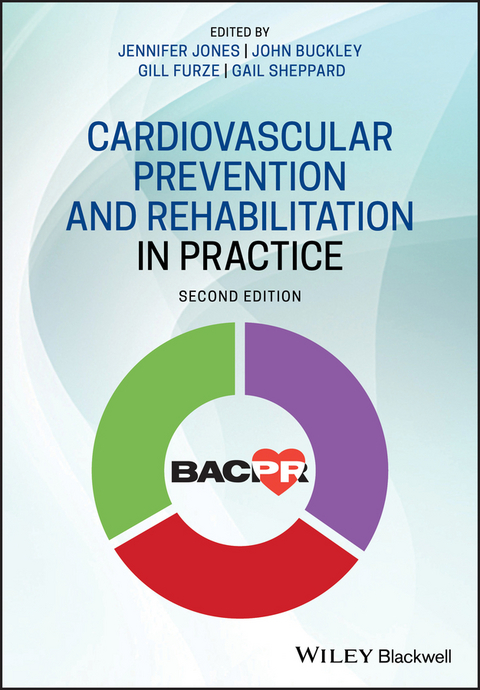
Cardiovascular Prevention and Rehabilitation in Practice (eBook)
John Wiley & Sons (Verlag)
978-1-118-45868-6 (ISBN)
The authoritative clinical handbook promoting excellence and best practice
Cardiovascular Prevention and Rehabilitation in Practice is a comprehensive, practitioner-focused clinical handbook which provides internationally applicable evidence-based standards of good practice. Edited and written by a multidisciplinary team of experts from the British Association for Cardiovascular Prevention and Rehabilitation (BACPR), this book is invaluable for practitioners helping people with heart disease return to health. The text provides an overview of research findings, examines the core components of cardiac rehabilitation, and discusses how to support healthier lifestyles and reduce the risks of recurrence.
Now in its second edition, this textbook has been fully revised to incorporate recent clinical evidence and align with current national and international guidelines. Increased emphasis is placed on an integrated approach to cardiac rehabilitation programmes, whilst six specified standards and six core components are presented to promote sustainable health outcomes.
- Describes how cardiovascular prevention and rehabilitation programmes can be delivered to meet standards of good practice
- Covers a broad range of topics including: promoting health behaviour change to improve lifestyle risk factors, supporting psycho-social health, managing medical risk factors, and how to develop long-term health strategies
- Emphasises the importance of early programme commencement with assessment and reassessment of patient goals and outcomes, and gives examples of strategies to achieve these
- Discusses the role of programme audit and certification of meeting minimum standards of practice
- Looks to the future and how delivery of cardiovascular prevention and rehabilitation programmes internationally will need to meet common challenges
Cardiovascular Prevention and Rehabilitation in Practice is an indispensable resource for all health professionals involved in cardiac rehabilitation and cardiovascular disease prevention.
Jennifer Jones is the Director of Preventive Medicine and Cardiovascular Health at the National University of Ireland Galway, Ireland, and Reader in Physiotherapy at Brunel University, UK. She was President of BACPR 2011-2013.
John Buckley is Professor of Applied Exercise Science, Director of the Centre for Active Living, University Centre Shrewsbury, University of Chester, UK. He is Executive Officer and Past-Chair, International Council of Cardiovascular Prevention and Rehabilitation, and was President of BACPR 2009-2011.
Gill Furze is Emeritus Professor in Health and Life Sciences at Coventry University, UK, and was President of BACPR 2013-2015.
Gail Sheppard is Senior Lecturer and Academic Group Lead in Public Health and Health Promotion at Canterbury Christ Church University, UK. She was Scientific Officer at BACPR 2013-2016.
The authoritative clinical handbook promoting excellence and best practice Cardiovascular Prevention and Rehabilitation in Practice is a comprehensive, practitioner-focused clinical handbook which provides internationally applicable evidence-based standards of good practice. Edited and written by a multidisciplinary team of experts from the British Association for Cardiovascular Prevention and Rehabilitation (BACPR), this book is invaluable for practitioners helping people with heart disease return to health. The text provides an overview of research findings, examines the core components of cardiac rehabilitation, and discusses how to support healthier lifestyles and reduce the risks of recurrence. Now in its second edition, this textbook has been fully revised to incorporate recent clinical evidence and align with current national and international guidelines. Increased emphasis is placed on an integrated approach to cardiac rehabilitation programmes, whilst six specified standards and six core components are presented to promote sustainable health outcomes. Describes how cardiovascular prevention and rehabilitation programmes can be delivered to meet standards of good practice Covers a broad range of topics including: promoting health behaviour change to improve lifestyle risk factors, supporting psycho-social health, managing medical risk factors, and how to develop long-term health strategies Emphasises the importance of early programme commencement with assessment and reassessment of patient goals and outcomes, and gives examples of strategies to achieve these Discusses the role of programme audit and certification of meeting minimum standards of practice Looks to the future and how delivery of cardiovascular prevention and rehabilitation programmes internationally will need to meet common challenges Cardiovascular Prevention and Rehabilitation in Practice is an indispensable resource for all health professionals involved in cardiac rehabilitation and cardiovascular disease prevention.
Jennifer Jones is the Director of Preventive Medicine and Cardiovascular Health at the National University of Ireland Galway, Ireland, and Reader in Physiotherapy at Brunel University, UK. She was President of BACPR 2011-2013. John Buckley is Professor of Applied Exercise Science, Director of the Centre for Active Living, University Centre Shrewsbury, University of Chester, UK. He is Executive Officer and Past-Chair, International Council of Cardiovascular Prevention and Rehabilitation, and was President of BACPR 2009-2011. Gill Furze is Emeritus Professor in Health and Life Sciences at Coventry University, UK, and was President of BACPR 2013-2015. Gail Sheppard is Senior Lecturer and Academic Group Lead in Public Health and Health Promotion at Canterbury Christ Church University, UK. She was Scientific Officer at BACPR 2013-2016.
Foreword vii
List of Contributors ix
Preface xiii
Chapter 1 Cardiovascular Disease Prevention and Rehabilitation 1
Jennifer Jones, Gill Furze, and John Buckley
Chapter 2 Standards and Core Components in Cardiovascular Disease Prevention and Rehabilitation 21
BACPR Standards Writing Group
Chapter 3 Delivering Quality Standards 47
Kathryn Carver
Chapter 4 Health Behaviour Change and Education 67
Linda Speck, Gill Furze, and Nick Brace
Chapter 5 Lifestyle Risk Factor Management 99
Jennifer Jones, John Buckley, and Gill Furze
Chapter 5A Achieving Long-term Abstinence from Tobacco Use in Patients in a Cardiovascular Prevention and Rehabilitation Setting 101
Catriona Jennings and Robert West
Chapter 5B Diet and Weight Management 127
Alison Atrey and Rachel Vine
Chapter 5C Physical Activity and Exercise 151
John Buckley, Tim Grove, Sally Turner, and Samantha Breen
Chapter 6 Psychosocial Health 193
Linda Speck, Nick Brace, and Molly Byrne
Chapter 7 Medical Risk Management 227
Joe Mills, Susan Connolly, Barbara Conway, Marie-Kristelle Ross, Samantha Breen, and Dorothy J. Frizelle
Chapter 8 Long-term Management 271
Sally Hinton, Ann Marie Johnson, and Gail Sheppard
Chapter 9 Audit and Evaluation 285
Patrick Doherty, Alex Harrison, Corinna Petre, and Nerina Onion
Chapter 10 Future Prospects and International Perspectives 305
Joe Mills, Sherry L. Grace, Marie-Kristelle Ross, Caroline Chessex, Robyn Gallagher, Cate Ferry, and Vicki Wade
Index 313
CHAPTER 1
Cardiovascular Disease Prevention and Rehabilitation
Jennifer Jones1,2, Gill Furze3, and John Buckley4
1 National University of Ireland, Galway, Ireland
2 Department of Clinical Sciences, Brunel University, Uxbridge, UK
3 Faculty of Health and Life Sciences, Coventry University, Coventry, UK
4 Centre for Active Living, University Centre Shrewsbury, Shrewsbury, UK
Abstract
This chapter presents the current burden of cardiovascular disease (CVD) together with the historical context of cardiac rehabilitation (CR) and its evolving evidence base. In accordance with the growing emphasis on secondary prevention and the benefits gained, including people with manifestations of atherosclerosis beyond coronary heart disease (CHD), the rationale for referring to cardiovascular prevention and rehabilitation programmes (CPRPs) in contemporary practice is discussed. Despite rehabilitation's proven benefits, participation still has much room for growth, and approaches to redress this challenge form a key feature of this chapter and textbook more widely. Finally, a brief insight into future perspectives are explored in recognition of the value of new technologies and connected health approaches that offer opportunities in the scalability of services, provide further choice, and potentially reach more people.
Keywords: cardiovascular disease, cardiac rehabilitation, prevention; health
Key Points
- Whilst age‐adjusted mortality rates are falling in high‐income countries, cardiovascular disease still remains the single largest cause of mortality in the United Kingdom (UK), Europe, and globally.
- More people are, however, surviving acute cardiovascular events, which contributes to a growing and ageing population who are living with long‐term conditions.
- Cardiac rehabilitation has evolved from its traditional components of exercise, education, and psychology to now include a broadened focus on the wider physical and psycho‐social lifestyle issues that lead to the underlying causes of the disease along with the related behavioural and medical management needs.
- The evidence for cardiac rehabilitation is compelling. There is now a growing emphasis, which reaches beyond outcomes of reducing morbidity and mortality, towards greater patient‐centred improvements in health‐related quality of life and reduced costly unplanned hospital readmissions.
- Despite the benefits, uptake to cardiac rehabilitation remains less than desirable. Programmes need to ensure to apply evidence‐based approaches to increase uptake and programme adherence.
- As services develop to treat any atheromatic condition as part of a ‘single family of diseases’ there is a need to consider all elements of disease management and prevention within the terminology of cardiac rehabilitation.
- There is a growing interest in the use of technologies and connected health solutions in delivering successful cardiac rehabilitation, and whilst these are encouraged, novel approaches also require rigorous evaluation. As such, contemporary cardiovascular prevention and rehabilitation programmes need to participate in driving vital research to address priority health needs and inform better the prevention and management of cardiovascular disease.
1.1 RATIONALE AND AIMS
Adverse trends in non‐communicable diseases (NCDs) are being seen worldwide. In low and low–middle income countries, premature mortality from cardiovascular disease (CVD) continues to rise. Whilst significant reductions are being observed across most high‐income countries, CVD remains the leading cause of mortality. In addition, the number of people surviving an acute cardiac event has risen greatly resulting in a growing population living with atheromatic CVD. Coronary heart disease (CHD) and cerebrovascular disease constitute the most important preventable NCDs and completing a cardiac rehabilitation (CR) programme is strongly recommended (Class 1 indication). A multidisciplinary CR programme aims to address the underlying causes of the disease, enable patient empowerment and self‐care, and optimise health and wellbeing. Despite its demonstrated benefits and endorsement by most recognised cardiovascular societies, participation remains vastly underutilised. This chapter aims to provide a brief historical background to traditional CR and its evidence base together with a review of current perspectives and future directions. To increase uptake there is a need for services to evolve and innovate. This includes employing different modes of delivery and offering flexibility when attempting to attract either new or hitherto hard to reach ‘in‐scope’ groups. The rationale for advocating for the provision of CPRPs as opposed to CR also features strongly. This is in recognition that preventive medicine and comprehensive intensive lifestyle and risk factor management are key if reductions in overall mortality together with a plethora of other health‐related benefits are to be realised in contemporary practice.
1.2 THE BURDEN OF CVD
Atheromatic CVD remains the world's number one cause of death and disability (Global Burden of Disease 2015). Low‐ and middle‐income countries (LMICs) are most affected and account for 80% of all CVD deaths (Bovet and Paccaud 2011). In high‐income countries, although age‐adjusted mortality for this disease has seen significant decline over the last 30 years, it remains the leading single disease burden. These trends concur in the United Kingdom (UK) where deaths from CVD cause more than a quarter of all deaths, or around 150 000 each year (British Heart Foundation 2018). As one of the key NCDs, the World Health Organization (WHO) has acknowledged that the prevention and/or management of CVD requires the implementation of nine different health and medical strategies, including reductions in smoking, poor nutrition/salt intake, alcohol, physical inactivity, obesity, and diabetes and hypertension, along with increasing the availability of medical and counselling therapies to prevent heart attacks and strokes and the availability of essential medicines and technologies to treat CVD and other NCDs (World Health Organization 2013). The British Association for Cardiovascular Prevention and Rehabilitation (BACPR) has identified a number of core components (British Association for Cardiovascular Prevention and Rehabilitation [BACPR] 2017; Figure 1.1) that include all of these WHO targets.
CVD is an umbrella term for all diseases of the heart and circulation, including heart disease, stroke, heart failure, cardiomyopathy, atrial fibrillation, peripheral arterial disease, chronic kidney disease, or any other functional disorder of the cardiovascular system. Of all CVDs, CHD is the leading cause of mortality and disease burden worldwide (WHO 2018), resulting in approximately 8.9 million deaths and 164.0 million disability‐adjusted life years (DALYs) globally in 2015 (Kassebaum et al. 2016; Wang et al. 2016). In the UK specifically, CHD is responsible for around 66 000 deaths each year, an average of 180 people each day, or one every eight minutes (British Heart Foundation 2018). The total cost of premature death, lost productivity, hospital treatment, and prescriptions relating to CVD is estimated at £19 billion each year (British Heart Foundation 2018). This is highly relevant to CR, given that CHD is largely preventable with up to 90% of the risk of a first heart attack being due to nine lifestyle risk factors that can be changed (Yusuf et al. 2004). These global and national trends in mortality from CVD highlight there is a growing need for better investment in prevention‐based strategies.
FIGURE 1.1 Core components of cardiac rehabilitation (CR) as defined by the British Association for Cardiovascular Prevention and Rehabilitation (BACPR).
In high‐income countries, whilst age‐adjusted CVD mortality is declining morbidity is increasing, placing an escalating and untenable strain on their healthcare systems. Advances in diagnosis, revascularisation, pharmacotherapy, and overall more successful treatment of acute illness have contributed to these reductions in mortality, but simultaneously result in a growing population of people surviving acute cardiac events and living longer with chronic l,ong‐term conditions, such as heart failure. Currently, there are more than 6 million new cases of CVD in the European Union (EU) and more than 11 million in Europe as a whole, every year. With almost 49 million people living with the disease in the EU, the cost to the EU economies is high at €210 billion a year (European Heart Network 2017). In the UK alone, there are an estimated 7 million people living with CVD; 2.3 million of these individuals are living with CHD – over 1.4 million men and 850 000 women (British Heart Foundation 2018). This places a growing and unsustainable burden on healthcare...
| Erscheint lt. Verlag | 20.3.2020 |
|---|---|
| Sprache | englisch |
| Themenwelt | Medizin / Pharmazie ► Allgemeines / Lexika |
| Medizinische Fachgebiete ► Innere Medizin ► Kardiologie / Angiologie | |
| Schlagworte | BACPR competencies • BACPR components • BACPR guide • BACPR guidelines • BACPR handbook • BACPR reference • Cardiology Nursing • Cardiovascular Disease • cardiovascular disease prevention • Cardiovascular rehabilitation • CVD handbook • CVD nursing • CVD prevention • CVD rehabilitation</p> • Kardiologiepflege • Kardiovaskuläre Erkrankung • Kardiovaskuläre Erkrankungen • Krankenpflege • <p>BACPR standards • Medical Science • Medizin • nursing • Physical rehabilitation • Physikalische Medizin u. Rehabilitation |
| ISBN-10 | 1-118-45868-0 / 1118458680 |
| ISBN-13 | 978-1-118-45868-6 / 9781118458686 |
| Informationen gemäß Produktsicherheitsverordnung (GPSR) | |
| Haben Sie eine Frage zum Produkt? |
 EPUB (Adobe DRM)
Kopierschutz: Adobe-DRM
Adobe-DRM ist ein Kopierschutz, der das eBook vor Mißbrauch schützen soll. Dabei wird das eBook bereits beim Download auf Ihre persönliche Adobe-ID autorisiert. Lesen können Sie das eBook dann nur auf den Geräten, welche ebenfalls auf Ihre Adobe-ID registriert sind.
Details zum Adobe-DRM
Dateiformat: EPUB (Electronic Publication)
EPUB ist ein offener Standard für eBooks und eignet sich besonders zur Darstellung von Belletristik und Sachbüchern. Der Fließtext wird dynamisch an die Display- und Schriftgröße angepasst. Auch für mobile Lesegeräte ist EPUB daher gut geeignet.
Systemvoraussetzungen:
PC/Mac: Mit einem PC oder Mac können Sie dieses eBook lesen. Sie benötigen eine
eReader: Dieses eBook kann mit (fast) allen eBook-Readern gelesen werden. Mit dem amazon-Kindle ist es aber nicht kompatibel.
Smartphone/Tablet: Egal ob Apple oder Android, dieses eBook können Sie lesen. Sie benötigen eine
Geräteliste und zusätzliche Hinweise
Buying eBooks from abroad
For tax law reasons we can sell eBooks just within Germany and Switzerland. Regrettably we cannot fulfill eBook-orders from other countries.
aus dem Bereich