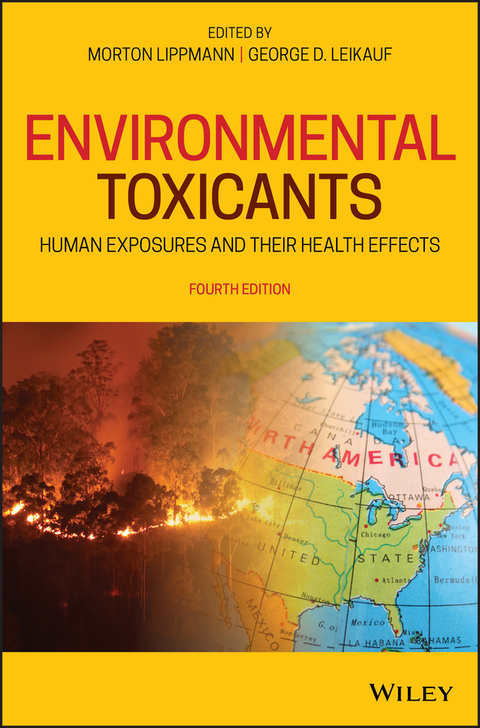
Environmental Toxicants (eBook)
2111 Seiten
John Wiley & Sons (Verlag)
978-1-119-43891-5 (ISBN)

An Updated Reference on Human Exposure to Environmental Toxicants and A Study of Their Impact on Public Health
With the 4th edition of Environmental Toxicants: Human Exposures and Their Health Effects, readers have access to up-to-date information on the study and science of environmental toxicology and public health worldwide. Practitioners and professionals can use this resource to understand newly discovered information on the adverse health effects of toxins and pollutants in air, water, and occupational and environmental environments on large human populations.
The 4th edition of this book is updated to reflect new knowledge and research on:
? Performing risk assessments on exposed individuals
? Assessing the effects of toxicants and substances on large populations for health and medical professionals
? Patterns of human exposure to select chemical toxicants
? World Trade Center dust, agents for chemical terrorism, and nanoparticles
For health professionals, including health authorities, public health officials, physicians, and industrial managers, who are seeking new research and techniques for managing environmental substances, this invaluable reference will guide you through in a thorough, easy- to-read manner.
MORTON LIPPMANN, PHD, earned a Bachelor of Chemical Engineering at Cooper Union, an MS in Industrial Hygiene at Harvard School of Public Health, and a PhD in Environmental Health Science at New York University (NYU) School of Engineering. He is currently a professor of Environmental Medicine at NYU School of Medicine. He has spent his adult life researching the health effects of particulate matter (PM) in ambient air on public health. He has published over 370 research papers and two reference texts on environmental health science.
GEORGE D. LEIKAUF earned his A.B at the University of California, Berkeley, his Ph.D. in environmental health science at New York University, and finished his postdoctoral training at CVRI-University of California, San Francisco. Throughout his career, he has developed several in vitro approaches to the study of pulmonary epithelial, cellular, and molecular responses to toxicants. Currently, he is a professor of Environmental and Occupational Health at the University of Pittsburgh, Graduate School of Public Health.
An Updated Reference on Human Exposure to Environmental Toxicants and A Study of Their Impact on Public Health With the 4th edition of Environmental Toxicants: Human Exposures and Their Health Effects, readers have access to up-to-date information on the study and science of environmental toxicology and public health worldwide. Practitioners and professionals can use this resource to understand newly discovered information on the adverse health effects of toxins and pollutants in air, water, and occupational and environmental environments on large human populations. The 4th edition of this book is updated to reflect new knowledge and research on: Performing risk assessments on exposed individuals Assessing the effects of toxicants and substances on large populations for health and medical professionals Patterns of human exposure to select chemical toxicants World Trade Center dust, agents for chemical terrorism, and nanoparticles For health professionals, including health authorities, public health officials, physicians, and industrial managers, who are seeking new research and techniques for managing environmental substances, this invaluable reference will guide you through in a thorough, easy- to-read manner.
MORTON LIPPMANN, PHD, earned a Bachelor of Chemical Engineering at Cooper Union, an MS in Industrial Hygiene at Harvard School of Public Health, and a PhD in Environmental Health Science at New York University (NYU) School of Engineering. He is currently a professor of Environmental Medicine at NYU School of Medicine. He has spent his adult life researching the health effects of particulate matter (PM) in ambient air on public health. He has published over 370 research papers and two reference texts on environmental health science. GEORGE D. LEIKAUF earned his A.B at the University of California, Berkeley, his Ph.D. in environmental health science at New York University, and finished his postdoctoral training at CVRI-University of California, San Francisco. Throughout his career, he has developed several in vitro approaches to the study of pulmonary epithelial, cellular, and molecular responses to toxicants. Currently, he is a professor of Environmental and Occupational Health at the University of Pittsburgh, Graduate School of Public Health.
PREFACE
This fourth (2019) edition of Environmental Toxicants reflects the evolution of the field of environmental health science. Most of the 26 chapters review the health effects associated with exposures of human populations to chemical toxicants encountered in the course of routine activities in and around their homes, while commuting, and in recreational microenvironments. They do not emphasize the generally higher levels of exposure to some of the same toxicants that can occur in occupational settings, which are the focus of other multi‐author reference works. However, two of the chapters address very high exposures that were intended to terrorize military and/or civilian populations.
Chapter 8 covers chemical and biological agents that may be used to kill, harm, or terrorize noncombatant people. Chapter 25 describes the results of a terrorist attack on September 11, 2001, that brought down the twin towers of the World Trade Center in New York City. The resulting dense cloud of highly alkaline inhalable dust caused acute respiratory irritation among residents and recovery workers immediately, as well as chronic respiratory effects among those disturbing and re‐entraining the settled dust in the months that followed.
Other new chapters include Chapter 7, “Acrolein and Unsaturated Aldehydes,” wherein health risks have attained new prominence, and Chapter 19, which covers the risks of inhaling relatively low concentrations of a new type of man‐made particulate matter that is increasingly incorporated into a wide range of industrial and consumer products, that is, particles with diameters <50 nm. They are known as nanoparticles and represent a new challenge to our biological defense mechanisms.
Some of the differences between traditional occupational and other environmental toxicant exposures, and any adverse health effects that may result from such exposures, are affected by temporal exposure patterns, as well as by activity levels. Occupational exposures are generally limited to 8 h per day but often involve higher levels of minute ventilatory volumes and dermal exposures than those in most of their other microenvironments. In contrast, nonoccupational toxicant exposures usually involve low concentrations of more diverse chemical mixtures over longer time periods. For such exposures, it is often more difficult to detect increased rates of mortality, morbidity, or losses of function. In this volume, most of the chapters deal with exposures to complex chemical mixtures and/or multiple chemicals having similar biological impacts or common sources. Other chapters deal with either specific metals in their various chemical forms or the classes of gaseous ambient air pollutants that are regulated under the U.S. Clean Air Act and other U.S. governmental entities.
Some chapters that appeared in previous editions have been dropped on the basis that nonoccupational exposures of populations likely to cause adverse health effects have substantially diminished (sick building syndrome, benzene, and dioxins). Others (microwaves, ionizing radiation, ultraviolet radiation, noise, and drinking water) were dropped because the size of the volume was getting too great and/or they were not focused on chemical toxicants.
Some of the chapters that reappear have new authors or coauthors who have brought their topics up‐to‐date with new information and insights, acquired in the intervening decade, on exposures, biological responses, and their mechanisms.
BACKGROUND
The origin of the first edition of this reference book was the result of a visit to my office at NYU School of Medicine by Bob Esposito, who then worked at Van Nostrand Reinhold (VNR). He had seen the Lippmann comprehensive critical review paper on ozone, which appeared in the Journal of the Air Pollution Control Association, and was interested in gathering together a series of such reviews on other environmental toxicants for a new title for VNR. I said I would think about it and let him know.
Before responding, I sounded out some professional colleagues who were experts on a variety of environmental toxicants, and, somewhat to my surprise, many were willing to prepare a chapter‐length critical review. On that basis, I signed a contract with VNR to produce the first version of the volume (containing 23 chapters), which was published in 1992. When Esposito, by then working for Wiley, which had acquired VNR, called again, in 1988, about preparing a second edition, I agreed. The second edition, with 30 chapters, appeared in 2000. The third edition, also published by Wiley, with 30 chapters, appeared in 2009.
When Esposito recently indicated that Wiley was interested in a fourth edition, I was hesitant to pull it all together again as a single editor. However, I was able to recruit one of my former NYU doctoral students, George D. Leikauf, by then a professor at the University of Pittsburgh School of Public Health, to work with me as co‐editor for the fourth edition. It would be up to Professor Leikauf to carry it forward should there be any subsequent editions.
A PERSONAL NOTE FROM THE SENIOR EDITOR (ML)
I began my professional career, in 1954, by enrolling in an MS program in Industrial Hygiene at Harvard. I studied there under Philip Drinker and Leslie Silverman, who were, along with Ted Hatch, leading academic pioneers in occupational health and aerosol science. At that time, there was not yet an academic program in environmental health science at Harvard, or elsewhere.
Upon completion of my MS, I joined the U.S. Public Health Service (PHS) in 1955 to work at the Occupational Health Program in Cincinnati; I met colleagues who investigated not only occupational exposures to workplace toxicants but also the lethal smog exposures in 1948 in Donora, PA. While in Cincinnati, I also had the opportunity to get to know Herb Stokinger, the chief toxicologist of the PHS, and to work with him in refining the design of animal chambers for inhalation exposures of toxicants.
When I moved on, in 1957, to work in the Industrial Hygiene Branch of the Health and Safety Laboratory (HASL) of the Atomic Energy Commission (AEC) in New York City, I got to work with the lab director, Merrill Eisenbud, and my branch chief, Bill Harris, and became familiar with their work with their HASL colleagues in assessing stratospheric samples of radioactive aerosols and worldwide fallout from atmospheric testing of A‐bombs and H‐bombs. I also helped to develop early versions of particle size‐selective air samplers that could separate particles, during the sampling process, into those depositing within respiratory tract regions having different particle deposition and particle clearance dynamics.
I moved on to NYU in 1964 to pursue a doctoral research project under the supervision of Dr. Roy E. Albert, which was to define quantitative aspects of regional particle deposition and bronchial airway particle clearance in the human respiratory tract, along with a parallel and simultaneous effort in laboratory animals. My doctoral thesis was on the effect of particle size on regional deposition and particle clearance dynamics in human airways.
In retrospect, I recognize how fortunate I was to get to know personally and to appreciate the historic work of my mentors. They were pioneers who created so much of the knowledge base that I relied upon in pursuing my own subsequent research career.
After completing the PhD program at NYU in 1967, the Department Chair, Dr. Norton Nelson, arranged for me to be appointed to the faculty, where I remained for the next 50 years, pursuing research projects involving human exposure assessment, inhalation toxicology, and occupational and environmental epidemiology. This varied experience, along with my service on review and advisory committees for EPA, the National Institute for Occupational Safety and Health (NIOSH), the National Institute of Environmental Health Science (NIEHS), the World Health Organization (WHO), and other academic institutions, broadened my horizons, and enabled me to (1) focus my specific research proposals on key issues that were in most need of resolution, (2) help in guiding the regulatory and research programs elsewhere to make more effective use of their own resources, and (3) have the broad perspective in environmental health science to guide the organization and overall perspective for this unique book. I now pass the task of maintaining this unique reference book on to Dr. Leikauf.
The inclusion of chapters on the criteria air pollutants for which I was the senior or coauthor, those on airborne fibers, and on the dust generated by the collapse of the World Trade Center towers on September 11, 2001, reflects my own strong research interests, as well as my service on external scientific advisory committees dealing with such toxicant exposures to substantial populations. For the other toxicant classes covered in the other chapters, we are grateful to the expert authors, their excellent contributions, and their willingness to provide the complementary content on the other toxicant groupings.
My research career began at a time that occupational health science was nearing maturity and was beginning to broaden into environmental health science. In occupational health, it was possible and reasonable to focus research on the identification of specific toxic agents or elements as the or at least major causal components of an exposure‐related occupational disease or disability in a working adult population. As my research focus shifted, at least in part, to environmental...
| Erscheint lt. Verlag | 3.3.2020 |
|---|---|
| Sprache | englisch |
| Themenwelt | Medizin / Pharmazie ► Medizinische Fachgebiete |
| Naturwissenschaften ► Chemie | |
| Schlagworte | Allg. Public Health • Arbeitssicherheit u. Umweltschutz i. d. Chemie • Chemical and Environmental Health and Safety • Chemical Safety • Chemie • Chemistry • Environmental Analysis • Environmental medicine • environmental substances • Environmental toxicants • Gesundheits- u. Sozialwesen • Health & Social Care • Health Science • Human health • occupational medicine • particulate matter • Public Health General • public health, toxicants • Schadstoff • Toxicology • Umweltanalytik • Umweltgift • Umwelttoxikologie |
| ISBN-10 | 1-119-43891-8 / 1119438918 |
| ISBN-13 | 978-1-119-43891-5 / 9781119438915 |
| Informationen gemäß Produktsicherheitsverordnung (GPSR) | |
| Haben Sie eine Frage zum Produkt? |
 EPUB (Adobe DRM)
Kopierschutz: Adobe-DRM
Adobe-DRM ist ein Kopierschutz, der das eBook vor Mißbrauch schützen soll. Dabei wird das eBook bereits beim Download auf Ihre persönliche Adobe-ID autorisiert. Lesen können Sie das eBook dann nur auf den Geräten, welche ebenfalls auf Ihre Adobe-ID registriert sind.
Details zum Adobe-DRM
Dateiformat: EPUB (Electronic Publication)
EPUB ist ein offener Standard für eBooks und eignet sich besonders zur Darstellung von Belletristik und Sachbüchern. Der Fließtext wird dynamisch an die Display- und Schriftgröße angepasst. Auch für mobile Lesegeräte ist EPUB daher gut geeignet.
Systemvoraussetzungen:
PC/Mac: Mit einem PC oder Mac können Sie dieses eBook lesen. Sie benötigen eine
eReader: Dieses eBook kann mit (fast) allen eBook-Readern gelesen werden. Mit dem amazon-Kindle ist es aber nicht kompatibel.
Smartphone/Tablet: Egal ob Apple oder Android, dieses eBook können Sie lesen. Sie benötigen eine
Geräteliste und zusätzliche Hinweise
Buying eBooks from abroad
For tax law reasons we can sell eBooks just within Germany and Switzerland. Regrettably we cannot fulfill eBook-orders from other countries.
aus dem Bereich