


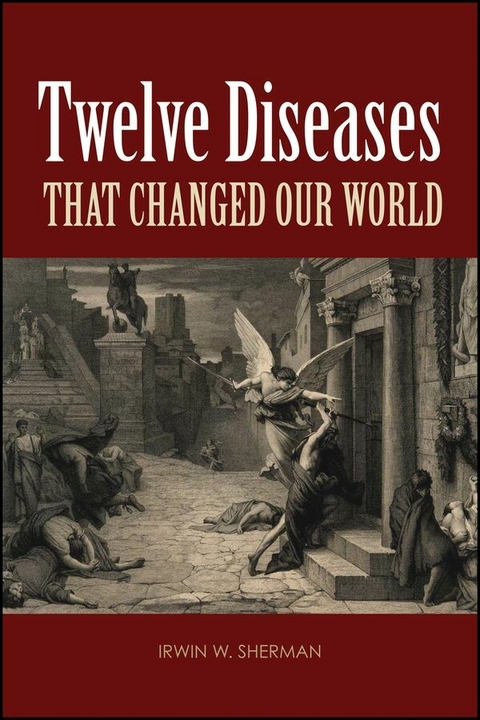
Twelve Diseases that Changed Our World (eBook)
John Wiley & Sons (Verlag)
978-1-68367-353-8 (ISBN)
Covers the history of twelve important diseases and addresses public health responses and societal upheavals.
- Chronicles the ways disease outbreaks shaped traditions and institutions of Western civilization.
- Explains the effects, causes, and outcomes from past epidemics.
- Describes a dozen diseases to show how disease control either was achieved or failed.
- Makes clear the interrelationship between diseases and history.
- Presents material in a compelling, clear, and jargon-free prose for a wide audience.
- Provides a picture of the best practices for dealing with disease outbreaks.
Irwin W. Sherman, The Scripps Research Institute, USA.
Covers the history of twelve important diseases and addresses public health responses and societal upheavals. Chronicles the ways disease outbreaks shaped traditions and institutions of Western civilization. Explains the effects, causes, and outcomes from past epidemics. Describes a dozen diseases to show how disease control either was achieved or failed. Makes clear the interrelationship between diseases and history. Presents material in a compelling, clear, and jargon-free prose for a wide audience. Provides a picture of the best practices for dealing with disease outbreaks.
Irwin W. Sherman, The Scripps Research Institute, USA.
Preface vii
1 The Legacy of Disease: Porphyria and Hemophilia 1
2 The Irish Potato Blight 19
3 Cholera 33
4 Smallpox: the Speckled Monster 50
5 Bubonic Plague 68
6 Syphilis: the Great Pox 83
7 Tuberculosis: the People's Plague 104
8 Malaria 130
9 Yellow Fever: the Saffron Scourge 143
10 The Great Influenza 158
11 AIDS: the 21st Century Plague 174
Epilogue 195
Notes 199
Index 207
1 The Legacy of Disease: Porphyria and Hemophilia
In 1962 the U.S. President John F. Kennedy said, “Life is unfair. Some people are sick and others are well.” He, of course, was referring to himself and the persistent rumors about his ill health. Forty years later, an examination of his medical records revealed that he had Addison's disease, a life-threatening lack of adrenal gland function, as well as osteoporosis and persistent digestive problems. He was given pain killers (demerol and methadone), stimulants, and antianxiety agents, as well as hormones (hydrocortisone and testosterone) to keep him alive, especially during times of stress. Although doubts linger whether President Kennedy's physical ailments influenced the manner by which the Cuban missile crisis was handled or whether they affected other political decisions, it is clear that for many world leaders, including Great Britain's King George III, several of Queen Vizctoria's children and grandchildren, Tsar Nicholas II of Russia, and Alfonso XIII and Generalissimo Franco in Spain, as well as, indirectly, the leaders of Nazi Germany, sickness was the seed for historical change.
Porphyria
Madness in the monarchy
Mary Queen of Scots (1542 to 1587) had a mysterious ailment. At the age of 24 she wrote, “Oftentimes I have great pains . . . ascending unto my head . . . it descends to my stomach so that it makes me lack an appetite . . . and there is sickness with great vomit . . . excuse my writing, caused by the weakness of my arm . . . wherewith we are tormented.” In 1570, when she had another attack, her symptoms were described by her physician: “terrible pains in the side made worse by every movement, even breathing. She vomited continuously, more than 60 times, and eventually brought up blood. She became delirious, and two days later she lost her sight and speech, had a series of fits, remained unconscious for some hours and was thought to be dead. Yet within 10 days she was up and about again. She had unquiet and melancholy fits, convulsions, shivering, difficulty in swallowing, altered voice, weakness of arms and legs so that she could neither write, walk or even stand unaided.” The onset of her symptoms was rapid and suggested to some in her court that she was being poisoned. Others judged her to be hysterical. It is most likely, however, that Mary Queen of Scots was neither hysterical nor the victim of poisoning. Instead, she and many of her descendants probably suffered from an inherited disorder—a curse of British royalty—that would alter the course of world history.
Mary Stuart, Queen of Scotland since birth, was engaged at the age of 3 to Prince Francis, heir to the throne of France; at age 15, when she married him, he was already King Francis II, so she became Queen of France as well as of Scotland. Such glory did not last very long. Francis II died unexpectedly a year after the marriage, and Mary returned to Scotland, where she later married Henry Stuart, Lord Darnley, a relation of the English royal family who was described by historians as a drunkard and an imbecile. Mary did not trust Darnley with affairs of state, and she had several male secretaries who advised her. One of her favorites was David Rizzio, who provoked such jealousy in Mary's husband that he arranged for Rizzio to be murdered. Darnley himself was murdered a year later, and it was widely believed that James Hepburn, 4th Earl of Bothwell, had conspired with the Queen to kill her husband. Shortly thereafter, Mary married Bothwell. This, together with Mary's episodes of blindness, depression, and inability to speak or stand, so disturbed the Scottish nobility that they forced her to abdicate the throne. Mary sought refuge and protection in England, where her cousin Elizabeth I was queen. Mary was an ungrateful and tormented guest in England and became involved in plots to kill Elizabeth. The plots were discovered, and in 1587 Mary was beheaded.
When Elizabeth I died in 1603, Mary's son, James VI of Scotland, succeeded her as James I of England. The King had a disease similar to that of his mother. According to his physician, Sir Theodore de Mayerne, “He was afflicted with pain . . . under his ribs . . . he glows with heat, and his appetite falls off; he sleeps badly; he readily vomits, at times so violently that his face is covered with red spots for two or three days . . . very often he suffered from painful colic . . . with vomiting and diarrhea, preceded by melancholy and nocturnal rigors . . . he had such pain and weakness in the foot that it was left with an odd twist when walking . . . In 1616 . . . for 4 months he had to stay in bed or in a chair . . . In 1619 . . . he sweats easily . . . often suffers bruises . . . he is of exquisite sensitiveness and most impatient of pain . . . He often passed urine red like Alicante wine.” Although diagnosis of medical conditions in persons living so long ago is uncertain, it is very likely that the mysterious disease suffered by Mary Queen of Scots, her son King James, and many of their descendants was porphyria, derived from the Greek word “porphuros,” meaning “purple,” with its telltale sign of red-purple urine.
Gene failure
Porphyria, a hereditary error of metabolism, is linked to the body's production of the pigment hemoglobin, which gives color to our red blood cells and grabs oxygen molecules as blood courses through the lungs. Hemoglobin consists of a protein, globin, coupled to a nonprotein molecule, heme. Heme, an iron complex within a ring structure called porphyrin, is synthesized in the red cells and liver. The reverse of this process, that is, the breakdown of heme to salvage the iron, results in the formation of bile pigments which are stored in the gallbladder and function as a detergent to emulsify fats for easier digestive action; bile pigments also color the feces brown. If there is a block anywhere in the eight-step pathway of heme formation, heme is not produced and the porphyrin intermediates accumulate in a variety of tissues in the body.
The pathway of heme manufacture can be thought of as if it were a river flowing downstream with a series of eight waterwheels along the way; each waterwheel is a cellular factory for making heme intermediates, i.e., porphyrins. To allow for control of water flow, a series of sluice gates are positioned ahead of each waterwheel. For a waterwheel to turn, each sluice gate must be opened by a gatekeeper. When a gatekeeper cannot open a gate, the flow of water is interrupted; water accumulates behind the waterwheel and spills over. Similarly, in the pathway for the synthesis of heme, the gatekeepers are the eight biological catalysts, called enzymes, that allow a controlled flow of intermediates in the pathway. If a gatekeeper “falls asleep at the wheel,” i.e., a particular enzyme does not function properly (or is absent), the normal pathway to heme is blocked and porphyrins accumulate in front of the block. These increased amounts of porphyrins do their dirty work, causing abdominal pain and neuropsychiatric symptoms (such as those seen in Mary and James), although the precise molecular basis for this is not known. The porphyrins in the skin, when exposed to UV light, become “excited” and in this state react with molecular oxygen to form activated oxygen, which can lead to cell death, with redness and blistering of the skin and scarring. The porphyrin intermediates also spill over into the urine during an attack. In an individual with porphyria, fresh urine is colorless, but on exposure to air and light for several hours it turns the color of port wine.
How did James I get porphyria from his mother, Queen Mary? The disease was transmitted through inheritance, not by contagion. Porphyria is transmitted as an autosomal dominant; that is, it is not carried on either the X or Y chromosome but on one of the other 44 chromosomes. The presence of a single copy of the defective gene has noticeable effects on the body. If one parent carries the defective gene, then, on average, half the children will bear the defective gene; this gene encodes a defective enzyme and causes porphyria. Most often the disease arises from a partial deficiency in a liver enzyme in the third step (or sometimes the seventh step) of heme synthesis. Porphyria is often more prevalent in females than in males, but in both sexes the symptoms rarely occur before puberty. These days, there are treatments for the disease symptoms, and dietary measures can reduce overproduction of porphyrins; however, in the time of Queen Mary and King James there was no such help.
The curse of the British royal family
The pedigree of porphyria can be traced back as far as Mary Queen of Scots. Her grandson Henry Frederick, Prince of Wales (the eldest son of James I), is believed to have inherited porphyria. His younger brother Charles was next in line for succession to the throne (he reigned as Charles I from 1625 to 1649); he did not have symptoms suggestive of porphyria. Charles I had a daughter named Henrietta Anne, who married a brother of Louis XIV of France and became the Duchess of Orleans. She had symptoms of porphyria and died unexpectedly at the age of 26. The eldest surviving son of Charles I, Charles II, did not appear to have porphyria. However, he had no legitimate children and was succeeded by his younger brother, James II, whose daughter Mary had married William of Orange, ruler of the Netherlands. In 1688, King William was invited to invade England, and James II was forced to leave the country for France. In effect, Mary (the daughter of James II) and William...
| Erscheint lt. Verlag | 1.8.2007 |
|---|---|
| Reihe/Serie | ASM |
| ASM | ASM Books |
| Sprache | englisch |
| Themenwelt | Medizin / Pharmazie ► Medizinische Fachgebiete |
| Studium ► Querschnittsbereiche ► Geschichte / Ethik der Medizin | |
| Studium ► Querschnittsbereiche ► Prävention / Gesundheitsförderung | |
| Naturwissenschaften ► Biologie ► Mikrobiologie / Immunologie | |
| Schlagworte | Biowissenschaften • blight • Cell & Molecular Biology • Century • Disease • Epilogue • Krankheit • legacy • Life Sciences • Microbiology & Virology • Mikrobiologie • Mikrobiologie u. Virologie • Monster • potato • saffron scourge • ST • Zell- u. Molekularbiologie |
| ISBN-10 | 1-68367-353-0 / 1683673530 |
| ISBN-13 | 978-1-68367-353-8 / 9781683673538 |
| Informationen gemäß Produktsicherheitsverordnung (GPSR) | |
| Haben Sie eine Frage zum Produkt? |
 EPUB (Adobe DRM)
Kopierschutz: Adobe-DRM
Adobe-DRM ist ein Kopierschutz, der das eBook vor Mißbrauch schützen soll. Dabei wird das eBook bereits beim Download auf Ihre persönliche Adobe-ID autorisiert. Lesen können Sie das eBook dann nur auf den Geräten, welche ebenfalls auf Ihre Adobe-ID registriert sind.
Details zum Adobe-DRM
Dateiformat: EPUB (Electronic Publication)
EPUB ist ein offener Standard für eBooks und eignet sich besonders zur Darstellung von Belletristik und Sachbüchern. Der Fließtext wird dynamisch an die Display- und Schriftgröße angepasst. Auch für mobile Lesegeräte ist EPUB daher gut geeignet.
Systemvoraussetzungen:
PC/Mac: Mit einem PC oder Mac können Sie dieses eBook lesen. Sie benötigen eine
eReader: Dieses eBook kann mit (fast) allen eBook-Readern gelesen werden. Mit dem amazon-Kindle ist es aber nicht kompatibel.
Smartphone/Tablet: Egal ob Apple oder Android, dieses eBook können Sie lesen. Sie benötigen eine
Geräteliste und zusätzliche Hinweise
Buying eBooks from abroad
For tax law reasons we can sell eBooks just within Germany and Switzerland. Regrettably we cannot fulfill eBook-orders from other countries.
aus dem Bereich


