Textbook for Orthodontic Therapists (eBook)
John Wiley & Sons (Verlag)
978-1-119-56543-7 (ISBN)
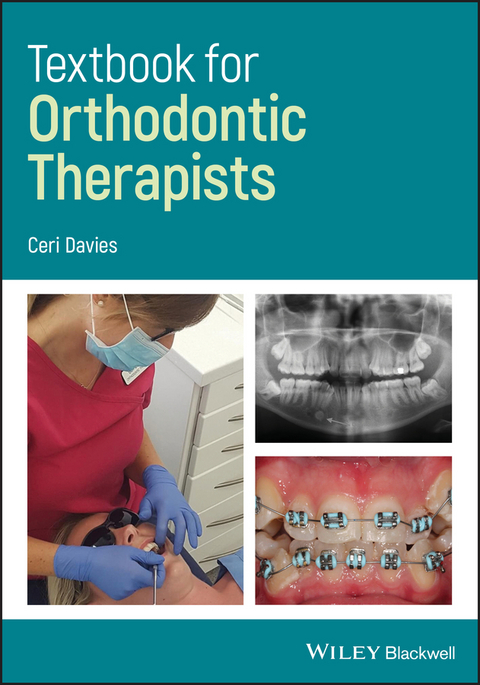
Textbook for Orthodontic Therapists is a comprehensive text specifically designed for orthodontic therapists. Written in an accessible and digestible format, it provides the essential clinical and theoretical knowledge needed for daily clinical practice.
Covering learning outcomes required by the examining bodies and the General Dental Council (GDC), it includes topics such as common types of orthodontic appliances, frequently found orthodontic problems, skeletal assessment and classification of malocclusion. It also contains information on subjects relevant to the dental profession for example medical emergencies, clinical governance and more.
Written to help the reader understand the role and function of an orthodontic therapist, Textbook for Orthodontic Therapists offers support to those undertaking the Diploma in Orthodontic Therapy and to assist those who already work as orthodontic therapists, helping them in their quest to enhance safe and effective care.
About the Author
Ceri Davies, Dip.Orth Ther RCSEd, is an Orthodontic Therapist at a private specialist orthodontic practice, and a Lecturer of Orthodontic Therapy at the Medicine and Dentistry School, University of Central Lancashire, Preston, UK.
Textbook for Orthodontic Therapists is a comprehensive text specifically designed for orthodontic therapists. Written in an accessible and digestible format, it provides the essential clinical and theoretical knowledge needed for daily clinical practice. Covering learning outcomes required by the examining bodies and the General Dental Council (GDC), it includes topics such as common types of orthodontic appliances, frequently found orthodontic problems, skeletal assessment and classification of malocclusion. It also contains information on subjects relevant to the dental profession for example medical emergencies, clinical governance and more. Written to help the reader understand the role and function of an orthodontic therapist, Textbook for Orthodontic Therapists offers support to those undertaking the Diploma in Orthodontic Therapy and to assist those who already work as orthodontic therapists, helping them in their quest to enhance safe and effective care.
About the Author Ceri Davies, Dip.Orth Ther RCSEd, is an Orthodontic Therapist at a private specialist orthodontic practice, and a Lecturer of Orthodontic Therapy at the Medicine and Dentistry School, University of Central Lancashire, Preston, UK.
Foreword xxv
Acknowledgements xxix
1 History of Orthodontics 1
2 Patient Assessment 11
3 Classification of Malocclusion 19
4 Aetiology of Malocclusion 25
5 Class I Malocclusion 31
6 Class II Div I Malocclusion 35
7 Class II Div II Malocclusion 41
8 Class III Malocclusion 47
9 Prevalences 53
10 Hypodontia 55
11 Supernumeraries 63
12 Impacted Canines 69
13 Impacted Teeth 77
14 Deepbites 81
15 Openbites: Anterior and Posterior 87
16 Crossbites 93
17 Centreline 101
18 Overjets 103
19 Bimaxillary Proclination 107
20 Growth Rotations 109
21 Tooth Movement 111
22 Impressions 123
23 Study Models 127
24 Radiographs 129
25 Cephalometrics 137
26 Removable Appliances 149
27 Functional Appliances 165
28 Fixed Appliances 179
29 Headgear 207
30 Instructions for all Appliances 215
31 Uncommon Removable Appliances 219
32 Anchorage 221
33 Index of Orthodontic Treatment Need (IOTN) 229
34 Peer Assessment Rating (PAR) 233
35 Space Analysis 239
36 Cleft Lip and Palate 245
37 Orthognathic Surgery 251
38 Retention and Stability 259
39 Interceptive Treatment 271
40 Adult Orthodontics 283
41 Orthodontic Materials 287
42 Archwire Ligation 293
43 Risks and Benefits of Orthodontic Treatment 295
44 Oral Hygiene 299
45 Decalcification 305
46 Fluorosis 307
47 Fluoride 309
48 Hypoplastic Enamel 311
49 Hyperplastic Enamel 313
50 General Dental Council (GDC) 315
51 Sharps Injury 325
52 Health and Safety 327
53 Control of Substances Hazardous to Health (COSHH) 329
54 Reporting of Injuries, Diseases and Dangerous Occurrences (RIDDOR) 331
55 Consent 333
56 Pain and Anxiety Control 337
57 Emergency Care 341
58 Orthodontic Instruments 347
59 Medical Emergencies 363
60 Eruption Dates 371
61 Extraction Patterns 373
62 Tooth Fusion and Gemination 375
63 Extra Notes 377
64 Definitions 381
Index 385
1
History of Orthodontics
The practice of orthodontics, as we know it today, is not just about correcting the position of misaligned teeth, but has a long history behind it. Teeth are important to us, and even in ancient times they were of interest. Archaeologists have found attempts to straighten teeth on human skulls, which had wire wrapped around the teeth in an attempt to realign them. It has taken the knowledge and written works of many dentists and orthodontists to reach the current state of the science.
1.1 Orthodontics before the Twenty‐First Century
Modern orthodontics began developing around the eighteenth and nineteenth centuries, but was not known as a specialism until 1900. The appliances that were developed and used over that time were very different to the appliances we use today. A French dentist named Pierre Fauchard designed the first expansion appliance in 1723, which was known as the Bandeau. This consisted of a U‐shaped metal strip to which the teeth were ligated. The ligation helped to create expansion. In the late eighteenth century, an American dentist, Norman W. Kingsley, started using an early form of headgear, a traction device to help move teeth distally. The very first type of headgear was created in 1840 and was known as the chin cup. Removable appliances were not used much at this time due to the retention making stability poor. It was not until 1949, when Adams clasps were introduced, that their use became more widespread. A Dwinelle's jack screw was a popular screw to use within removable appliances in the nineteenth century, quite similar to the screws we use on patients today.
Functional appliances only started to be developed in 1879 and again this was by Norman W. Kingsley. The functionals we know today work by posturing the mandible forward, whereas Kingsley designed one that would make the bite jump into the desired position. After this, many more functional appliances were produced, some removable and others fixed. Examples of removable functionals are the monobloc by Pierre Robin in 1902, the medium opening activator by Viggo Andresen in 1990 and the Frankel functional appliances FR‐1, FR‐2 and FR3, all designed by Rolf Frankel in 1957. An example of a fixed functional is the Herbst, produced in 1905 by Emil Herbst. Clark's twin block is a very popular functional appliance, still used today due to being well tolerated by most patients. This was developed by William Clark and has been used since the 1980s. Fixed appliances were employed very regularly by 1970, although they were slightly different from those we use today.
Edward Angle produced a number of appliances, including in 1904 Angle's E (expansion) arch, which consisted of molar bands with a labial archwire connecting from one molar band to the other running across the labial aspect of the dentition. Teeth needing expansion were then ligated to the archwire. Around 1910 Angle realised that he needed more control of the teeth, so to gain this he developed the pin and tube appliance. Gold and platinum bands were used on all the teeth with a vertical tube soldered onto them, then a pin was used which passed through this tube, achieving tooth movement. The downside of this was that rotational movement and root parallelism were difficult to achieve due to the use of round archwires. The pins had to be removed and resoldered into a new position at every appointment. The ribbon arch was the next appliance that Angle developed in 1915. With this rotational movement was achievable due to the vertical bracket soldered onto each band. Raymond Begg was inspired by this appliance and went on to develop his lightwire technique from it. Five years before Angle died in 1930, his final invention was the edgewise appliance, which was a bracket with a horizontal slot that was identical for every tooth. Angle moved away from the vertical slot, since he found that using a horizontal slot meant rectangular archwires could be used and by placing bends this allowed three‐dimensional control of the teeth. The preadjusted edgewise appliance used today is based on Angle’s edgewise appliance.
During the twentieth century fixed appliances consisted of bands with brackets welded onto them. Bands were made chairside by using straight strips of stainless steel that were shaped for each individual tooth, but as you might imagine this was very time consuming. In 1930 these stainless steel bands began being sold ready made by the very first orthodontic supply company. The purpose of the bracket was to hold the archwire in place. Tooth movement was achieved by the orthodontist placing bends within the archwire. Again, this was very time consuming and it took hours to get fixed appliances onto a patient.
In 1970, Lawrence Andrews developed the preadjusted edgewise appliance which is still popular today, and this changed much in orthodontics. The difference with this appliance was that the brackets were made for each specific tooth and contained prescriptions such as in and out, tip and torque within the bracket. These prescriptions all helped with tooth movement and reduced the need for wire bending. Today these prescription brackets are available with different angulations, slot sizes and base types.
Aesthetic brackets first become available in 1963, which are very popular today, as are lingual appliances, the first of which were developed in the 1980s. Since then a wide range of different systems have been developed by orthodontists, including the standard edgewise appliance, Begg appliance, tip edge appliance, preadjusted edgewise appliance, self‐ligating appliance, and the lingual appliance system. We will look at each of these in turn.
1.2 Standard Edgewise Appliance
Edward Angle (1855–1930):
- Developed the standard edgewise appliance in 1925.
- Was an American dentist and was known as the ‘Father of orthodontics’.
- Attended Pennsylvania College of Dental Surgery and qualified in 1878 as a dentist.
- Founded the Angle School of Orthodontia in 1890, where orthodontics become known as a specialism.
- Angle’s classification of malocclusion that we use today was developed by him in 1890.
- Established many appliances within his lifetime, such as the E arch appliance (1907), the pin and tube appliance (1910), the ribbon arch appliance (1915) and the edgewise appliance (1925).
- In 1930 he died at the age of 75.
Figure 1.1 Standard edgewise bracket. The same bracket is used for every tooth which contains a passive bracket slot with no inbuilt prescription.
Figure 1.2 First‐, second‐, and third‐order bends.
Standard edgewise appliance (Figure 1.1):
- The design of the bracket was the same for every tooth which had a passive bracket slot.
- All brackets were rectangular in shape.
- The size of the bracket was determined by the width of the bracket slot.
- The brackets came in two different sizes:
- Width usually 0.018 or 0.022 in.
- Depth usually 0.025 or 0.028 in.
- The appliance had three‐dimensional control of the teeth.
- To aid tooth movement all archwires were dependent on bends being added. However, this was time consuming and difficult for the orthodontist, as it was required at every visit.
- The bends created were to achieve the following (Figure 1.2):
- First‐order bend – in and out:
- To compensate for the different tooth widths, bends are placed in the horizontal plane of the archwire.
- The bends correct the tooth widths in the bucco‐lingual and labial‐palatal direction (anterio‐posterior [AP] plane – anterior/posterior movement, front to back).
- For example: in modern‐day orthodontics, central incisors are always slightly in front of the lateral incisors, which sit slightly back. Canines sit in the same anterio‐posterior position as the central incisors, which helps to create the canine eminence (corner of the mouth).
- Second‐order bend – tip:
- To compensate and correct the angulation of the teeth, bends are placed in the vertical plane to achieve the correct mesiodistal angulation of the teeth.
- For example: distally angulated laterals would need bends to help upright the laterals mesially, which ensures that teeth gain the desired angulation.
- Third‐order bend – torque (rectangular wire only):
- This is achieved with rectangular archwires only.
- Orthodontists would place a bend in the archwire to help correct the torque of the roots.
- For example: buccal root torque is achieved by the archwire being twisted forwards; palatal root torque is achieved by the archwire being twisted backwards.
- First‐order bend – in and out:
- Closing loops were placed within the archwire and used as a method of space closure.
- This system placed a high demand on anchorage.
- Tooth movement can be effected due to the inter‐bracket span, the distance between the brackets:
- Narrow brackets (more span): a greater span of the archwire between the brackets has the ability to make the archwire more flexible, which can achieve faster alignment.
- Wider brackets (less span): a reduced span of the archwire between the brackets is more efficient for de‐rotation and mesiodistal control of...
| Erscheint lt. Verlag | 28.1.2020 |
|---|---|
| Sprache | englisch |
| Themenwelt | Medizin / Pharmazie ► Allgemeines / Lexika |
| Medizin / Pharmazie ► Zahnmedizin | |
| Schlagworte | Adult Orthodontics • aetiology of malocclusion • bimaxillary proclination • Centerline • Cleft lip and palate • COSHH • crossbites • deepbites • Dental Nursing • dentistry • fixed appliances • Functional Appliances • General Dental Council • growth rotations • guide for orthodontic therapists • Hypodontia • impacted canines • Impacted teeth • index of orthodontic treatment need • <p>Textbook for Orthodontic Therapists • Malocclusion • oral hygiene</p> • Orthodontics • orthodontic therapy • Orthodontic Treatment • Orthodontik • orthognathic surgery • overjets • Praxis • Praxis der Zahnarzthelferin • Removable appliances • RIDDOR • Teeth • Zahnmedizin |
| ISBN-10 | 1-119-56543-X / 111956543X |
| ISBN-13 | 978-1-119-56543-7 / 9781119565437 |
| Informationen gemäß Produktsicherheitsverordnung (GPSR) | |
| Haben Sie eine Frage zum Produkt? |
 EPUB (Adobe DRM)
Kopierschutz: Adobe-DRM
Adobe-DRM ist ein Kopierschutz, der das eBook vor Mißbrauch schützen soll. Dabei wird das eBook bereits beim Download auf Ihre persönliche Adobe-ID autorisiert. Lesen können Sie das eBook dann nur auf den Geräten, welche ebenfalls auf Ihre Adobe-ID registriert sind.
Details zum Adobe-DRM
Dateiformat: EPUB (Electronic Publication)
EPUB ist ein offener Standard für eBooks und eignet sich besonders zur Darstellung von Belletristik und Sachbüchern. Der Fließtext wird dynamisch an die Display- und Schriftgröße angepasst. Auch für mobile Lesegeräte ist EPUB daher gut geeignet.
Systemvoraussetzungen:
PC/Mac: Mit einem PC oder Mac können Sie dieses eBook lesen. Sie benötigen eine
eReader: Dieses eBook kann mit (fast) allen eBook-Readern gelesen werden. Mit dem amazon-Kindle ist es aber nicht kompatibel.
Smartphone/Tablet: Egal ob Apple oder Android, dieses eBook können Sie lesen. Sie benötigen eine
Geräteliste und zusätzliche Hinweise
Buying eBooks from abroad
For tax law reasons we can sell eBooks just within Germany and Switzerland. Regrettably we cannot fulfill eBook-orders from other countries.
aus dem Bereich