Chest X-Rays for Medical Students (eBook)
John Wiley & Sons (Verlag)
978-1-119-50412-2 (ISBN)
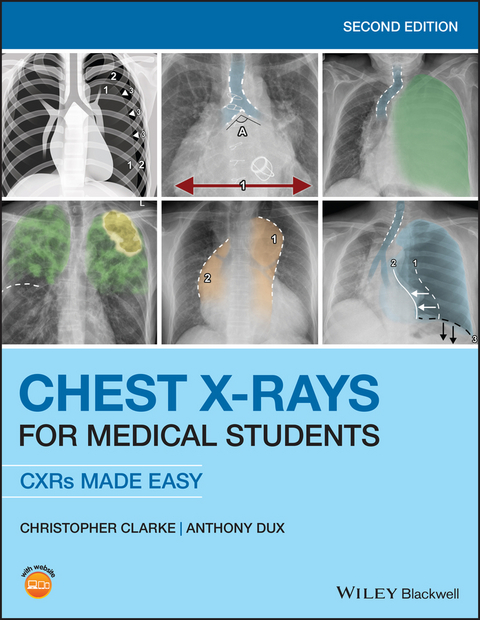
Chest X-rays for Medical Students offers a fresh analytical approach to identifying chest abnormalities, helping medical students, junior doctors, and nurses understand the underlying physics and basic anatomical and pathological details of X-ray images of the chest. The authors provide a memorable framework for analysing and presenting chest radiographs, with each radiograph appearing twice in a side-by-side comparison, one as seen in a clinical setting and the second highlighting the pathology.
This new second edition includes significant revisions, improved annotations of X-rays, expanded pathologies, and numerous additional high-quality images. A comprehensive one-stop guide to learning chest radiograph interpretation, this book:
- Aligns with the latest Royal College of Radiologists' Undergraduate Radiology Curriculum
- Offers guidance on how to formulate normal findings
- Features self-assessment tests, presentation exercises, and varied examples
- Includes sections on radiograph quality X-ray hazards and precautions
Chest X-rays for Medical Students is an ideal study guide and clinical reference for any medical student, junior doctor, nurse or radiographer.
CHRISTOPHER CLARKE, Consultant Radiologist at Nottingham University Hospitals NHS Trust, Nottingham, UK. He is a member of the British and European Societies of Gastrointestinal and Abdominal Radiology.
ANTHONY DUX, Former Consultant Radiologist and Honorary Senior Lecturer at the University Hospitals of Leicester NHS Trust, Leicester, UK.
Chest X-rays for Medical Students offers a fresh analytical approach to identifying chest abnormalities, helping medical students, junior doctors, and nurses understand the underlying physics and basic anatomical and pathological details of X-ray images of the chest. The authors provide a memorable framework for analysing and presenting chest radiographs, with each radiograph appearing twice in a side-by-side comparison, one as seen in a clinical setting and the second highlighting the pathology. This new second edition includes significant revisions, improved annotations of X-rays, expanded pathologies, and numerous additional high-quality images. A comprehensive one-stop guide to learning chest radiograph interpretation, this book: Aligns with the latest Royal College of Radiologists Undergraduate Radiology Curriculum Offers guidance on how to formulate normal findings Features self-assessment tests, presentation exercises, and varied examples Includes sections on radiograph quality X-ray hazards and precautions Chest X-rays for Medical Students is an ideal study guide and clinical reference for any medical student, junior doctor, nurse or radiographer.
CHRISTOPHER CLARKE, Consultant Radiologist at Nottingham University Hospitals NHS Trust, Nottingham, UK. He is a member of the British and European Societies of Gastrointestinal and Abdominal Radiology. ANTHONY DUX, Former Consultant Radiologist and Honorary Senior Lecturer at the University Hospitals of Leicester NHS Trust, Leicester, UK.
Preface to the 2nd Edition ix
Acknowledgements xi
Learning objectives checklist xiii
About the companion website xv
Part I Introduction to X-rays 1
1 Introduction to X-rays 3
What are X-rays? 3
How are X-rays produced? 3
How do X-rays make an image? 4
The five densities on an X-ray 4
How are X-ray images (radiographs) stored? 4
Hazards and precautions 5
2 Chest X-ray views 7
PA erect chest X-ray 7
Other views 8
3 Radiograph quality 9
Inclusion 9
Rotation 10
Inspiration 11
4 Normal anatomy on a PA chest X-ray 13
Right and left 13
Lung zones 14
The mediastinum 14
Normal pulmonary vasculature 15
General anatomy 16
Bronchial and lobar anatomy: Figure 4.8 17
5 Presenting a chest radiograph 19
Example of presenting a normal chest X-ray 19
Part II The ABCDE of chest X-rays 21
6 A - Airway 23
How to review the airway 23
What to look for 24
Tracheal deviation 24
Carinal angle 25
7 B - Breathing 27
How to review the lungs 27
What to look for 28
Consolidation/airspace opacification 29
Air bronchogram 31
Collapse (atelectasis) overview 32
Pneumonectomy 41
Solitary mass lesion 44
Multiple mass lesions 47
Cavitating lung lesion 48
Fibrosis 50
Pneumothorax 53
Tension pneumothorax 55
Hydropneumothorax 56
Pleural effusion 57
Pulmonary oedema 60
Septal lines 64
Asbestos-related lung disease 65
8 C - Circulation 69
How to review the heart and mediastinum 69
What to look for 69
Dextrocardia 69
Cardiomegaly (enlarged heart) 70
Left atrial enlargement 71
Widened mediastinum 72
Hilar enlargement 76
Hiatus hernia 78
9 D - Disability 79
How to review the bones 79
What to look for 80
Fractures 80
Sclerotic and lucent bone lesions 81
10 E - Everything else (review areas) 83
How to look at the review areas 83
What to look for 83
Gas under the diaphragm (pneumoperitoneum) 84
Subcutaneous emphysema/surgical emphysema 86
Mastectomy 87
Medical and surgical objects (iatrogenic) 88
Foreign bodies 99
Part III Common conditions and their radiological signs 101
11 Common conditions and their radiological signs 103
Pulmonary embolism (PE) 103
Primary lung malignancy 103
Pneumonia 104
Chronic obstructive pulmonary disease (COPD) 104
Heart failure 105
Tuberculosis 106
Glossary 111
Index 119
7
B – Breathing
How to review the lungs
A general rule is that black = air and white = no air. There are five main areas to look at.
- Are the lungs uniformly expanded?
- Compare the lung fields and look for white areas (opacities):
- compare left apex with right apex;
- compare left upper zone with right upper zone;
- compare left mid zone with the right mid zone;
- compare the left lower zone with the right lower zone.
- Look around the edges of each lung.
- Look at the costophrenic angles.
- Look for the following four silhouettes (outlines) (Figure 7.1):
- Right heart border. Loss of definition of the right heart border silhouette indicates a loss of air in the middle lobe (due to collapse or consolidation).
- Left heart border. Loss of definition of the left heart border silhouette indicates a loss of air in the lingula (part of the left upper lobe).
- Right hemidiaphragm. Loss of definition of the right hemidiaphragmatic silhouette indicates a loss of air in the right lower lobe (due to collapse or consolidation), or that there is something between the diaphragm and the right lower lobe (e.g. pleural fluid).
- Left hemidiaphragm. Loss of definition of the left hemidiaphragmatic silhouette indicates a loss of air in the left lower lobe (due to collapse or consolidation), or that there is something between the diaphragm and the left lower lobe (e.g. pleural fluid).
Figure 7.1 The four silhouettes. The right heart border (red), left heart border (yellow), right hemidiaphragm (purple), and left hemidiaphragm (pink).
Note: It is normal to see all four silhouettes as there should be air in the lobes adjacent to each these four areas. If there is an opacity in the lobe adjacent to one of these areas (e.g. consolidation or collapse), then the crisp silhouette is lost and this is called the ‘silhouette sign’ (Figure 7.2). Because the ‘silhouette sign’ refers to the loss of one of the above silhouettes, it may be more accurate to call it the ‘loss of silhouette sign’ or ‘loss of outline sign’.
Figure 7.2 Diagrammatic representation of the silhouette sign. Image 1 (left) shows a normal crisp silhouette. Image 2 (right) shows the ‘silhouette sign’. As you can see the ‘silhouette sign’ refers to loss of definition/blurring of the normal crisp silhouette.
What to look for
Chest X‐rays do not show many specific diseases (e.g. pneumonia, primary lung malignancy, etc.), only signs of pathology, which can give a clue to the underlying disease process. The following are a list of pathologies and signs that you should know.
- Consolidation/airspace opacificationp.29
- Air bronchogramp.31
- Collapse (atelectasis) overviewp.32
- right upper lobe collapsep.33
- middle lobe collapsep.34
- right lower lobe collapsep.36
- left upper lobe collapsep.37
- left lower lobe collapse p.39
- complete lung collapsep.40
- Pneumonectomyp.41
- Solitary mass lesionp.44
- Multiple mass lesionsp.47
- Cavitating lung lesion p.48
- Fibrosisp.50
- Pneumothorax p.53
- Tension pneumothoraxp.55
- Hydropneumothoraxp.56
- Pleural effusionp.57
- Pulmonary oedemap.60
- ‘Bat’s wing’ pattern opacificationp.61
- Septal linesp.64
- Asbestos‐related lung diseasep.65
- benign pleural diseasep.65
- asbestosisp.66
- mesotheliomap.66
Consolidation/airspace opacification
Consolidation (also known as airspace opacification) is the replacement of alveolar air by fluid, cells, pus, or other material (Figure 7.3). Pneumonia is by far the most common cause of consolidation. It is also sometimes seen in primary TB.
Figure 7.3 Diagrammatic representation of three normal alveoli (left image) and consolidation (green) within the three alveoli (right image).
Features of consolidation on a chest radiograph
- Heterogenous or patchy opacification: the opacification is non‐uniform and the border is not well demarcated (it sometimes looks fluffy).
- Lobar or segmental distribution: the opacification usually corresponds anatomically to a lobe or lung segment.
- Air bronchogram (see p. 31): the presence of an air bronchogram would confirm that the density (fluid/pus) was in the alveoli and not the larger airways. Bronchial breathing on auscultation is the clinical sign of an air bronchogram.
- No loss of lung volume: lung volumes may actually increase in the early stages of consolidation. In later stages there can be a small loss of lung volume due to secretions obstructing airways; however, as a general rule, there is no significant loss of lung volume in consolidation.
Note: Remember the clinical history. In the presence of a temperature and signs of infection, consolidation is by far the most likely abnormality. Also compare with previous radiographs – the presence of a similar abnormality on a previous radiograph should lead you to suspect fibrosis rather than consolidation.
Example 1: Figure 7.4
Figure 7.4 Consolidation in the lingula (green). There is heterogenous airspace opacification in the left lower zone and no loss of lung volume. The left hemidiaphragm can be clearly seen, however the left heart border is poorly defined (silhouette sign); therefore, the pathology is in the lung adjacent to the left heart border, i.e. the lingula of the left upper lobe.
Example 2: Figure 7.5
Figure 7.5 Consolidation (green) in the middle lobe and left lower lobe. There is heterogenous airspace opacification in the right and left lower zones and no loss of lung volume. We know the consolidation on the right side is in the middle lobe as there is loss of definition of the right heart border (silhouette sign) and the superior border is the horizontal fissure (marked with a white dashed line). We know the consolidation on the left side is in the left lower lobe as there is loss of definition of the left hemidiaphragm (silhouette sign), yet the left heart border is still clearly visible.
Example 3: Figure 7.6
Figure 7.6 Consolidation (green) in both lungs with moderate sparing of the right upper zone (which appears darker than the rest). There is heterogenous airspace opacification, no loss of lung volume, and air bronchograms seen in both lungs. You can also see an endotracheal tube (white arrowheads), ECG leads (white dashed lines), nasogastric tube in situ, and other overlying tubing.
Air bronchogram
An air bronchogram is the radiographic appearance of an air‐filled bronchus that is surrounded by fluid‐filled or solid alveoli.
- It can appear when there is consolidation (e.g. pneumonia) or pulmonary oedema in the surrounding alveoli.
- Sometimes it is a good prognostic sign as it shows that secretions are able to exit from the consolidated region via the bronchus.
Note: The air bronchogram is the radiological equivalent of bronchial breathing on clinical examination.
Example 1: Figure 7.7
Figure 7.7 This is the same radiograph as Figure 7.6 and is a good example of an air bronchogram caused by severe bilateral consolidation. The air bronchogram is marked in grey on the inferior radiograph. You can also see an endotracheal tube, ECG leads, nasogastric tube in situ, and other overlying tubing.
Collapse (atelectasis) overview
Collapse is failure of all or part of the lung to expand due to loss of air in the alveoli.
- Lobar collapse refers to collapse of a particular lobe of the lung.
- Lung collapse refers to collapse of a whole lung.
General features of collapse on a chest radiograph include:
- An increase in density, representing lung devoid of air (whiteness).
- Signs indicating decreased lung volume, such as:
- displacement of mediastinum/trachea towards the collapsed lung;
- elevation of the hemidiaphragm;
- compensatory over‐inflation of adjacent lobes or opposite lung.
Note: When looking at a white lung, it is important to be thorough in looking...
| Erscheint lt. Verlag | 20.1.2020 |
|---|---|
| Sprache | englisch |
| Themenwelt | Medizin / Pharmazie ► Gesundheitsfachberufe |
| Medizinische Fachgebiete ► Radiologie / Bildgebende Verfahren ► Nuklearmedizin | |
| Medizinische Fachgebiete ► Radiologie / Bildgebende Verfahren ► Radiologie | |
| Schlagworte | chest X-ray analysis • chest X-ray interpretation • chest X-ray introduction • chest X-ray pathologies</p> • chest X-rays • chest X-rays nurses • chest X-rays students • chest X-rays trainees • CXRs guide • CXRs reference • Interventional cardiology • intro to radiography • Invasive Kardiologie • <p>intro to X-rays • Medical Science • Medizin • Radiologie • Radiologie u. Bildgebende Verfahren • Radiology & Imaging |
| ISBN-10 | 1-119-50412-0 / 1119504120 |
| ISBN-13 | 978-1-119-50412-2 / 9781119504122 |
| Informationen gemäß Produktsicherheitsverordnung (GPSR) | |
| Haben Sie eine Frage zum Produkt? |
 EPUB (Adobe DRM)
Kopierschutz: Adobe-DRM
Adobe-DRM ist ein Kopierschutz, der das eBook vor Mißbrauch schützen soll. Dabei wird das eBook bereits beim Download auf Ihre persönliche Adobe-ID autorisiert. Lesen können Sie das eBook dann nur auf den Geräten, welche ebenfalls auf Ihre Adobe-ID registriert sind.
Details zum Adobe-DRM
Dateiformat: EPUB (Electronic Publication)
EPUB ist ein offener Standard für eBooks und eignet sich besonders zur Darstellung von Belletristik und Sachbüchern. Der Fließtext wird dynamisch an die Display- und Schriftgröße angepasst. Auch für mobile Lesegeräte ist EPUB daher gut geeignet.
Systemvoraussetzungen:
PC/Mac: Mit einem PC oder Mac können Sie dieses eBook lesen. Sie benötigen eine
eReader: Dieses eBook kann mit (fast) allen eBook-Readern gelesen werden. Mit dem amazon-Kindle ist es aber nicht kompatibel.
Smartphone/Tablet: Egal ob Apple oder Android, dieses eBook können Sie lesen. Sie benötigen eine
Geräteliste und zusätzliche Hinweise
Buying eBooks from abroad
For tax law reasons we can sell eBooks just within Germany and Switzerland. Regrettably we cannot fulfill eBook-orders from other countries.
aus dem Bereich