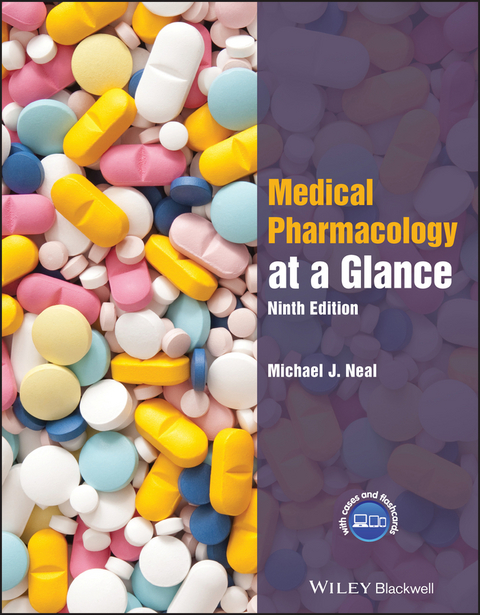
Medical Pharmacology at a Glance (eBook)
John Wiley & Sons (Verlag)
978-1-119-54809-6 (ISBN)
The internationally best-selling Medical Pharmacology at a Glance is the ideal companion for all medical and healthcare students, providing a visual overview of pharmacology, and describing the basic principles of drug action, interaction, absorption, and excretion. Clear and accessible chapters organised around common diseases and conditions facilitate efficient clinical learning, and include references to drug classes and side effects, disease pathophysiology, prescribing guidelines, and more.
Now in its ninth edition, this leading guide has been thoroughly updated to reflect current guidelines and drug information. This edition features new and revised illustrations, additional pedagogical tools, and enhanced online content. Widely recognised as both the best introduction to medical pharmacology and the perfect revision tool for USMLE and pharmacology exams, this invaluable guide:
- Covers a wide range of drugs used to treat conditions such as hypertension, anaemias, cancer, and affective disorders
- Explains drug mechanisms and the principles of drug action
- Discusses practical topics including drug misuse, drug indications, and side effects
- Includes a companion website featuring online cases, flashcards, and a list of core drugs
Michael J. Neal is former Chairman of Pharmacology, United Medical and Dental School of Guy's and St Thomas' Hospital, and Emeritus Professor of Pharmacology, King's College London, UK.
The internationally best-selling Medical Pharmacology at a Glance is the ideal companion for all medical and healthcare students, providing a visual overview of pharmacology, and describing the basic principles of drug action, interaction, absorption, and excretion. Clear and accessible chapters organised around common diseases and conditions facilitate efficient clinical learning, and include references to drug classes and side effects, disease pathophysiology, prescribing guidelines, and more. Now in its ninth edition, this leading guide has been thoroughly updated to reflect current guidelines and drug information. This edition features new and revised illustrations, additional pedagogical tools, and enhanced online content. Widely recognised as both the best introduction to medical pharmacology and the perfect revision tool for USMLE and pharmacology exams, this invaluable guide: Covers a wide range of drugs used to treat conditions such as hypertension, anaemias, cancer, and affective disorders Explains drug mechanisms and the principles of drug action Discusses practical topics including drug misuse, drug indications, and side effects Includes a companion website featuring online cases, flashcards, and a list of core drugs
Michael J. Neal is former Chairman of Pharmacology, United Medical and Dental School of Guy's and St Thomas' Hospital, and Emeritus Professor of Pharmacology, King's College London, UK.
Preface vii
Acknowledgements viii
Further reading ix
List of abbreviations x
Core drugs xi
About the companion website xii
1 Introduction: principles of drug action 2
2 Drug-receptor interactions 4
3 Drug absorption, distribution and excretion 6
4 Drug metabolism 8
5 Local anaesthetics 10
6 Drugs acting at the neuromuscular junction 12
7 Autonomic nervous system 14
8 Autonomic drugs acting at cholinergic synapses 16
9 Drugs acting on the sympathetic system 18
10 Ocular pharmacology 20
11 Asthma, hay fever and anaphylaxis 22
12 Drugs acting on the gastrointestinal tract I: peptic ulcer 24
13 Drugs acting on the gastrointestinal tract II: motility and secretions 26
14 Drugs acting on the kidney: diuretics 28
15 Drugs used in hypertension 30
16 Drugs used in angina 32
17 Antiarrhythmic drugs 34
18 Drugs used in heart failure 36
19 Drugs used to affect blood coagulation 38
20 Lipid-lowering drugs 40
21 Agents used in anaemias 42
22 Central transmitter substances 44
23 General anaesthetics 46
24 Anxiolytics and hypnotics 48
25 Antiepileptic drugs 50
26 Drugs used in Parkinson's disease 52
27 Antipsychotic drugs (neuroleptics) 54
28 Drugs used in affective disorders: antidepressants 56
29 Opioid analgesics 58
30 Drugs used in nausea and vertigo (antiemetics) 60
31 Drug misuse and dependence 62
32 Non-steroidal anti-inflammatory drugs (NSAIDs) 64
33 Corticosteroids 66
34 Sex hormones and drugs 68
35 Thyroid and antithyroid drugs 70
36 Antidiabetic agents 72
37 Antibacterial drugs that inhibit nucleic acid synthesis: sulphonamides, trimethoprim, quinolones and nitroimidazoles 74
38 Antibacterial drugs that inhibit cell wall synthesis: penicillins, cephalosporins and vancomycin 76
39 Antibacterial drugs that inhibit protein synthesis: aminoglycosides, tetracyclines, macrolides and chloramphenicol 78
40 Antifungal drugs 80
41 Antiviral drugs 82
42 Drugs acting on parasites I: helminths (worms) 84
43 Drugs acting on parasites II: protozoa 86
44 Drugs used in cancer 88
45 Immunosuppressants and antirheumatoid drugs 90
46 Poisoning 92
47 Adverse drug reactions 94
Case studies and questions 96
Answers 98
Index 102
1
Introduction: principles of drug action
Medical pharmacology is the science of chemicals (drugs) that interact with the human body. These interactions are divided into two classes:
- pharmacodynamics – the effects of the drug on the body; and
- pharmacokinetics – the way the body affects the drug with time (i.e. absorption, distribution, metabolism and excretion).
The most common ways in which a drug can produce its effects are shown in the figure. A few drugs (e.g. activated charcoal, osmotic diuretics) act by virtue of their physicochemical properties, and this is called non‐specific drug action. Some drugs act as false substrates or inhibitors for certain transport systems (bottom right) or enzymes (bottom left). However, most drugs produce their effects by acting on specific protein molecules, usually located in the cell membrane. These proteins are called receptors (), and they normally respond to endogenous chemicals in the body. These chemicals are either synaptic transmitter substances (top left, ) or hormones (top right, ). For example, acetylcholine is a transmitter substance released from motor nerve endings; it activates receptors in skeletal muscle, initiating a sequence of events that results in contraction of the muscle. Chemicals (e.g. acetylcholine) or drugs that activate receptors and produce a response are called agonists (). Some drugs, called antagonists (), combine with receptors, but do not activate them. Antagonists reduce the probability of the transmitter substance (or another agonist) combining with the receptor and so reduce or block its action.
The activation of receptors by an agonist or hormone is coupled to the physiological or biochemical responses by transduction mechanisms (lower figure) that often (but not always) involve molecules called ‘second messengers’ ().
The interaction between a drug and the binding site of the receptor depends on the complementarity of ‘fit’ of the two molecules. The closer the fit and the greater the number of bonds (usually noncovalent), the stronger will be the attractive forces between them, and the higher the affinity of the drug for the receptor. The ability of a drug to combine with one particular type of receptor is called specificity. No drug is truly specific, but many have a relatively selective action on one type of receptor.
Drugs are prescribed to produce a therapeutic effect, but they often produce additional unwanted effects (Chapter 46) that range from the trivial (e.g. slight nausea) to the fatal (e.g. aplastic anaemia).
Receptors
These are protein molecules that are normally activated by transmitters or hormones. Many receptors have now been cloned and their amino acid sequences determined. The four main types of receptor are listed below.
- Agonist (ligand)‐gated ion channels are made up of protein subunits that form a central pore (e.g. nicotinic receptor, Chapter 6; γ‐aminobutyric acid (GABA) receptor, Chapter 24).
- G‐protein‐coupled receptors (see below) form a family of receptors with seven membrane‐spanning helices. They are linked (usually) to physiological responses by second messengers.
- Nuclear receptors for steroid hormones (Chapter 34) and thyroid hormones (Chapter 35) are present in the cell nucleus and regulate transcription and thus protein synthesis.
- Kinase‐linked receptors are surface receptors that possess (usually) intrinsic tyrosine kinase activity. They include receptors for insulin, cytokines and growth factors (Chapter 36).
Transmitter substances are chemicals released from nerve terminals that diffuse across the synaptic cleft and bind to the receptors. This binding activates the receptors by changing their conformation and triggers a sequence of postsynaptic events resulting in, for example, muscle contraction or glandular secretion. Following its release, the transmitter is inactivated (left of the figure) by either enzymic degradation (e.g. acetylcholine) or reuptake (e.g. norepinephrine [noradrenaline], GABA). Many drugs act by either reducing or enhancing synaptic transmission.
Hormones are chemicals released into the bloodstream; they produce their physiological effects on tissues possessing the necessary specific hormone receptors. Drugs may interact with the endocrine system by inhibiting (e.g. antithyroid drugs, Chapter 35) or increasing (e.g. oral antidiabetic agents, Chapter 36) hormone release. Other drugs interact with hormone receptors, which may be activated (e.g. steroidal anti‐inflammatory drugs, Chapter 33) or blocked (e.g. oestrogen antagonists, Chapter 34). Local hormones (autacoids), such as histamine, serotonin (5‐hydroxytryptamine, 5HT), kinins and prostaglandins, are released in pathological processes. The effects of histamine can sometimes be blocked with antihistamines (Chapter 11), and drugs that block prostaglandin synthesis (e.g. aspirin) are widely used as anti‐inflammatory agents (Chapter 32).
Transport systems
The lipid cell membrane provides a barrier against the transport of hydrophilic molecules into or out of the cell.
Ion channels are selective pores in the membrane that allow the ready transfer of ions down their electrochemical gradient. The open–closed state of these channels is controlled either by the membrane potential (voltage‐gated channels) or by transmitter substances (ligand‐gated channels). Some channels (e.g. Ca2+ channels in the heart) are both voltage and transmitter gated. Voltage‐gated channels for sodium, potassium and calcium have the same basic structure (Chapter 5), and subtypes exist for each different channel. Important examples of drugs that act on voltage‐gated channels are calcium‐channel blockers (Chapter 16), which block L‐type calcium channels in vascular smooth muscle and the heart, and local anaesthetics (Chapter 5), which block sodium channels in nerves. Some anticonvulsants (Chapter 25) and some antiarrhythmic drugs (Chapter 17) also block Na+ channels. No clinically useful drug acts primarily on voltage‐gated K+ channels, but oral antidiabetic drugs act on a different type of K+ channel that is regulated by intracellular adenosine triphosphate (ATP, Chapter 36).
Active transport processes are used to transfer substances against their concentration gradients. They utilize special carrier molecules in the membrane and require metabolic energy. Two examples are listed below.
- Sodium pump. This expels Na+ ions from inside the cell by a mechanism that derives energy from ATP and involves the enzyme adenosine triphosphatase (ATPase). The carrier is linked to the transfer of K+ ions into the cell. The cardiac glycosides (Chapter 18) act by inhibiting the Na+/K+‐ATPase. Na+ and/or Cl− transport processes in the kidney are inhibited by some diuretics (Chapter 14).
- Norepinephrine transport. The tricyclic antidepressants (Chapter 28) prolong the action of norepinephrine by blocking its reuptake into central nerve terminals.
Enzymes
These are catalytic proteins that increase the rate of chemical reactions in the body. Drugs that act by inhibiting enzymes include: anticholinesterases, which enhance the action of acetylcholine (Chapters 6 and 8); carbonic anhydrase inhibitors, which are diuretics (i.e. increase urine flow, Chapter 14); monoamine oxidase inhibitors, which are antidepressants (Chapter 28); and inhibitors of cyclo‐oxygenase (e.g. aspirin, Chapter 32).
Second messengers
These are chemicals whose intracellular concentration increases or, more rarely, decreases in response to receptor activation by agonists, and which trigger processes that eventually result in a cellular response. The most studied second messengers are: Ca2+ ions, cyclic adenosine monophosphate (cAMP), inositol‐1,4,5‐trisphosphate (InsP3) and diacylglycerol (DAG).
cAMP is formed from ATP by the enzyme adenylyl cyclase when, for example, β‐adrenoceptors are stimulated. The cAMP activates an enzyme (protein kinase A), which phosphorylates a protein (enzyme or ion channel) and leads to a physiological effect.
InsP3 and DG are formed from membrane phosphatidylinositol 4,5‐bisphosphate by activation of a phospholipase C. Both messengers can, like cAMP, activate kinases, but InsP3 does this indirectly by mobilizing intracellular calcium stores. Some muscarinic effects of acetylcholine and α1‐adrenergic effects involve this mechanism (Chapter 7).
G‐proteins
G‐protein‐coupled receptors are linked to their responses by a family of regulatory guanosine triphosphate (GTP)‐binding proteins (G‐proteins). The receptor–agonist complex induces a conformational change in the G‐protein, causing its α‐subunit to bind GTP. The α–GTP complex dissociates from the G‐protein and activates (or inhibits) the membrane enzyme or channel. The signal to the enzyme or channel ends because α–GTP...
| Erscheint lt. Verlag | 10.1.2020 |
|---|---|
| Reihe/Serie | At a Glance |
| At a Glance | At a Glance |
| Sprache | englisch |
| Themenwelt | Medizin / Pharmazie ► Gesundheitsfachberufe |
| Medizin / Pharmazie ► Medizinische Fachgebiete ► Pharmakologie / Pharmakotherapie | |
| Medizin / Pharmazie ► Studium | |
| Schlagworte | Basic Pharmacology • drug guide • Grundlagen der Pharmakologie • <p>medical pharmacology • medical education • Medical Science • Medizin • Medizinstudium • Pharmacology & Pharmaceutical Medicine • pharmacology exam guide • pharmacology exam prep • pharmacology guide • pharmacology intro • pharmacology medical students • pharmacology nurses • pharmacology review guide • pharmacology revision guide • Pharmakologie u. Pharmazeutische Medizin • prescribing guide</p> |
| ISBN-10 | 1-119-54809-8 / 1119548098 |
| ISBN-13 | 978-1-119-54809-6 / 9781119548096 |
| Informationen gemäß Produktsicherheitsverordnung (GPSR) | |
| Haben Sie eine Frage zum Produkt? |
 EPUB (Adobe DRM)
Kopierschutz: Adobe-DRM
Adobe-DRM ist ein Kopierschutz, der das eBook vor Mißbrauch schützen soll. Dabei wird das eBook bereits beim Download auf Ihre persönliche Adobe-ID autorisiert. Lesen können Sie das eBook dann nur auf den Geräten, welche ebenfalls auf Ihre Adobe-ID registriert sind.
Details zum Adobe-DRM
Dateiformat: EPUB (Electronic Publication)
EPUB ist ein offener Standard für eBooks und eignet sich besonders zur Darstellung von Belletristik und Sachbüchern. Der Fließtext wird dynamisch an die Display- und Schriftgröße angepasst. Auch für mobile Lesegeräte ist EPUB daher gut geeignet.
Systemvoraussetzungen:
PC/Mac: Mit einem PC oder Mac können Sie dieses eBook lesen. Sie benötigen eine
eReader: Dieses eBook kann mit (fast) allen eBook-Readern gelesen werden. Mit dem amazon-Kindle ist es aber nicht kompatibel.
Smartphone/Tablet: Egal ob Apple oder Android, dieses eBook können Sie lesen. Sie benötigen eine
Geräteliste und zusätzliche Hinweise
Buying eBooks from abroad
For tax law reasons we can sell eBooks just within Germany and Switzerland. Regrettably we cannot fulfill eBook-orders from other countries.
aus dem Bereich