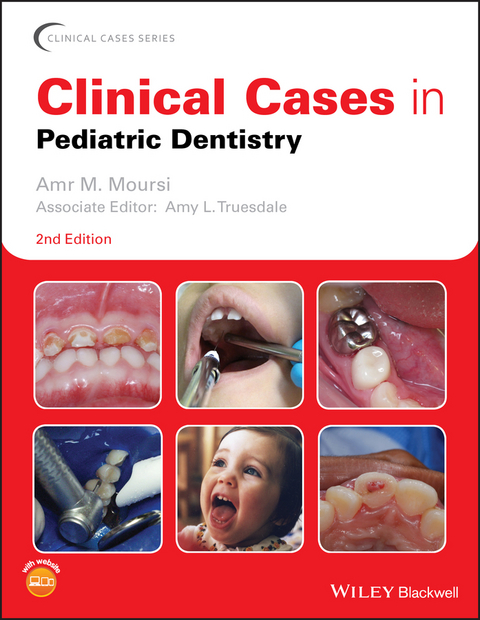
Clinical Cases in Pediatric Dentistry (eBook)
John Wiley & Sons (Verlag)
978-1-119-29091-9 (ISBN)
Maintaining the original popular format enjoyed by so many readers, this Second Edition features comprehensive updates to all 66 cases to include the latest diagnostic and treatment techniques. Each chapter also includes brand-new cases, for a total of 13 entirely new cases. The most current references to the literature, best practices, and evidence based clinical guidelines, plus new and updated self-assessment questions with detailed answers and explanations, have been added to all the cases.
This second edition maintains the same aim of presenting actual clinical cases to question and educate the reader on pediatric dentistry, using a clear, concise, and consistent format to offer a case history, diagnostics and treatment plans for each case. Clinical Cases in Pediatric Dentistry, Second Edition is based on the most current evidence, with standards of care and policies as adopted by relevant associations and societies. This important resource:
- Presents updated content, clinical guidelines, and references in existing cases, with thirteen brand new case scenarios
- Takes an easy-to-follow format, with patient history and diagnostics, questions, and answers, and explanations for each case
- Part of the 'Clinical Cases' series applying both theory and practice to actual clinical cases
- Includes access to a companion website featuring additional case studies, charts, tables, web links, and the figures from the book in PowerPoint
Presenting real-world cases that encompass all-important areas of pediatric dentistry, Clinical Cases in Pediatric Dentistry, Second Edition is an essential resource for pre-doctoral dental students, post-graduate residents, and pediatric dentists preparing for board examinations and recertification. It's also an excellent guide for students and faculty in pediatric dentistry departments, as well as practicing pediatric dentists and family dentists.
Editor Amr M. Moursi, DDS, PhD, is Professor and Chairman of the Department of Pediatric Dentistry at the New York University College of Dentistry and an Attending Dentist on the medical staff at NYU Langone Medical Center and Bellevue Hospital Center in New York, New York, USA.
Associate Editor Amy L. Truesdale, DDS, is Clinical Assistant Professor and Associate Post-Doctoral Program Director in the Department of Pediatric Dentistry at the New York University College of Dentistry in New York, New York, USA.
Editor Amr M. Moursi, DDS, PhD, is Professor and Chairman of the Department of Pediatric Dentistry at the New York University College of Dentistry and an Attending Dentist on the medical staff at NYU Langone Medical Center and Bellevue Hospital Center in New York, New York, USA. Associate Editor Amy L. Truesdale, DDS, is Clinical Assistant Professor and Associate Post-Doctoral Program Director in the Department of Pediatric Dentistry at the New York University College of Dentistry in New York, New York, USA.
1
Early Childhood Oral Health
Homa Amini
- Case 1: Perinatal Oral Pathology
Homa Amini
- Case 2: First Dental Visit, Healthy Child
Homa Amini
- Case 3: First Dental Visit, Medically Compromised Child
Homa Amini
- Case 4: Early Childhood Caries Managed with Silver Diamine Fluoride
Homa Amini and James R. Boynton
- Case 5: Early Childhood Caries Managed with Interim Therapeutic Restorations
Homa Amini
- Case 6: Early Childhood Caries Managed with General Anesthesia
Homa Amini
Case 1 Perinatal Oral Pathology
Figure 1.1.1 Intraoral photograph showing anterior mandibular natal teeth.
A. Presenting Patient
- Seven‐day‐old male
- Consultative visit requested by neonatologist
B. Chief Complaint
- Neonatologist requests “evaluation of what appear to be teeth erupting on bottom jaw”
FUNDAMENTAL POINT 1
Obtaining a History
- Obtain a thorough history of the pregnancy and birth
- Obtain a thorough understanding of the child’s natal teeth, including when first observed, associated complications with ventilator tubing, or infections (Cunha et al. 2001; Amini and Casamassimo 2010)
C. Social History
- First child
- Twenty‐one‐year‐old single, immigrant mother
- Qualified for public assistance
D. Medical History
- Born two weeks prematurely
- On ventilator for two days
- Currently in pediatric intensive care unit
E. Medical Consult
- Not applicable
F. Dental History
- Teeth present at birth
G. Extraoral Exam
- Head misshapen
- Sparse hair
FUNDAMENTAL POINT 2
Clinical Exam: Significance of Findings
- Determine if the teeth present a problem for nursing due to irritation of child or mother. Also determine the potential risk of aspiration if teeth are mobile
- If removal is contemplated, consider radiographic examination to determine whether teeth are supernumerary or prematurely erupting teeth of the primary dentition
H. Intraoral Exam
- Edentulous maxillary arch
- High maxillary frenum
- Palate intact
- Mandibular arch with teeth in the mandibular left central incisor and mandibular right central incisor positions, partially erupted, brownish in color, rotated and firm to manipulation (Figure 1.1.1)
BACKGROUND INFORMATION 1
Natal and Neonatal Teeth
- Teeth can be present at birth (natal teeth) or erupt within the first 30 days after birth (neonatal teeth)
- Most natal teeth are members of the normal complement of primary teeth
- Most natal teeth appear in the mandibular anterior region
- Natal teeth may be associated with other disorders, usually those involving the skin, bones, or ectoderm, such as chondroectodermal dysplasia. Therefore, careful systemic evaluation of children with natal teeth is necessary (Moura et al. 2014)
I. Diagnostic Tools
- Occlusal radiograph of mandibular anterior region if deemed necessary (Figure 1.1.2)
J. Differential Diagnosis
- Other congenital neonatal pathology including: Bohn’s nodules, Epstein’s pearls, and other retention phenomena
Figure 1.1.2 Mandibular occlusal radiograph showing natal teeth.
K. Diagnosis and Problem List
Diagnosis
- Natal teeth
Problem List
- Potential for nursing difficulty
- Potential for aspiration
- Potential for traumatic ulcer of the ventral surface of the tongue known as Riga–Fede disease (Figure 1.1.3)
- Potential for trauma to the mucosa of the opposing arch
L. Treatment Plan
- Observe for mobility, ulcerations, and nursing difficulty
- Extraction as indicated
M. Prognosis and Discussion
- No literature describes the risk of aspiration of natal teeth, so removal should be based primarily on the appearance, firmness, and likelihood of function of the tooth
- In the event the tooth is a member of the normal complement of primary teeth, parents should be made aware that the loss might result in alteration of spacing and alignment of the remaining primary teeth
N. Complications and Alternative Treatment Plan
- If the infant presents with a ventral tongue ulceration or the mother presents with an ulceration on the breast, incisal edge recontouring can be considered
- The child's vitamin K status should be determined prior to extraction within the first 10 days of life. Intramuscular administration of vitamin K at birth can reduce the risk of bleeding
Figure 1.1.3 Traumatic ulcer (arrow) on the ventral surface of the tongue.
Self‐Study Questions
- 1. What is the probability that natal teeth are members of the normal complement of primary teeth?
- 2. Where do natal teeth most often occur in the mouth?
- 3. What is a potential risk of using topical anesthetics in infants prior to extraction of a natal tooth?
- 4. What are potential etiologies of natal teeth?
- 5. What are characteristics of other neonatal oral lesions that would help differentiate a natal tooth?
Answers are located at the end of the case
Self‐Study Answers
- 1. The overwhelming probability is that a natal or neonatal tooth is a member of the 10 primary teeth in the arch, with fewer than 10% in most surveys being supernumeraries
- 2. Most natal teeth occur in the mandibular arch in the incisor region, and more than half the time they occur in pairs
- 3. Methemoglobinemia is a rare risk if topical anesthetics like benzocaine or prilocaine are used in infants. Oral sucrose can be considered prior to the extraction of a mobile natal tooth to soothe the neonate
- 4. Etiologies are usually attributed to a superficial position of the primary tooth bud, but also may include genetic factors, endocrine disorders, infection, and conditions such as cleft lip and palate, and Hallermann–Streiff syndrome
- 5. The other congenital oral abnormalities, which might be mistaken for a natal tooth, include a keratin‐filled body such as a Bohn’s nodule or a mucous retention cyst. However, they are softer in consistency
Bibliography
- Amini H, Casamassimo PS. 2010. Prenatal dental care: a review. Gen Dent 58(3):176–80.
- Cunha RF, Boe FAC, Torriani DD, Frossard WTG. 2001. Natal and neonatal teeth: review of the literature. Pediatr Dent 23(2):158–62.
- Moura LF, Moura MS, Lima MD et al. 2014. Natal and neonatal teeth: a review of 23 cases. J Dent Child 81:107–11.
Case 2 First Dental Visit, Healthy Child
Figure 1.2.1 (A) Knee‐to‐knee exam; (B) extraoral exam; (C) intraoral exam.
A. Presenting Patient
- Twelve‐month‐old African‐American female
B. Chief Complaint
- Mother reports, “My pediatrician said I needed to bring her in for her first dental check‐up”
C. Social History
- Lives with parents and two older siblings
- Mother is primary caregiver
D. Medical History
- Review of systems: normal
- History of well‐child visits and immunizations up to date in medical home
E. Medical Consult
- Not applicable
F. Dental History
- First dental visit
- No toothbrushing performed at this time
- Fluoridated water supply is main source of drinking water
- Uses pacifier intermittently
- Still drinks from bottle for meals and snacks, but not freely
G. Extraoral Exam
- Head, neck, and facial features normal
- Height and weight at 60th percentile
- Child marginally cooperative for knee‐to‐knee examination (Figure 1.2.1a,b)
H. Intraoral Exam (Figure 1.2.1c)
- Soft tissues healthy
- Eight teeth present, developmentally within normal range for age but with crowding
- Plaque on teeth
FUNDAMENTAL POINT 1
Dental History in Infant Oral Health
- The first dental visit...
| Erscheint lt. Verlag | 31.12.2019 |
|---|---|
| Reihe/Serie | Clinical Cases (Dentistry) |
| Clinical Cases (Dentistry) | Clinical Cases (Dentistry) |
| Mitarbeit |
Stellvertretende Herausgeber: Amy L. Truesdale |
| Sprache | englisch |
| Themenwelt | Medizin / Pharmazie ► Gesundheitsfachberufe |
| Medizin / Pharmazie ► Medizinische Fachgebiete | |
| Medizin / Pharmazie ► Zahnmedizin | |
| Schlagworte | Clinical Dentistry • Dental • dental case study</p> • dental guidebook • dentistry • Einführung i. d. Zahnmedizin • Endodontics • family dentistry • Healthcare • Introductions to Dentistry • Kinderzahnheilkunde • <p>Pediatric dentistry • Medical • Oral health • Oral Pathology • Orofacial • Pediatric Dentistry • perinatal • Pulp Therapy • restorative dentistry • Zahnmedizin |
| ISBN-10 | 1-119-29091-0 / 1119290910 |
| ISBN-13 | 978-1-119-29091-9 / 9781119290919 |
| Informationen gemäß Produktsicherheitsverordnung (GPSR) | |
| Haben Sie eine Frage zum Produkt? |
 EPUB (Adobe DRM)
Kopierschutz: Adobe-DRM
Adobe-DRM ist ein Kopierschutz, der das eBook vor Mißbrauch schützen soll. Dabei wird das eBook bereits beim Download auf Ihre persönliche Adobe-ID autorisiert. Lesen können Sie das eBook dann nur auf den Geräten, welche ebenfalls auf Ihre Adobe-ID registriert sind.
Details zum Adobe-DRM
Dateiformat: EPUB (Electronic Publication)
EPUB ist ein offener Standard für eBooks und eignet sich besonders zur Darstellung von Belletristik und Sachbüchern. Der Fließtext wird dynamisch an die Display- und Schriftgröße angepasst. Auch für mobile Lesegeräte ist EPUB daher gut geeignet.
Systemvoraussetzungen:
PC/Mac: Mit einem PC oder Mac können Sie dieses eBook lesen. Sie benötigen eine
eReader: Dieses eBook kann mit (fast) allen eBook-Readern gelesen werden. Mit dem amazon-Kindle ist es aber nicht kompatibel.
Smartphone/Tablet: Egal ob Apple oder Android, dieses eBook können Sie lesen. Sie benötigen eine
Geräteliste und zusätzliche Hinweise
Buying eBooks from abroad
For tax law reasons we can sell eBooks just within Germany and Switzerland. Regrettably we cannot fulfill eBook-orders from other countries.
aus dem Bereich