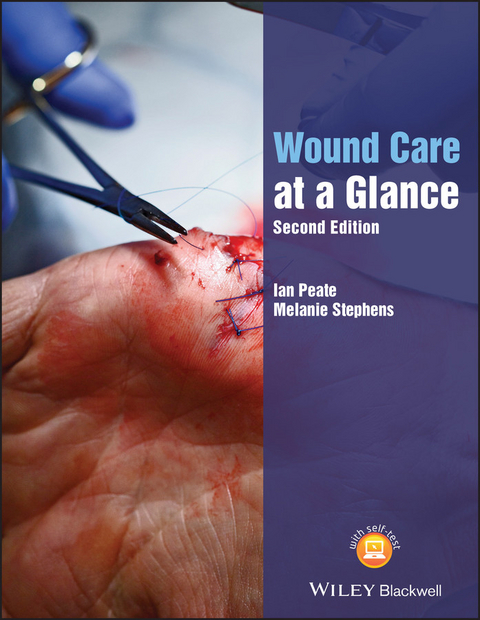
Wound Care at a Glance (eBook)
John Wiley & Sons (Verlag)
978-1-119-59059-0 (ISBN)
The second edition of Wound Care at a Glance is the ideal study and revision companion for undergraduate nursing and healthcare students, newly qualified practitioners, and for all involved with the provision of high quality, evidence-based wound care. This concise and user-friendly guide enables readers to expand their knowledge and understanding of wound care and skin integrity, and render safe and effective patient-centred care.
The guide's highly illustrated, visual approach to the subject of wound care and skin integrity explores the anatomy and physiology of the skin, acute and chronic wounds, pain management, legal and ethical issues, the various complexities of practical wound care, and more.
- Contains all the information you need to provide safe and effective patient care
- Presents a clear and concise account of appropriate wound care
- Incorporates both images and text to appeal to visual and non-visual learners alike
- Features a companion website containing interactive self-testing features
Ian Peate, OBE FRCN is Visiting Professor of Nursing, Visiting Senior Clinical Fellow, Editor-in-Chief of the British Journal of Nursing, and Head of School, School of Health Studies, Gibraltar.
Melanie Stephens is Senior Lecturer in Adult Nursing at Salford University, Chairman of the University of Salford International Wound Management Committee, and Module Lead for Tissue Viability and Leg Ulcer Management Modules.
The second edition of Wound Care at a Glance is the ideal study and revision companion for undergraduate nursing and healthcare students, newly qualified practitioners, and for all involved with the provision of high quality, evidence-based wound care. This concise and user-friendly guide enables readers to expand their knowledge and understanding of wound care and skin integrity, and render safe and effective patient-centred care. The guide s highly illustrated, visual approach to the subject of wound care and skin integrity explores the anatomy and physiology of the skin, acute and chronic wounds, pain management, legal and ethical issues, the various complexities of practical wound care, and more. Contains all the information you need to provide safe and effective patient care Presents a clear and concise account of appropriate wound care Incorporates both images and text to appeal to visual and non-visual learners alike Features a companion website containing interactive self-testing features
Ian Peate, OBE FRCN is Visiting Professor of Nursing, Visiting Senior Clinical Fellow, Editor-in-Chief of the British Journal of Nursing, and Head of School, School of Health Studies, Gibraltar. Melanie Stephens is Senior Lecturer in Adult Nursing at Salford University, Chairman of the University of Salford International Wound Management Committee, and Module Lead for Tissue Viability and Leg Ulcer Management Modules.
Preface to the second edition vii
Acknowledgements viii
How to use your textbook ix
About the companion website xi
Part 1 Anatomy and physiology 1
1 The history of wound care 2
2 Anatomy and physiology of the skin 4
3 Psychological and social aspects of the skin 6
4 Body image 8
5 The skin and ageing 12
Part 2 The normal healing process: acute wounds 15
6 Haemostasis 16
7 Inflammation 18
8 Proliferation (granulation and epithelialisation) 20
9 Maturation 22
10 Factors affecting wound-healing 24
Part 3 The abnormal healing process: chronic wound healing 27
11 The impaired healing process 28
12 Factors affecting wound-healing 30
13 Nutrition and wound-healing 32
14 Incontinence and wounds 34
15 Vascular disease 36
Part 4 Wound management in practice 39
16 Assessment of skin 40
17 Assessment of the patient with a wound 42
18 Classification of wounds 46
19 Legal and ethical aspects of wound care 48
20 Documenting wounds and keeping records 50
21 Evidence based practice 52
22 Treatment options 54
23 Pain management 56
Part 5 Dressing selection 59
24 Principles of wound management I 60
25 Principles of wound management II 61
26 Managing wound exudate: moist wound healing, hydration and maceration 62
27 Generic wound products: mode of action 64
28 Choosing a wound care product 68
29 Use of topical antimicrobials and antibiotics 70
30 Application of lotions, creams, emollients and ointments 74
31 Advanced technologies 76
Part 6 Complexities of wound care 79
32 Pressure redistribution equipment 80
33 Pressure ulcer classification and prevention 82
34 Pressure ulcers 86
35 Venous leg ulcers 88
36 Lymphoedema 90
37 Compression therapy 92
38 Arterial ulcers 94
39 Assessing for arterial disease: ankle-brachial pressure index and toe-brachial pressure index 96
40 Interpreting ABPIs 100
41 Diabetic foot ulcers 102
42 Moisture lesions 106
43 Surgical wounds 108
44 Traumatic wounds 112
45 Burns and scalds 114
46 Atypical wounds 116
47 Wounds in different populations 118
48 Malignant wounds and palliative wound care 120
Glossary 124
References and further reading 126
Index 128
4
Body image
Figure 4.1 The impact of a wound on a person’s self‐esteem and body image.
Table 4.1 Examples of communication strategies for addressing body image concerns (source: Adapted from Fingerert 2014).
| Body image challenge | Typical responses | Preferred responses |
| Exploratory phrases | Empathic phrases |
| 1. | ‘I can’t bear to look in the mirror or show my body to my wife since I had my mastectomy’. | You look smashing! Don’t worry, the swelling will continue to go down and, in a couple of weeks, things will look even better. | What is it that you see when you look in the mirror?Have you discussed your worries with your wife? | This must be a big change for you, as you used to be more comfortable with your body. |
| 2. | ‘I rarely leave the house any more since my surgery. I don’t like it when people stare at me or talk about my appearance or my garbled speech. I worry about what others think of me, particularly my grandchildren’. | You need to get out more, and then you will feel much better. Your family still needs you and they love you just the way you are. | What do you think your grandchildren think of you now?Do you think your friends and family miss seeing you? | It is obvious that you love your grandchildren a lot. It must be difficult for you to not spend time with them as you used to do. |
Case study: Carry Anne
A malignant fungating breast wound is an infiltration of a cancer or metastasis into the skin and the afferent blood and lymph vessels in the breast. Unless the malignant cells are brought under control, through treatment with chemotherapy, radiotherapy or hormone therapy, the fungation may spread outwards by local extension causing damage through a combination of loss of vascularity, proliferative growth and ulceration. Damage is also caused to the patient’s psychological well‐being.
Carry Anne, 71 years old, was admitted to the surgical ward via the emergency department with an initial diagnosis of malignant fungating breast wound. Carry Anne had delayed seeking help and tried to hide the reality of the cancer. The wound she said has had a huge impact causing her shame. Carry Anne told the nurse that she has given up, feels dirty and no longer feels like a woman. Initially Carry Anne tried to manage the wound herself, but the symptoms had caused revulsion, and this had a significant impact on her psychological well‐being. She was embarrassed by the symptoms, and this had taken its toll on her social life. Carry Anne told the nurse about failing to seek medical help, as she was scared this could be cancer.
The visibility of the wound and the odour caused Carry Anne immense distress and changed her relationships with family and friends. She had stopped inviting people to her home, was embarrassed, and had not gone out in over 8 months; she was socially isolated. Carry Anne said she wanted to die.
A wound care clinical nurse specialist undertook an assessment of Carry Anne’s physical and psychological needs; there was excessive exudate and leakage, and the odour emanating from the wound was unpleasant. Carry Anne was in pain and the wound site was bleeding. She was constantly itching or wanting to itch. It was evident that Carry Anne was severely depressed, as she had no interest in the care that was being planned or offered. Malignant fungating wounds cause enormous distress and they are associated with significant morbidity. The life expectancy for a person living with such a wound is very short.
The overall aim of the care plan was to make Carry Anne more comfortable, to be less distressed and to reduce the experience of stigma and social isolation as the wound‐related symptoms are managed. Malignant wounds do not heal, and in Carry Anne’s case she was cared for using palliative methods to control both wound‐related symptoms and to manage her pain. Carry Anne died 6 days after admission to the ward.
Body image
In contemporary Western societies, appearances in general and specifically the body image have become central and important concepts. The strong emphasis on the appearance and a beautiful body is very much evident when media images are examined, shop windows are looked at, magazines flicked through and websites visited. The amount of money spent in the pursuit of beauty through dieting, aesthetic surgical procedures and everyday grooming practices reinforces the emphasis placed on the appearance and its esteem.
The body image is associated with the mental representation or perception that we create of what we think we look like; it can or may not bear a close relation to how others really see us; it may be very different from a person’s actual physical appearance. Body image is subjected to many different kinds of distortions that can come from internal factors, such as our emotions, moods, our early experiences, the attitudes of our parents and more. However, it has a strong influence on behaviour. Infatuation with and distortions of body image are widespread among those people (as well as onlookers) who have a wound or have a scar that has formed as a result of a wound.
All those with wounds will experience some form of altered body image, and this in turn can have an effect on a person’s sense of self‐esteem. A person’s social and psychological well‐being is in danger of being threatened, and as such his/her quality of life can be impacted in a negative and detrimental way. Those wounds that result in disfigurement are
- Amputation
- Mastectomy
- Burns
- Formation of ostomy.
These wounds can profoundly alter the mental picture a person has of him or her – the body image. This is confounded further, as that person may be anxious about the unknown and its prognosis.
Disfiguring surgery, such as mastectomy or amputation, brings with it a dramatic change in body image; this coupled with the diagnosis of a life‐threatening condition such as cancer can leave a person vulnerable. Those who have undergone disfiguring surgery with, for example, the loss of a body part may be experiencing and going through the grieving process and having to deal with a number of mixed emotions, such as:
- Loss
- Anxiety
- Withdrawal of social relationships
- Depression
- Suicidal ideation.
Natural changes to body image, for example, the changes that are associated with puberty and ageing, are generally the expected changes, but any development from a wound may not be. Altered body image happens when unnatural or unexpected changes in a person’s self‐concept occur, for example, a wound. Wounds can bring unexpected challenges and are themselves capable of changing the course of a person’s life.
The circumstances, the visibility and the severity under which the injury occurred can have a significant effect on a person’s acceptance of the wound associated with his or her altered body image (Figure 4.1). Some people have developed coping mechanisms that enable them to think that the wound does not belong to them (objectification).
Management
The response that a person makes to the presence of a wound (patient, healthcare provider or stranger) is unpredictable. Those wounds that are present on the face, hands and neck are often the most difficult to conceal from the viewpoints of others as well as the person himself/herself. Table 4.1 provides the examples of communication strategies for addressing body image concerns.
Assessing the impact of altered body image
Wound assessment should also take into account the assessment of a person’s physical and psychological well‐being, as both may have a negative impact upon the wound‐healing process (see Chapter 3).
Body image can be adversely affected or altered (temporarily or permanently) as a result of a change in a person’s physical appearance, such as trauma or the result of surgical intervention. Acute and chronic wounds have the potential to adversely impact on a person’s body image and as such their self‐esteem.
There are a number of tools and scales that can be used to assess the impact of altered body image on a person. A five‐point Likert scale – the Stigma Scale – has been developed that can be used to provide objective assessment as to how a person views their body image. There are different types of stigma, for example:
- Anticipated stigma (perceived stigma)
- Internalised stigma (self‐stigma)
- Experienced stigma (discrimination).
When the results of the assessment are analysed, a care pathway can be formulated to help the patients and their families cope with the problems and challenges they may have. The practitioner should aim to establish a person‐centred approach that acknowledges any person as a whole. Neglecting the psychological needs of a person may result in a threat to his/her quality of life and the sense of self. The emotional trauma experienced by people with wounds that result in an altered body image due to disfiguration can take many years of adjustment (and in some cases the person...
| Erscheint lt. Verlag | 21.11.2019 |
|---|---|
| Reihe/Serie | At a Glance (Nursing and Healthcare) |
| Wiley Series on Cognitive Dynamic Systems | Wiley Series on Cognitive Dynamic Systems |
| Sprache | englisch |
| Themenwelt | Medizin / Pharmazie ► Pflege |
| Schlagworte | Acute wounds • Chronic wounds • Dermatologie • Dermatology • Diabetes • General Clinical Nursing • Klinische Krankenpflege • Krankenpflege • Medical Science • Medizin • nursing • patient centred wound care • would care healthcare students • Wound Care • wound care nurses • wound care nursing students • wound care reference • wound care refresher • wound care study guide • wound healing • wound management |
| ISBN-10 | 1-119-59059-0 / 1119590590 |
| ISBN-13 | 978-1-119-59059-0 / 9781119590590 |
| Informationen gemäß Produktsicherheitsverordnung (GPSR) | |
| Haben Sie eine Frage zum Produkt? |
 EPUB (Adobe DRM)
Kopierschutz: Adobe-DRM
Adobe-DRM ist ein Kopierschutz, der das eBook vor Mißbrauch schützen soll. Dabei wird das eBook bereits beim Download auf Ihre persönliche Adobe-ID autorisiert. Lesen können Sie das eBook dann nur auf den Geräten, welche ebenfalls auf Ihre Adobe-ID registriert sind.
Details zum Adobe-DRM
Dateiformat: EPUB (Electronic Publication)
EPUB ist ein offener Standard für eBooks und eignet sich besonders zur Darstellung von Belletristik und Sachbüchern. Der Fließtext wird dynamisch an die Display- und Schriftgröße angepasst. Auch für mobile Lesegeräte ist EPUB daher gut geeignet.
Systemvoraussetzungen:
PC/Mac: Mit einem PC oder Mac können Sie dieses eBook lesen. Sie benötigen eine
eReader: Dieses eBook kann mit (fast) allen eBook-Readern gelesen werden. Mit dem amazon-Kindle ist es aber nicht kompatibel.
Smartphone/Tablet: Egal ob Apple oder Android, dieses eBook können Sie lesen. Sie benötigen eine
Geräteliste und zusätzliche Hinweise
Buying eBooks from abroad
For tax law reasons we can sell eBooks just within Germany and Switzerland. Regrettably we cannot fulfill eBook-orders from other countries.
aus dem Bereich