Clinical Examination Skills in Paediatrics (eBook)
John Wiley & Sons (Verlag)
978-1-119-23893-5 (ISBN)
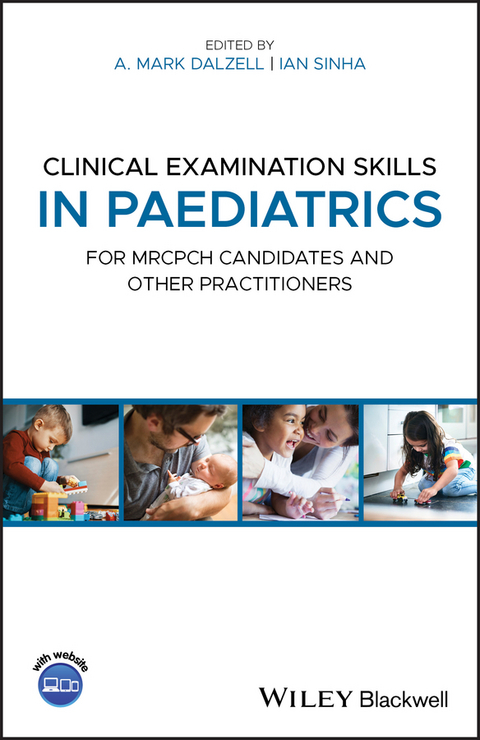
Examining children presents unique challenges for trainees and new doctors in paediatrics. Paediatric patients vary greatly in age and development, often find it difficult to describe their symptoms, and can behave unpredictably in clinical settings. Clinical Examination Skills in Paediatrics helps MRCPCH candidates and other practitioners learn effective history taking and fundamental examination techniques.
Clear and concise chapters-with contributions from a team of paediatric specialists-demonstrate the clinical examination and questioning techniques used in daily practice. Emphasis on the intellectual processes involved in decision making assists both trainees preparing for a formal examination as well as new clinicians faced with a difficult diagnostic problem. Topics include cardiovascular and respiratory examination, examining a child with a neuromuscular disorder, musculoskeletal examination, and taking history from a child with diabetes and a rheumatological condition.
- Includes access to a companion website containing high-quality videos that demonstrate techniques, procedures and approaches
- Features commentary by experienced practitioners which offer observations and deductions at each stage of the examination process
- Offers tips for communicating effectively with the patients using appropriate lay terms
- Helps translate the symptoms and signs experienced by patients into medical-speak
- Covers all the skills tested in the MRCPCH Clinical exam
Clinical Examination Skills in Paediatrics is the perfect study and reference guide for paediatrics trainees, MRCPCH candidates, foundation doctors, allied healthcare professionals, and anyone looking to improve their clinical and communication skills in paediatrics.
EDITORS
A. MARK DALZELL is a retired Consultant in Paediatric Gastroenterology at Alder Hey Children's NHS Foundation Trust, Liverpool, UK.
IAN SINHA is Consultant in Paediatric Respiratory Medicine and Honorary Senior Lecturer in Child Health at Alder Hey Children's NHS Foundation Trust, Liverpool, UK.
EDITORS A. MARK DALZELL is a retired Consultant in Paediatric Gastroenterology at Alder Hey Children's NHS Foundation Trust, Liverpool, UK. IAN SINHA is Consultant in Paediatric Respiratory Medicine and Honorary Senior Lecturer in Child Health at Alder Hey Children's NHS Foundation Trust, Liverpool, UK.
List of contributors viii
How to use this book xiii
Ian Sinha and A. Mark Dalzell
About the companion website xvi
Chapter 1 Rules of engagement (with the clinical examination and the examiners) 1
Richard E. Appleton
Chapter 2 Tips for the communication station 4
Andrew Riordan
Chapter 3 Translating into medical-speak 7
Daniel B. Hawcutt and Ian Sinha
Chapter 4 Cardiovascular examination 11
Michael T. Bowes and Caroline B. Jones
Chapter 5 Respiratory examination 18
Anna Shawcross and Sarah J. Mayell
Chapter 6 Respiratory examination in a child with neurodisability 23
Clare P. Halfhide
Chapter 7 Gastrointestinal examination 28
Anastasia Konidari and A. Mark Dalzell
Chapter 8 Examining a child with a renal transplant 33
Dean Wallace
Chapter 9 Examining a child with cerebral palsy 37
Rachel Kneen and Anand S. Iyer
Chapter 10 Cranial nerve and ocular examination 43
Richard E. Appleton
Chapter 11 Examining a child with a neuromuscular disorder (focusing on Duchenne muscular dystrophy) 50
Stefan Spinty and Anand S. Iyer
Chapter 12 Musculoskeletal examination 58
Liza J. McCann
Chapter 13 Examining a child with endocrine problems 76
Poonam Dharmaraj, Urmi Das and Renuka Ramakrishnan
Chapter 14 Examining a child with diabetes 82
Mark Deakin
Chapter 15 Examining a toddler with motor delay 85
Melissa Gladstone and Ruairi Gallagher
Chapter 16 Examining a toddler with speech delay 89
Ruairi Gallagher and Melissa Gladstone
Chapter 17 Examining a child with autism 93
Ruairi Gallagher and Melissa Gladstone
Chapter 18 Taking a history from a child with cardiovascular disease 96
Michael T. Bowes and Caroline B. Jones
Chapter 19 Taking a history from a child with asthma 100
Sarah J. Mayell and Anna Shawcross
Chapter 20 Taking a history from a child with cystic fibrosis 103
Antonia K.S. McBride and Kevin W. Southern
Chapter 21 Taking a history from a child with inflammatory bowel disease (Crohn disease and ulcerative colitis) 110
Anastasia Konidari and A. Mark Dalzell
Chapter 22 Taking a history from a child with renal transplant 113
Dean Wallace
Chapter 23 Taking a history from a child with diabetes 117
Mark Deakin
Chapter 24 Taking a history from a child with a rheumatological condition 122
Gavin Cleary
Index 129
Chapter 4
Cardiovascular examination
Michael T. Bowes and Caroline B. Jones
Key points to consider while conducting your examination
- Is there evidence of cyanosis or heart failure?
- Are there any signs of an associated chromosomal or genetic disease?
- Does the child appear to be failing to thrive?
- Are there any scars suggestive of previous heart surgery?
Positioning the child
Position babies flat in a cot wearing just a nappy, and toddlers on a parent's lap. Ideally, position older children on the couch at 45° with the chest entirely exposed (although not for adolescent girls).
From the end of the bed
- Is the child comfortable?
- Look for signs of increased work of breathing.
- Count the respiratory rate.
- Is the child dysmorphic? In particular, for a cardiovascular examination:
- trisomy 21 (atrioventricular septal defect, ventricular and atrial septal defects)
- Turner syndrome (left‐sided heart lesions, coarctation of the aorta)
- 22q11 deletion (conotruncal abnormalities, common arterial trunk, interruption of the aorta, tetralogy of Fallot)
- Williams syndrome (supravalvular aortic stenosis, peripheral pulmonary artery stenosis)
- Noonan syndrome (valvular pulmonary stenosis).
- Extra clues
- Does the child have a nasogastric or percutaneous gastrostomy (PEG) tube to supplement feeding?
- Other features that may help you to identify an underlying syndrome, e.g.
- limb abnormalities in association with Holt–Oram syndrome
- eye signs such as Brushfield spots in children with trisomy 21
- cleft lip and palate repair scar
- arachnodactyly or high arched palate in Marfan syndrome.
- Does the child require supplementary oxygen?
- Is the child appropriately grown?
- Infants who appear small for their age, or older children with short stature, may have chronic disease, heart failure, or a syndrome.
- Tall stature may signify Marfan syndrome.
Important signs to look for (and not miss)
- Hands – peripheral perfusion and palmar creases. In older children, check for clubbing and stigmata of bacterial endocarditis.
- Cyanosis – peripheral/central (often noted on the bridge of the nose in infants).
- Assess brachial pulse rate and rhythm for 10 seconds (leave femoral pulses until the end, but don't forget to palpate them!).
- Apex beat – may be in the 4th intercostal space in children under four years. Remember that dextrocardia is frequently encountered in exams.
- Heaves and thrills. Note that heaves can be difficult to distinguish in young children with an active praecordium.
- Jugular venous pulse (JVP) should not be performed in children under four years, but consider it in older children with heart failure and in teenagers.
- Palpate the liver edge. This is usually palpable in children under four years. Percussion can be helpful to locate the upper edge.
What scars might you see?
- Cardiac surgical scars – left or right thoracotomy, median sternotomy.
- Smaller scars – chest drains, central lines, cardiac catheterisation, gastrostomy, or abdominal pacemaker.
Heart sounds and murmurs
- Listen over all five areas (remember the back) with the diaphragm, whilst palpating the pulse, then repeat at the apex with the bell.
- Radiation can be difficult to elicit in babies, but consider it in toddlers at the end of auscultation. If you hear a murmur at the upper sternal edge listen at the carotid for radiation. If the murmur is best heard at the apex move the child to the left lateral decubitus position and auscultate the axilla.
- In infants, attempt to repeat the process in a different position to detect postural variation (particularly if you suspect an innocent murmur).
- Heart sounds:
- most commonly heart sounds will be ‘normal with a…’
- prosthetic metallic heart sounds should be easily identifiable
- only comment on abnormal sounds such as ‘wide splitting of the second heart sound’ if you are confident in your findings
- abnormal heart sounds are rarely identifiable in younger children with fast heart rates.
- Murmurs should be described according to the:
- intensity or volume – graded 1–6/6 systolic and 1–4/4 diastolic
- timing in the cardiac cycle
- systolic – ejection, pansystolic
- diastolic – early, mid, or late (though this may be difficult)
- continuous
- most murmurs in infancy will be systolic or continuous
- site at which they are heard maximally (loud murmurs are often heard throughout the praecordium, particularly in infants, but you should state where you think they are loudest)
- radiation.
Additional components of the cardiovascular examination
- Measure the blood pressure and oxygen saturation.
- Plot the child's height and weight on a centile chart.
- Listen to the lung bases – you are unlikely to have a child with pulmonary oedema attending the examination, but this gives you valuable time to gather your thoughts.
- Palpate the ankles to look for oedema.
- Check for radio‐femoral delay in teenagers.
How to summarise your findings
‘From my examination, I have found that _____________
- is comfortable at rest/has some increased work of breathing
- is pink/has signs of central cyanosis
- has no scars/describe scars
- has heart sounds that are normal/abnormal …
- … with a murmur (describe)/no murmur.’
Questions to prepare
- Consider which investigations you require to make a complete assessment.
- You should know common genetic or chromosomal abnormalities associated with congenital heart disease.
- Be able to list common lesions presenting with either cyanosis or heart failure in the neonate.
- Be able to suggest operations that the child may have undergone.
- Be aware of treatments for infants with heart failure (typically left to right shunt) and failure to thrive – including medications and nutritional support.
Top tips
- Stick with the brachial pulses as they are most reliable in all ages.
- Pedal pulses may be a less intrusive way of gaining information, prior to femoral palpation (but not instead of).
- Look thoroughly for scars, especially thoracotomy scars, which often can't be seen from the front. When examining adolescent girls, who should leave their bra on, ask if they have any scars underneath.
- Palpate for the apex beat on both sides together initially.
- You should be able to combine palpation for heaves and thrills with three hand movements and the suprasternal notch.
- If you hear a murmur palpate the area of maximal intensity again after auscultation to be certain there isn't an accompanying thrill.
- Repeating the auscultation process in a different position at the end of the examination will allow you to detect postural variation and give you another chance to confirm your findings prior to presentation.
- Reaching a diagnosis following a cardiovascular examination is often difficult (and in reality often requires an echocardiogram), so present in a logical structured fashion and don't jump straight to the diagnosis.
Possible scenarios
In the child without scars:
- Your main focus will be correctly identifying the murmur.
- The examiner will expect you to suggest a diagnosis.
- Example: ‘As ________ has some evidence of increased work of breathing and a pansystolic murmur at the left lower sternal edge I suspect she has a ventricular septal defect or perhaps an atrioventricular septal defect.’
- Example: ‘As ________ has a 3/6 ejection systolic murmur at the right upper sternal edge that radiates to the carotids, I suspect he has aortic stenosis.’
In the child with surgical scars and cyanosis or evidence of heart failure:
- These children are likely to have complex congenital heart disease and undergone surgical ‘palliative’ procedures rather than complete repair.
- They may or may not have a murmur – this is unlikely to help you make a diagnosis.
- Example: ‘As _______ is cyanosed and has a midline sternotomy scar I suspect that she has had palliative surgery for complex congenital heart disease. This is likely to be a univentricular type of circulation such as hypoplastic left heart syndrome.’
- Making a definitive diagnosis will be difficult but you should at least present a logical thought process.
In the child with surgical scars and no cyanosis or evidence of heart failure:
- These children are likely to have had surgical repair, though may have residual lesions or murmurs.
- A murmur may be helpful...
| Erscheint lt. Verlag | 15.11.2019 |
|---|---|
| Reihe/Serie | How to Perform |
| How to Perform | How to Perform |
| Sprache | englisch |
| Themenwelt | Medizin / Pharmazie ► Medizinische Fachgebiete ► Pädiatrie |
| Studium ► 2. Studienabschnitt (Klinik) ► Anamnese / Körperliche Untersuchung | |
| Schlagworte | <p>paediatric examination • Medical Professional Development • Medical Science • Medizin • Medizinstudium • MRCPCH exam • MRCPCH prep • Pädiatrie • paediatric cardiovascular exam • paediatric exam guide • paediatric exam reference • paediatric exam techniques • paediatric gastrointestinal exam</p> • paediatric history taking • paediatric respiratory exam • Pediatrics • Perspektiven in medizinischen Berufen |
| ISBN-10 | 1-119-23893-5 / 1119238935 |
| ISBN-13 | 978-1-119-23893-5 / 9781119238935 |
| Informationen gemäß Produktsicherheitsverordnung (GPSR) | |
| Haben Sie eine Frage zum Produkt? |
 EPUB (Adobe DRM)
Kopierschutz: Adobe-DRM
Adobe-DRM ist ein Kopierschutz, der das eBook vor Mißbrauch schützen soll. Dabei wird das eBook bereits beim Download auf Ihre persönliche Adobe-ID autorisiert. Lesen können Sie das eBook dann nur auf den Geräten, welche ebenfalls auf Ihre Adobe-ID registriert sind.
Details zum Adobe-DRM
Dateiformat: EPUB (Electronic Publication)
EPUB ist ein offener Standard für eBooks und eignet sich besonders zur Darstellung von Belletristik und Sachbüchern. Der Fließtext wird dynamisch an die Display- und Schriftgröße angepasst. Auch für mobile Lesegeräte ist EPUB daher gut geeignet.
Systemvoraussetzungen:
PC/Mac: Mit einem PC oder Mac können Sie dieses eBook lesen. Sie benötigen eine
eReader: Dieses eBook kann mit (fast) allen eBook-Readern gelesen werden. Mit dem amazon-Kindle ist es aber nicht kompatibel.
Smartphone/Tablet: Egal ob Apple oder Android, dieses eBook können Sie lesen. Sie benötigen eine
Geräteliste und zusätzliche Hinweise
Buying eBooks from abroad
For tax law reasons we can sell eBooks just within Germany and Switzerland. Regrettably we cannot fulfill eBook-orders from other countries.
aus dem Bereich