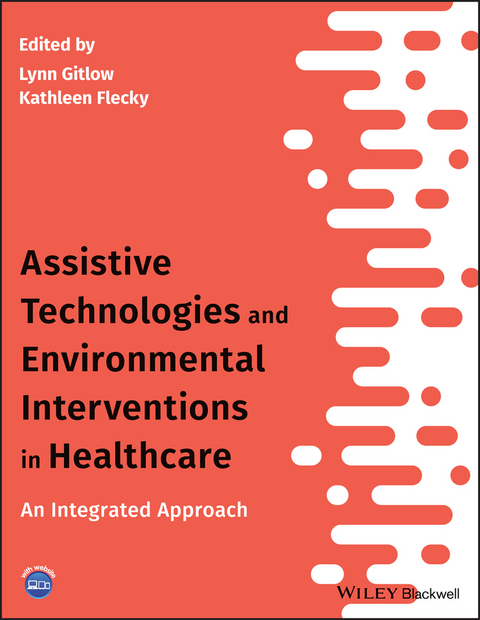
Assistive Technologies and Environmental Interventions in Healthcare (eBook)
John Wiley & Sons (Verlag)
978-1-119-48326-7 (ISBN)
Providing a holistic and client-centered approach, Assistive Technologies and Environmental Interventions in Healthcare explores the individual's needs within the environment, examines the relationship between disability and a variety of traditional and cutting-edge technologies, and presents a humanistic discussion of Technology-Environment Intervention (TEI).
Written by a multidisciplinary team of authors, this text introduces readers to a variety of conceptual practice models and the clinical reasoning perspectives. It also provides insight into how designers go about solving human-tech problems, discusses best practices for both face-to-face and virtual teams, and looks at the psychological, sociocultural, and cognitive factors behind the development and provision of assistive technologies.
- Examines a wide range of technologies and environmental interventions
- Demonstrates how a better understanding of the complexity of human interaction with both the physical and social environment can lead to better use of technology
- Explores the future of technology and research in TEI
Complete with a range of learning features such as keywords, case studies and review questions, this book is ideal for undergraduate and graduate students in occupational therapy and other related health professions, as well as those undertaking certification and board examinations.
Lynn Gitlow is an Associate Professor in the Department of Occupational Therapy at Ithaca College in Ithaca, New York, USA. She has practiced in the area of assistive technology for over 20 years.
Kathleen Flecky is an Associate Professor in the Department of Occupational Therapy in the School of Pharmacy and Health Professions, Creighton University in Omaha, Nebraska, USA. She has been teaching and practicing in the area of community health and health promotion for 19 years.
Providing a holistic and client-centered approach, Assistive Technologies and Environmental Interventions in Healthcare explores the individual s needs within the environment, examines the relationship between disability and a variety of traditional and cutting-edge technologies, and presents a humanistic discussion of Technology-Environment Intervention (TEI). Written by a multidisciplinary team of authors, this text introduces readers to a variety of conceptual practice models and the clinical reasoning perspectives. It also provides insight into how designers go about solving human-tech problems, discusses best practices for both face-to-face and virtual teams, and looks at the psychological, sociocultural, and cognitive factors behind the development and provision of assistive technologies. Examines a wide range of technologies and environmental interventions Demonstrates how a better understanding of the complexity of human interaction with both the physical and social environment can lead to better use of technology Explores the future of technology and research in TEI Complete with a range of learning features such as keywords, case studies and review questions, this book is ideal for undergraduate and graduate students in occupational therapy and other related health professions, as well as those undertaking certification and board examinations.
Lynn Gitlow is an Associate Professor in the Department of Occupational Therapy at Ithaca College in Ithaca, New York, USA. She has practiced in the area of assistive technology for over 20 years. Kathleen Flecky is an Associate Professor in the Department of Occupational Therapy in the School of Pharmacy and Health Professions, Creighton University in Omaha, Nebraska, USA. She has been teaching and practicing in the area of community health and health promotion for 19 years.
1
The person, the environment, and technology: Introduction to the human‐tech ladder
Lynn Gitlow and Kathleen Flecky
Outline
- The person, the environment, and technology: Introduction to the human‐tech ladder
- Models of disability
- Assistive technology and the environment
- Choosing the human‐tech ladder
- Human‐tech ladder
- Why are definitions important?
- Defining technology
- Defining AT
- Environmental interventions
- Categories of AT
- Summary
- References
Learning outcomes
After reading this chapter, you should be able to:
- Describe human technology as a complex interaction between a person and the environment.
- Delineate distinguishing features of the Human‐Tech Ladder and a client‐centered approach.
- Describe the relationship between the Human‐Tech Ladder and assistive technology.
- Identify the components of the assistive technology continuum.
- Compare medical and social models of disability in relationship to a client‐centered focus on the Human‐Tech Ladder and assistive technology.
- Define assistive technology and environmental intervention.
Active learning prompts
Before you read this chapter:
- Describe the role that technology plays in your life in terms of how you interact with the environment on a daily basis to meet needed and desired tasks and goals.
- Complete a brief literature search using the keywords, client‐centered, health, disability and assistive technology, medical models of disability, and social models of disability.
- Using the website, www.resna.org, define assistive technology and locate the eligibility requirements for Rehabilitation Engineering and Assistive Technology Society of North America (RESNA) certification as an Assistive Technology Professional.
- Define assistive technology using two or more sources.
- Compare and contrast three definitions of assistive technology.
- Classify assistive technology in three different ways.
Key terms
- Assistive technology
- Assistive technology continuum
- Client‐centered
- Contextual factors
- Disability
- Disability models
- Environmental factors
- Environmental intervention (EI)
- Human‐Tech Ladder
- Technology
- Technology and environmental intervention (TEI)
The person, the environment, and technology: Introduction to the human‐tech ladder
The changes we have all seen in technology and correspondingly with assistive technology in the past 10 years are mind‐boggling. Futurist and inventor Ray Kurzweil (2000) stated early in the twenty‐first century that computers are 100 million times more powerful than they were 50 years ago. The exponential growth of computer capacity that Kurzweil and others predicted in the late 1990s continues to advance and has the potential for improving all aspects of life (Diamandis and Kotler 2014). These exponential changes in technology make it hard to keep up with the latest innovations. For example, one of the chapter authors worked in an assistive technology laboratory in which serial port add‐ons to computers evolved into Universal Serial Bus (USB) ports rendering the former connections and their attachments obsolete within in less than five years. Currently, computers no longer come with disk drives and all of the software one needs to load on the computer comes from the cloud. Vicente (2006) stated, “… more and more technology is being foisted upon us at a faster and faster pace” (p. 13).
In addition, technology is clearly a necessary part of our lives. For many of us, it is difficult to remember a time when cell phones, laptops, or navigation devices were not available to those who could afford it. Furthermore, the convergence of multiple technologies into a single, small, handheld device such as a smartphone is common as part of our work and personal experiences.
Medical technology has evolved to intervene when the body fails. For example, you may know someone who has a heart pacemaker to pick up the pace when the heart lags. Moreover, as older adults live longer in many countries, these family members or neighbors may likely experience a joint replacement or utilize assistive or medical devices to recover or make daily tasks easier on either a short‐term or a long‐term basis.
Given the pervasiveness of technology in our lives, it is not surprising that the words “human” and “technology” are conceptualized in new ways to describe the link between our humanness and the non‐humanness of technology. The “Human‐Tech Ladder” is a unique concept developed by Vicente (2006) to merge the humanistic view of social sciences with the mechanistic and reductionist views of basic sciences and technological sciences. It is a systems approach that considers how to holistically match humans and technology. Rather than coming up with a new conceptual model, this book will use Vicente's Human‐Tech Ladder to provide a systematic way of structuring the text to consider all of the factors, which interact to make a match between humans and technology. The Human‐Tech Ladder is a five‐level visual model which can be used to conceptualize human factors, such as personal and environmental factors that interact with technology.
According to Vicente (2006), a bad fit or match occurs if human factors are not at the center of the technology design process. Knowing how the human mind and body react to multiple stimuli and situations with technology, and understanding the complexity of human interaction with both the physical and the social environment, can lead to better use of technology (Vicente 2006). This multifactorial approach mirrors development in the field of matching those who have disabilities with technology interventions. Moreover, a multifactorial approach is considered to be critical to making a successful human technology match (National Academies of Sciences, Engineering, and Medicine 2017). This interactive approach in using technology as an intervention for people with disabilities has not occurred in a vacuum, and changes in ways of thinking about people with disabilities are important to review as an introduction to this text.
Models of disability
With the primary chapter author having practiced in the area of assistive technology for over 20 years, there have been many changes in the field, which influence the things one needs to consider when using assistive technology as an intervention. One critical change is the way that disability is viewed. Disability is “the dynamic interaction between an individual (with a health condition) and that individual's contextual factors (personal and environmental factors)” (World Health Organization [WHO] 2001, p. 190). This change in thinking about disability parallels the shift in thinking about disability from viewing it as strictly a medical problem to viewing it more as an interactive social problem (Charlton 2000). Disability models are conceptual frameworks that delineate how disability has been regarded by society over the centuries.
For example, within the medical model, disability is viewed as being a personal problem – one that lies within an individual and must be fixed by a practitioner’s intervention. This model is aligned with a mechanistic or reductionist view of human life (Vicente 2006). In this view, the practitioner is the expert and the client or person with a disability has little to add to the relationship.
In the 1950s, Carl Rogers used the term client‐centered to describe the active and directive role of the client in collaboration with the therapist to problem‐solve issues uniquely related to each client's care (Rogers 1951). Building on the work of Rogers and others, terms such as client‐centered care, client‐centered counseling, and person‐centered practice are used to describe a focus on the client or patient as central to all decision‐making about care, emphasizing client strengths and unique cultural and environmental contexts and capacities (Fearing and Clark 2000; Institute of Medicine [IOM] 2001, 2003; Morgan and Yoder 2012). In rehabilitation therapies, client‐centered care respects the client as an active partner whose choices and participation in care are valued and facilitated with dignity and respect (Law 1998; Sumsion 2006).
Vicente's concept of human technology as noted earlier highlights the importance of the person as the center of the technology process in a similar way to that in which client‐centered concepts view the client as person in the center of the therapeutic process (Vicente 2006). Following this client‐centered focus and in concert with the human rights movements of the 1960s and 1970s, people with disabilities advanced a social model of disability which emphasized that disability results from a mismatched and therefore unsuccessful interaction between an individual and the environment (WHO 2001).
This interactive relationship,...
| Erscheint lt. Verlag | 8.8.2019 |
|---|---|
| Reihe/Serie | Wiley Custom Select |
| Sprache | englisch |
| Themenwelt | Medizin / Pharmazie ► Naturheilkunde |
| Medizin / Pharmazie ► Physiotherapie / Ergotherapie ► Ergotherapie | |
| Studium ► Querschnittsbereiche ► Prävention / Gesundheitsförderung | |
| Schlagworte | Activities of Daily Living • adaptive devices for disabled • ADL • ADLs • assisting the disabled • assistive devices for disabled • assistive technologies in healthcare • Assistive Technology • assistive technology and environmental interventions • assistive technology for the disabled • creating technology for people with disabilities • Environmental & Occupational Health • environmental interventions in healthcare • Ergotherapie • Gesundheits- u. Sozialwesen • Gesundheitswesen • Gesundheitswesen / Umwelt u. Arbeitsplatz • guide to assistive technologies for disabled • Health & Social Care • helping people with disabilities • helping the disabled • high-tech technologies for disabled • Medical technology • occupational therapy • rehab equipment • rehab equipment for disabled • rehabilitative devices for people with disabilities • tech for the disabled • tei • the disabled and ADL • understanding those with disabilities |
| ISBN-10 | 1-119-48326-3 / 1119483263 |
| ISBN-13 | 978-1-119-48326-7 / 9781119483267 |
| Informationen gemäß Produktsicherheitsverordnung (GPSR) | |
| Haben Sie eine Frage zum Produkt? |
 EPUB (Adobe DRM)
Kopierschutz: Adobe-DRM
Adobe-DRM ist ein Kopierschutz, der das eBook vor Mißbrauch schützen soll. Dabei wird das eBook bereits beim Download auf Ihre persönliche Adobe-ID autorisiert. Lesen können Sie das eBook dann nur auf den Geräten, welche ebenfalls auf Ihre Adobe-ID registriert sind.
Details zum Adobe-DRM
Dateiformat: EPUB (Electronic Publication)
EPUB ist ein offener Standard für eBooks und eignet sich besonders zur Darstellung von Belletristik und Sachbüchern. Der Fließtext wird dynamisch an die Display- und Schriftgröße angepasst. Auch für mobile Lesegeräte ist EPUB daher gut geeignet.
Systemvoraussetzungen:
PC/Mac: Mit einem PC oder Mac können Sie dieses eBook lesen. Sie benötigen eine
eReader: Dieses eBook kann mit (fast) allen eBook-Readern gelesen werden. Mit dem amazon-Kindle ist es aber nicht kompatibel.
Smartphone/Tablet: Egal ob Apple oder Android, dieses eBook können Sie lesen. Sie benötigen eine
Geräteliste und zusätzliche Hinweise
Buying eBooks from abroad
For tax law reasons we can sell eBooks just within Germany and Switzerland. Regrettably we cannot fulfill eBook-orders from other countries.
aus dem Bereich