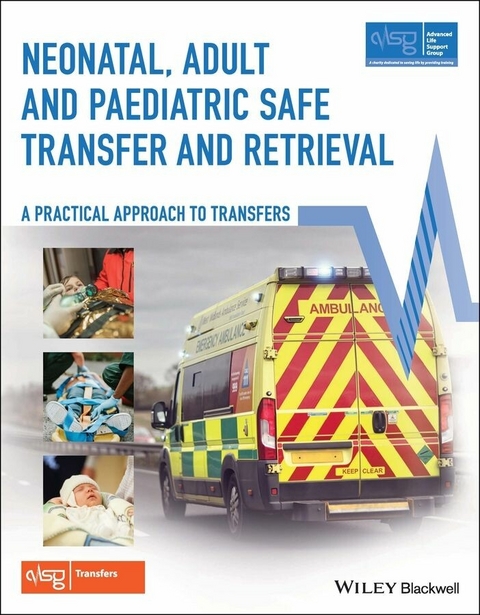
Neonatal, Adult and Paediatric Safe Transfer and Retrieval (eBook)
444 Seiten
John Wiley & Sons (Verlag)
978-1-119-14493-9 (ISBN)
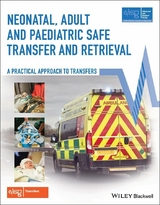
Neonatal, Adult and Paediatric Safe Transfer and Retrieval is a new and vital instalment in the blended learning course from the Advanced Life Support Group (ALSG), which aims to provide hospital staff at all levels with essential information on the inter- and intra-hospital transfer of both child and adult patients.
This essential manual covers the basics of mobile medicine, the elements of transfer, patient and team safety, and the practical and clinical considerations associated with the patient transfer process. Each chapter makes use of checklists, practical examples and content summaries to help readers understand and overcome the challenges of both adult and paediatric patient transfers.
- Combines Paediatric and Neonatal Safe Transport and Retrieval (PaNSTaR) and the (Adult) Safe Transport and Retrieval (STaR) into a single volume (NAPSTaR)
- Written and edited by an expert team of specialists from across the UK
- Complements Advanced Paediatric Life Support and Prehospital Paediatric Life Support
Neonatal, Adult and Paediatric Safe Transfer and Retrieval is a must-have resource for doctors, nurses, paramedics and healthcare professionals involved in patient transfer and those in ALSG courses in patient transport.
Advanced Life Support Group (ALSG) improves outcomes for people in life-threatening situations, anywhere along the health care pathway, anywhere in the world. ALSG is a leading medical education charity and have delivered advanced life support training to over 156,000 clinicians in 42 countries, across five continents, for over 21 years.
Neonatal, Adult and Paediatric Safe Transfer and Retrieval is a new and vital instalment in the blended learning course from the Advanced Life Support Group (ALSG), which aims to provide hospital staff at all levels with essential information on the inter- and intra-hospital transfer of both child and adult patients. This essential manual covers the basics of mobile medicine, the elements of transfer, patient and team safety, and the practical and clinical considerations associated with the patient transfer process. Each chapter makes use of checklists, practical examples and content summaries to help readers understand and overcome the challenges of both adult and paediatric patient transfers. Combines Paediatric and Neonatal Safe Transport and Retrieval (PaNSTaR) and the (Adult) Safe Transport and Retrieval (STaR) into a single volume (NAPSTaR) Written and edited by an expert team of specialists from across the UK Complements Advanced Paediatric Life Support and Prehospital Paediatric Life Support Neonatal, Adult and Paediatric Safe Transfer and Retrieval is a must-have resource for doctors, nurses, paramedics and healthcare professionals involved in patient transfer and those in ALSG courses in patient transport.
Advanced Life Support Group (ALSG) improves outcomes for people in life-threatening situations, anywhere along the health care pathway, anywhere in the world. ALSG is a leading medical education charity and have delivered advanced life support training to over 225,000 clinicians in 44 countries, across 5 continents, for over 25 years.
Working group vii
Contributors ix
PaNSTaR (Paediatric and Neonatal Safe Transfer and Retrieval) first edition xi
STaR (Safe Transfer and Retrieval) first and second editions xiii
Preface xv
Acknowledgements xvii
Contact details and website information xix
How to use your textbook xxi
Part 1: Introduction 1
1 Introduction 3
2 Medicine on the move 7
3 Planning the move 9
4 Human factors 13
Part 2: The elements of transfer 23
5 Assessment 25
6 Control 27
7 Communication 29
8 Evaluation 35
9 Preparation and packaging 39
10 Transportation 53
Part 3: Practical considerations 63
11 SCRUMP - the differences between transport and hospital-based care 65
12 Safety and the team 73
Part 4: Clinical considerations 81
13 Clinical considerations - an introduction 83
14 Clinical considerations for neonates and children 87
15 Clinical considerations for adults 107
Part 5: Special considerations 117
16 Support for the family 119
17 Air transfers - an introduction 123
18 Respiratory support and the patient with a difficult airway or tracheostomy 133
19 Patient monitoring 153
20 The infectious or contaminated patient 161
21 Governance, legal and insurance issues 167
22 Documentation 173
Part 6: Appendices 177
A Intensive care levels: classification of ICU patient dependency 179
B Transfer quick reference 181
C Pre-departure checks 183
D Generic forms: referral and transfer 185
E Glossary 207
Index 215
CHAPTER 3
Planning the move
Learning outcomes
After reading this chapter, you will be able to:
- Define the complexity of transfer planning
- Name the factors that should be considered when planning a transfer
- Prepare for the likely events during transfer
- Recognise the need to appropriately plan for the worst case scenario
3.1 Introduction
The decision to move a patient pivots on a number of factors. The requirement for transfer may be to an internal location, such as the computed tomography (CT) scanner or theatres, or external, to another centre with staffing of facilities not available on the current site. The decision to proceed and the timing of the transfer must be based on balancing the benefits of the transfer against the clinical risk posed to the patient and team by the transfer. Whilst on most occasions this can be quite straightforward, there are a significant number of occasions where the risk of deterioration or even death en route will need to be weighed up in this analysis.
The first stage of this process is to gather all the key information required. This will usually be achieved during the assessment stage of the process but further information may also be needed.
The following information should be considered as a minimum dataset.
Patient
- Clinical assessment of the patient’s status:
- How stable is the patient? (ABCDEF approach)
- If unstable, is it possible to stabilise and how long might that be expected to take?
- An assessment of the likelihood of deterioration during transfer based on:
- Diagnosis (if known)
- Current status and physiological trends
- Need to transfer before optimal stabilisation
- Specific condition/transport factors, e.g.
- Severe pulmonary dysfunction and air travel
- Mobile extracorporeal membrane oxygenation
- Rationale for transfer, e.g. access to specialist care
Staff and logistics
- Staff:
- Availability of staff with suitable competencies
- Risk of removing expert staff from local unit (if local transfer team)
- Expected time taken for transfer (impacts on above)
- Safety of the transfer – weather/mode of transfer
ABCDEF approach
| A | Airway assessment and control |
| B | Breathing |
| C | Circulation |
| D | Disability |
| E | Exposure (including temperature in neonates and children) and everything else |
| F | Family |
3.2 Patient risk assessment
Increasingly, patient track and trigger systems (or early warning systems (EWS)) are embedded in hospital practice and are a tool for identifying patient deterioration by analysing physiological parameters. The monitored physiological parameters are scored, and when a threshold abnormal score is reached a clinical review is triggered.
The EWS may be employed in conjunction with a structured ABCDEF assessment to help highlight specific clinical risks associated with transport. The likelihood of deterioration during transfer may be assessed through serial EWS and reassessments of ABCDEF. An understanding of the progression of the disease process together with the likelihood of requiring additional interventions during transportation and an understanding of the clinical benefit of transfer will inform when to move a patient.
It is important to recognise both the advantages and limitations of EWS. They are designed to provide an alert, usually on the general wards, when a patient is likely to be unwell or deteriorating. It is critical to understand that a low score should never be used to provide reassurance when there are other worrying factors in the clinical assessment. It is also true that EWS are relatively insensitive to ongoing deterioration once a patient is decompensating and has already generated a high score. In summary, EWS are a useful adjunct to structured clinical assessment, which should always be the primary assessment tool. The patient’s lead consultant should always be contacted if at any time there is any doubt about this assessment. They in turn may choose to discuss the patient’s status with other colleagues or experts at the receiving centre where appropriate.
3.3 Staff and logistics risk assessment
Patient assessment for transfer should always be viewed in the context of the duration and mode of transport. The longer a transfer the more time there is for deterioration to occur. Even short transfers, within a hospital, may not be without challenges. For example, when going outside, between buildings, or when utilising a lift, never go without supplies for at least 30 minutes!
When travelling between centres the mode of transport may also present specific risks. In all cases there will be some limitation of access to the patient and equipment, and the team may not be 100% familiar with the environment and may have to cope with complex logistics. The latter is especially true for air transfers where there are also the effects of altitude physiology to consider.
The staff accompanying a patient must have suitable competencies to deliver clinical care not only at the current level of dependency of the patient, but also at an increased dependency level in the event of deterioration. In an ideal world, staff should neither be fatigued nor stressed and they should always be familiar with all the transport equipment, policies and procedures (see Chapter 4).
Adverse weather conditions such as snow, ice or poor visibility should always be factored into the assessment of the need for transfer. Risks of this type can be reduced by using familiar vehicles and modes of transport, by altering routes or delaying the transfer; an alternative destination may need to be considered for very long transfers. The use of sirens and blue lights to facilitate anything more than progression at safe, standard road speeds should be avoided wherever possible. High speed transfers have no impact on clinical outcome, but expose the patient, the team and the public to considerably enhanced risk. Safety of the team and patient is the absolute priority.
3.4 Use of physiological measurements in identifying transfer risk
The clinical risk of the transfer and the level of competence required by escorting staff will be informed by the patient’s condition. As discussed previously, a physiological track and trigger system (EWS) may, under certain circumstances, be used in combination with other parameters (SpO2, Glasgow Coma Scale (GCS), base excess) to risk assess patients prior to transfer. For the purposes of discussion, the risk may be divided into categories of low, medium and high. The EWS score may be used to inform this classification but will be dependent on the score used and therefore must be calibrated locally.
Low risk group
This group includes all patients with near normal physiology. In this group there are no additional concerns and these patients should have a low risk of clinical deterioration during transfer, although some clinical competences may be required during transfer, e.g. oxygen therapy or infusion therapy.
Medium risk group
These patients will have clear evidence of systemic illness or instability. They are likely to have an EWS score in the middle of the range. The group may include patients who would fit the criteria for high dependency care.
This group are potentially the highest risk transfers. They may be transported with the minimum of technological support but could be of risk of major deterioration during transfer. They require a detailed pre‐transfer assessment that should be based on an ABCDEF approach. The following should be considered:
- Is the general condition of the patient improving, stable or deteriorating?
- Review the rationale for the transfer:
- Does the need/benefit for investigation or enhanced support outweigh the transfer risks?
- Is this the right time to transfer?
- How long will the transfer take?
- What physiological deterioration may occur during the transfer?
- What competences are required during the transfer?
If after making the assessment, there are concerns for the patient’s safety during transfer, these must be discussed with senior medical staff. If it is judged appropriate to proceed, it is vital that the transfer team have the competencies to cope with the very worst case scenario. It is neither safe nor fair to the patient or staff to compromise on this.
High risk group
Patients in this group will have significant physiological derangement or have a condition that would be expected to rapidly deteriorate during transfer. They will usually have already have triggered an emergency response from the critical care team. A formal risk assessment and consideration of the cause, as described for the medium risk patient, must be undertaken.
Patients in this group must only be transferred by a team with critical care...
| Erscheint lt. Verlag | 24.7.2019 |
|---|---|
| Reihe/Serie | Advanced Life Support Group |
| Advanced Life Support Group | Advanced Life Support Group |
| Sprache | englisch |
| Themenwelt | Medizin / Pharmazie ► Allgemeines / Lexika |
| Medizin / Pharmazie ► Gesundheitsfachberufe | |
| Medizin / Pharmazie ► Medizinische Fachgebiete ► Notfallmedizin | |
| Medizin / Pharmazie ► Studium | |
| Schlagworte | ALSG mobile medicine manual • ALSG retrieval manual • ALSG transfer guide • ALSG transfer manual • ALSG transport guide • ALSG transport manual • Emergency Medicine & Trauma • medical education • Medical Science • medical transport introduction • Medizin • Medizinstudium • neonatal transfer • Notfallmedizin • Notfallmedizin u. Traumatologie • paediatric transfer • patient transfer manual |
| ISBN-10 | 1-119-14493-0 / 1119144930 |
| ISBN-13 | 978-1-119-14493-9 / 9781119144939 |
| Informationen gemäß Produktsicherheitsverordnung (GPSR) | |
| Haben Sie eine Frage zum Produkt? |
 EPUB (Adobe DRM)
Kopierschutz: Adobe-DRM
Adobe-DRM ist ein Kopierschutz, der das eBook vor Mißbrauch schützen soll. Dabei wird das eBook bereits beim Download auf Ihre persönliche Adobe-ID autorisiert. Lesen können Sie das eBook dann nur auf den Geräten, welche ebenfalls auf Ihre Adobe-ID registriert sind.
Details zum Adobe-DRM
Dateiformat: EPUB (Electronic Publication)
EPUB ist ein offener Standard für eBooks und eignet sich besonders zur Darstellung von Belletristik und Sachbüchern. Der Fließtext wird dynamisch an die Display- und Schriftgröße angepasst. Auch für mobile Lesegeräte ist EPUB daher gut geeignet.
Systemvoraussetzungen:
PC/Mac: Mit einem PC oder Mac können Sie dieses eBook lesen. Sie benötigen eine
eReader: Dieses eBook kann mit (fast) allen eBook-Readern gelesen werden. Mit dem amazon-Kindle ist es aber nicht kompatibel.
Smartphone/Tablet: Egal ob Apple oder Android, dieses eBook können Sie lesen. Sie benötigen eine
Geräteliste und zusätzliche Hinweise
Buying eBooks from abroad
For tax law reasons we can sell eBooks just within Germany and Switzerland. Regrettably we cannot fulfill eBook-orders from other countries.
aus dem Bereich