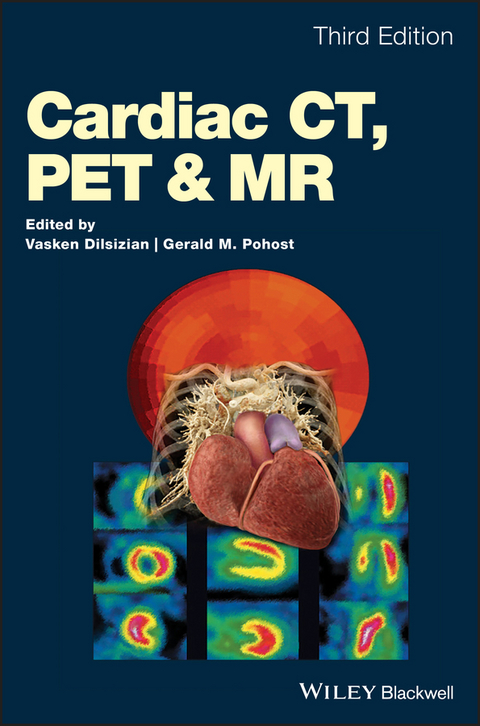
Cardiac CT, PET and MR (eBook)
John Wiley & Sons (Verlag)
978-1-118-75449-8 (ISBN)
A complete guide to non-invasive imaging techniques in cardiology
Today's imaging technologies offer cardiologists more ways than ever to diagnose conditions of the heart without the need of endoscopies and other invasive procedures. Now in its third edition,Cardiac CT, PET and MRI continues to provide an in-depth explanation of these tools and their correct applications, while also exploring cardiac imaging's most recent and groundbreaking developments.
This wide-ranging guide places CT, PET and MRI in a practical context, illustrating clearly their respective functions as they apply to specific cardiological disorders and clinical situations. With the addition of seven new chapters, it also offers an expanded insight into PET - an increasingly popular and affordable diagnostic utility, hitherto underexplored in texts devoted to imaging. Cardiac CT, PET and MRI includes:
- Clinically focused examinations of CT, PET and MRI - the three most popular non-invasive imaging modalities
- Illustrative full-color photos and images
- Access to a companion website featuring additional content
Cardiologists, radiologists, nuclear medicine physicians, physicists, and imaging technologists alike will find the third edition of Cardiac CT, PET and MRI an informative and accessible resource with a direct use in their day-to-day practice.
Vasken Dilsizian, MD, MASNC, FACC, FAHA, Professor of Medicine and Radiology, University of Maryland School of Medicine, and Chief, Division of Nuclear Medicine, University of Maryland Medical Center, Baltimore, MD, USA
Gerald M. Pohost, MD, FACC, FAHA, Professor of Medicine, Department of Medicine, Loma Linda University, Loma Linda, CA, and Director of Cardiovascular Imaging, Westside Medical Imaging, Beverly Hills, CA, USA
A complete guide to non-invasive imaging techniques in cardiology Today's imaging technologies offer cardiologists more ways than ever to diagnose conditions of the heart without the need of endoscopies and other invasive procedures. Now in its third edition,Cardiac CT, PET and MRI continues to provide an in-depth explanation of these tools and their correct applications, while also exploring cardiac imaging's most recent and groundbreaking developments. This wide-ranging guide places CT, PET and MRI in a practical context, illustrating clearly their respective functions as they apply to specific cardiological disorders and clinical situations. With the addition of seven new chapters, it also offers an expanded insight into PET an increasingly popular and affordable diagnostic utility, hitherto underexplored in texts devoted to imaging. Cardiac CT, PET and MRI includes: Clinically focused examinations of CT, PET and MRI the three most popular non-invasive imaging modalities Illustrative full-color photos and images Access to a companion website featuring additional content Cardiologists, radiologists, nuclear medicine physicians, physicists, and imaging technologists alike will find the third edition of Cardiac CT, PET and MRI an informative and accessible resource with a direct use in their day-to-day practice.
Vasken Dilsizian, MD, MASNC, FACC, FAHA, Professor of Medicine and Radiology, University of Maryland School of Medicine, and Chief, Division of Nuclear Medicine, University of Maryland Medical Center, Baltimore, MD, USA Gerald M. Pohost, MD, FACC, FAHA, Professor of Medicine, Department of Medicine, Loma Linda University, Loma Linda, CA, and Director of Cardiovascular Imaging, Westside Medical Imaging, Beverly Hills, CA, USA
Contributors vii
Foreword xi
Robert O. Bonow
1 Positron Emission Tomography 1
Juan Jose Vaquero and Stephen L. Bacharach
2 Cardiovascular Magnetic Resonance 38
Joseph Selvanayagam, Gaetano Nucifora, and Stefan Neubauer
3 Cardiac Computed Tomography 91
Dahlia Banerji, Sandeep Hedgire, and Udo Hoffmann
4 PET Myocardial Perfusion Imaging: Progress in Quantitative Assessment of Blood Flow and Flow Reserve 129
Thomas H. Schindler, Ines Valenta, and Vasken Dilsizian
5 PET Imaging of Myocardial Metabolism in Health and Disease 175
Robert J. Gropler and Linda R. Peterson
6 PET Imaging of Autonomic Innervation and Receptors 203
James T. Thackeray and Frank M. Bengel
7 Cardiovascular Magnetic Resonance Angiography 236
R. Reeve Ingle, Amr A. Youssef , Dwight G. Nishimura, and Phillip C. Yang
8 CMR to Assess Morphology, Function, Perfusion, and Viability 282
Himanshu Gupta, Oleg F. Sharifov, Heewon Kim, Kuncheng Li, and Gerald M. Pohost
9 Cardiac CT for Coronary Imaging 327
Marisa Lubbers and Koen Nieman
10 Multislice CT: Myocardial Function, Perfusion, and Viability 345
Raymond T. Yan, Richard T. George, and Joao A. C. Lima
11 Cardiac CT and MR for the Evaluation of Acute Chest Pain in the Emergency Setting 366
Nupur Verma, Tan-Lucien Mohammed, and Charles S. White
12 Noninvasive Imaging of High-Risk Plaque 388
Amir Ahmadi, Farouc A. Jaffer, and Jagat Narula
13 Molecular Imaging Targets in Heart Failure and Left Ventricular Remodeling 405
Nabil E. Boutagy, Attila Feher, Saad Sikanderkhel, and Albert J. Sinusas
14 Nuclear Imaging Guidance for Ablation of Ventricular Arrhythmias 436
John Duell, Mark F. Smith, Wengen Chen, Vasken Dilsizian, and Timm-Michael L. Dickfeld
Index 450
1
Positron Emission Tomography
Juan José Vaquero1 and Stephen L. Bacharach2
1 Universidad Carlos III de Madrid and Instituto de Investigación Sanitaria Gregorio Marañón, Madrid, Spain
2 University of California at San Francisco, San Francisco, CA, USA
Introduction
The goal of all cardiac nuclear imaging is to trace the fate of radioactively labeled biochemical compounds (tracers) within the body, usually in the myocardium or blood pool. One usually either makes a static image of the distribution of the radiotracer (e.g., technetium‐99m (99mTc) sestamibi (methoxyisobutylisonitrile or MIBI) or thalium‐201 (201Tl)) or follows the uptake and clearance of the tracer with time. In the former case, static imaging is all that is required, while in the latter a series of images, acquired dynamically over time, is necessary. Positron emission tomography (PET) has these same goals. Although PET works in a manner very similar to conventional tomographic nuclear imaging techniques (e.g., single photon emission computed tomography or SPECT), there are some very significant differences. It is these differences that make PET of great potential value in nuclear cardiology, and it is these differences we will emphasize in this chapter.
Positron Decay
PET tracers, as their name implies, decay by emission of a positron. Except for their opposite charge, positrons are nearly identical to ordinary negatively charged electrons (which in fact are often called “negatrons”). They have the same mass and behave similarly when passing through the body. Positrons, however, are the “antimatter” of electrons. When a positron and an electron are in close proximity for more than the briefest interval, both will disappear (an event called “annihilation”), and their masses will be converted into energy in the form of two gamma rays traveling in almost exactly opposite directions. The energy of each photon is 0.511 MeV (precisely the equivalent energy corresponding to the mass of the electron or positron). These photons are sometimes called “annihilation” photons. The two photons travel in nearly exactly opposite directions in order to conserve momentum. The entire process is illustrated in Figure 1.1. In this figure it is assumed that a positron emitter (in this case carbon‐11 (11C)) is part of a tracer somewhere in the body (e.g., the myocardium). When the positron is emitted from the nucleus it is traveling at very high speed, nearly the speed of light. It moves through the tissue just as an electron would, bouncing off many of the atoms and losing energy as it does so. The final distance between the original atom and the annihilation point is called the “positron range.” Eventually (typically within a millimeter or so, depending on the radionuclide) it slows down enough to spend a significant time near an electron. As soon as this happens the two annihilate and the two gamma rays (each with 0.511 MeV) are emitted, as shown in Figure 1.1, each going in nearly the exact opposite direction. Although in the figure the annihilation photons are shown traveling in exactly opposite directions, occasionally photons are emitted a few tenths of a degree more or less than 180° apart.
Figure 1.1 A positron is shown being emitted from the nucleus of 11C. It is assumed that the 11C atom is located in tissue. The positron is initially emitted at a speed which is a significant fraction of the speed of light. As it passes through the tissue, it gradually slows down, as it bounces off the atoms in the tissue. Eventually it slows down sufficiently so that it spends significant time near an atomic electron—its antimatter equivalent. When this happens the electron and the positron both annihilate—their mass being converted to energy in the form of two 511‐keV photons traveling in opposite directions, as shown.
PET scanners detect pairs of gamma rays resulting from annihilation. By determining where these two gamma rays (and all other pairs of gamma rays) originated, the PET scanner can produce an image showing the location in the body where the positrons were annihilated. However, if the positron has traveled far from its parent atom, the image will be inaccurate since the locus of the annihilating positron will not correspond to the locus of the radioactive atom. For this reason the initial speed (i.e., energy) of an emitted positron will affect the capacity of the PET scanner to accurately define the position of radioactive atoms within the body (e.g. the myocardium). This in turn affects the ultimate spatial resolution of the images that can be obtained with a PET scanner.
There are many radioisotopes that emit positrons, and so would be suitable for use with a PET scanner. Several of the most important ones are listed in Table 1.1, along with their half‐lives and some characteristics of the positron that is emitted [1]. One of the reasons why PET has played such an important role in basic research is that several of the radioisotopes that are positron emitters (carbon, nitrogen, and oxygen) are the basic building blocks of all physiologically important biochemical compounds. This has permitted researchers to label amino acids, glucose, and a host of other biochemical compounds. Unlike the case with 99mTc and other heavy metals used in SPECT imaging, the labeling of PET tracers can often be done without making any alterations to the biochemical structure of the compound of interest. That is, a nonradioactive 12C atom can be replaced with a 11C atom, so that the resultant radiolabeled biochemical compound behaves just like the unlabeled one. The difficulty with 11C, nitrogen‐13 (13N) and oxygen‐15 (15O) is that their half‐lives are very short. This means they must be produced locally with an on‐site cyclotron. It also means that the chemist in charge of labeling the biochemical compound of interest has very little time to do so. For these reasons (and others discussed later in this chapter), the two most clinically important positron‐emitting isotopes for cardiology are the last two on the list, rubidium‐82 (82Rb) and fluorine‐18 (18F).
Table 1.1 Positron energies and ranges (in tissue).
| Isotope | Maximum energy (MeV) | Average energy (MeV) | Average distance positrons travel (mm) | Maximum distance positrons travel (mm) | Half‐life (m: min, s: sec) |
| 11C | 0.96 | 0.386 | 0.56 | 4.1 | 20 m |
| 13N | 1.19 | 0.492 | 0.72 | 5.2 | 10 m |
| 15O | 1.72 | 0.735 | 1.1 | 8.1 | 124 s |
| 68Ga | 1.90 | 0.836 | 1.1 | 9.4 | 68 m |
| 82Rb* | 3.35 (83%) | 1.52 | 2.4 | 16.7 | 75 s |
| 18F | 0.635 | 0.250 | 0.35 | 2.3 | 109 m |
*82Rb emits two different positrons. Eighty‐three percent of the time it emits a 3.35‐MeV maximum energy positron and 12% of the time a 2.57‐MeV positron.
18F has a 2‐hour half‐life. This is long enough to allow production at a site up to an hour or two away. The recent dramatic increase in the use of fluorodeoxyglucose (18FDG) for tumor imaging has resulted in a large number of such commercial production sites, and one can easily arrange for daily delivery of unit doses. 18FDG has proven very valuable in assessing myocardial viability [2]. Its use for this purpose, in the past, was limited to large research institutions because of the lack of availability of 18FDG and a PET scanner. As mentioned, 18FDG is now widely available commercially, and there are a huge number of new PET scanners installed, the majority in nonresearch hospitals. Although most of these scanners were installed for oncology imaging, the machines are suitable for cardiac imaging as well.
The other clinically important radiopharmaceutical in Table 1.1 is 82Rb. This is a potassium analog and can be used to measure myocardial perfusion [3]. No labeling is required. Although it has a very short half‐life (76 seconds), it can be produced from a longer lived rubidium‐82 (82Sr) generator, with a half‐life of 25 days. At the moment such generators are expensive, but their cost is dropping as demand increases.
Aside from half‐life, two other factors must be considered when determining the utility of a positron‐emitting isotope. First, it is important that nearly all the decays are by positron emission, rather than by other forms of decay whose emissions cannot be imaged with a PET scanner. 11C, 13N, 15O, and 18F all decay nearly 100% of the time by positron emission, and 82Rb decays about 95% of time by positron emission [4]. The remaining fraction of the decays is by electron capture, a process that produces radiation that cannot be imaged with a PET scanner. In addition, for 82Rb, a small fraction (~12%) of the positrons are accompanied by an additional high‐energy gamma ray (0.778 MeV) which can...
| Erscheint lt. Verlag | 4.7.2019 |
|---|---|
| Sprache | englisch |
| Themenwelt | Medizin / Pharmazie ► Allgemeines / Lexika |
| Medizinische Fachgebiete ► Innere Medizin ► Kardiologie / Angiologie | |
| Medizin / Pharmazie ► Medizinische Fachgebiete ► Onkologie | |
| Medizinische Fachgebiete ► Radiologie / Bildgebende Verfahren ► Kernspintomographie (MRT) | |
| Schlagworte | Angiography • Bildgebende Verfahren f. Herz- u. Gefäßuntersuchung • Cardiac Imaging • cardiovascular imaging • clinical applications of CT scans • clinical applications of MRIs • clinical applications of PETs • Coronary CT angiography • CT and occlusion in the coronary arteries</p> • diagnostic imaging • electrophysiology mapping • guide to cardiac MRI • Guide to Cardiac PET • imaging acute chest pain • Kardiovaskuläre Erkrankung • <p>Guide to Cardiac CT • Medical Science • Medizin • molecular imaging targets in heart failure • MRI risk stratification • myocardial function and CT scan • PET imaging and mobile services • Radiologie • Radiologie u. Bildgebende Verfahren • Radiology & Imaging • Radiopharmaceutical • Resource to Cardiac CT • resource to cardiac MRI • resource to Cardiac PET • Text to Cardiac CT • text to cardiac MRI • text to cardiac PET • Understanding cardiac CT • understanding cardiac MRI • understanding cardiac PET • Valvular heart disease and CT scan |
| ISBN-10 | 1-118-75449-2 / 1118754492 |
| ISBN-13 | 978-1-118-75449-8 / 9781118754498 |
| Informationen gemäß Produktsicherheitsverordnung (GPSR) | |
| Haben Sie eine Frage zum Produkt? |
 EPUB (Adobe DRM)
Kopierschutz: Adobe-DRM
Adobe-DRM ist ein Kopierschutz, der das eBook vor Mißbrauch schützen soll. Dabei wird das eBook bereits beim Download auf Ihre persönliche Adobe-ID autorisiert. Lesen können Sie das eBook dann nur auf den Geräten, welche ebenfalls auf Ihre Adobe-ID registriert sind.
Details zum Adobe-DRM
Dateiformat: EPUB (Electronic Publication)
EPUB ist ein offener Standard für eBooks und eignet sich besonders zur Darstellung von Belletristik und Sachbüchern. Der Fließtext wird dynamisch an die Display- und Schriftgröße angepasst. Auch für mobile Lesegeräte ist EPUB daher gut geeignet.
Systemvoraussetzungen:
PC/Mac: Mit einem PC oder Mac können Sie dieses eBook lesen. Sie benötigen eine
eReader: Dieses eBook kann mit (fast) allen eBook-Readern gelesen werden. Mit dem amazon-Kindle ist es aber nicht kompatibel.
Smartphone/Tablet: Egal ob Apple oder Android, dieses eBook können Sie lesen. Sie benötigen eine
Geräteliste und zusätzliche Hinweise
Buying eBooks from abroad
For tax law reasons we can sell eBooks just within Germany and Switzerland. Regrettably we cannot fulfill eBook-orders from other countries.
aus dem Bereich