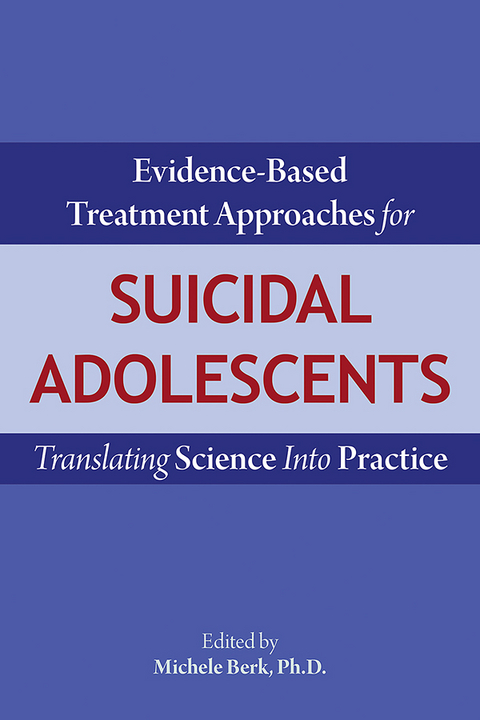
Evidence-Based Treatment Approaches for Suicidal Adolescents (eBook)
363 Seiten
American Psychiatric Association Publishing (Verlag)
978-1-61537-251-5 (ISBN)
The book includes a chapter, written by the treatment developer(s), on each of the six treatments that have been shown in randomized controlled trials to reduce suicidal and/or self-harm behavior in adolescents with prior histories of these behaviors.
Evidence-Based Treatment Approaches for Suicidal Adolescents: Translating Science Into Practice combines state-of-the-art research and treatment development with clinical descriptions of evidence-based and evidence-informed treatment strategies for adolescents struggling with suicidality and self-harm. The book provides important information on clinical approaches that have shown promise in reducing the risk of suicide attempts and self-harm in teens and preventing the tragedy of premature death by suicide. Following two chapters on risk assessment and safety planning, six chapters present different approaches to psychosocial treatment. Although some approaches share common theoretical roots, and most address similar targets and mechanisms (e.g., restricting access to lethal means of self-harm, enhancing family support and functioning, and strengthening emotion regulation), each treatment modality has important differences and distinct strengths. The book's final chapter addresses pharmacological strategies for managing and treating suicidality. This combination of information on risk assessment and management, safety planning, psychosocial treatment, and pharmacologic treatment reflects the perspective that psychosocial and biologically based risk and protective factors are increasingly recognized as crucial for improving the mental health of and outcomes for adolescents and their families.
The volume's many useful features include the following: The book is user-friendly. Each treatment chapter follows a common structure: overview, theoretical model, review of current empirical evidence, primary treatment components and intervention strategies, case example, recommendations for implementing the approach in practice, resources for obtaining training, and suggested readings. Readers can easily find relevant information and compare treatment approaches. The book is practice friendly. By offering a review of existing evidence-based treatments for at-risk adolescents in one accessible volume, the book makes it easier for clinicians to learn about current findings in the field and to choose between existing approaches. Moreover, the clinically rich chapters contain case examples and suggestions for implementing each treatment into practice across a range of settings. The book is pragmatic. Recognizing that clinicians attempting to implement these promising treatments in community practice with limited resources may encounter challenges, the authors include a table at the end of each treatment chapter describing elements that may more easily be put into practice when implementation of the full treatment protocol is not feasible. The book emphasizes risk assessment and safety. Risk and protective factors are explored in-depth, as are strategies for enhancing safety. These strategies are relatively straightforward, but they have the enormous potential to save lives.
An indispensable resource not only for clinicians working across diverse practice settings, Evidence-Based Treatment Approaches for Suicidal Adolescents: Translating Science Into Practice will also prove valuable to policy makers, health and behavioral health system leaders, and researchers engaged in the critically important work of reducing suicide among adolescents.
Michele Berk, Ph.D., is an Assistant Professor in the Department of Psychiatry and Behavioral Sciences in the Division of Child and Adolescent Psychiatry at Stanford University in Stanford, California.�
Chapter 1. Introduction Part I: Suicide Risk Assessment and Basic Safety PlanningChapter 2. Risk and Protective Factors for Suicidal Thoughts and Behaviors in AdolescentsChapter 3. Safety Planning and Risk ManagementPart II: Treatment ApproachesChapter 4. Dialectical Behavior Therapy for Suicidal Multi-Problem Adolescents (DBT)Chapter 5. Mentalization-Based Therapy for Adolescents (MBT-A)Chapter 6. CBT for Co-occurring Suicidal Behavior and Substance Use (I-CBT)Chapter 7. A Psychiatric Adaptation of Multisystemic Therapy (MST) for Suicidal YouthChapter 8. Attachment-Based Family Therapy for Suicidal Youth and Young Adults (ABFT)Chapter 9. The SAFETY Program: A Youth and Family Centered Cognitive-Behavioral Intervention Informed by Dialectical Behavior TherapyChapter 10. Pharmacological Approaches for Treating Suicidality in Adolescents
| Erscheint lt. Verlag | 12.3.2019 |
|---|---|
| Zusatzinfo | 9 figures, 24 tables |
| Verlagsort | Washington |
| Sprache | englisch |
| Maße | 150 x 150 mm |
| Themenwelt | Medizin / Pharmazie ► Gesundheitsfachberufe |
| Medizin / Pharmazie ► Medizinische Fachgebiete ► Psychiatrie / Psychotherapie | |
| ISBN-10 | 1-61537-251-2 / 1615372512 |
| ISBN-13 | 978-1-61537-251-5 / 9781615372515 |
| Informationen gemäß Produktsicherheitsverordnung (GPSR) | |
| Haben Sie eine Frage zum Produkt? |
 EPUB (Adobe DRM)
Kopierschutz: Adobe-DRM
Adobe-DRM ist ein Kopierschutz, der das eBook vor Mißbrauch schützen soll. Dabei wird das eBook bereits beim Download auf Ihre persönliche Adobe-ID autorisiert. Lesen können Sie das eBook dann nur auf den Geräten, welche ebenfalls auf Ihre Adobe-ID registriert sind.
Details zum Adobe-DRM
Dateiformat: EPUB (Electronic Publication)
EPUB ist ein offener Standard für eBooks und eignet sich besonders zur Darstellung von Belletristik und Sachbüchern. Der Fließtext wird dynamisch an die Display- und Schriftgröße angepasst. Auch für mobile Lesegeräte ist EPUB daher gut geeignet.
Systemvoraussetzungen:
PC/Mac: Mit einem PC oder Mac können Sie dieses eBook lesen. Sie benötigen eine
eReader: Dieses eBook kann mit (fast) allen eBook-Readern gelesen werden. Mit dem amazon-Kindle ist es aber nicht kompatibel.
Smartphone/Tablet: Egal ob Apple oder Android, dieses eBook können Sie lesen. Sie benötigen eine
Geräteliste und zusätzliche Hinweise
Buying eBooks from abroad
For tax law reasons we can sell eBooks just within Germany and Switzerland. Regrettably we cannot fulfill eBook-orders from other countries.
aus dem Bereich