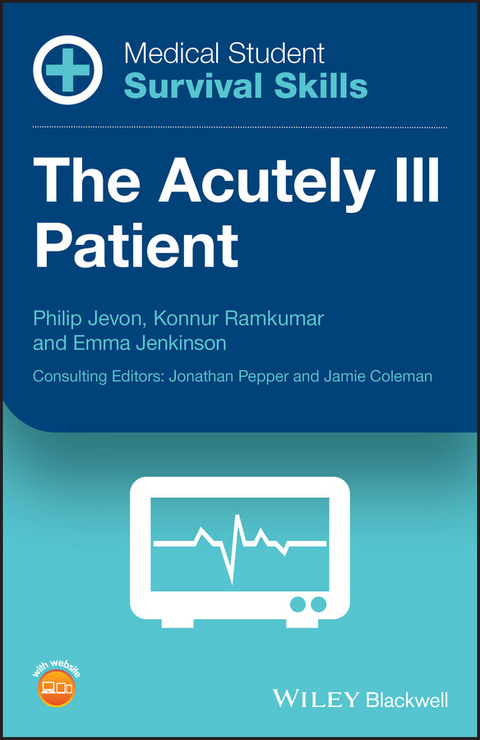
Medical Student Survival Skills (eBook)
John Wiley & Sons (Verlag)
978-1-118-90282-0 (ISBN)
Medical students encounter many challenges on their path to success, from managing their time, applying theory to practice, and passing exams. The Medical Student Survival Skills series helps medical students navigate core subjects of the curriculum, providing accessible, short reference guides for OSCE preparation and hospital placements. These guides are the perfect tool for achieving clinical success.
Medical Student Survival Skills: The Acutely Ill Patient is a concise and portable reference on the management of patients in acute care settings. Managing acutely ill patients can be challenging for many medical students, where quick and decisive decision-making is crucial. This important resource covers the management of numerous acute care conditions, such as tachypnoea, acute stroke, ketoacidosis, anaphylaxis and acute liver failure. With OCSE key learning points, figures and illustrations, The Acutely Ill Patient is the key to success in emergency and surgical rotations and OCSE exams.
Philip Jevon is Honorary Clinical Lecturer at Birmingham Medical School and Academy Manager/Tutor, Walsall Teaching Academy, Manor Hospital, Walsall, UK.
Konnur Ramkumar is Consultant Anaesthetist, Senior Academy Tutor, Walsall Healthcare NHS Trust, Manor Hospital, Walsall, UK.
Emma Jenkinson is Consultant, Emergency Medicine and Paediatric Emergency Medicine, The Royal Wolverhampton NHS Trust, New Cross Hospital, West Midlands, UK.
Medical students encounter many challenges on their path to success, from managing their time, applying theory to practice, and passing exams. The Medical Student Survival Skills series helps medical students navigate core subjects of the curriculum, providing accessible, short reference guides for OSCE preparation and hospital placements. These guides are the perfect tool for achieving clinical success. Medical Student Survival Skills: The Acutely Ill Patient is a concise and portable reference on the management of patients in acute care settings. Managing acutely ill patients can be challenging for many medical students, where quick and decisive decision-making is crucial. This important resource covers the management of numerous acute care conditions, such as tachypnoea, acute stroke, ketoacidosis, anaphylaxis and acute liver failure. With OCSE key learning points, figures and illustrations, The Acutely Ill Patient is the key to success in emergency and surgical rotations and OCSE exams.
Philip Jevon is Honorary Clinical Lecturer at Birmingham Medical School and Academy Manager/Tutor, Walsall Teaching Academy, Manor Hospital, Walsall, UK. Konnur Ramkumar is Consultant Anaesthetist, Senior Academy Tutor, Walsall Healthcare NHS Trust, Manor Hospital, Walsall, UK. Emma Jenkinson is Consultant, Emergency Medicine and Paediatric Emergency Medicine, The Royal Wolverhampton NHS Trust, New Cross Hospital, West Midlands, UK.
About the companion website vii
1 ABCDE: Assessment and treatment of the acutely Ill patient 1
2 Management of tachypnoea 13
3 Management of bradycardia 17
4 Management of sinus tachycardia 25
5 Management of other tachycardias 27
6 Management of oliguria 37
7 Management of pyrexia 41
8 Management of anaphylaxis 47
9 Management of acute asthma 55
10 Management of hypovolaemia 61
11 Management of sepsis 67
12 Management of acute stroke 73
13 Management of chest pain 79
14 Management of abdominal pain 85
15 Management of acute ischaemic leg 91
16 Management of acute kidney injury 99
17 Management of the unconscious patient 105
18 Management of upper gastrointestinal bleed 113
19 Management of diabetic ketoacidosis 121
20 Management of hypoglycaemia 127
21 Management of severe headache 131
22 Management of acute liver failure 141
23 Management of self-harm and poisoning 147
24 Management of trauma 159
25 In-hospital resuscitation 167
References 179
Index 181
1
ABCDE: Assessment and treatment of the acutely Ill patient
Box 1.1 ABCDE assessment
| A | Airway |
| B | Breathing |
| C | Circulation |
| D | Disability |
| E | Exposure |
ABCDE approach: Guiding principles
- Undertake a complete initial ABCDE assessment (Box 1.1); reassess regularly
- Treat life‐threatening problems first, before proceeding to the next part of assessment.
- Evaluate the effects of treatment and/or other interventions
- Recognise the circumstances when additional help is required
- Ensure effective communication
- Call for help early (SBAR) (Box 1.2)
Box 1.2 SBAR: Structured approach to calling for help
| S | Situation |
| B | Background |
| A | Assessment |
| R | Recommendation |
Initial approach
Safety
- Ensure safe approach: check the environment and remove any hazards
- Take measures to minimise the risk of cross infection
Simple question
- Ask the patient a simple question, e.g. ‘How are you, sir?’ If there is a normal verbal response the patient has a patent airway, is breathing, and has cerebral perfusion. If the patient can only speak in short sentences, they may have extreme respiratory distress, and failure to respond is a clear indicator of serious illness. If there is an inappropriate response or if there is no response, the patient may be acutely ill
NB If the patent is unconscious: summon help from colleagues immediately.
General appearance
- Note the general appearance of the patient, e.g. comfortable or distressed, content or concerned, colour and posture
Vital signs monitoring
- Attach vital signs monitoring, e.g. pulse oximetry, electrocardiogram () and continuous non‐invasive blood pressure () monitoring
Airway
- Patient talking: there is a patent airway
- Complete airway obstruction: there are no breath sounds at the mouth or nose
- Partial airway obstruction: air entry diminished, often noisy breathing
Look
- Look for the signs of airway obstruction, e.g. paradoxical chest and abdominal movements (‘see‐saw’ respirations); central cyanosis is a late sign of airway obstruction
Listen
- Gurgling: fluid in the mouth or upper airway
- Snoring: tongue partially obstructing the pharynx
- Crowing: laryngeal spasm
- Inspiratory stridor: ‘croaking respirations’ indicating partial upper airway obstruction, e.g. foreign body, laryngeal oedema
- Expiratory wheeze: noisy musical sound caused by turbulent flow of air through narrowed bronchi and bronchioles, more pronounced on expiration; causes include asthma and chronic obstructive pulmonary disease ()
Feel
- Feel for signs of airway obstruction. Place your face or hand in front of the patient's mouth to determine whether there is movement of air
OSCE Key Learning Points
Causes of airway obstruction
- Tongue: commonest cause of airway obstruction in a semi‐conscious or unconscious patient – relaxation of the muscles supporting the tongue can result in it falling back and blocking the pharynx
- Vomit, blood, and secretions
- Foreign body
- Tissue swelling: causes include anaphylaxis, trauma, or infection
- Laryngeal oedema (due to burns, inflammation, or allergy occurring at the level of the larynx)
- Laryngeal spasm (due to foreign body, airway stimulation, or secretions/blood in the airway)
- Tracheobronchial obstruction (due to aspiration of gastric contents, secretions, pulmonary oedema fluid, or bronchospasm)
Treatment of airway obstruction
- If airway obstruction is identified, treat appropriately; for example suction, lateral position, and insertion of oropharyngeal airway are often effective
- Administer oxygen 15 l min−1 via a non‐rebreathe oxygen mask as appropriate
- If necessary, call for help early (SBAR)
Breathing
Inspect
- Look for signs of respiratory distress: tachypnoea, sweating, central cyanosis, use of the accessory muscles of respiration, abdominal breathing, and posture (e.g. pyramid position)
- Count the respiratory rate (normal respiratory rate in adults is approximately 12–20 min−1): tachypnoea is often the first sign that the patient is becoming acutely ill and causes include pneumonia, pulmonary embolism (), heart failure, and shock; bradypnoea is an ominous sign and possible causes include drugs, opiates, fatigue, hypothermia, head injury, and central nervous system () depression
OSCE Key Learning Points
Causes of tachypnoea
- Respiratory pathology, e.g. acute asthma attack, PE
- Heart failure
- Acidosis
- Normal physiological response, e.g. exercise
OSCE Key Learning Points
Causes of bradypnoea
- Medications, e.g. opiates
- Head injury
- CNS depression
- Hypothermia
- Assess the depth of breathing. Ascertain whether chest movement is equal on both sides. Unilateral movement of the chest suggests unilateral disease, e.g. pneumothorax, pneumonia, or pleural effusion. Kussmaul's breathing (air hunger) is characterised by deep, rapid respirations due to stimulation of the respiratory centre by metabolic acidosis, e.g. in ketoacidosis and chronic renal failure.
- Assess the pattern (rhythm) of breathing. A Cheyne–Stokes breathing pattern (periods of apnoea alternating with periods of hyperpnoea) can be associated with brainstem ischaemia, cerebral injury, and severe left ventricular failure (altered carbon dioxide sensitivity of the respiratory centre)
- Note the presence of any chest deformity, e.g. kyphosis, as this could increase the risk of deterioration in the patient's ability to breathe normally
- If the patient has a chest drain, check it is patent and functioning effectively
- Note the presence of abdominal distension (could limit diaphragmatic movement, thereby exacerbating respiratory distress)
- Note the oxygen saturation (SaO2) reading (normal is 94–100%); in a COPD patient normal can be 88–92%
- Check the inspired oxygen concentration (%) being administered to the patient; adjust if necessary
Common misinterpretations and pitfalls
Pulse oximetry does not detect hypercapnia and that, if the patient is receiving oxygen therapy, the SaO2 may be normal in the presence of a very high PaCO2.
Palpate
- Check chest expansion
- Palpate the chest wall to detect surgical emphysema or crepitus (suggesting a pneumothorax until proven otherwise)
- Perform chest percussion
OSCE Key Learning Points
Causes of different percussion notes
- Resonant: air‐filled lung
- Dull: liver, spleen, heart, lung consolidation/collapse
- Stoney dull: pleural effusion/thickening
- Hyper‐resonant: pneumothorax, emphysema
- Tympanitic: gas‐filled viscus
- Check the position of the trachea. Place the tip of your index finger into the supersternal notch, let it slip either side of the trachea and determine whether it fits more easily into one or other side of the trachea; deviation of the trachea to one side indicates mediastinal shift (e.g. pneumothorax, lung fibrosis, pleural fluid)
Auscultate
- Auscultate the chest: assess the depth of breathing and the equality of breath sounds on both sides of the chest. Any additional sounds, e.g. crackles, wheeze, and pleural rubs should be noted. Bronchial breathing indicates lung consolidation; absent or reduced sounds suggest a pneumothorax or pleural fluid
Assessing efficacy of breathing, work of breathing, and adequacy of ventilation
- Efficacy of breathing: can be assessed by air entry, chest movement, pulse oximetry, arterial blood gas analysis, and capnography
- Work of breathing: can be assessed by respiratory rate and accessory muscle use, e.g. neck and abdominal muscles
- Adequacy of ventilation: can be assessed by heart rate, skin colour, and mental status
Causes of compromised breathing
Causes of...
| Erscheint lt. Verlag | 2.4.2019 |
|---|---|
| Reihe/Serie | Medical Student Survival Skills | Medical Student Survival Skills |
| Sprache | englisch |
| Themenwelt | Medizin / Pharmazie ► Allgemeines / Lexika |
| Medizin / Pharmazie ► Medizinische Fachgebiete | |
| Medizin / Pharmazie ► Pflege | |
| Medizin / Pharmazie ► Studium | |
| Schlagworte | abcde assessment • acute care checklists • acute care handbook • acute care instructions • acute condition care</p> • Acute, Critical & Emergency Care • acutely ill patient management • acute medical management • acute patient care’ acute patient management • Clinical Skills • Intensiv- u. Notfallpflege • Klinische Fertigkeiten • Krankenpflege • <p>acute illness guide • medical education • Medical Science • Medizin • Medizinstudium • nursing • OCSE acute care |
| ISBN-10 | 1-118-90282-3 / 1118902823 |
| ISBN-13 | 978-1-118-90282-0 / 9781118902820 |
| Informationen gemäß Produktsicherheitsverordnung (GPSR) | |
| Haben Sie eine Frage zum Produkt? |
 EPUB (Adobe DRM)
Kopierschutz: Adobe-DRM
Adobe-DRM ist ein Kopierschutz, der das eBook vor Mißbrauch schützen soll. Dabei wird das eBook bereits beim Download auf Ihre persönliche Adobe-ID autorisiert. Lesen können Sie das eBook dann nur auf den Geräten, welche ebenfalls auf Ihre Adobe-ID registriert sind.
Details zum Adobe-DRM
Dateiformat: EPUB (Electronic Publication)
EPUB ist ein offener Standard für eBooks und eignet sich besonders zur Darstellung von Belletristik und Sachbüchern. Der Fließtext wird dynamisch an die Display- und Schriftgröße angepasst. Auch für mobile Lesegeräte ist EPUB daher gut geeignet.
Systemvoraussetzungen:
PC/Mac: Mit einem PC oder Mac können Sie dieses eBook lesen. Sie benötigen eine
eReader: Dieses eBook kann mit (fast) allen eBook-Readern gelesen werden. Mit dem amazon-Kindle ist es aber nicht kompatibel.
Smartphone/Tablet: Egal ob Apple oder Android, dieses eBook können Sie lesen. Sie benötigen eine
Geräteliste und zusätzliche Hinweise
Buying eBooks from abroad
For tax law reasons we can sell eBooks just within Germany and Switzerland. Regrettably we cannot fulfill eBook-orders from other countries.
aus dem Bereich