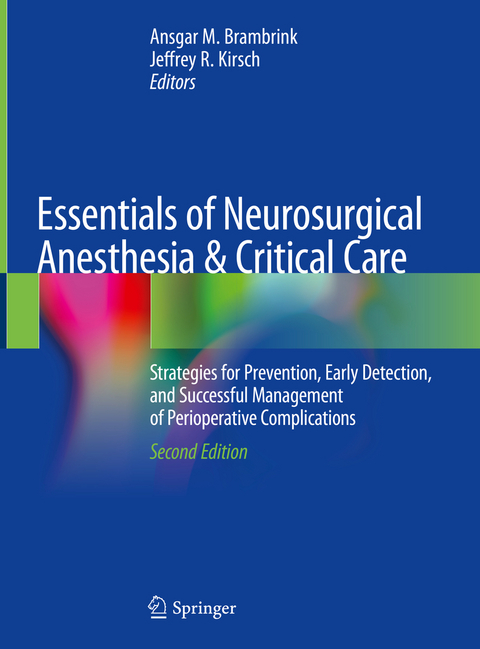
Essentials of Neurosurgical Anesthesia & Critical Care
Springer International Publishing (Verlag)
978-3-030-17408-8 (ISBN)
This comprehensive, evidence-based book is intended to serve as a reference for medical practitioners involved in the perioperative care of neurosurgical patients. Fundamental aspects of neuroanesthesiology and neurocritical care are thoroughly examined across 101 chapters, outlining key elements that are crucial to a care provider's knowledge of the practice. These elements include specific diagnostic procedures and treatment options, concepts and applicable details of the available neurosurgical interventions and techniques, and mechanisms necessary to provide top of the line care for patients. Each chapter features definitive and distinct areas of this multi-specialty discipline, and is designed to guide the reader from problem to solution in situations that can arise in the clinical setting.
Essentials of Neurosurgical Anesthesia & Critical Care, 2nd edition is a problem-oriented approach textbook that will aid a wide variety of readers in handling day-to-day issues and developments relevant to the perioperative care of neurosurgical patients.
Ansgar M. Brambrink, MD, PhD E.M. Papper Professor and Chair Department of Anesthesiology College of Physicians & Surgeons Columbia University Medical Center / NewYork Presbyterian Hospital New York, NY 10032, USA Jeffrey R. Kirsch, MD Professor, Chair-Emeritus Department of Anesthesiology and Perioperative Medicine Oregon Health & Science University Portland, OR 97239
Section I. Basics of Neuroanesthesia Care.- 1 - The Adult Central Nervous System: Anatomy and Physiology.- 2 - Neuroendocrine Physiology: Fundamentals and Common Syndromes.- 3 - Cerebral Edema: Pathophysiology and Principles of Management.- 4 - Management of Fluids, Electrolytes and Blood Products in Neurosurgical Patients.- 5 - Key Monitoring in Neuroanesthesia: Principles, Techniques and Indications.- 6 - Assessing the Anesthetized State with the Electroencephalogram.- Section II. Preoperative Concerns of the Neuroanesthesiologist.- 7 - Cardiovascular Risk and Instability: Evaluation, Management and Triage.- 8 - Risk Assessment and Treatment of Critical Carotid Stenosis: Suggestions for Perioperative Management.- 9 - Aneurysmal Subarachnoid Hemorrhage: Risk Assessment and Perioperative Complications.- 10 - Traumatic Brain Injury: Risk Assessment and Perioperative Management.- 11 - Rare Neurologic Disorders and Neuromuscular Diseases: Risk Assessment and Perioperative Management.-12 - Perioperative Pharmacotherapy in Neurosurgery: Risk Assessment and Planning.- 13. Specific Considerations Regarding Consent and Communication with Patients and Family Prior to Neurosurgery.- 14. Neurotoxicity of General Anesthetics.- 15. Postoperative Neurocognitive Disorders in the Geriatric Patient.- 16: The Chronic Pain Patient Scheduled For Neurosurgery.- 17 - Anesthesia for Patients Scheduled for Intraoperative Electrophysiological Monitoring.- 18 - Factors Influencing Outcome in Neurosurgical Anesthesia.- 19 - A Comparison of Inhaled Anesthesia and Total Intravenous Anesthesia with Target-Controlled Infusion for Neuroanesthesia.- Section III. Fundamentals of Adult Neurosurgery / Neuroanesthesia.- 20. Preparing for Anesthesia in Neurosurgical Patients.- 21 - Basics of Neurosurgical Techniques and Procedures.- 22 - Positioning the Patient for Neurosurgical Operations.- 23 - The Intraoperative Team: Getting the Most out of Collaborative Care in the Operating Room.- 24 - Next Level Communication.- Section IV. Critical Situations During Anesthesia for Brain Surgery in Adults.- 25: The "Tight Brain": Cerebral Herniation Syndrome.- 26: Cerebral Ischemia: Options for Perioperative Neuroprotection.- 27 : Massive Hemorrhage During Craniotomy: Emergency Management.- 28: Challenges During Anesthesia for Awake Craniotomy.- 29: Perioperative Challenges During Stereotactic Neurosurgery and Deep Brain Stimulator Placement.- 30: Perioperative Challenges During Posterior Fossa Surgery.- 31: Perioperative Challenges During Surgical Evacuation of Subdural and Epidural Hematomas.- 32: Perioperative Challenges During Cerebrovascular Surgery.- 33: Perioperative Challenges During Pituitary Surgery.- 34: Perioperative Challenges During Craniotomy for Space-Occupying Brain Lesions.- Section V. Critical Situations During Anesthesia for Spinal Surgery in Adults.- 35: Perioperative Challenges in Patients With Unstable Spine.- 36: Airway Crisis Associated with Cervical Spine Surgery.- 37: Spinal Cord Injury During Spinal Surgery.- 38: Blood Loss During Spinal Surgery.- 39 - Coagulopathy in Spinal Surgery.- 40 - Postoperative Visual Loss Following Spinal Surgery.- Section VI. Critical Situations During Anesthesia for Other Procedures in Adult Neurosurgery.- 41: Perioperative Challenges During Diagnostic and Perioperative Magnetic Resonance Imaging (MRI).- 42: Perioperative Challenges During Electro Convulsive Therapy (ECT) .- 43: Perioperative Challenges During Carotid Artery Revascularization.- VII. Specific Perioperative Concerns in Adult Neuroanesthesia.- 44: Venous Air Embolism During Neurosurgery.- 45 - Arterial Hypotension, Hypertension.- 46 - Hyperthermia and Hypothermia During Neurosurgical Procedures.- 47: Challenges Associated with Perioperative Monitoring During Neurosurgery.- 48: Unintended Wake-up During Neurosurgery.- 49: Cardiac Arrest/Code.- 50: Arousal from Anesthesia: Failure to Emerge.- 51: Communication Challenges During the Perioperative Pe
| Erscheinungsdatum | 12.10.2019 |
|---|---|
| Zusatzinfo | XXX, 671 p. 92 illus., 37 illus. in color. |
| Verlagsort | Cham |
| Sprache | englisch |
| Maße | 210 x 279 mm |
| Gewicht | 2704 g |
| Themenwelt | Medizin / Pharmazie ► Medizinische Fachgebiete ► Anästhesie |
| Schlagworte | complications • neuroanesthesia • Neurocritical Care • neurosurgery • perioperative |
| ISBN-10 | 3-030-17408-5 / 3030174085 |
| ISBN-13 | 978-3-030-17408-8 / 9783030174088 |
| Zustand | Neuware |
| Informationen gemäß Produktsicherheitsverordnung (GPSR) | |
| Haben Sie eine Frage zum Produkt? |
aus dem Bereich