


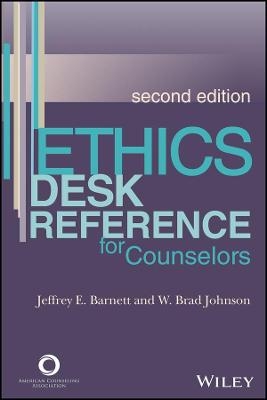
Ethics Desk Reference for Counselors
American Counseling Association (Hersteller)
978-1-119-22155-5 (ISBN)
- Titel ist leider vergriffen;
keine Neuauflage - Artikel merken
Part I presents each section of the Code, along with a brief commentary that emphasizes its most essential elements, common ethical dilemmas and problems relevant to that section, and specific strategies for risk prevention and positive practice. Part II contains ethical guidance sections focused on areas that counselors often encounter in their work, including culture and diversity, confidentiality and exceptions to confidentiality, counseling suicidal clients, multiple relationships in counseling, competence, supervision, managed care, termination and abandonment, and how to respond to an ethics complaint or malpractice suit. New to this edition is a section titled “Integrating Technology into Counseling Practice.”
*Requests for digital versions from ACA can be found on www.wiley.com.
*To request print copies, please visit the ACA website.
*Reproduction requests for material from books published by ACA should be directed to publications@counseling.org
Jeffrey E. Barnett, PsyD, ABPP, is a licensed mental health professional and a professor at Loyola University, Maryland. W. Brad Johnson, PhD, teaches in the counseling program in the Graduate School of Education at Johns Hopkins University and is also a professor at the U.S. Naval Academy.
Foreword ix
Preface xiii
About the Authors xv
PART I The American Counseling Association Code of Ethics
The ACA Code of Ethics Preamble 3
Section A The Counseling Relationship 5
Introduction 5
A.1. Client Welfare 6
A.2. Informed Consent in the
Counseling Relationship 10
A.3. Clients Served by Others 16
A.4. Avoiding Harm and Imposing Values 16
A.5. Prohibited Noncounseling Roles and Relationships 17
A.6. Managing and Maintaining Boundaries and Professional Relationships 20
A.7. Roles and Relationships at Individual, Group, Institutional, and Societal Levels 23
A.8. Multiple Clients 24
A.9. Group Work 25
A.10. Fees and Business Practices 26
A.11. Termination and Referral 30
A.12. Abandonment and Client Neglect 30
Section B Confidentiality and Privacy 33
Introduction 33
B.1. Respecting Client Rights 33
B.2. Exceptions 35
B.3. Information Shared With Others 40
B.4. Groups and Families 43
B.5. Clients Lacking Capacity to Give Informed Consent 45
B.6. Records and Documentation 46
B.7. Case Consultation 52
Section C Professional Responsibility 55
Introduction 55
C.1. Knowledge of and Compliance With Standards 55
C.2. Professional Competence 57
C.3. Advertising and Soliciting Clients 62
C.4. Professional Qualifi cations 64
C.5. Nondiscrimination 66
C.6. Public Responsibility 67
C.7. Treatment Modalities 70
C.8. Responsibility to Other Professionals 71
Section D Relationships With Other Professionals 73
Introduction 73
D.1. Relationships with Colleagues, Employers, and Employees 74
D.2. Provision of Consultation Services 78
Section E Evaluation, Assessment, and Interpretation 81
Introduction 81
E.1. General 81
E.2. Competence to Use and Interpret Assessment Instruments 83
E.3. Informed Consent in Assessment 84
E.4. Release of Data to Qualifi ed Personnel 85
E.5. Diagnosis of Mental Disorders 86
E.6. Instrument Selection 88
E.7. Conditions of Assessment Administration 89
E.8. Multicultural Issues/Diversity in Assessment 90
E.9. Scoring and Interpretation of Assessments 91
E.10. Assessment Security 93
E.11. Obsolete Assessment and Outdated Results 93
E.12. Assessment Construction 94
E.13. Forensic Evaluation: Evaluation for Legal Proceedings 95
Section F Supervision, Training, and Teaching 99
Introduction 99
F.1. Counselor Supervision and Client Welfare 99
F.2. Counselor Supervision Competence 102
F.3. Supervisory Relationship 103
F.4. Supervisor Responsibilities 105
F.5. Student and Supervisee Responsibilities 107
F.6. Counseling Supervision Evaluation, Remediation, and Endorsement 109
F.7. Responsibilities of Counselor Educators 110
F.8. Student Welfare 115
F.9. Evaluation and Remediation 117
F.10. Roles and Relationships Between Counselor Educators and Students 118
F.11. Multicultural/Diversity Competence in Counselor Education and Training Programs 121
Section G Research and Publication 123
Introduction 123
G.1. Research Responsibilities 123
G.2. Rights of Research Participants 125
G.3. Managing and Maintaining Boundaries 130
G.4. Reporting Results 131
G.5. Publications and Presentations 133
Section H Distance Counseling, Technology, and Social Media 139
Introduction 139
H.1. Knowledge and Legal Considerations 140
H.2. Informed Consent and Security 141
H.3. Client Verification 144
H.4. Distance Counseling Relationship 145
H.5. Records and Web Maintenance 149
H.6. Social Media 150
Section I Resolving Ethical Issues 153
Introduction 153
I.1. Standards and the Law 154
I.2. Suspected Violations 156
I.3. Cooperation With Ethics Committees 159
Glossary of Terms 161
PART II Decision Making and Ethical Practice in Counseling
An Ethical Decision-Making Process for Counselors 167
Ethical Issues Regarding Culture and Diversity 173
Confidentiality 179
Exceptions to Confidentiality 185
Counseling Suicidal Clients 189
Boundaries and Multiple Relationships in Counseling 193
Competence 197
Supervision 201
Managed Care 205
Integrating Technology Into Counseling Practice 209
Termination and Abandonment 215
Responding to Subpoenas and Court Orders, Lawsuits, and Ethics Complaints 221
Appendix Resources for Counselors 227
Index 231
| Erscheint lt. Verlag | 20.9.2015 |
|---|---|
| Sprache | englisch |
| Themenwelt | Medizin / Pharmazie ► Medizinische Fachgebiete ► Psychiatrie / Psychotherapie |
| ISBN-10 | 1-119-22155-2 / 1119221552 |
| ISBN-13 | 978-1-119-22155-5 / 9781119221555 |
| Zustand | Neuware |
| Informationen gemäß Produktsicherheitsverordnung (GPSR) | |
| Haben Sie eine Frage zum Produkt? |


