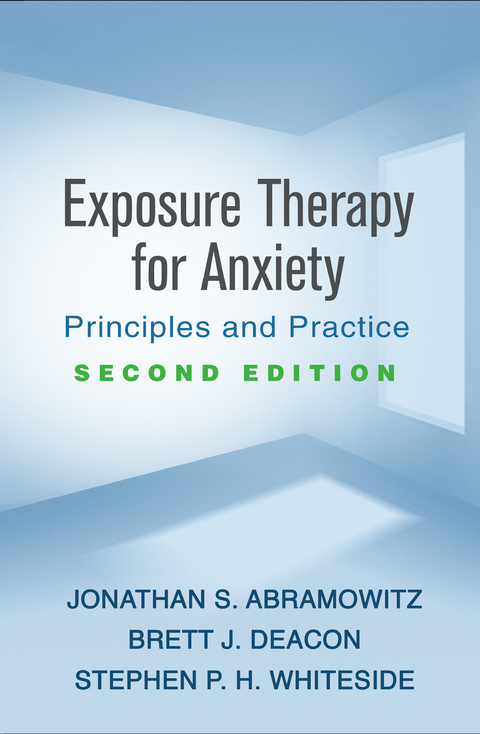
Exposure Therapy for Anxiety (eBook)
459 Seiten
The Guilford Press (Verlag)
978-1-4625-3970-3 (ISBN)
Jonathan S. Abramowitz, PhD, ABPP, is Professor of Psychology and Neuroscience, Research Professor of Psychiatry, and Director of the Anxiety and Stress Disorders Clinic at the University of North Carolina at Chapel Hill. Dr. Abramowitz conducts research on anxiety disorders and has published over 250 articles, book chapters, and books. He serves as Editor of the Journal of Obsessive–Compulsive and Related Disorders and is on the editorial boards of several other scientific journals. He is past president of the Association for Behavioral and Cognitive Therapies and serves on the scientific and clinical advisory board of the International OCD Foundation. Dr. Abramowitz is a recipient of the Outstanding Contributions to Research Award from the Mayo Clinic Department of Psychiatry and Psychology and the David Shakow Early Career Award for Distinguished Scientific Contributions to Clinical Psychology from Division 12 of the American Psychological Association. His books include Getting Over OCD, Second Edition, and The Stress Less Workbook (for general readers) and Exposure Therapy for Anxiety, Second Edition (for mental health professionals). Brett J. Deacon, PhD, is a clinical psychologist in private practice in Wollongong, Australia, and Conjoint Associate Professor at the University of New South Wales. He has published approximately 100 research articles and book chapters, served as Editor of The Behavior Therapist and Associate Editor of the Journal of Cognitive Psychotherapy, and is an editorial board member of numerous scientific journals. Dr. Deacon’s research examines the dissemination, optimal delivery, and acceptability of exposure therapy for anxiety. He is the recipient of numerous teaching, research, and student mentorship awards from the University of Wyoming, as well as the Golden Anniversary Alumni Award from Northern Illinois University College of Liberal Arts and Sciences. Dr. Deacon presents workshops around the world on exposure therapy. Stephen P. H. Whiteside, PhD, ABPP, is Professor of Psychology and Director of the Pediatric Anxiety Disorders Program at the Mayo Clinic in Rochester, Minnesota. His research focuses on improving access to evidence-based care for pediatric anxiety disorders and obsessive–compulsive disorder through the development of effective and efficient treatments facilitated by technology. Dr. Whiteside serves on the editorial board of the Journal of Anxiety Disorders and on the Education and Training Committee of the Minnesota Psychological Association. He has published over 60 scientific articles and is the codeveloper of the Mayo Clinic Anxiety Coach, a smartphone app that aids in the delivery of exposure.
I. The Fundamentals of Exposure Therapy 1. Overview and History of Exposure Therapy for Anxiety 2. How Well Does Exposure Therapy Work? 3. The Nature and Treatment of Clinical Anxiety 4. Treatment Planning I: Functional Assessment 5. Treatment Planning II: Treatment Engagement and Exposure List Development 6. Implementing Exposure Therapy: An Overview II. Implementing Exposure Therapy for Specific Types of Fears 7. Animal-Related Fears 8. Environmental Fears 9. Social Situations 10. Unwanted Intrusive Thoughts 11. Bodily Cues and Health Concerns 12. Contamination 13. Trauma-Focused Fear 14. Blood-, Injection-, and Injury-Related Stimuli 15. Incompleteness, Asymmetry, and Not-Just-Right Feelings III. Special Considerations in the Use of Exposure Techniques 16. Exposure Therapy with Complex Cases 17. Exposure Therapy with Children 18. Involving Significant Others in Treatment 19. Combining Exposure Therapy with Medication 20. Maintaining Improvement after Treatment 21. Using Technology to Implement Exposure Therapy 22. Using Acceptance and Commitment Therapy with Exposure 23. A Risk–Benefit Analysis of Exposure Therapy
| Sprache | englisch |
|---|---|
| Maße | 150 x 150 mm |
| Themenwelt | Geisteswissenschaften ► Psychologie |
| Medizin / Pharmazie ► Medizinische Fachgebiete ► Psychiatrie / Psychotherapie | |
| Schlagworte | acceptance • Acceptance and Commitment Therapy • amp;#160 • Anxiety Disorders • anxious • anxious • Assessments • avoidant behaviors • behavioral avoidance • Behavioral Experiments • behavioural therapies • books on CBT • books on cognitive-behavioral therapy • books on Psychotherapy • CBT • Clients • clinical practice • Clinical psychology • clinical tools • Clinicians • Cognitive-behavioral therapy • compulsions • Coping skills • Counseling • doing exposure therapy • Evidence-based Treatments • exposure hierarchy • exposures • fear ladders • Fears • functional assessments • generalized anxiety disorder • how to conduct exposures • imaginal • inhibitory learning • Interventions • intrusive thoughts • In vivo • mental health professionals • obsessions • Obsessive-compulsive disorder • OCD • panic attacks • Panic disorder • patients • Practitioners • PSTD • psychiatric disorders • Psychoeducational • Psychological disorders • Psychosocial • Psychotherapists • psychotherapy • PTSD • specific phobias • therapist resources • transdiagnostic • Trauma • treating anxiety • treating anxious clients • treating anxious patients • treatment manuals • Treatment Planning • Treatments • using virtual reality in therapy • worries • worrying |
| ISBN-10 | 1-4625-3970-X / 146253970X |
| ISBN-13 | 978-1-4625-3970-3 / 9781462539703 |
| Informationen gemäß Produktsicherheitsverordnung (GPSR) | |
| Haben Sie eine Frage zum Produkt? |
 EPUB (Adobe DRM)
Kopierschutz: Adobe-DRM
Adobe-DRM ist ein Kopierschutz, der das eBook vor Mißbrauch schützen soll. Dabei wird das eBook bereits beim Download auf Ihre persönliche Adobe-ID autorisiert. Lesen können Sie das eBook dann nur auf den Geräten, welche ebenfalls auf Ihre Adobe-ID registriert sind.
Details zum Adobe-DRM
Dateiformat: EPUB (Electronic Publication)
EPUB ist ein offener Standard für eBooks und eignet sich besonders zur Darstellung von Belletristik und Sachbüchern. Der Fließtext wird dynamisch an die Display- und Schriftgröße angepasst. Auch für mobile Lesegeräte ist EPUB daher gut geeignet.
Systemvoraussetzungen:
PC/Mac: Mit einem PC oder Mac können Sie dieses eBook lesen. Sie benötigen eine
eReader: Dieses eBook kann mit (fast) allen eBook-Readern gelesen werden. Mit dem amazon-Kindle ist es aber nicht kompatibel.
Smartphone/Tablet: Egal ob Apple oder Android, dieses eBook können Sie lesen. Sie benötigen eine
Geräteliste und zusätzliche Hinweise
Buying eBooks from abroad
For tax law reasons we can sell eBooks just within Germany and Switzerland. Regrettably we cannot fulfill eBook-orders from other countries.
aus dem Bereich