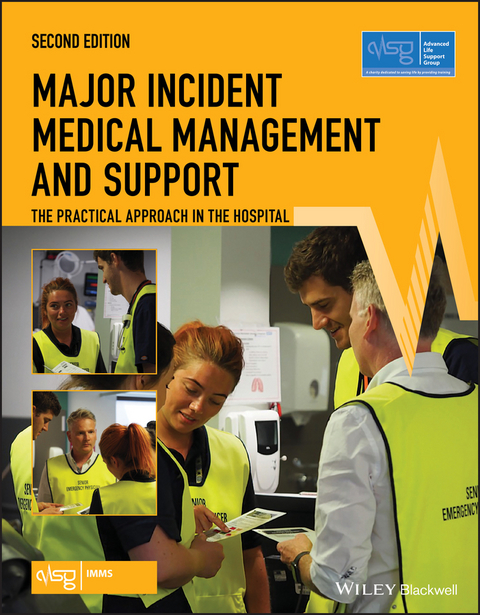
Major Incident Medical Management and Support (eBook)
319 Seiten
John Wiley & Sons (Verlag)
978-1-119-50104-6 (ISBN)
The new edition of Major Incident Medical Management and Support is a vital component in the blended learning course from Advanced Life Support Group (ALSG), which aims to provide hospital staff at all levels with essential information on the preparation, management and support elements of dealing with casualties in a major incident.
Split into five sections, each focuses on the elements requisite in preparing for, and responding, to a major incident. The first section discusses the epidemiology and incidences of major incidents and the structured approach to the hospital response. The second section contains the preparation required in planning for major incidents, including equipment and training. The third section covers the management of a major incident, concentrating on the clinical, nursing and management hierarchies. The fourth includes the various stages of support in a major incident, including declaring an incident and activating the plan, the reception, triage, definitive care and recovery phases of an incident. The final section focuses on special incidents which require additional consideration, including those involving hazardous chemicals, burns and children.
Written in collaboration with the National Emergency Planning, Major Incident Medical Management and Support is an invaluable reference in the emergency department and beyond for staff needing to prepare for the rare, but inevitable, hospital major incidence response.
The Advanced Life Support Group (ALSG), Manchester UK, began life in 1990 and became a registered medical education charity in 1993. The organisation exists to 'preserve life by providing training and education to the general public and in particular but not exclusively to doctors, nurses and other members of the medical profession, in life saving techniques'.
The book is written and edited by Emergency Medicine specialists who are Advanced Life Support Group (ALSG) trainers.
The new edition of Major Incident Medical Management and Support is a vital component in the blended learning course from Advanced Life Support Group (ALSG), which aims to provide hospital staff at all levels with essential information on the preparation, management and support elements of dealing with casualties in a major incident. Split into five sections, each focuses on the elements requisite in preparing for, and responding, to a major incident. The first section discusses the epidemiology and incidences of major incidents and the structured approach to the hospital response. The second section contains the preparation required in planning for major incidents, including equipment and training. The third section covers the management of a major incident, concentrating on the clinical, nursing and management hierarchies. The fourth includes the various stages of support in a major incident, including declaring an incident and activating the plan, the reception, triage, definitive care and recovery phases of an incident. The final section focuses on special incidents which require additional consideration, including those involving hazardous chemicals, burns and children. Written in collaboration with the National Emergency Planning, Major Incident Medical Management and Support is an invaluable reference in the emergency department and beyond for staff needing to prepare for the rare, but inevitable, hospital major incidence response.
The Advanced Life Support Group (ALSG), Manchester UK, began life in 1990 and became a registered medical education charity in 1993. The organisation exists to "preserve life by providing training and education to the general public and in particular but not exclusively to doctors, nurses and other members of the medical profession, in life saving techniques". The book is written and edited by Emergency Medicine specialists who are Advanced Life Support Group (ALSG) trainers.
Working group vii
Contributors to first edition viii
Preface to the second edition ix
Preface to the first edition x
Contact details and further information xi
How to use your textbook xii
PART 1: Introduction 1
1 The epidemiology and incidence of major incidents 3
2 Are we ready for the next major incident? 11
3 The structured approach to the hospital response 15
PART 2: Preparation 21
4 Planning for major incidents 23
5 Major incident equipment 27
6 Training 33
PART 3: Management 37
7 The scaleable hierarchy concept 39
8 The clinical hierarchy 43
9 The nursing hierarchy 55
10 The management hierarchy 65
PART 4: Support 79
11 Declaring a major incident and activating the plan 81
12 The reception phase 87
13 Triage 97
14 The definitive care phase 107
15 The recovery phase 111
PART 5: Special incidents 115
16 Incidents involving hazardous chemicals 117
17 Incidents involving a large number of burns 129
18 Incidents involving large numbers of children 139
Template annexe of local highlights 149
Glossary 159
Index 161
CHAPTER 1
The epidemiology and incidence of major incidents
Learning outcomes
After reading this chapter, you will be able to:
- Define and classify a major incident
- Identify the type of major incidents that can occur
- Describe the incidence of major incidents
1.1 Introduction
A major incident is said to have occurred when an incident requires an extraordinary response by the emergency services. While major incidents may affect any of the emergency services, the health service’s focus is the resulting casualties. A major incident cannot, however, simply be defined in terms of the number of casualties – the resources available at the time of the incident are also relevant. For example, a road traffic accident in a remote area producing five multiply injured casualties may overwhelm the immediately available local resources. However, a similar incident in a major urban conurbation may require little or no additional resources. Thus, the same incident in different localities may produce a major incident in one but not in the other.
For the purposes of planning, major incidents have been defined as:
Events that owing to the number, severity, type or location of live casualties require special arrangements to be made by the health services.
Local highlights: Major incident definition
This definition is an operational one that recognises that major incidents occur when the resources available are unable to cope with the workload from the incident. The need to relate major incidents to the availability of resources is most clearly demonstrated when considering incidents that produce ‘specialist’ types of casualties. An incident producing paediatric, burned or chemically contaminated casualties may require the mobilisation of specialist services even when there are only a few casualties. This is because the expertise and resources needed to deal with these types of casualties are limited and widely scattered around any country.
Incidents such as plane crashes may occur in which all casualties are dead at the scene. Whilst these are clearly major incidents for the police and fire service, there is often little requirement for the health service beyond mortuary and pathology services. An example of such an incident is an air crash where all passengers are killed and only a few people are injured on the ground.
1.2 Classifying major incidents
Whilst the health service definition is an adequate one for planners at a local level, it does not tell us anything about the size of the incident or the incident’s effect on society as a whole.
Rutherford and de Boer (1983) have classified and defined major incidents with regard to their size and effect on the health service and society. This classification system is useful for emergency planners and researchers. Their system defines major incidents in three ways:
- Simple or compound
- Size – minor, moderate or severe
- Compensated or uncompensated
Simple or compound
Compound incidents are those in which the incident destroys the infrastructure of society itself. Roads, communications and even the health services may be destroyed, inaccessible or unavailable. Compound incidents typically arise as the result of war, terrorism or natural disasters. A simple incident is an incident in which the infrastructure remains intact.
Size – minor/moderate/severe
While it is not possible to decide whether a major incident has occurred purely on the number of casualties involved, an appreciation of the size of the incident can assist in the planning process for a major incident response. Rutherford and de Boer (1983) divide incidents into minor, moderate or severe (Table 1.1).
Table 1.1 Size classification of major incidents
| Size | Total number of casualties (alive or dead) | Casualties admitted to hospital |
| Minor | 25–100 | 10–50 |
| Moderate | 100–1000 | 50–250 |
| Severe | >1000 | >250 |
Compensated or uncompensated
By definition, major incidents require the additional mobilisation of resources in order to deal with the health service workload. Incidents may be considered to be compensated if the additional resources mobilised can cope with the additional workload. When an incident is such that even following the mobilisation of additional resources the emergency services are still unable to manage, it is said to be uncompensated.
Failure to compensate may occur in three circumstances. First, the absolute number of casualties may be so large as to overwhelm the available health service resources. Second, the resulting casualties may require such specialised (or rare) skills or equipment that any more than a few casualties overwhelm resources. Such incidents may require relatively few casualties to reach this point, as there may be scant resources available to deal with them. Third, incidents occurring in remote areas may remain decompensated as the health services may be unable to reach the casualties.
The point at which decompensation occurs is often difficult to define and in many respects depends on the perspective of the observer. Total failure of the response to a major incident (such as the absence of any medical care) is clearly failure to compensate, and is most likely to occur in natural disasters or war. However, failure to compensate may also be considered to have occurred when the care given to individual patients is of a standard less than that acceptable in day‐to‐day practice. For instance, if there are many seriously injured casualties, specialist trauma networks may be overwhelmed and patients may be treated in facilities unused to treating severe injury. Decompensation is only considered to have occurred when the system fails to such an extent that individual patient care is seriously compromised.
At the present time little is known about the effectiveness of the health services’ response to major incidents as this information is rarely recorded or analysed. However, anecdotal evidence suggests that the care given to individual patients during major incidents is often below the standard that would be delivered in normal daily practice.
1.3 The all hazards approach and special major incidents
Major incident planning should follow an ‘all hazards approach’. This means that one basic major incident plan should be able to cope with all types of major incident. This is necessary as it is impossible for any emergency planner to predict the nature of the next incident. In addition, maintenance of separate major incident plans for all possible eventualities would be impractical. The all hazards approach also allows planning to be kept as simple and as near to normal working practice as possible.
However, despite these guiding principles, there are still certain types of incident that require additional modifications to the basic plan. This is the only way to achieve the aim of optimal clinical management for as many casualties as possible.
Incidents involving chemicals, radiation, burns, infectious diseases or large numbers of children are considered by many emergency planners as ‘special’ types of major incidents. Whilst it may be necessary to alter or embellish major incident plans to deal with these specific types of incidents, the required modifications should be made without significant departure from the basic (all hazards) major incident plan. All these incidents are characterised by a type of casualty for which resources may be scarce. They may, therefore, result in a failure to compensate by the health services’ response even though there are relatively few casualties. Although these types of incident are considered separately, the general principles of emergency planning must still apply.
1.4 Natural disasters
It is worthwhile reiterating the difference between man‐made and natural disasters when considering the epidemiology of major incidents. Natural disasters result from earthquake, flood, tsunami, volcano, drought, famine and/or pestilence. The potential for suffering and loss of life is enormous (Table 1.2).
Table 1.2 Natural disasters
| Date | Place | Event | Estimated casualties |
| 2011 | Japan | Earthquake and tsunami | 21 000 dead, 5888 injured |
| 2010 | Haiti | Earthquake | 220 000 dead, 300 000 injured |
| 2008 | Great Sichuan | Earthquake | 69 000 dead, 375 000 injured |
| 2004 | Indian Ocean | Tsunami | Over 225 000 dead and injured |
| 1998 | Turkey | Earthquake | 145 dead, 1500 injured |
On a world scale, natural disasters are important but require a different type of response to the simple, compensated major incident more...
| Erscheint lt. Verlag | 3.10.2018 |
|---|---|
| Reihe/Serie | Advanced Life Support Group |
| Advanced Life Support Group | Advanced Life Support Group |
| Sprache | englisch |
| Themenwelt | Medizin / Pharmazie ► Allgemeines / Lexika |
| Medizin / Pharmazie ► Medizinische Fachgebiete ► Notfallmedizin | |
| Schlagworte | A&E • accident • Acute, Critical & Emergency Care • Casualty • Doctor • Emergency • Emergency Department • Emergency Medicine & Trauma • equipment • Hospital • hospital response • Intensiv- u. Notfallpflege • Krankenpflege • major incident • Management • medical education • medical management • Medical Science • Medicine • Medizin • Medizinstudium • National Emergency Planning • Notfallmedizin • Notfallmedizin u. Traumatologie • Nurse • nursing • paramedic • Planning • Practitioner • Preparation • Safety • Support • Training • Transport • Treatment • Triage |
| ISBN-10 | 1-119-50104-0 / 1119501040 |
| ISBN-13 | 978-1-119-50104-6 / 9781119501046 |
| Informationen gemäß Produktsicherheitsverordnung (GPSR) | |
| Haben Sie eine Frage zum Produkt? |
 EPUB (Adobe DRM)
Kopierschutz: Adobe-DRM
Adobe-DRM ist ein Kopierschutz, der das eBook vor Mißbrauch schützen soll. Dabei wird das eBook bereits beim Download auf Ihre persönliche Adobe-ID autorisiert. Lesen können Sie das eBook dann nur auf den Geräten, welche ebenfalls auf Ihre Adobe-ID registriert sind.
Details zum Adobe-DRM
Dateiformat: EPUB (Electronic Publication)
EPUB ist ein offener Standard für eBooks und eignet sich besonders zur Darstellung von Belletristik und Sachbüchern. Der Fließtext wird dynamisch an die Display- und Schriftgröße angepasst. Auch für mobile Lesegeräte ist EPUB daher gut geeignet.
Systemvoraussetzungen:
PC/Mac: Mit einem PC oder Mac können Sie dieses eBook lesen. Sie benötigen eine
eReader: Dieses eBook kann mit (fast) allen eBook-Readern gelesen werden. Mit dem amazon-Kindle ist es aber nicht kompatibel.
Smartphone/Tablet: Egal ob Apple oder Android, dieses eBook können Sie lesen. Sie benötigen eine
Geräteliste und zusätzliche Hinweise
Buying eBooks from abroad
For tax law reasons we can sell eBooks just within Germany and Switzerland. Regrettably we cannot fulfill eBook-orders from other countries.
aus dem Bereich