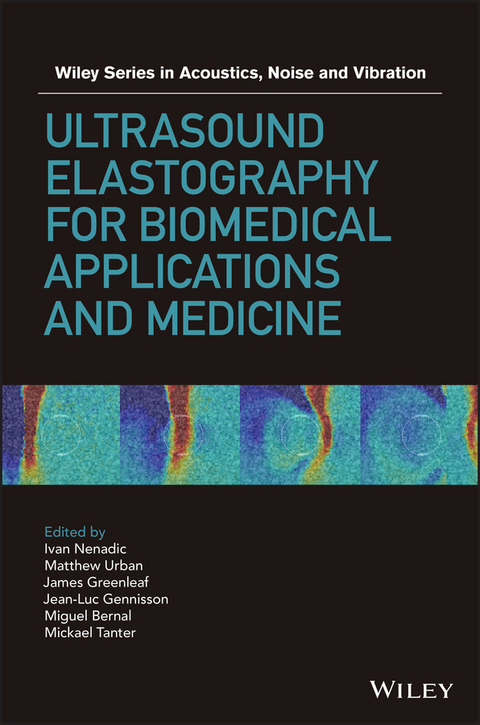
Ultrasound Elastography for Biomedical Applications and Medicine (eBook)
John Wiley & Sons (Verlag)
978-1-119-02154-4 (ISBN)
Ultrasound Elastography for Biomedical Applications and Medicine
Ivan Z. Nenadic, Matthew W. Urban, James F. Greenleaf, Mayo Clinic Ultrasound Research Laboratory, Mayo Clinic College of Medicine, USA
Jean-Luc Gennisson, Miguel Bernal, Mickael Tanter, Institut Langevin - Ondes et Images, ESPCI ParisTech CNRS, France
Covers all major developments and techniques of Ultrasound Elastography and biomedical applications
The field of ultrasound elastography has developed various techniques with the potential to diagnose and track the progression of diseases such as breast and thyroid cancer, liver and kidney fibrosis, congestive heart failure, and atherosclerosis. Having emerged in the last decade, ultrasound elastography is a medical imaging modality that can noninvasively measure and map the elastic and viscous properties of soft tissues.
Ultrasound Elastography for Biomedical Applications and Medicine covers the basic physics of ultrasound wave propagation and the interaction of ultrasound with various media. The book introduces tissue elastography, covers the history of the field, details the various methods that have been developed by research groups across the world, and describes its novel applications, particularly in shear wave elastography.
Key features:
- Covers all major developments and techniques of ultrasound elastography and biomedical applications.
- Contributions from the pioneers of the field secure the most complete coverage of ultrasound elastography available.
The book is essential reading for researchers and engineers working in ultrasound and elastography, as well as biomedical engineering students and those working in the field of biomechanics.
Ivan Z. Nenadic, Matthew W. Urban, James F. Greenleaf, Mayo Clinic, USA.
Jean-Luc Gennisson, Imagerie par Résonance Magnétique Médicale et Multi-Modalités, France.
Miguel Bernal, Universidad Pontificia Bolivariana, Colombia.
Mickael Tanter, Institut Langevin - Ondes et Images, ESPCI ParisTech CNRS, France.
Ultrasound Elastography for Biomedical Applications and Medicine Ivan Z. Nenadic, Matthew W. Urban, James F. Greenleaf, Mayo Clinic Ultrasound Research Laboratory, Mayo Clinic College of Medicine, USA Jean-Luc Gennisson, Miguel Bernal, Mickael Tanter, Institut Langevin Ondes et Images, ESPCI ParisTech CNRS, France Covers all major developments and techniques of Ultrasound Elastography and biomedical applications The field of ultrasound elastography has developed various techniques with the potential to diagnose and track the progression of diseases such as breast and thyroid cancer, liver and kidney fibrosis, congestive heart failure, and atherosclerosis. Having emerged in the last decade, ultrasound elastography is a medical imaging modality that can noninvasively measure and map the elastic and viscous properties of soft tissues. Ultrasound Elastography for Biomedical Applications and Medicine covers the basic physics of ultrasound wave propagation and the interaction of ultrasound with various media. The book introduces tissue elastography, covers the history of the field, details the various methods that have been developed by research groups across the world, and describes its novel applications, particularly in shear wave elastography. Key features: Covers all major developments and techniques of ultrasound elastography and biomedical applications. Contributions from the pioneers of the field secure the most complete coverage of ultrasound elastography available. The book is essential reading for researchers and engineers working in ultrasound and elastography, as well as biomedical engineering students and those working in the field of biomechanics.
Ivan Z. Nenadic, Matthew W. Urban, James F. Greenleaf, Mayo Clinic, USA. Jean-Luc Gennisson, Imagerie par Résonance Magnétique Médicale et Multi-Modalités, France. Miguel Bernal, Universidad Pontificia Bolivariana, Colombia. Mickael Tanter, Institut Langevin - Ondes et Images, ESPCI ParisTech CNRS, France.
1
Editors' Introduction
Ivan Nenadic1, Matthew Urban2, James Greenleaf1, Jean‐Luc Gennisson3, Miguel Bernal4 and Mickael Tanter5
1, Department of Physiology and Biomedical Engineering, Mayo Clinic, Rochester, MN, USA
2 Department of Radiology, Mayo Clinic, Rochester, MN, USA
3 Imagerie par Résonance Magnétique Médicale et Multi‐Modalités, Université Paris‐Saclay, Orsay, France
4 Universidad Pontificia Bolivariana, Medellín, Colombia
5 Institut Langevin–Waves and Images, Ecole Superieure de Physique et de Chimie, Industrielle (ESPCI) Paris, France
Medical imaging has become an integrated part of modern medicine. Images are made on the basis of exploiting physical processes as contrast mechanisms. For example, X‐Ray imaging takes advantage of the differences in mass density of different tissues. Magnetic resonance imaging uses proton densities and magnetic relaxation times to create exquisite images of different soft tissues. Ultrasound imaging takes advantage of acoustic impedance differences related to the compressibility of tissue.
Palpation has been practiced by physicians for centuries because pathological tissue “feels” harder or stiffer than normal tissues, as in the examples of breast tumors. Palpation has some disadvantages – such as being subjective, dependent on the proficiency of the examiner, insensitive to deep or small lesions, and difficult to compare assessments at different time points. For the last 25 years scientists have been working on methods to create images based on the material stiffness differences of tissues in the body. This imaging modality has come to be known as elasticity imaging or elastography. The advantages of such a modality are that it would be objective, quantitative, independent of the examiner, and have high spatial and temporal resolution.
Within the field of elasticity there is a very large parameter space of different material properties – such as the Young's modulus, shear modulus, Poisson's ratio, viscoelasticity, anisotropy, nonlinearity, and density [1]. These different properties vary in different tissue types, some over narrow ranges and some over large ranges – such as the shear modulus which can range over six orders of magnitude [2, 3].
There is a wide range of pathological processes that change the material properties of tissue such as the liver, breast, thyroid, skeletal muscle, pancreas, spleen, kidney, myocardium, vasculature, brain, bladder, prostate, etc. Different conditions, such as inflammation, fibrosis, edema, and cancer, all contribute to changing the material properties of organs because the constituents of the organs are altered on the microscopic scale and that translates into changes observed at the macroscopic scale (micrometers to centimeters).
Elastographic measurements require some form of mechanical stimulation or excitation to cause deformation. Then a measurement system is needed to measure the resulting deformation. The deformation can be caused by an external applied source, such as mechanical vibration, an internal source, such as acoustic radiation force, or an endogenous process, such as the pumping of the heart. Based on the particular form of excitation and its temporal and spatial characteristics, different material properties can be evaluated. The measurement system could be magnetic resonance imaging, ultrasound, optical, or acoustic (hydrophone or accelerometer). For the purposes of this book, we focus only on ultrasound‐based measurement of deformations.
This book is comprised of chapters written by pioneers and innovators in the field of ultrasound‐based elastography. The book is broken up into eight primary sections.
The first section provides an overview of ultrasound physics and imaging theory, a primer on mechanical stimulation of tissue and its response, and ultrasound‐based methods for motion estimation. In Chapter 2, Drs. Roberto Lavarello and Michael Oelze provide a systematic review of ultrasound physics and imaging formation relevant for the field of ultrasound‐based elastography. Dr. Kevin Parker gives an overview of the continuum of excitation used in this field in Chapter 3. Chapter 4, by Drs. Jingfeng Jiang and Bo Peng, provides a thorough treatment of the ultrasonic and signal‐processing methods to measure tissue motion, which is one of the main components of any elastographic measurement.
The second section provides an in‐depth theoretical background on continuum mechanics and wave propagation. Wave propagation in anisotropic, bounded, and viscoelastic media is covered in detail. Chapter 5 provides the basis for continuum mechanics and solutions to wave equations as a foundation for elastography. In Chapter 6, Dr. Jean‐Luc Gennisson presents theory for shear wave (or transverse wave) propagation in anisotropic media. Chapter 7, by Dr. Javier Brum, describes wave propagation in bounded media, which has applications to thin structures such as vessels, myocardium, cornea, and tendons. Chapters 8 and 9 cover measurements of tissue viscoelasticity.
The third section is devoted to methods that have been developed based on quasi‐static compression and endogenous excitations. Compression elastography, particularly as applied in nonlinear materials, is covered in Chapter 10. Dynamic strain and strain rate in cardiac applications are addressed in Chapter 11 by Dr. Jan D'hooge and colleagues. Dr. Marvin Doyley describes vascular and intravascular elastography methods in Chapter 12. Dr. Carolina Amador presents different approaches for measurement of viscoelasticity with creep‐based methods in Chapter 13. Lastly, Dr. Elisa Konofagou writes about wave and strain imaging based on the intrinsic motion present in the cardiovascular system in Chapter .
The fourth section describes methods based on external vibration for generating propagating waves in the tissue. Two different approaches for performing dynamic elastography measurements with harmonic excitations are presented in Chapters 15 and 16. Methods that produce harmonic acoustic radiation forces including vibro‐acoustography, harmonic motion imaging, and shearwave dispersion ultrasound vibrometry are presented by leaders in these methods in Chapters 17–19, respectively.
The fifth section details methods that use mechanical and acoustic radiation force to perturb the tissue within the organ itself with transient excitations. Transient elastography, described by Dr. Laurent Sandrin and colleagues in Chapter 20, is a mechanically based system used primarily for investigation of liver diseases. Dr. Stefan Catheline presents methods to use time reversal techniques for measuring wave propagation in the body in Chapter 21. Chapter 22, by Drs. Tomasz Czernuszewicz and Caterina Gallippi, describes the acoustic radiation force impulse (ARFI) imaging method and its applications. The supersonic shear imaging method is presented by Drs. Jean‐Luc Gennisson and Mickael Tanter in Chapter 23. Dr. Stephen McAleavey presents the benefits of applying single tracking location shear wave elastography in Chapter 24. Lastly, Chapter 25 describes the comb‐push ultrasound shear elastography method developed by Drs. Pengfei Song and Shigao Chen, which uses multiple simultaneous acoustic radiation force push beams to generate shear waves for measurement of local shear wave velocity.
The sixth section provides insights into emerging areas that are being explored in the elastography field. Chapter 26, by Dr. Sara Aristizabal, provides an overview of different shear wave elastography approaches applied to characterizing elastic properties in anisotropic tissues. The use of guided waves for shear wave elastography and quantitative measurement of mechanical properties in thin tissues is addressed in Chapter 27 by Drs. Miguel Bernal and Ivan Nenadic and colleagues. Rheological model‐free approaches for measuring viscoelasticity are described in Chapter 28. Lastly, methods that combine quasi‐static compression elastography and dynamic shear wave elastography are presented to measure nonlinear elastic parameters in Chapter 29.
The seventh section reviews clinical application areas, including measurements made in abdominal organs, cardiovascular tissues, the musculoskeletal system, and breast and thyroid tissues. Chapter 30, by Dr. Matthew Urban, provides an overview of these clinical applications. Chapter 31 describes abdominal applications with shear wave elastography in liver, kidney, spleen, pancreas, intestines, bladder, prostate, and uterus. The group at Duke University led by Dr. Gregg Trahey describe the use of ARFI for cardiac applications in Chapter 32. Additional description of other cardiovascular applications of shear wave elastography are provided in Chapter 33. Dr. Jean‐Luc Gennisson details the use of supersonic shear imaging for musculoskeletal applications using different levels of contraction of skeletal muscle and measurements in tendons in Chapter 34. Dr. Azra Alizad writes about the use of shear wave elastography in breast and thyroid applications in Chapters 35 and 36, respectively.
The final section provides a reflection on the growth of elastography from a literature‐based perspective by Drs. Armen Sarvazyan...
| Erscheint lt. Verlag | 25.10.2018 |
|---|---|
| Reihe/Serie | Wiley Series in Acoustics Noise and Vibration |
| Wiley Series in Acoustics Noise and Vibration | Wiley Series in Acoustics Noise and Vibration |
| Sprache | englisch |
| Themenwelt | Medizin / Pharmazie ► Gesundheitsfachberufe |
| Medizinische Fachgebiete ► Radiologie / Bildgebende Verfahren ► Sonographie / Echokardiographie | |
| Technik ► Bauwesen | |
| Technik ► Maschinenbau | |
| Schlagworte | Acoustic Radiation Force • Acoustic Radiation Force Imaging • Bildgebende Verfahren i. d. Biomedizin • biomedical engineering • Biomedical Imaging • Biomedizintechnik • Control Process & Measurements • elastographie • Maschinenbau • mechanical engineering • Medical Science • Medizin • Mess- u. Regeltechnik • Shear wave dispersion • shear wave elastography • Shear wave propagation • Shear Wave Velocity • Tissue elastography • Tissue Viscoelasticity • Tissue Viscosity • Ultraschall • Ultraschallelastographie • Ultrasound • Ultrasound Vibrometry |
| ISBN-10 | 1-119-02154-5 / 1119021545 |
| ISBN-13 | 978-1-119-02154-4 / 9781119021544 |
| Informationen gemäß Produktsicherheitsverordnung (GPSR) | |
| Haben Sie eine Frage zum Produkt? |
 EPUB (Adobe DRM)
Kopierschutz: Adobe-DRM
Adobe-DRM ist ein Kopierschutz, der das eBook vor Mißbrauch schützen soll. Dabei wird das eBook bereits beim Download auf Ihre persönliche Adobe-ID autorisiert. Lesen können Sie das eBook dann nur auf den Geräten, welche ebenfalls auf Ihre Adobe-ID registriert sind.
Details zum Adobe-DRM
Dateiformat: EPUB (Electronic Publication)
EPUB ist ein offener Standard für eBooks und eignet sich besonders zur Darstellung von Belletristik und Sachbüchern. Der Fließtext wird dynamisch an die Display- und Schriftgröße angepasst. Auch für mobile Lesegeräte ist EPUB daher gut geeignet.
Systemvoraussetzungen:
PC/Mac: Mit einem PC oder Mac können Sie dieses eBook lesen. Sie benötigen eine
eReader: Dieses eBook kann mit (fast) allen eBook-Readern gelesen werden. Mit dem amazon-Kindle ist es aber nicht kompatibel.
Smartphone/Tablet: Egal ob Apple oder Android, dieses eBook können Sie lesen. Sie benötigen eine
Geräteliste und zusätzliche Hinweise
Buying eBooks from abroad
For tax law reasons we can sell eBooks just within Germany and Switzerland. Regrettably we cannot fulfill eBook-orders from other countries.
aus dem Bereich