


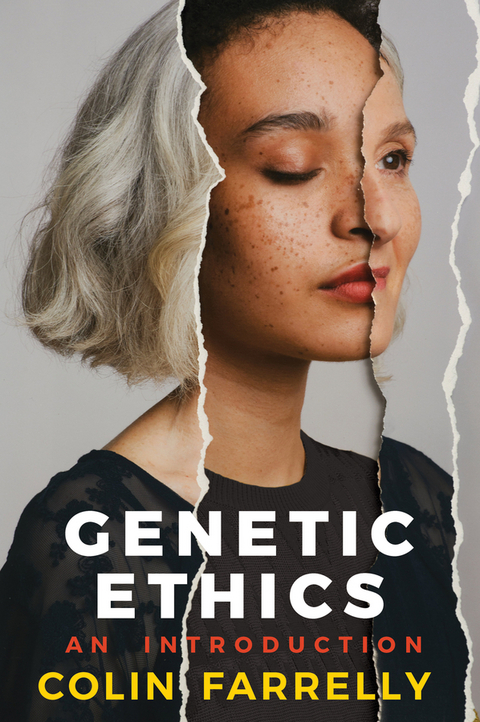
Genetic Ethics (eBook)
John Wiley & Sons (Verlag)
978-0-7456-9507-5 (ISBN)
Farrelly applies an original virtue ethics framework to assess these and other challenges posed by the genetic revolution. Chapters discuss virtue ethics in relation to eugenics, infectious and chronic disease, evolutionary biology, epigenetics, happiness, reproductive freedom and longevity. This fresh approach creates a roadmap for thinking ethically about technological progress that will be of practical use to ethicists and scientists for years to come.
Accessible in tone and compellingly argued, this book is an ideal introduction for students of bioethics, applied ethics, biomedical sciences, and related courses in philosophy and life sciences.
Colin Farrelly is Professor of Political Studies at Queen's University, Canada.
Colin Farrelly contemplates the various ethical and social quandaries raised by the genetic revolution. Recent biomedical advances such as genetic screening, gene therapy and genome editing might be used to promote equality of opportunity, reproductive freedom, healthy aging, and the prevention and treatment of disease. But these technologies also raise a host of ethical questions: Is the idea of genetically engineering humans a morally objectionable form of eugenics? Should parents undergoing IVF be permitted to screen embryos for the sex of their offspring? Would it be ethical to alter the rate at which humans age, greatly increasing longevity at a time when the human population is already at potentially unsustainable levels? Farrelly applies an original virtue ethics framework to assess these and other challenges posed by the genetic revolution. Chapters discuss virtue ethics in relation to eugenics, infectious and chronic disease, evolutionary biology, epigenetics, happiness, reproductive freedom and longevity. This fresh approach creates a roadmap for thinking ethically about technological progress that will be of practical use to ethicists and scientists for years to come. Accessible in tone and compellingly argued, this book is an ideal introduction for students of bioethics, applied ethics, biomedical sciences, and related courses in philosophy and life sciences.
Colin Farrelly is Professor of Political Studies at Queen's University, Canada.
1
Eugenics: Inherently Immoral?
I What is “eugenics”?
One major reason why critics oppose the prospect of human genetic technologies – whether it be screening technologies, such as pre-implantation genetic diagnosis (or PGD) for parents undergoing IVF, or genetic therapy or genome editing – is that they fear this will take humanity down the same path we visited in the past with unjust eugenics policies. The late nineteenth and first half of the twentieth century witnessed a number of unjust policies (e.g. sterilization of the “unfit”) and measures being pursued in the name of “improving the stock” of heredity. This dark episode of our history is what commonly comes to mind when one mentions the word “eugenics.”
“Francis Galton, a cousin of Darwin, invented the term [eugenics] and launched a movement to improve the human race, or at least to halt its perceived decline, through selective breeding” (Wikler 1999: 183). Eugenic-like concepts can be found in the ideas of the ancient Greeks. Plato, Aristotle’s mentor and teacher, proposed an ideal society that would pursue genetic engineering through selective breeding. The “just” Platonic society was one ruled by philosophers, who possessed knowledge and wisdom and who would govern for the common good. The rest of society, divided into the classes of soldiers and workers, would do the work for which they were best suited. Through censorship (e.g. of poetry) and education of the “guardian class,” as well as selective breeding among these class members, the best candidates for the philosopher class could be cultivated and perpetuated. Harmony between the classes could be maintained, argued Plato, if a noble lie was disseminated that some people were made of gold (the philosophers), others of silver and most of bronze. That way people would accept the position in society to which they were best suited.
Most elements of Plato’s ideal society will strike us as obviously misguided and authoritarian. Justice, for Plato, meant “doing what you are best suited to do.” This ancient construal of the moral virtue of justice was predicated upon the foundational premise that people are unequal. Plato’s noble lie that people were made from one of the three different elements of gold, silver or bronze clearly shows that his political theory contravened the idea of the moral equality of all persons.
A contemporary interpretation of the virtues of benevolence and justice must be compatible with the basic moral premise that all persons are moral equals and, as such, deserve to be treated, in the language of John Rawls (1971), as “separate persons” – persons worthy of respect, equal treatment and the protection of basic rights and opportunities.
How should we define “eugenics”? And what was morally wrong with the eugenic aspirations of Plato and the social movements of the late nineteenth and early twentieth century? Must everything considered “eugenic” necessarily be immoral? These are the questions we consider in this chapter. Virtue ethics is a useful moral framework for helping us understand why the eugenic movements of the past were wrong – namely, they epitomized moral and epistemic vice. But, perhaps just as importantly, virtue ethics can help illustrate why eugenics is not inherently immoral. Indeed, justly pursuing eugenic aspirations might actually be required by the virtues of beneficence, justice and the epistemic virtue of adaptability of intellect.
Some have argued that, while “eugenics talk” per se is not wrong, there is something wrong with using its emotive power as a means of circumventing people’s critical–rational faculties (Wilkinson 2008). I agree with this point, and the analysis developed in this chapter is one I hope will help reduce emotive reactions to the word “eugenics” and instead bring to the fore the moral and empirical sensibilities needed to determine whether a specific eugenic proposal or aspiration is just or unjust.
Many have defined eugenics in different ways. To help align our moral analysis of eugenics with the social application of virtue ethics developed in this book, I think the most useful way of defining eugenics is one which emphasizes it as a social movement. Bertrand Russell (1929: 254) provides the following definition of eugenics, one that defines it as a social movement: “The attempt to improve the biological character of a breed by deliberate methods adopted to that end.”
Humans have, since the domestication of animals and agriculture, sought to control and improve the breed of plants and animals they consume and rely upon for labour, sport and leisure. The case of “plant eugenics” is an easy example that satisfies Russell’s definition. Humans purposively intervene in the reproduction of plants, for example. Desired phenotypes, such as a beautiful flower or heatresistant crop, can be achieved through selective breeding or genetic engineering – “a process by which humans introduce or change DNA, RNA, or proteins in an organism to express a new trait or change the expression of an existing trait” (NASEM 2016: 5). The aim of such interventions is to improve the biological character of the plant, to improve its aesthetics, or to aid in feeding the world’s growing human population as well as livestock. And a variety of methods are available. These methods are not without controversy. Many critics of genetically modified crops oppose these technologies, either because they believe (contrary to evidence) eating such foods can be unsafe or because they fear they might cause significant harm to the environment.
Russell’s definition of eugenics is helpful because it draws attention to two distinct issues, each of which warrants closer consideration: (1) an end (i.e. improving the biological character of a breed) and (2) the means (“deliberate methods”) to achieve (1). Without more details, such as what the specific ends and means are, I believe eugenics is a morally neutral aspiration. Some ends are immoral and unjust, whereas other ends are morally laudable. Some means are immoral (even if the ends are morally laudable), and other means are reasonable and defensible. As I have said many times before, the devil really is in the details! I will illustrate this by considering some current public health practices that I believe could be considered “eugenic” but also morally obligatory. And then we will consider the historical eugenic policies that were clearly unjust.
II Folic acid, vaccinations and water fluoridation: eugenics?
Consider, for example, the Centers for Disease Control’s recommendation1 that woman of childbearing age (ages fifteen to forty-five) in the United States should consume 0.4mg of folic acid daily. It is recommended that all women in this age group, not only those planning to get pregnant, take folic acid supplements because nearly half of the pregnancies in the United States are unplanned (Finer and Zolna 2016). The goal of having folic acid be taken en masse is to prevent two common and serious birth defects – spina bifida and anencephaly. Is this recommendation by a public health agency an example of “eugenics”?
If eugenics is understood as an attempt to “improve the biological character of a breed” by “deliberate methods,” then the answer appears to be “yes.” It certainly is an interesting case to debate, and it is not obvious the answer is clearly “no” – that prescribing folic acid isn’t a case of eugenics. But the important point worth noting is that, even if the recommendation that women take folic acid is “eugenic,” it does not mean it is immoral or unjust. In fact, one might take the view, as many public health agencies do, that it is morally obligatory that this recommendation be made. Why? Because it could help prevent serious birth defects. This is beneficial to the prospective parents and their potential offspring. The virtue of benevolence prescribes that a virtuous polity aspire to prevent harm and disadvantage.
Why is the case of recommending folic acid not (at least obviously) morally problematic? I believe there are a few important factors worth emphasizing that are linked to moral and intellectual virtue. Firstly, the CDC simply recommends women take folic acid. It is not something that is legally obligatory. Women of childbearing age in the United States are not compelled, under threat of a fine or imprisonment or public shaming, to take folic acid. To go that far would be to contravene the virtue of justice as it would impose unfair burdens on women. Reducing birth defects is important, but it should not be pursued by placing unfair burdens on women of childbearing age.
Secondly, there is a sound empirical basis for thinking that taking folic acid is linked to the desired objective – namely, reducing serious birth defects. And as such the measure is an example of epistemic virtue rather than vice. The recommended dosage, along with its effectiveness and any potential adverse side-effects, has been extensively studied and the case for prescribing folic acid found to be supported. The CDC does not make the recommendation it does simply on “a hunch” or because it wants to increase the monetary revenue of the...
| Erscheint lt. Verlag | 22.10.2018 |
|---|---|
| Sprache | englisch |
| Themenwelt | Geisteswissenschaften ► Philosophie ► Allgemeines / Lexika |
| Geisteswissenschaften ► Philosophie ► Ethik | |
| Medizin / Pharmazie ► Medizinische Fachgebiete ► Medizinethik | |
| Studium ► Querschnittsbereiche ► Geschichte / Ethik der Medizin | |
| Naturwissenschaften ► Biologie ► Genetik / Molekularbiologie | |
| Sozialwissenschaften ► Soziologie | |
| Schlagworte | Bioethics • Bioethics & Medical Ethics • Bioethik • Bioethik, Medizinethik • Biomedical Sciences • Biotechnology • Biowissenschaften • ethics • Genetic Engineering • genetic ethics • Genetics & Society • Genetic Screening • Genetik • Genetik u. Gesellschaft • genome therapy • Life Sciences • Philosophie • Philosophie in den Naturwissenschaften • Philosophy • philosophy of science |
| ISBN-10 | 0-7456-9507-8 / 0745695078 |
| ISBN-13 | 978-0-7456-9507-5 / 9780745695075 |
| Informationen gemäß Produktsicherheitsverordnung (GPSR) | |
| Haben Sie eine Frage zum Produkt? |
 EPUB (Adobe DRM)
Kopierschutz: Adobe-DRM
Adobe-DRM ist ein Kopierschutz, der das eBook vor Mißbrauch schützen soll. Dabei wird das eBook bereits beim Download auf Ihre persönliche Adobe-ID autorisiert. Lesen können Sie das eBook dann nur auf den Geräten, welche ebenfalls auf Ihre Adobe-ID registriert sind.
Details zum Adobe-DRM
Dateiformat: EPUB (Electronic Publication)
EPUB ist ein offener Standard für eBooks und eignet sich besonders zur Darstellung von Belletristik und Sachbüchern. Der Fließtext wird dynamisch an die Display- und Schriftgröße angepasst. Auch für mobile Lesegeräte ist EPUB daher gut geeignet.
Systemvoraussetzungen:
PC/Mac: Mit einem PC oder Mac können Sie dieses eBook lesen. Sie benötigen eine
eReader: Dieses eBook kann mit (fast) allen eBook-Readern gelesen werden. Mit dem amazon-Kindle ist es aber nicht kompatibel.
Smartphone/Tablet: Egal ob Apple oder Android, dieses eBook können Sie lesen. Sie benötigen eine
Geräteliste und zusätzliche Hinweise
Buying eBooks from abroad
For tax law reasons we can sell eBooks just within Germany and Switzerland. Regrettably we cannot fulfill eBook-orders from other countries.
aus dem Bereich


