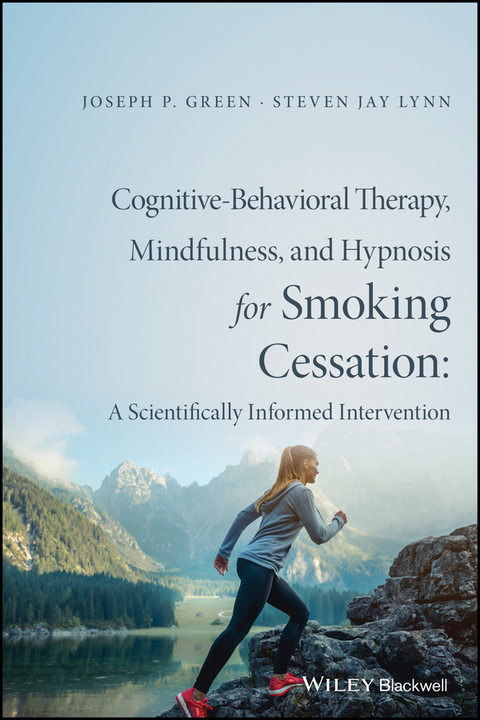
Cognitive-Behavioral Therapy, Mindfulness, and Hypnosis for Smoking Cessation (eBook)
John Wiley & Sons (Verlag)
978-1-119-13966-9 (ISBN)
A scientifically informed intervention to help smokers quit for life, based in cognitive-behavioral therapy
Cognitive-Behavioral Therapy, Mindfulness, and Hypnosis for Smoking Cessation: A Scientifically Informed Intervention presents a comprehensive program developed by noted experts to help smokers achieve their goal of life-long abstinence from smoking. This brief, cost-effective intervention, called The Winning Edge, incorporates state-of-the-science advances and best clinical practices in the treatment of tobacco addiction and offers participants a unique blend of strategies based on cognitive-behavioral, mindfulness, and hypnotic approaches to achieve smoking cessation. This valuable treatment guide, developed and refined over the past 30 years, provides all of the information necessary for health care providers to implement the program on a group or individual basis.
This important resource:
- Provides a detailed, step-by-step guide to conducting the program, with scripts for providers and handouts for participants
- Explains the scientific basis for the many strategies of cognitive, behavioral, and affective change in The Winning Edge program
- Contains information for treatment providers on frequently asked questions, adapting and tailoring the program to the needs of participants, and overcoming challenges, ambivalence, and resistance to stop smoking
Written for a wide audience of mental health professionals, Cognitive-Behavioral Therapy, Mindfulness, and Hypnosis for Smoking Cessation: A Scientifically Informed Intervention offers a comprehensive, science-based approach to help participants achieve their goal of a smoke-free life.
JOSEPH P. GREEN, PHD, is Professor of Psychology at The Ohio State University, Lima. Elected President of APA Div.30 Society for Psychological Hypnosis three times, he conceptualizes hypnotic phenomena as resulting from social, cognitive, motivational, and interpersonal variables.
STEVEN JAY LYNN, PHD, is distinguished Professor of Psychology, Binghamton University, SUNY. Lynn's research interests include dissociation, memory, mindfulness/acceptance, hypnosis, experimental psychopathology, and science versus pseudoscience.
A scientifically informed intervention to help smokers quit for life, based in cognitive-behavioral therapy Cognitive-Behavioral Therapy, Mindfulness, and Hypnosis for Smoking Cessation: A Scientifically Informed Intervention presents a comprehensive program developed by noted experts to help smokers achieve their goal of life-long abstinence from smoking. This brief, cost-effective intervention, called The Winning Edge, incorporates state-of-the-science advances and best clinical practices in the treatment of tobacco addiction and offers participants a unique blend of strategies based on cognitive-behavioral, mindfulness, and hypnotic approaches to achieve smoking cessation. This valuable treatment guide, developed and refined over the past 30 years, provides all of the information necessary for health care providers to implement the program on a group or individual basis. This important resource: Provides a detailed, step-by-step guide to conducting the program, with scripts for providers and handouts for participants Explains the scientific basis for the many strategies of cognitive, behavioral, and affective change in The Winning Edge program Contains information for treatment providers on frequently asked questions, adapting and tailoring the program to the needs of participants, and overcoming challenges, ambivalence, and resistance to stop smoking Written for a wide audience of mental health professionals, Cognitive-Behavioral Therapy, Mindfulness, and Hypnosis for Smoking Cessation: A Scientifically Informed Intervention offers a comprehensive, science-based approach to help participants achieve their goal of a smoke-free life.
JOSEPH P. GREEN, PHD, is Professor of Psychology at The Ohio State University, Lima. Elected President of APA Div.30 Society for Psychological Hypnosis three times, he conceptualizes hypnotic phenomena as resulting from social, cognitive, motivational, and interpersonal variables. STEVEN JAY LYNN, PHD, is distinguished Professor of Psychology, Binghamton University, SUNY. Lynn's research interests include dissociation, memory, mindfulness/acceptance, hypnosis, experimental psychopathology, and science versus pseudoscience.
Acknowledgments iv
About the Companion Website v
1 The Winning Edge: Development and Refinement of our Program 1
2 Why Hypnosis? Rationale and Supporting Evidence 12
3 Before You Start: Tips for Facilitators 23
4 Beginning the Program: The First Treatment Session 36
5 Interview with a Coping Model and Self-Hypnosis Script 1 103
6 Handouts and Worksheets to Accompany Session 1 109
7 Completing the Program: The Second Treatment Session 123
8 Treatment Session 2 Handouts and Follow-Up Forms 137
9 Common Questions, Individualizing Treatment, and Extensions Beyond Smoking Cessation 142
10 Review of Overall Program Scheme and Forms to Aid Research and Data Collection 163
References 189
Name Index (selective author list) 216
Subject Index 221
1
The Winning Edge: Development and Refinement of our Program
We wrote this book to describe a cost‐effective program we developed—The Winning Edge—to help smokers achieve their goal of lifelong abstinence from smoking. Sobering statistics bring into sharp relief the tremendous personal and societal burdens of tobacco smoking and the urgent need to find viable ways to combat the world’s leading preventable cause of premature mortality and morbidity. In the pages that follow, we describe our response to addressing this imperative.
We begin with an overview of the myriad, and increasingly well‐documented and compelling, health‐related risks of smoking. Smoking can cause cancer in almost any organ of the body. Smoking accounts for about 90% of all lung cancer mortalities and over 80% of deaths from chronic pulmonary obstructive disease (COPD), including emphysema and chronic bronchitis (United States Department of Health and Human Services/USDHHS, 2014). Furthermore, smoking increases the risk of developing type 2 diabetes mellitus, cataracts, tooth loss and gum disease, and age‐related macular degeneration, and has been linked to rheumatoid arthritis (USDHHS, 2014). Smoking causes high blood pressure, strokes, and cardiovascular disease (Centers for Disease Control and Prevention/CDCP, 2010); reduces fertility levels of men and women; and increases the risks of miscarriage and birth defects (USDHHS, 2010, 2014). Moreover, smoking nearly doubles the risk of postoperative complications and is associated with higher odds of postoperative infections, increased risk of pulmonary and neurological complications, and higher intensive care unit admission rates (Gronkjaer et al., 2014; Turan et al., 2011).
Public campaigns against smoking, education about the dangers of smoking, and numerous treatment programs have reduced smoking rates. Indeed, the American smoking rate has been halved since 1962 (USDHHS, 2010), and the US smoking rate between 2005 and 2015 has continued to decline, from 20.9% to 15.1% (CDCP, 2016). Still, 36.5 million US adults continue to smoke (CDCP, 2016). Each year, in the US alone, approximately 480,000 people die of a smoking‐attributable illness (USDHHS, 2014).
Globally, the World Health Organization (WHO) estimates that tobacco has caused 100 million deaths in the 20th century (WHO, 2008). To put this into perspective, The Guardian (Chalabi, 2013) reported that 8.5 to 16.5 million people—soldiers and civilians—died during World War I. Another 40 to 72 million people died during World War II. Accordingly, more people have died from smoking than from both world wars combined! Current smokers in the US die, on average, roughly 10 years younger than their lifelong nonsmoker counterparts (Jha et al., 2013).
In the European Union (EU), the number of smokers and deaths attributable to smoking is even higher than in the US. In 2017, the European Commission Special Eurobarometer (ECSE) report, based on nearly 28,000 survey respondents, revealed that 28% of the population smokes and that smoking produces 700,000 annual deaths inside the EU. The report projects that about half of all EU smokers will die prematurely, on average 14 years earlier than nonsmokers. According to the EU Directorate General of Health and Human Safety, tobacco consumption is the single largest avoidable health risk in the European Union (Eurostat News, 2017).
The good news is that smoking rates in the EU are trending downward, paralleling the trend in the US. For example, between 2006 and 2017, EU smoking rates declined by about 6 percentage points, although the pattern was inconsistent across EU countries (ECSE, 2017). In the US, there are concerns that the downward trend in smoking prevalence rates may have stalled (see Fletcher, 2012). Accordingly, the remaining US smokers are more likely to be hardcore smokers who are smoking more and for longer periods of time than earlier cohorts of smokers seeking treatment for smoking cessation.
Still, smokers generally wish to stop. For example, over half (i.e., 54%) of the smokers completing the Eurobarometer survey reported that they had attempted to stop smoking at some point in the past. US surveys note that around 70% of current smokers want to stop, and that a majority of smokers have attempted to quit within the past year (USDHHS, 2014). Importantly, a majority of current smokers believe that they will successfully stop smoking at some point in the future (DiClemente, Delahanty, & Fiedler, 2010). Given the alarming health‐related consequences of continued smoking and the public knowledge about the dangers of smoking, it’s surprising that relatively few smokers wanting to stop seek professional help or formal treatment options for smoking cessation. Indeed, nearly three‐fourths of people in the EU reported not using any formal treatment methods or assistance when trying to stop smoking. Astonishingly, within Spain, the percentage of current smokers trying to stop on their own was nearly 90% (ECSE, 2017). Unfortunately, only a small percentage of smokers trying to stop on their own are successful during any given attempt. US surveys and reviews estimate that less than 5–7% of smokers successfully stop smoking without assistance on any given quit attempt (e.g., Brose et al., 2011; Hughes, Keely, & Naud, 2004).
Fortunately, smoking cessation is associated with decreased mortality and morbidity across many health conditions. For example, ex‐smokers reduce their excess lung cancer risk by upward of 50% within 10 years of quitting (USDHHS, 2010). After stopping smoking, cardiovascular risks, including heart attacks, decrease substantially. Following 2–5 years of smoking cessation, the risk of stroke mirrors that of a nonsmoker (USDHHS, 2010). Estimates indicate that nearly one‐third of all cancer deaths would be eliminated if people didn’t smoke (USDHHS, 2010, 2014). Additionally, stopping smoking is associated with increased reports of subjective happiness. Nearly 70% of adults and 72% of parents reported increased levels of happiness after stopping smoking (Drehmer, Hipple, Ossip, Nabi‐Burza, & Winickoff, 2015; Shahab & West, 2009). Furthermore, at a macro‐level perspective, getting patients to stop smoking prior to a surgical intervention requiring hospitalization reduces the overall costs associated with treatment and follow‐up (Gaskill et al., 2017). With more than a billion people still smoking worldwide (WHO, 2018), and an estimated economic impact of 1.8% of the world’s annual gross domestic product (Goodchild, Nargis, & Tursan d’Espaignet, 2018), it’s imperative to develop cost‐effective treatments that promote long‐term abstinence (Levy et al., 2017; Raw et al., 2017).
Responding to the Need for a Cost‐effective Treatment
Our book responds to this pressing need. We present a cutting‐edge treatment program for tobacco addiction that uses cognitive‐behavioral approaches, including acceptance and mindfulness‐based interventions, to defeat smoking behaviors. Cognitive‐behavioral therapy (CBT) encompasses a broad range of approaches which share the assumption that modifying maladaptive and self‐defeating cognitions, emotions, and behaviors can alleviate distress and problems in living, including those associated with tobacco addiction (Hofmann, Glombiewski, Asnaani, & Sawyer, 2011). Our program is premised on the assumption that acceptance and mindfulness of the constantly changing stream of thoughts and emotions—rather than avoidance of anxiety‐arousing or painful experiences—are key to psychological and experiential flexibility, and are a pathway to breaking the grip of smoking (Bowen & Marlatt, 2009). Hypnosis, which is also an important component of our program, is fundamentally a cognitive‐behavioral intervention, which involves thinking, imagining, and experiencing in response to suggestions that can target cognitive, behavioral, and affective change (Green, Barabasz, Barrett, & Montgomery, 2005; Lynn et al., 2015; Lynn, Malaktaris, Condon, Maxwell, & Cleere, 2012; Milburn, 2011; Schoenberger, 1999).
As we noted at the outset, we collectively refer to the various strategies we teach in our program—CBT, mindfulness, acceptance, and hypnosis—as The Winning Edge. We invite participants to employ these strategies tactically to increase their motivation and to learn skills necessary to draw on personal resources to resist smoking urges and to stop smoking for life. When appropriate, we also encourage the use of nicotine replacement therapy (NRT) as a method to reduce withdrawal symptoms and cravings to smoke, and we disseminate handouts that describe the nature and pros and cons of using NRT. We’ll address NRT more specifically later on, as well as elaborate more fully all of the ingredients of our program. Our program constitutes a multifaceted approach that can be customized to leverage the strengths of participants and to respond to their individual needs.
A Bit of History
How did our program come to be? At the crux of many a good story is another story. Perhaps the history of The Winning Edge is such a story. Here’s how...
| Erscheint lt. Verlag | 31.8.2018 |
|---|---|
| Sprache | englisch |
| Themenwelt | Geisteswissenschaften ► Psychologie ► Biopsychologie / Neurowissenschaften |
| Medizin / Pharmazie ► Allgemeines / Lexika | |
| Medizin / Pharmazie ► Medizinische Fachgebiete ► Psychiatrie / Psychotherapie | |
| Schlagworte | Addictions • Cognitive behavioral therapy (CBT) • cognitive behavior program for smoking cessation • coping model for smoking cessation • Development of program for smoking cessation • Dissociation • empirical evidence for smoking cessation • evidence that hypnosis works for smoking cessation • experimental psychopathology • follow up session for smoking cessation</p> • Gesundheits- u. Sozialwesen • Guide to a Scientifically Informed Intervention for smoking cessation • handouts and worksheets to help with smoking cessation • Health & Social Care • hypnosis • Hypnosis and Smoking Cessation • ideas for facilitating smoking cessation • individualizing treatment for smoking cessation • Klinische Psychologie • Kognitive Verhaltenstherapie • <p>Guide to Cognitive-Behavior Therapy for smoking cessation • Memory • mindfulness and acceptance • Mindfulness and smoking cessation • Psychologie • Psychology • questions about hypnosis and smoking cessation • Science versus pseudoscience • self-hypnosis for smoking cessation • Sucht • Tabakabhängigkeit • Tabaksucht • the first treatment session for smoking cessation • Tobacco Addiction |
| ISBN-10 | 1-119-13966-X / 111913966X |
| ISBN-13 | 978-1-119-13966-9 / 9781119139669 |
| Informationen gemäß Produktsicherheitsverordnung (GPSR) | |
| Haben Sie eine Frage zum Produkt? |
 EPUB (Adobe DRM)
Kopierschutz: Adobe-DRM
Adobe-DRM ist ein Kopierschutz, der das eBook vor Mißbrauch schützen soll. Dabei wird das eBook bereits beim Download auf Ihre persönliche Adobe-ID autorisiert. Lesen können Sie das eBook dann nur auf den Geräten, welche ebenfalls auf Ihre Adobe-ID registriert sind.
Details zum Adobe-DRM
Dateiformat: EPUB (Electronic Publication)
EPUB ist ein offener Standard für eBooks und eignet sich besonders zur Darstellung von Belletristik und Sachbüchern. Der Fließtext wird dynamisch an die Display- und Schriftgröße angepasst. Auch für mobile Lesegeräte ist EPUB daher gut geeignet.
Systemvoraussetzungen:
PC/Mac: Mit einem PC oder Mac können Sie dieses eBook lesen. Sie benötigen eine
eReader: Dieses eBook kann mit (fast) allen eBook-Readern gelesen werden. Mit dem amazon-Kindle ist es aber nicht kompatibel.
Smartphone/Tablet: Egal ob Apple oder Android, dieses eBook können Sie lesen. Sie benötigen eine
Geräteliste und zusätzliche Hinweise
Buying eBooks from abroad
For tax law reasons we can sell eBooks just within Germany and Switzerland. Regrettably we cannot fulfill eBook-orders from other countries.
aus dem Bereich