


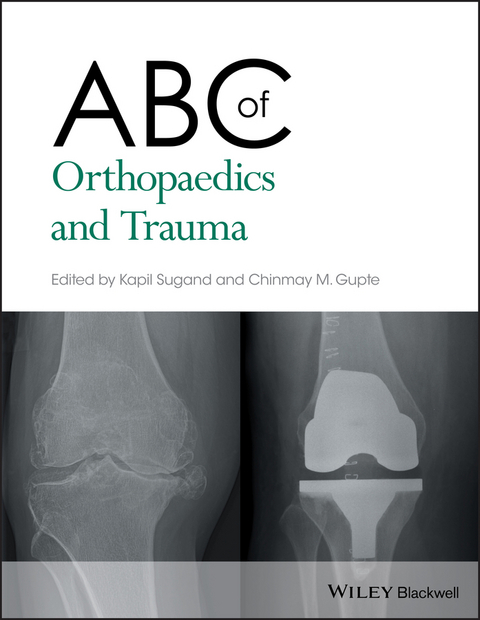
ABC of Orthopaedics and Trauma (eBook)
John Wiley & Sons (Verlag)
978-1-118-56120-1 (ISBN)
Fully illustrated throughout with a wide range of scans, images and line drawings, ABC of Orthopaedics and Trauma provides practical guidance on the diagnosis, treatment and management of orthopaedic conditions, and assists with the initial assessment based on common presentations. Written by a team of renowned expert orthopaedic surgeons and rheumatologists, it includes coverage of the current national guidelines from NICE and professional bodies.
Twenty-four chapters cover all the major areas of this vast speciality using a digestible and reader-friendly approach, including sections on fractures, joint replacements, rheumatological disorders, osteoarthritis, emergencies, and post-operative care. Introduction to specialist topics like metabolic bone disease, peripheral nerve injury, paediatric orthopaedics and tumours are also featured. Topics consist of history and examination, investigation and initial management of common orthopaedic trauma and elective presentations.
In addition, this full-colour, user-friendly reference guide offers readers a look at the day-to-day clinical practice of a speciality that will affect at least half of the global population at some point, covering further chapters on epidemiology, biomechanics, common procedures, future developments and education.
ABC of Orthopaedics and Trauma is an excellent resource for all healthcare professionals caring for patients with musculoskeletal and orthopaedic related disorders. This will be a valuable reference to orthopaedic trainees, sports physicians, physiotherapists, nurses, occupational therapists, clinical researchers and student doctors.Kapil Sugand PgCert HBE, BSc, MBBS, MRCS, AICSM, Surgical Research Fellow & Orthopaedic Specialist Trainee, MSk Lab, Charing Cross Hospital, Imperial College London, London, UK; North West London Rotation, London, UK
Chinmay M. Gupte PhD, FRCS (Tr&Orth) MA(Oxon) BMBCh, Consultant Orthopaedic Surgeon and Senior Clinical Lecturer, MSk Lab, Charing Cross Hospital, Imperial College London, London, UK; Imperial College Healthcare NHS Trust, London, UK
Fully illustrated throughout with a wide range of scans, images and line drawings, ABC of Orthopaedics and Trauma provides practical guidance on the diagnosis, treatment and management of orthopaedic conditions, and assists with the initial assessment based on common presentations. Written by a team of renowned expert orthopaedic surgeons and rheumatologists, it includes coverage of the current national guidelines from NICE and professional bodies. Twenty-four chapters cover all the major areas of this vast speciality using a digestible and reader-friendly approach, including sections on fractures, joint replacements, rheumatological disorders, osteoarthritis, emergencies, and post-operative care. Introduction to specialist topics like metabolic bone disease, peripheral nerve injury, paediatric orthopaedics and tumours are also featured. Topics consist of history and examination, investigation and initial management of common orthopaedic trauma and elective presentations. In addition, this full-colour, user-friendly reference guide offers readers a look at the day-to-day clinical practice of a speciality that will affect at least half of the global population at some point, covering further chapters on epidemiology, biomechanics, common procedures, future developments and education. ABC of Orthopaedics and Trauma is an excellent resource for all healthcare professionals caring for patients with musculoskeletal and orthopaedic related disorders. This will be a valuable reference to orthopaedic trainees, sports physicians, physiotherapists, nurses, occupational therapists, clinical researchers and student doctors.
Kapil Sugand PgCert HBE, BSc, MBBS, MRCS, AICSM, Surgical Research Fellow & Orthopaedic Specialist Trainee, MSk Lab, Charing Cross Hospital, Imperial College London, London, UK; North West London Rotation, London, UK Chinmay M. Gupte PhD, FRCS (Tr&Orth) MA(Oxon) BMBCh, Consultant Orthopaedic Surgeon and Senior Clinical Lecturer, MSk Lab, Charing Cross Hospital, Imperial College London, London, UK; Imperial College Healthcare NHS Trust, London, UK
Foreword, ix
Contributors, xi
Preface, xiii
Abbreviations, xv
1 General Overview, 1
Kapil Sugand, Anita Khurwal, and Chinmay M. Gupte
2 Epidemiology of Musculoskeletal Disease, 7
David Metcalfe
3 Orthopaedic Investigations, 11
Adil Ajuied, Christian Smith, and Cynthia Gupte
4 Orthopaedic Trauma, 23
Aamer Nisar, Chinmay M. Gupte, and Rajarshi Bhattacharya
5 Management of Adult Fractures, 29
Aamer Nisar, Chinmay M. Gupte, and Rajarshi Bhattacharya
6 Shoulder and Elbow, 37
Andrew Sankey and Peter Reilly
7 Hand and Wrist, 47
Issaq Ahmed and Philippa Rust
8 Pelvis and Acetabulum, 59
Hani B Abdul-Jabar and Jasvinder Daurka
9 The Hip, 67
Simond Jagernauth and Joshua KL Lee
10 The Knee, 75
Nawfal Al-Hadithy and Chinmay M. Gupte
11 Foot and Ankle, 85
Nadeem Mushtaq, Ali Abbasian, Kapil Sugand, and Chinmay M. Gupte
12 Spine, 95
Syed Aftab and Robert Lee
13 Paediatric Orthopaedics, 105
Bassel El-Osta, Alex Shearman, and Neel Mohan
14 Orthopaedic Emergencies, 117
14.1 Emergency: Dislocated Hip, 117
Simond Jagernauth and Joshua KL Lee
14.2 Emergency: Locked Knee and Dislocation, 119
Sohail Yousaf, Mubeen Nazar, and Chinmay M. Gupte
14.3 Emergency: Acute Shoulder Dislocation, 123
Andrew Sankey and Peter Reilly
14.4 Emergency: Supracondylar Fractures of Distal Humerus in Children, 125
Alex Shearman, Bassel El-Osta, and Neel Mohan
14.5 Emergency: Septic Arthritis, 128
James Donaldson and Jonathan Miles
14.6 Compartment Syndrome, 131
Ahsan Sheeraz
14.7 Emergency: Cauda Equina Syndrome, 133
Syed Aftab and Robert Lee
15 Orthopaedic Procedures, 135
Simon Mordecai and Jacqueline Waterman
16 Prevention and Postoperative Care, 141
Ahsan Sheeraz
17 Osteoarthritis, 149
Alexander L. Dodds and Dinesh Nathwani
18 Inflammatory Diseases, 155
Sanam Kia and Sonya Abraham
19 Bone and Joint Infections, 163
James Donaldson and Jonathan Miles
20 Metabolic Bone Diseases, 173
Michael Fertleman, Shuli Levy, and Georgina Meredith
21 Bone and Soft Tissue Tumours, 181
Rej Bhumbra
22 Peripheral Nerve Injury (PNI), 187
Rishi Dhir, Kapil Sugand, and Tom Quick
23 Orthopaedic Biomechanics, 195
Hussein Taki and Bernard van Duren
24 Tools of the Trade, 199
Mike Rafferty
Index, 207
CHAPTER 1
General Overview
Kapil Sugand1,2, Anita Khurwal2, and Chinmay M. Gupte1,3
1 MSk Lab, Charing Cross Hospital, Imperial College London, London, UK
2 North West London Rotation, London, UK
3 Imperial College Healthcare NHS Trust, London, UK
OVERVIEW
- Orthopaedics is one of the oldest surgical practices since ancient civilisations.
- With an ever‐growing and ageing population, there is a greater global clinical burden of trauma and elective orthopaedics.
- Fracture classifications can help with management plans, either nonoperative or operative treatment.
- Poor management of fractures and dislocations can lead to loss of function, long‐term disability, and chronic pain, as well as deterioration in quality of life.
Introduction
Trauma and orthopaedics is an ancient practice of surgery. Records from Ancient Egypt, for example, document the splintage of fractures, wound care, and the reduction of shoulder dislocation. The art and skill of managing musculoskeletal injuries depends on adequate history, thorough examination, patient selection, and meticulous operative technique. Orthopaedic surgeons are trained not only to manage fractures but also to treat deep‐seated infection, degenerative disease, tumours, and congenital deformities, as well as the repair of soft tissue like muscles, nerves, tendons, ligaments, and minimally invasive access surgery.
Epidemiology
There is an increasing demand for orthopaedic surgeons, owing to an ever‐growing population. Immigration patterns and an ageing population have further contributed to the clinical burden worldwide. The World Health Organisation (WHO) predicts that by 2020, trauma will be the third most common cause for the global burden of disease, and that one in two people in the world will require at least one orthopaedic procedure in their lifetime. Trauma services have been centralised in more economically developed countries, where specialist centres manage complex trauma effectively. However, there is a discrepancy in the infrastructure of the trauma services in less economically developed countries, which leads to increased mortality and chronic disability rates, which are potentially avoidable. Furthermore, specific registries have collated information including demographics, indications and complications, in order to improve the orthopaedic service provided to patients.
Definitions
Trauma and orthopaedics, like any other speciality, has its own jargon and terminology. There are 300 bones in newborns and 206 in adults, divided into the midline axial skeleton (head, spine, ribs, and pelvis) and the appendicular skeleton (limbs), seen in Figure 1.1a. Movements of the body are seen in Figure 1.1b.
Some popular terms include the following:
- Trauma: any injury, bony or soft tissue
- Joint: articulation between two or more bones
- Arthro‐: related to a joint
- Arthrocentesis: joint aspiration
- Arthroscopy: insertion of a minimally invasive camera into a joint
- Arthroplasty: joint reconstruction
- Arthrodesis: joint fusion
- Displacement: deviation of fracture fragment from original anatomical site
- Intra‐/extra‐articular: inside/outside joint
- Stable fractures: those able to withstand physiological loading, without further displacement (usually extra‐articular and minimally displaced)
- Open fracture: bone breaching soft tissue and skin, to be in contact with outside environment (as opposed to closed)
- Revision surgery: successive surgical attempts at achieving the desired result
Figure 1.1 (a) Human skeleton and (b) movement of the body
History
Taking a thorough history is the cornerstone of medical practice. It is important that as much information as possible about the patient’s symptoms and medical background is ascertained, in order reach a list of differential diagnoses and to offer optimal management options. It is said that 80% of the diagnosis is within the medical history. An orthopaedic approach to history taking is seen in Table 1.1.
Table 1.1 Orthopaedic history
|
Examination
A systematic examination is essential in orthopaedic practice. The impression gained from the history is tested and further information is ascertained. The management options, and whether surgical intervention is necessitated, depends on the extent of disease and its consequent functional limitation and quality of life. As the idiom goes, a good surgeon knows when to operate, but the best surgeon knows when not to operate. The general principles of examining in orthopaedics are to (1) look, (2) feel, and (3) move as well as any (4) special tests (Figure 1.2).
Figure 1.2 Orthopaedic examination
Reading radiographs
Regardless of speciality, all doctors and medical students are expected to interpret basic orthopaedic plain radiographs (do not refer to them as X‐rays). Competency in reading radiographs is based on the following six points of information:
- Anatomical site: which bone and which part of bone? Long bones are divided into proximal, middle, and distal thirds.
- Number of fragments: simple (two‐part) vs. multifragmentary (formerly referred to as comminuted).
- Fracture pattern: transverse vs. oblique (>30°) vs. spiral.
- Is the fracture displaced vs. undisplaced (Figure 1.3)?
- Is the fracture translated/ angulated/ rotated?
- Extent of displacement/angulation/rotation/tilt in X/Y/Z planes.
Figure 1.3 Displacement in three planes
Examples of presenting radiographs
Figure 1.4 is “an AP and lateral radiograph of the right tibia and fibula of [patient name] taken on [date] at [time]. There is a two‐part transverse fracture of the junction between middle and distal third of the tibia, with 15% anterolateral translation and 10° angulation in the x plane.”
Figure 1.4 AP and lateral radiograph of the right tibia and fibula
Figure 1.5 is “an AP and lateral radiograph of the right tibia and fibula of a skeletally immature (growth plates present and not fused) patient, named [patient name], taken on [date] at [time]. There is a displaced multifragmentary fracture of the fibula and a minimally displaced two‐part oblique fracture of the tibia, both at the junction of middle and distal thirds of the diaphysis. Both have 20° valgus angulation and anterior tilt.”
Figure 1.5 AP and lateral radiograph of the right tibia and fibula of a skeletally immature patient
Note that angulation and translation is always described of the distal fragment, relative to the proximal fragment. Look for fracture dislocations near joints. Valgus refers to deviation away from the midline in the coronal plane, whereas varus is towards the midline. Malrotation is more common in the shoulder, hip, and ankle.
An aide‐memoire is vaLgus is Lateral to midline.
Common fracture classifications
There are numerous fracture classifications (Table 1.2) to describe the severity of injury, energy of trauma, and to guide your management options. Each classification has an eponymous name, often of the surgeon who developed it. The ideal classification describes the severity of injury in terms of anatomy, displacement, stability, and prognosis. Since most fall short of this ideal, it is up to the orthopaedic surgeon to not simply follow guidelines but to deliver optimal healthcare with a patient‐centred approach. It is the duty of every surgeon to offer the right treatment, to the right person, at the right time, and in the right place.
Table 1.2 Common fracture...
| Erscheint lt. Verlag | 27.8.2018 |
|---|---|
| Reihe/Serie | ABC Series |
| ABC Series | ABC Series |
| Sprache | englisch |
| Themenwelt | Medizinische Fachgebiete ► Chirurgie ► Unfallchirurgie / Orthopädie |
| Medizin / Pharmazie ► Medizinische Fachgebiete ► Orthopädie | |
| Schlagworte | ABC of series • Allgemeine u. Innere Medizin • Allgemeinpraxis, hausärztliche Praxis • common orthopaedic conditions • common orthopedic conditions • General & Internal Medicine • General Practice/Family Practice • Medical Science • Medizin • Musculoskeletal disorders • Musculoskeletal system • Orthopädie • orthopaedic emergencies • orthopaedic related disorders • orthopaedics • orthopaedic surger • orthopedic disorders • orthopedic emergencies • orthopedic post-operative care • Orthopedics • orthopedic surgery • Osteoarthritis • Osteoporosis • Paget's Disease • peripheral nervous system • physiotherapy • post-hospital management of orthopaedic patients • rheumatological disorders • skeletal deformities • skeletal infection rheumatological disorders • Trauma • treating patients with musculoskeletal disorders • Tumors • Tumours |
| ISBN-10 | 1-118-56120-1 / 1118561201 |
| ISBN-13 | 978-1-118-56120-1 / 9781118561201 |
| Informationen gemäß Produktsicherheitsverordnung (GPSR) | |
| Haben Sie eine Frage zum Produkt? |
 EPUB (Adobe DRM)
Kopierschutz: Adobe-DRM
Adobe-DRM ist ein Kopierschutz, der das eBook vor Mißbrauch schützen soll. Dabei wird das eBook bereits beim Download auf Ihre persönliche Adobe-ID autorisiert. Lesen können Sie das eBook dann nur auf den Geräten, welche ebenfalls auf Ihre Adobe-ID registriert sind.
Details zum Adobe-DRM
Dateiformat: EPUB (Electronic Publication)
EPUB ist ein offener Standard für eBooks und eignet sich besonders zur Darstellung von Belletristik und Sachbüchern. Der Fließtext wird dynamisch an die Display- und Schriftgröße angepasst. Auch für mobile Lesegeräte ist EPUB daher gut geeignet.
Systemvoraussetzungen:
PC/Mac: Mit einem PC oder Mac können Sie dieses eBook lesen. Sie benötigen eine
eReader: Dieses eBook kann mit (fast) allen eBook-Readern gelesen werden. Mit dem amazon-Kindle ist es aber nicht kompatibel.
Smartphone/Tablet: Egal ob Apple oder Android, dieses eBook können Sie lesen. Sie benötigen eine
Geräteliste und zusätzliche Hinweise
Buying eBooks from abroad
For tax law reasons we can sell eBooks just within Germany and Switzerland. Regrettably we cannot fulfill eBook-orders from other countries.
aus dem Bereich


