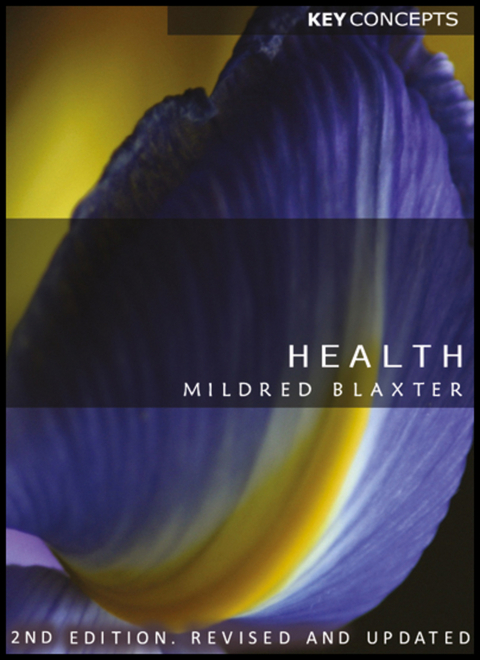
Health (eBook)
John Wiley & Sons (Verlag)
978-0-7456-9951-6 (ISBN)
The new edition has been thoroughly revised and updated, with new material added on health and identity, the 'new genetics', the sociology of the body, and the formation of health capital throughout the life course. The topic is the concept of health, rather than the more usual emphasis on illness and health-care systems. Special emphasis is given to the lay perspective to show how people themselves think about and experience health. Blaxter guides students through all the relevant conceptual models of the relationship of health to the structure of society, from inequality in health to the ideas of the risk society, the 'socio-biological translation' and the contribution of health to social capital. The book concludes with a comprehensively revised and thought-provoking discussion of the impact of new technology, the boundaries between life and death, modern commodification of health, technological transformations of the body and theories of evolutionary biology.
Health is an invaluable textbook for students of medicine and other health professions as well as those studying sociology, health sciences and health promotion.
Mildred Blaxter is Hon. Professor of Medical Sociology at the Department of Social Medicine, University of Bristol.
The second edition of Mildred Blaxter's successful and highly respected book offers a comprehensive and engaging introduction to the key debates surrounding the concept of health today. It discusses how health is defined, constructed, experienced and acted out in contemporary developed societies, drawing on a range of empirical data from the USA, Britain, France, and many other countries. The new edition has been thoroughly revised and updated, with new material added on health and identity, the "e;new genetics"e;, the sociology of the body, and the formation of health capital throughout the life course. The topic is the concept of health, rather than the more usual emphasis on illness and health-care systems. Special emphasis is given to the lay perspective to show how people themselves think about and experience health. Blaxter guides students through all the relevant conceptual models of the relationship of health to the structure of society, from inequality in health to the ideas of the risk society, the socio-biological translation and the contribution of health to social capital. The book concludes with a comprehensively revised and thought-provoking discussion of the impact of new technology, the boundaries between life and death, modern commodification of health, technological transformations of the body and theories of evolutionary biology. Health is an invaluable textbook for students of medicine and other health professions as well as those studying sociology, health sciences and health promotion.
Mildred Blaxter is Hon. Professor of Medical Sociology at the Department of Social Medicine, University of Bristol.
Introduction.
1. How is health defined?
Health as the absence of illness.
Disease as deviance.
Health as balance or homeostasis.
Health as function.
Health as state or status.
The biomedical model.
Contemporary biomedicine.
The social model.
Health, disease, illness and sickness.
How is health measured?
Health capital.
2. How is health constructed?
Health as social construction.
Constructions of history.
Constructions of culture.
Constructivism and feminism.
Illness, labelling and stigma.
Constructions of mental illness.
Constructions of disability.
The critique of relativism.
Medicalisation and the constructions of medical practice.
3. How is health embodied and experienced?
Embodiment.
Lay definitions of health.
Social representations of health.
Self-rated health.
Concepts of the causes of health and illness.
Health histories and subjective health capital.
Illness narratives.
Limitations of narrative.
The search for meaning.
Health as moral discourse and metaphor.
Responsibility for health.
4. How is health enacted?
The rise and fall of 'illness behaviour'.
Person to patient: help-seeking behaviour.
The patient role.
Control and concordance.
Enacted behaviour.
Behaving 'healthily'.
Structure/agency: health as cultural consumption.
Structure/agency: health as self-governance.
5. How is health related to social systems?
A functional relationship.
Responses to functionalism.
Medicine and society.
Health, economic development and social organization.
The downside of economic development.
The concept of inequality in health.
The nature and extent of inequalities.
The causes of inequality.
The socio-biologic translation.
Neo-materialistic explanations.
Social capital.
6. Contemporary change in the meaning of health.
Technology and postmodernity.
Changing boundaries between ill and not-ill.
Changing boundaries of life and death.
Changing boundaries between self and not-self.
Changing boundaries between therapy and enhancement.
Information technologies and medical practice.
Changing attitudes to health and medicine.
New technologies and the risk society.
Evolutionary medicine.
Conclusion.
References.
Index.
"A great text: revised and updated for students of health, whatever
their discipline or background. Changes in science, technology and
our understanding of the body are among the many important topics
covered. Mildred Blaxter writes in a lucid style and has a command
of her material that is second to none. Highly recommended."
Mike Bury, Royal Holloway, University of London
"Updated and with new material, this book provides a fascinating
insight into the phenomenon of health and how it is defined,
constructed, expressed and experienced. Written in a clear and
engaging style, it is an indispensable resource for students and
researchers in the health and social sciences."
Ellen Annandale, University of Leicester
"This fine book takes sociological perspectives of health as a
point of departure, while at the same time increasing our
understanding of illness. Students and professionals alike will
benefit from Blaxter's clear and succinct presentation."
Peter Conrad, Brandeis University
1
How is Health Defined?
Health may be defined differently by doctors and their patients, and over time and place. One of the most pervasive definitions, though, is simply normality, with illness as a deviation from the normal. The definition of disease as abnormality or damage – physiological, biochemical or psychological – held sway in modern thought for most of the last century. It is represented in lay thought by the replies commonly given in surveys to an invitation to define health: health is not being ill, health is having no disease. It is represented in clinical medicine by the whole array of tests and standards, rapidly growing in sophistication, to measure ‘normal’ body size and weight, blood composition, lung capacity, functioning of the liver, and so on, through every organ and system of the body.
This definition raises many problems, however. What is normal – normal for what, and for whom? (Clinical standards usually assume for a particular age and gender, but no more.) ‘Normal’ can have many meanings: average, most representative, the most common value, central in a distribution, the habitual or the best. Are we talking about the average for a given population, or some ideal? The ‘perfect’ is not only impossible of attainment, but also not necessarily to be desired. As Hippocrates noted in the Aphorisms:
In athletics a perfect condition that is at its highest pitch is treacherous. Such conditions cannot stay the same or remain at rest, and, change for the better being impossible, the only possible change is for the worse.
On the other hand, normal defined as average may not mean perfectly healthy, and the average – consider the examples of body weight or cholesterol level – may not be at all what clinicians regard as the ‘norm’ or ideal to be aimed for. What is normal degeneration in old age: are all the old unhealthy? Not all deviations from the normal are to be deplored or ‘treated’: some can be positively beneficial, and others are irrelevant to health. Erde (1979: 36) noted:
If you are 80 or running a marathon, what is normal would differ from the ‘norm’ of someone age 20 or asleep. Furthermore, if you can run two marathons and no one else can, you may be abnormal and yet as healthy as can be. If your IQ is 100 it is normal. If it is 140, your mind’s functions are not in a normal state. We need to know what ‘normal’ means, before we can tell whether someone has it or is it.
In other words, normal can be descriptive or proscriptive, and if it is proscriptive it has to depend on the state of knowledge at the time, or accepted current theory. A softer version is the recognition that there is a great range of normal variability, and only that which falls outside it need be considered as ill health. The range has still to be defined, perhaps arbitrarily.
Health as the absence of illness
For a time in the mid-twentieth century there was promulgation of the idea of disease or ill health as those phenomena which deviate from the norm in such a way as to place the individual at biological disadvantage. The healthy are those who are not biologically disadvantaged. To some extent this avoids the problems of the definition of normality, since those deviations which have no consequences are irrelevant. But it created new problems in the definition of disadvantage, which was usually described very specifically as shortened life and reduced fertility.
Commentators in the field of mental health used this to argue opposed positions: though no physiological abnormalities had so far been found to account for a condition such as schizophrenia, nevertheless it was a disease, using the biological disadvantage criteria. On the other hand, it was pointed out that many forms of mental ill health did not reduce life expectancy or fertility: was it impossible to call them diseases? In general, the focus on length of life and fertility seemed too Darwinian (disease is anything which interferes with the preservation of the species) and too restrictive.
A more subjective view can be taken, of course, resting the definition of health not on measurable, clinically defined abnormality, but on people’s own perception of the experience of symptoms or feelings of illness. The problem is that the norm becomes even more difficult to define. It is commonly demonstrated in studies of populations that to experience no symptoms of ill health at all – never to have pain, mild dysfunction, infection or injury – is in fact highly abnormal: most of us, most of the time, can identify something which we might call a symptom of an illness. Only a small proportion of this is taken for professional attention and diagnosis as disease, and much of it is self-limiting.
Any definition of health as the absence of self-perceived illness has to deal with the fact that this perception varies widely among individuals and depends on situations. Questions have again to be raised about normal illness – normal for this particular person, normal for this sort of individual, normal in these circumstances? – with even less certainty about what the average is, or what would be considered as the ideal.
Disease as deviance
The idea of health as the absence of disease or illness, and disease as deviation from the norm, elides easily into ill health seen as ‘deviance’ from social or moral norms. The objective observation of a lack of ‘normality’ meets a very ancient and universal tendency to see the sick person as in some way morally tainted or bewitched. Possibly, they are responsible for their own condition, and at best they are being offered the opportunity to gain merit or show their strength of character in enduring suffering. Ill health usually has negative connotations, and is spoken of as ‘bad luck’ for the individual. Ill health also harms the functioning or the prosperity of society: the sick are not productive, they may require resources, and they must be controlled and monitored. Thus the American sociologist Talcott Parsons’s treatment of sickness as a role designed to allow ‘deviants’ to find conditional and provisional legitimacy was influential in early medical sociology.
Health as balance or homeostasis
A link between the concepts of health and normality lies in the ancient idea of homeostasis – the idea that the normal state of the body is order, and its systems are designed to be self-righting. This old idea was given new life when it was realized that not only a pathogen, but also a host – the body which was being invaded or harmed – was actively involved in the development of ill health. When a system was being attacked by a specific agent, or was disordered by biological error or stresses and accidents in the environment, regulatory mechanisms came into play. Restoring the normal involves not only equilibrium of the human organism – mind and body – with its environment, but also internal equilibrium within the body’s functions and organs. Ill health arises when the balance is disturbed. In modern times this approach gained attraction from its association with the growth of ecology as a natural science.
As commentators such as Mishler (1981) have pointed out, this has elements of older, perhaps less scientific concepts. It echoes the classical Platonic model of health as harmony among the body’s processes and systems, with disease as a state of discord, and the Galenian concept of disease as a disturbance of function. Before the rise of modern medicine, not only the cultures of the West but all the great cultures of the world, such as those of China or India, held that health is to be defined as the right balance between supernatural beings, the environment, and processes within the body. Disease as imbalance had to be corrected by the remedying of deficiency (by, for instance, diet) or the removal of excess (by, for instance, purging or bleeding).
A theory of health has to accommodate the fact that all living things have some ability to respond to changing environments. The commonly accepted stance is that the environment does not wholly determine the properties of the organism which is, at least partly, self-organized and capable of change. Modern medicine shows that in certain physiological aspects the body is indeed a homeostatic machine: for instance, the immune system responds when infection enters the system, and loss of blood by injury is responded to by vasoconstriction to keep blood pressure steady. The capacity to sustain equilibrium, or more generally the ability of the body to heal itself, can be regarded as a measure of its healthiness. These ideas, ancient in principle, are elaborated by the findings of modern science. As a total model of health, however, homeostasis has limitations. This is undoubtedly part of healthiness, but some healthy functions – reproduction, for instance – upset equilibrium rather than maintain it, and not all systems are even theoretically self-righting. It can be accepted that some aspects of equilibrium are crucial to life, without confusing the idea of homeostasis with the broader ideal of the normal.
Health as function
This does, however, move away a little from the essentially negative definitions. Another, and even more positive, way is in terms of function. Health is being able to do things. This can be a very basic definition: as a woman of 70 said, when asked what it means to be healthy,
Health is being able to walk around better and doing some work in...
| Erscheint lt. Verlag | 30.7.2018 |
|---|---|
| Reihe/Serie | Key Concepts |
| Key Concepts | Key Concepts |
| Sprache | englisch |
| Themenwelt | Studium ► 1. Studienabschnitt (Vorklinik) ► Med. Psychologie / Soziologie |
| Sozialwissenschaften ► Soziologie | |
| Schlagworte | blaxters • Body • Book • Capital • Concept • Contemporary • Course • developed societies • Edition • Empirical data • engaging • experienced • Formation • Health • Introduction • Key • Life • Material • Mildred • New • Range • Sociology • Sociology of Health & Illness • Soziologie • Soziologie d. Gesundheit u. Krankheit • topic • USA |
| ISBN-10 | 0-7456-9951-0 / 0745699510 |
| ISBN-13 | 978-0-7456-9951-6 / 9780745699516 |
| Informationen gemäß Produktsicherheitsverordnung (GPSR) | |
| Haben Sie eine Frage zum Produkt? |
 EPUB (Adobe DRM)
Kopierschutz: Adobe-DRM
Adobe-DRM ist ein Kopierschutz, der das eBook vor Mißbrauch schützen soll. Dabei wird das eBook bereits beim Download auf Ihre persönliche Adobe-ID autorisiert. Lesen können Sie das eBook dann nur auf den Geräten, welche ebenfalls auf Ihre Adobe-ID registriert sind.
Details zum Adobe-DRM
Dateiformat: EPUB (Electronic Publication)
EPUB ist ein offener Standard für eBooks und eignet sich besonders zur Darstellung von Belletristik und Sachbüchern. Der Fließtext wird dynamisch an die Display- und Schriftgröße angepasst. Auch für mobile Lesegeräte ist EPUB daher gut geeignet.
Systemvoraussetzungen:
PC/Mac: Mit einem PC oder Mac können Sie dieses eBook lesen. Sie benötigen eine
eReader: Dieses eBook kann mit (fast) allen eBook-Readern gelesen werden. Mit dem amazon-Kindle ist es aber nicht kompatibel.
Smartphone/Tablet: Egal ob Apple oder Android, dieses eBook können Sie lesen. Sie benötigen eine
Geräteliste und zusätzliche Hinweise
Buying eBooks from abroad
For tax law reasons we can sell eBooks just within Germany and Switzerland. Regrettably we cannot fulfill eBook-orders from other countries.
aus dem Bereich