Round the Red Lamp (eBook)
644 Seiten
Seltzer Books (Verlag)
978-1-4554-4590-5 (ISBN)
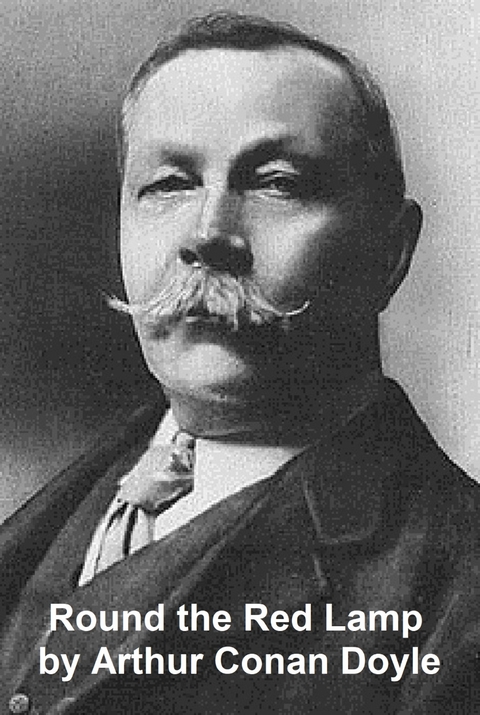
Collection of stories related to medicine, first published in 1894.According to Wikipedia: 'Sir Arthur Ignatius Conan Doyle (22 May 1859 - 7 July 1930) was a Scottish physician and writer who is most noted for his fictional stories about the detective Sherlock Holmes, which are generally considered milestones in the field of crime fiction. He is also known for writing the fictional adventures of a second character he invented, Professor Challenger, and for popularising the mystery of the Mary Celeste. He was a prolific writer whose other works include fantasy and science fiction stories, plays, romances, poetry, non-fiction, and historical novels.'
Collection of stories related to medicine, first published in 1894. According to Wikipedia: "e;Sir Arthur Ignatius Conan Doyle (22 May 1859 - 7 July 1930) was a Scottish physician and writer who is most noted for his fictional stories about the detective Sherlock Holmes, which are generally considered milestones in the field of crime fiction. He is also known for writing the fictional adventures of a second character he invented, Professor Challenger, and for popularising the mystery of the Mary Celeste. He was a prolific writer whose other works include fantasy and science fiction stories, plays, romances, poetry, non-fiction, and historical novels."e;
A QUESTION OF DIPLOMACY.
The Foreign Minister was down with the gout. For a week he had been confined to the house, and he had missed two Cabinet Councils at a time when the pressure upon his department was severe. It is true that he had an excellent undersecretary and an admirable staff, but the Minister was a man of such ripe experience and of such proven sagacity that things halted in his absence. When his firm hand was at the wheel the great ship of State rode easily and smoothly upon her way; when it was removed she yawed and staggered until twelve British editors rose up in their omniscience and traced out twelve several courses, each of which was the sole and only path to safety. Then it was that the Opposition said vain things, and that the harassed Prime Minister prayed for his absent colleague.
The Foreign Minister sat in his dressing-room in the great house in Cavendish Square. It was May, and the square garden shot up like a veil of green in front of his window, but, in spite of the sunshine, a fire crackled and sputtered in the grate of the sick-room. In a deep-red plush armchair sat the great statesman, his head leaning back upon a silken pillow, one foot stretched forward and supported upon a padded rest. His deeply-lined, finely-chiselled face and slow-moving, heavily- pouched eyes were turned upwards towards the carved and painted ceiling, with that inscrutable expression which had been the despair and the admiration of his Continental colleagues upon the occasion of the famous Congress when he had made his first appearance in the arena of European diplomacy. Yet at the present moment his capacity for hiding his emotions had for the instant failed him, for about the lines of his strong, straight mouth and the puckers of his broad, overhanging forehead, there were sufficient indications of the restlessness and impatience which consumed him.
And indeed there was enough to make a man chafe, for he had much to think of and yet was bereft of the power of thought. There was, for example, that question of the Dobrutscha and the navigation of the mouths of the Danube which was ripe for settlement. The Russian Chancellor had sent a masterly statement upon the subject, and it was the pet ambition of our Minister to answer it in a worthy fashion. Then there was the blockade of Crete, and the British fleet lying off Cape Matapan, waiting for instructions which might change the course of European history. And there were those three unfortunate Macedonian tourists, whose friends were momentarily expecting to receive their ears or their fingers in default of the exorbitant ransom which had been demanded. They must be plucked out of those mountains, by force or by diplomacy, or an outraged public would vent its wrath upon Downing Street. All these questions pressed for a solution, and yet here was the Foreign Minister of England, planted in an arm-chair, with his whole thoughts and attention riveted upon the ball of his right toe! It was humiliating--horribly humiliating! His reason revolted at it. He had been a respecter of himself, a respecter of his own will; but what sort of a machine was it which could be utterly thrown out of gear by a little piece of inflamed gristle? He groaned and writhed among his cushions.
But, after all, was it quite impossible that he should go down to the House? Perhaps the doctor was exaggerating the situation. There was a Cabinet Council that day. He glanced at his watch. It must be nearly over by now. But at least he might perhaps venture to drive down as far as Westminster. He pushed back the little round table with its bristle of medicine-bottles, and levering himself up with a hand upon either arm of the chair, he clutched a thick oak stick and hobbled slowly across the room. For a moment as he moved, his energy of mind and body seemed to return to him. The British fleet should sail from Matapan. Pressure should be brought to bear upon the Turks. The Greeks should be shown--Ow! In an instant the Mediterranean was blotted out, and nothing remained but that huge, undeniable, intrusive, red-hot toe. He staggered to the window and rested his left hand upon the ledge, while he propped himself upon his stick with his right. Outside lay the bright, cool, square garden, a few well-dressed passers-by, and a single, neatly- appointed carriage, which was driving away from his own door. His quick eye caught the coat-of-arms on the panel, and his lips set for a moment and his bushy eyebrows gathered ominously with a deep furrow between them. He hobbled back to his seat and struck the gong which stood upon the table.
"Your mistress!" said he as the serving-man entered.
It was clear that it was impossible to think of going to the House. The shooting up his leg warned him that his doctor had not overestimated the situation. But he had a little mental worry now which had for the moment eclipsed his physical ailments. He tapped the ground impatiently with his stick until the door of the dressing-room swung open, and a tall, elegant lady of rather more than middle age swept into the chamber. Her hair was touched with grey, but her calm, sweet face had all the freshness of youth, and her gown of green shot plush, with a sparkle of gold passementerie at her bosom and shoulders, showed off the lines of her fine figure to their best advantage.
"You sent for me, Charles?"
"Whose carriage was that which drove away just now?"
"Oh, you've been up!" she cried, shaking an admonitory forefinger. "What an old dear it is! How can you be so rash? What am I to say to Sir William when he comes? You know that he gives up his cases when they are insubordinate."
"In this instance the case may give him up," said the Minister, peevishly; "but I must beg, Clara, that you will answer my question."
"Oh! the carriage! It must have been Lord Arthur Sibthorpe's."
"I saw the three chevrons upon the panel," muttered the invalid.
His lady had pulled herself a little straighter and opened her large blue eyes.
"Then why ask?" she said. "One might almost think, Charles, that you were laying a trap! Did you expect that I should deceive you? You have not had your lithia powder."
"For Heaven's sake, leave it alone! I asked because I was surprised that Lord Arthur should call here. I should have fancied, Clara, that I had made myself sufficiently clear on that point. Who received him?"
"I did. That is, I and Ida."
"I will not have him brought into contact with Ida. I do not approve of it. The matter has gone too far already."
Lady Clara seated herself on a velvet-topped footstool, and bent her stately figure over the Minister's hand, which she patted softly between her own.
"Now you have said it, Charles," said she. "It has gone too far--I give you my word, dear, that I never suspected it until it was past all mending. I may be to blame--no doubt I am; but it was all so sudden. The tail end of the season and a week at Lord Donnythorne's. That was all. But oh! Charlie, she loves him so, and she is our only one! How can we make her miserable?"
"Tut, tut!" cried the Minister impatiently, slapping on the plush arm of his chair. "This is too much. I tell you, Clara, I give you my word, that all my official duties, all the affairs of this great empire, do not give me the trouble that Ida does."
"But she is our only one, Charles."
"The more reason that she should not make a mesalliance."
"Mesalliance, Charles! Lord Arthur Sibthorpe, son of the Duke of Tavistock, with a pedigree from the Heptarchy. Debrett takes them right back to Morcar, Earl of Northumberland."
The Minister shrugged his shoulders.
"Lord Arthur is the fourth son of the poorest duke in England," said he. "He has neither prospects nor profession."
"But, oh! Charlie, you could find him both."
"I do not like him. I do not care for the connection."
"But consider Ida! You know how frail her health is. Her whole soul is set upon him. You would not have the heart, Charles, to separate them?"
There was a tap at the door. Lady Clara swept towards it and threw it open.
"Yes, Thomas?"
"If you please, my lady, the Prime Minister is below."
"Show him up, Thomas."
"Now, Charlie, you must not excite yourself over public matters. Be very good and cool and reasonable, like a darling. I am sure that I may trust you."
She threw her light shawl round the invalid's shoulders, and slipped away into the bed-room as the great man was ushered in at the door of the dressing-room.
"My dear Charles," said he cordially, stepping...
| Erscheint lt. Verlag | 1.3.2018 |
|---|---|
| Sprache | englisch |
| Themenwelt | Medizin / Pharmazie ► Allgemeines / Lexika |
| ISBN-10 | 1-4554-4590-8 / 1455445908 |
| ISBN-13 | 978-1-4554-4590-5 / 9781455445905 |
| Informationen gemäß Produktsicherheitsverordnung (GPSR) | |
| Haben Sie eine Frage zum Produkt? |
 EPUB (Adobe DRM)
Größe: 643 KB
Kopierschutz: Adobe-DRM
Adobe-DRM ist ein Kopierschutz, der das eBook vor Mißbrauch schützen soll. Dabei wird das eBook bereits beim Download auf Ihre persönliche Adobe-ID autorisiert. Lesen können Sie das eBook dann nur auf den Geräten, welche ebenfalls auf Ihre Adobe-ID registriert sind.
Details zum Adobe-DRM
Dateiformat: EPUB (Electronic Publication)
EPUB ist ein offener Standard für eBooks und eignet sich besonders zur Darstellung von Belletristik und Sachbüchern. Der Fließtext wird dynamisch an die Display- und Schriftgröße angepasst. Auch für mobile Lesegeräte ist EPUB daher gut geeignet.
Systemvoraussetzungen:
PC/Mac: Mit einem PC oder Mac können Sie dieses eBook lesen. Sie benötigen eine
eReader: Dieses eBook kann mit (fast) allen eBook-Readern gelesen werden. Mit dem amazon-Kindle ist es aber nicht kompatibel.
Smartphone/Tablet: Egal ob Apple oder Android, dieses eBook können Sie lesen. Sie benötigen eine
Geräteliste und zusätzliche Hinweise
Buying eBooks from abroad
For tax law reasons we can sell eBooks just within Germany and Switzerland. Regrettably we cannot fulfill eBook-orders from other countries.
EPUB (Ohne DRM)Digital Rights Management: ohne DRM
Dieses eBook enthält kein DRM oder Kopierschutz. Eine Weitergabe an Dritte ist jedoch rechtlich nicht zulässig, weil Sie beim Kauf nur die Rechte an der persönlichen Nutzung erwerben.
Dateiformat: EPUB (Electronic Publication)
EPUB ist ein offener Standard für eBooks und eignet sich besonders zur Darstellung von Belletristik und Sachbüchern. Der Fließtext wird dynamisch an die Display- und Schriftgröße angepasst. Auch für mobile Lesegeräte ist EPUB daher gut geeignet.
Systemvoraussetzungen:
PC/Mac: Mit einem PC oder Mac können Sie dieses eBook lesen. Sie benötigen dafür die kostenlose Software Adobe Digital Editions.
eReader: Dieses eBook kann mit (fast) allen eBook-Readern gelesen werden. Mit dem amazon-Kindle ist es aber nicht kompatibel.
Smartphone/Tablet: Egal ob Apple oder Android, dieses eBook können Sie lesen. Sie benötigen dafür eine kostenlose App.
Geräteliste und zusätzliche Hinweise
Buying eBooks from abroad
For tax law reasons we can sell eBooks just within Germany and Switzerland. Regrettably we cannot fulfill eBook-orders from other countries.
aus dem Bereich