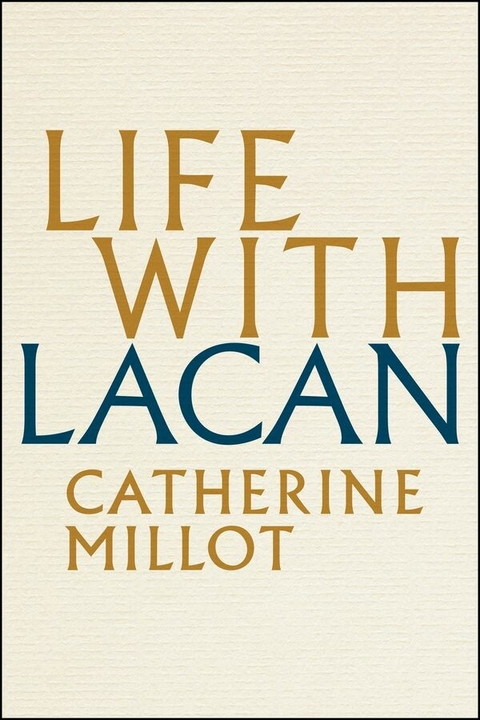
Life With Lacan (eBook)
80 Seiten
John Wiley & Sons (Verlag)
978-1-5095-2505-8 (ISBN)
'There was a time when I felt that I had grasped Lacan's essential being from within - that I had gained, as it were, an apperception of his relation to the world, a mysterious access to that intimate place from which sprang his relation to people and things, and even to himself. It was as if I had slipped within him.'
In this short book, Catherine Millot offers a richly evocative reflection on her life as analysand and lover of the greatest psychoanalyst since Freud. Dwelling on their time together in Paris and in Lacan's country house in Guitrancourt, as well as describing their many travels, Millot provides unparalleled insights into Lacan's character as well as his encounters with other major European thinkers of the time. She also sheds new light on key themes, including Lacan's obsession with the Borromean knot and gradual descent into silence, all enlivened by her unique perspective.
This beautifully written memoir, awarded the André Gide Prize for Literature, will be of interest to anyone wishing to understand the life and character of a thinker who continues to exert a wide influence in psychoanalysis and across the humanities and social sciences.
Catherine Millot is a writer and psychoanalyst who teaches at the University of Paris-VIII.
There was a time when I felt that I had grasped Lacan s essential being from within that I had gained, as it were, an apperception of his relation to the world, a mysterious access to that intimate place from which sprang his relation to people and things, and even to himself. It was as if I had slipped within him. In this short book, Catherine Millot offers a richly evocative reflection on her life as analysand and lover of the greatest psychoanalyst since Freud. Dwelling on their time together in Paris and in Lacan s country house in Guitrancourt, as well as describing their many travels, Millot provides unparalleled insights into Lacan s character as well as his encounters with other major European thinkers of the time. She also sheds new light on key themes, including Lacan s obsession with the Borromean knot and gradual descent into silence, all enlivened by her unique perspective. This beautifully written memoir, awarded the Andr Gide Prize for Literature, will be of interest to anyone wishing to understand the life and character of a thinker who continues to exert a wide influence in psychoanalysis and across the humanities and social sciences.
Catherine Millot is a writer and psychoanalyst who teaches at the University of Paris-VIII.
"This beautiful poetic book is not only a unique portrait of Lacan by someone who knew him better than others, but is in itself a remarkable literary and autobiographical work. It draws us into the adventure of psychoanalysis, into a relationship with all its complexities, and into an era, described with an elegance and precision that we find so rarely today. A remarkable work that will find a readership far beyond psychoanalytic circles."
Darian Leader, Psychoanalyst and author
"Millot's elegantly written little volume, winner of the Prix de littérature André-Gide, serves as refreshing antidote to those who pigeonhole Lacan as writer of gibberish and irresponsible id."
The Spectator
"A love letter celebrating someone Millot sees as an extraordinary and implacable genius."
Times Higher Education
"The portrait of Lacan which Millot offers is of an insatiable mind, always open to the world with the unbounded curiosity of a child.... the reader comes away learning much about what made Lacan tick. Millot is....a fantastic writer, and any reader with even a passing interest in Lacan would do well to pick up a copy of her book."
Psychology Today
There was a time when I felt that I had grasped Lacan’s essential being from within – that I had gained, as it were, a close sense of his relation to the world, a mysterious access to that intimate place from which sprang his relation to people and things, and even to himself. It was as if I had slipped inside him.
This feeling of grasping him from the inside was accompanied by the impression that I myself was comprehended, in the sense of being completely included within his own understanding, which extended far beyond my ken. His mind – with its breadth and depth – his mental world, enclosed mine in the way a bigger sphere contains a smaller one. I came across a similar idea in the letter where Madame Teste talks about her husband.1 Just as she felt transparent to her husband, I felt transparent to Lacan, convinced that he had an absolute knowledge of me. I had nothing to hide, no mystery to keep from him: this gave me complete freedom with him. But it went further than that. An essential part of my being was vouchsafed to him; he would watch over it, I was relieved of it. I lived at his side for years, in this state of lightness.
One day, however, he was busy manipulating those rings of string that were such a knotty problem for him, when he abruptly told me: ‘See that? It’s you!’ Like anyone, like any random person, I was the real that escaped his grasp and that gave him such a headache. I was overwhelmed by a sudden feeling of respect for what within me resisted him, in the way that the real alone resists.
When I say ‘his being’, what do I mean? His particularity, his singularity, what in him was irreducible, the weight of his reality. When I now try to grasp his being anew, it’s his power of concentration that I recall, his almost permanent concentration on the object that he was thinking of and that he never let go. In the end, he had simplified himself to an extreme degree. In one sense, that was all he now was: a pure concentration that merged with his desire, and made this desire tangible.
I recognized this concentration in the way he walked, headfirst, as if borne along by his weight, catching his balance in every step he took. But this very instability gave one a sense of his determination, he would never deviate an inch from his route, he would keep right on to the end, always moving straight ahead, without paying any attention to what might get in his way – he seemed to ignore such obstacles (which in any case were beneath his contempt). He liked to remind people that his star sign was Aries, the Ram.
The first time I saw him walking was on the paths of the Cinque Terre in Italy, where, after lunch, in the lazy summer heat – it was August – he would drag his entourage after him. They did not dare protest. He marched on ahead, with grim determination. The risks of sunstroke for himself or the rest were of no account. So we walked on, from one coastal village to the next, across the hills overlooking the sea, returning in the little local train.
That summer, he went water skiing in the narrow bay of Manarola. Firmly gripping the waterski handle, and without ever leaving the boat’s wake, here too he went straight ahead. The following winter, on the slopes of the Tignes ski resort, the only manoeuvre he seemed to know was the schuss. This had led to him breaking a leg a few years earlier. That was the time when Gloria, his secretary, had started to work for him. Being immobilized put him in a furious temper; he was like a bear with a sore head, and he took it out on the poor woman, who lost patience with him. He was lying stretched out on his bed, his leg in plaster; she grabbed hold of his leg, lifted it up and then suddenly dropped it. Taken aback by this woman’s refusal to be intimidated, Lacan immediately changed his tone and suddenly took an interest in her, asking her questions about where she was from and her whole life story. That day, a bond of unshakeable loyalty was forged between them.
Later on, I would often go with him from his country house in Guitrancourt to the golf course in which he held shares, though he never actually played. The golf course was just a destination for his walks. But ‘walks’ isn’t really the word. Here again, he would march straight off, his head lowered, through woods and fields, getting entangled in the thickets or bogged down in the greasy clods of freshly ploughed earth, never straying from his route. Indeed, I wondered how he knew which way to go, but he never got lost. I would follow along in my wellies, while he unconcernedly got his elegant, custom-made shoes covered in mud. Once he had reached the golf course, he would phone Jesus, his caretaker at Guitrancourt – his ‘kindly Jesus’ as he liked to call him – asking him to come and take us home in his car.
It was just the same when he drove: his head forward, gripping the steering wheel, treating obstacles with contempt, as one of my women friends noted, never slowing down even for a red light – and as for observing the right of way … well, let’s not go there. The first time, on the autoroute, travelling at some 120 mph, I had a fit of the giggles which I suppressed only with difficulty. But even if I’d burst out laughing, he’d never have noticed; he was concentrating too hard.
One day, however, he was forced to slam the brakes on so as not to crash into the car ahead of us which had suddenly slowed down. But braking wasn’t his forte; the car skidded, and that put an end to the sense of invulnerability that had filled me when I was at his side. I started to feel scared, and it was torture to travel as his passenger. There was no point in imploring him to slow down. Once, his stepdaughter Laurence had come up with a bright idea: she asked him to drive more slowly so that she could ‘look at the countryside’. He told her: ‘Just pay more attention’.
Only once, in my company, was he stopped by the police on the autoroute as he drove back from Guitrancourt. On Sunday evenings, when the traffic was always heavy, he was used to driving on the hard shoulder and overtaking the line of cars stuck in the queue, whose drivers grew furious at being overtaken on the right and would suddenly swing their cars out into his path even though this risked causing a collision. That evening we were taken to the police station near the Saint-Cloud tunnel, where he had to wait a long time before he could argue that a medical emergency had justified this offence. He showed no sign of impatience while awaiting his turn to be questioned. Sometimes, the real can assume the face of the police.
His way of driving was part and parcel of his ethics. It is no coincidence that, as a parable, he told the following story to his analyst Rudolph Loewenstein, a heavyweight in the International Psychoanalytical Association. Once, he’d been in a tunnel, driving his little car, when he saw a lorry overtaking another vehicle and heading towards him. He continued to step on the gas, and forced the lorry driver to back down. It was like a show of strength, but the message, rather, was that he couldn’t be intimidated and would never give way to force.
He told me this story at a time when he still liked talking about himself. He also related a recent incident that had left him feeling bitter. Two crooks had burst into his consulting room around 7 pm, pushing aside Paquita who opened the door once Gloria had left work at the end of the afternoon. They’d come into his office, where he was with Moustafa Safouan who was being supervised by him. The thugs told him they wanted his money, and pointed a revolver at him. He told them they’d get nothing from him by making threats, he was an old man, he wasn’t afraid of dying. One of them punched him on the chin; this didn’t make him change his mind but it did leave him with a dislocated jaw, the effects of which he suffered for a long time after. To resolve the situation, Safouan came up with the idea of writing a cheque which enabled the attackers to beat a retreat without losing face.
Lacan told me of this incident in reply to my question about the knuckleduster he always carried with him. He’d armed himself with it after this attack. The weapon slipped into his trouser pocket to join his handkerchief, his bunch of keys, his little multi-blade tortoise-shell knife from Émile Peter’s cutlery store in Paris, with its leather pouch, as well as a charming triangular boxwood netsuke, very smooth to the touch, that resembled a flattened Moebius strip.
Pierre Goldman too had planned to rob Lacan.2 But he had been disarmed by the sight of the white-haired man walking down the stairs of 5 rue de Lille in Paris, completely absorbed in his thoughts. The thinker’s austere and stately gait stopped him in his tracks. It relegated to the distant background Lacan’s reputation as a celebrity, and his alleged wealth, a wealth that stoked criticism and envy.
The knuckleduster tended to cause problems when Lacan went through the metal detectors at airports as it regularly set off the alarm. He had to empty his pockets. In those days, the weapon wasn’t confiscated, but handed over to an air hostess for the duration of the flight, and restored to its owner upon landing.
While no prohibition, no conventional limit ever led him to stray from his course, he still recognized the real when it barred his path. He paid no attention to prohibitions; perhaps this is why he was in direct...
| Erscheint lt. Verlag | 1.5.2018 |
|---|---|
| Übersetzer | Andrew Brown |
| Sprache | englisch |
| Themenwelt | Literatur ► Biografien / Erfahrungsberichte |
| Literatur ► Romane / Erzählungen | |
| Geisteswissenschaften ► Psychologie ► Psychoanalyse / Tiefenpsychologie | |
| Medizin / Pharmazie ► Medizinische Fachgebiete ► Psychiatrie / Psychotherapie | |
| Schlagworte | Cultural Studies • Cultural Studies Special Topics • French culture • Jacques Lacan • Kulturwissenschaften • Lacan • Literary & Cultural Theory • Literature • Literatur- u. Kulturtheorie • Literaturwissenschaft • Psychoanalyse • Psychoanalysis • Psychologie • Psychology • pyschoanalysis • Spezialthemen Kulturwissenschaften • what was lacan like |
| ISBN-10 | 1-5095-2505-X / 150952505X |
| ISBN-13 | 978-1-5095-2505-8 / 9781509525058 |
| Informationen gemäß Produktsicherheitsverordnung (GPSR) | |
| Haben Sie eine Frage zum Produkt? |
 EPUB (Adobe DRM)
Kopierschutz: Adobe-DRM
Adobe-DRM ist ein Kopierschutz, der das eBook vor Mißbrauch schützen soll. Dabei wird das eBook bereits beim Download auf Ihre persönliche Adobe-ID autorisiert. Lesen können Sie das eBook dann nur auf den Geräten, welche ebenfalls auf Ihre Adobe-ID registriert sind.
Details zum Adobe-DRM
Dateiformat: EPUB (Electronic Publication)
EPUB ist ein offener Standard für eBooks und eignet sich besonders zur Darstellung von Belletristik und Sachbüchern. Der Fließtext wird dynamisch an die Display- und Schriftgröße angepasst. Auch für mobile Lesegeräte ist EPUB daher gut geeignet.
Systemvoraussetzungen:
PC/Mac: Mit einem PC oder Mac können Sie dieses eBook lesen. Sie benötigen eine
eReader: Dieses eBook kann mit (fast) allen eBook-Readern gelesen werden. Mit dem amazon-Kindle ist es aber nicht kompatibel.
Smartphone/Tablet: Egal ob Apple oder Android, dieses eBook können Sie lesen. Sie benötigen eine
Geräteliste und zusätzliche Hinweise
Buying eBooks from abroad
For tax law reasons we can sell eBooks just within Germany and Switzerland. Regrettably we cannot fulfill eBook-orders from other countries.
aus dem Bereich