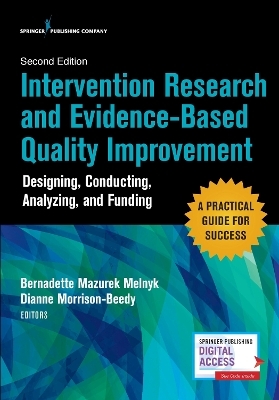
Intervention Research and Evidence-Based Quality Improvement, Second Edition
Springer Publishing Co Inc (Verlag)
978-0-8261-5553-5 (ISBN)
- Titel z.Zt. nicht lieferbar
- Versandkostenfrei
- Auch auf Rechnung
- Artikel merken
First Edition received 2012 First Place AJN Book of the Year Award in Nursing Research!
“This is a resource for success and should be a part of any researcher's library."
--Doody's Medical Reviews (Praise for the First Edition)
Written for researchers, clinicians and doctoral students, the newly revised edition of this comprehensive reference continues to deliver the essentials of intervention research with added content on evidence-based quality improvement, a must for improving healthcare quality, safety and population health outcomes. Although typically it takes years for research-based interventions to make their way to real world clinical settings, this “prolonged time for translation” frustrates researchers and their interprofessional teams. This second edition now delves even deeper into key strategies for rapidly moving research-based interventions into real world settings in the form of evidence-based quality improvement as well as the challenges of working in an increasingly diverse professional research environment.
Intervention Research and Evidence-Based Quality Improvement, Second Edition begins at the pilot study phase for intervention research and highlights every step of the way through to full-scale randomized controlled trials. Written in user-friendly format, content covers designing, conducting, analyzing, and funding intervention studies that improve healthcare quality and people’s health outcomes. Chapters cover writing grant applications and show examples of actual applications that have been funded by NIH and other organizations. These real-life samples are available online, alongside additional progress reports and final reports. Real-world examples of evidence-based quality improvement projects that have improved outcomes also are highlighted in this second edition.
New to the Second Edition:
Describes evidence-based quality improvement and specific steps in conducting EBQI projects, which are essential for enhancing healthcare quality, safety and costs along with enhancing population health outcomes.
Emphasizes the importance of interprofessional teams
Focuses on using research-based interventions in real-world settings
Six new chapters
o Generating Versus Using Evidence to Guide Best Practice
o Setting the Stage for Intervention Research and Evidence-based Quality Improvement
o Evidence-based Quality Improvement
o Translational Research: Why and How
o Factors Influencing Successful Uptake of Evidence-Based Interventions in Clinical Practice
o Using Social Media to Enhance Uptake of Research-Based Interventions into Real World Clinical Settings
Key Features:
Provides a practical, comprehensive resource for designing, conducting, analyzing, and funding intervention studies
Outlines the specific steps in designing, conducting and evaluating outcomes of evidence-based quality improvement projects
Includes examples of funding research grants, progress reports, and final reports
Serves as a core text for students in doctoral nursing and other health sciences programs
Bernadette Mazurek Melnyk, PhD, APRN-CNP, FAANP, FNAP, FAA, is the Vice President for Health Promotion, University Chief Wellness Officer, and Helene Fuld Health Trust Professor of Evidence-Based Practice and Dean of the College of Nursing at The Ohio State University. She also is a Professor of Pediatrics and Psychiatry at the College of Medicine and Executive Director of the Helene Fuld Health Trust National Institute for Evidence-based Practice in Nursing and Healthcare. Dr. Melnyk is a nationally and internationally recognized expert in evidence-based practice, intervention research, child and adolescent mental health, and health and wellness. She is both a pediatric nurse practitioner and psychiatric mental health nurse practitioner, and co-editor of eight books, including Evidence-Based Physical Examination: Best Practices for Health and Well-Being Assessment; Evidence-Based Physical Examination Handbook; Implementing the Evidence-Based Practice (EBP) Competencies in Healthcare: A Practical Guide for Improving Quality, Safety, and Outcomes; Evidence-Based Practice in Nursing and Healthcare: A Guide to Best Practice (4th Edition); Implementing EBP: Real World Success Stories; A Practical Guide to Child and Adolescent Mental Health Screening, Early Intervention and Health Promotion (3rd Edition); Intervention Research and Evidence-Based Quality Improvement: Designing, Conducting, Analyzing and Funding (2nd Edition); and Evidence-Based Leadership, Innovation and Entrepreneurship in Nursing and Healthcare. Dr. Melnyk has over 33 million dollars of sponsored funding from federal agencies and foundations and has authored over 450 publications. She is an elected fellow of the National Academy of Medicine, the American Academy of Nursing, the National Academies of Practice, and the American Association of Nurse Practitioners, and serves as Editor of the journal Worldviews on Evidence-based Nursing. Dr. Melnyk served a 4-year term on the United States Preventive Services Task Force and recently served on the mental health standing committee of the National Quality Forum. She is a currently a member of the board of directors for the National Forum for Heart Disease and Stroke Prevention and a member of the National Academy of Medicine's Action Collaborative on Clinician Well-being and Resilience. She has received numerous national and international awards, including being named an edge-runner three times by the American Academy of Nursing. Dianne Morrison-Beedy, PhD, RN, WHNP, FNAP, FAANP, FAAN, is the chief Talent and Global Strategy officer and the Centennial Endowed Professor of Nursing at The Ohio State University.
Contents
Contributors
Foreword
Preface
Acknowledgments
PART I: SETTING THE STAGE
1. Generating Evidence Through Intervention Research Versus Using Evidence in Evidence-Based Practice/Quality Improvement
Bernadette Mazurek Melnyk and Dianne Morrison-Beedy
2. Setting the Stage for Intervention Research and Evidence-Based Quality Improvement: The “So What,” “What Exists,” and “What’s Next” Factors
Bernadette Mazurek Melnyk and Dianne Morrison-Beedy
3. Designing, Conducting, and Evaluating Outcomes of Evidence-Based Quality Improvement Projects
Bernadette Mazurek Melnyk
PART II: DESIGNING INTERVENTION STUDIES
4. Using Theory to Guide Intervention Research
Julie Fleury and Souraya Sidani
5. Nuts and Bolts of Designing Intervention Studies
Bernadette Mazurek Melnyk, Dianne Morrison-Beedy, and Shirley M. Moore
6. Designing Interventions That Are Sensitive to Culture, Race/Ethnicity, and Gender
Usha Menon
7. Ethical Considerations in Designing Intervention Studies
Dónal P. O’Mathúna
8. Minimizing Threats to Internal Validity
Jacqueline Dunbar-Jacob
9. Minimizing Threats to External Validity
Wanda K. Nicholson
10. Measurement in Intervention Research
Dianne Morrison-Beedy and Bernadette Mazurek Melnyk
11. Biological Measures for Intervention Research
Rita H. Pickler and Cindy Munro
PART III: IMPLEMENTING INTERVENTION STUDIES
12. Developing the Budget for Intervention Studies
Steven Pease and Barbara Smith
13. Navigating the IRB for Investigators
Amanda A. Hastings, Cheryl L. Byers, and Barry B. Bercu
14. Participant Recruitment and Retention
Dianne Morrison-Beedy and Constance Visovsky
15. Maintaining Fidelity of an Intervention
Sandee McClowry and Sandra Gagnon
16. Study Implementation: An Example Using the Madres Para la Salud (Mothers for Health) Study
Colleen Keller and Barbara Ainsworth
17. Considerations in Conducting Multisite Trials
Peter A. Vanable
18. Considerations in Conducting Interventions in Specialized Settings
18.1. Conducting Interventions in Global Settings
Carol M. Baldwin, Luis Gabriel Cuervo, and Christine Hancock
18.2. Conducting Interventions in Long-Term Care Settings
Debra Parker Oliver and Marlys R. Peck
18.3. Conducting Interventions in Public Health Settings
LaRon E. Nelson and Dianne Morrison-Beedy
18.4. Conducting Interventions in School Settings
Bonnie Gance-Cleveland
18.5. Conducting Interventions in Palliative Care Settings
Kathryn B. Lindstrom
18.6. Conducting Interventions in Acute Care Settings
Cindy Munro
19. Data Management
Sharon M. Lawlor and Kevin E. Kip
PART IV: ANALYZING INTERVENTION STUDIES
20. Analyzing Intervention Studies
Laura A. Szalacha
21. Cost-Effectiveness Analyses for Intervention Studies
Kimberly Arcoleo and Kevin Frick
22. Explaining Intervention Effects
Kimberly Arcoleo
PART V: WRITING SUCCESSFUL GRANTS AND PROGRESS REPORTS
23. Writing Grants That Fund!
Bernadette Mazurek Melnyk and Dianne Morrison-Beedy
24. Submitting a Research Grant Application to the National Institutes of Health: Navigating the Application and Peer Review System
Mindy B. Tinkle and Ann Marie McCarthy
25. Writing Progress and Final Reports
Margaret Roudebush and Shirley M. Moore
PART VI: MOVING INTERVENTION FINDINGS INTO THE REAL WORLD
26. Disseminating Findings of Intervention Studies
Marion E. Broome
27. Social Media Use in Intervention Research and Dissemination
Linsey N. Grove and Dianne Morrison-Beedy
28. Speeding the Translation of Evidence-Based Interventions Into Real-World Practice Settings
Bernadette Mazurek Melnyk
29. Factors Influencing Successful Uptake of Evidence-Based Interventions in Clinical Practice
Sharon Tucker
Glossary
Index
| Erscheinungsdatum | 19.09.2018 |
|---|---|
| Verlagsort | New York |
| Sprache | englisch |
| Maße | 178 x 254 mm |
| Themenwelt | Medizin / Pharmazie ► Pflege |
| Studium ► Querschnittsbereiche ► Prävention / Gesundheitsförderung | |
| ISBN-10 | 0-8261-5553-7 / 0826155537 |
| ISBN-13 | 978-0-8261-5553-5 / 9780826155535 |
| Zustand | Neuware |
| Informationen gemäß Produktsicherheitsverordnung (GPSR) | |
| Haben Sie eine Frage zum Produkt? |
aus dem Bereich