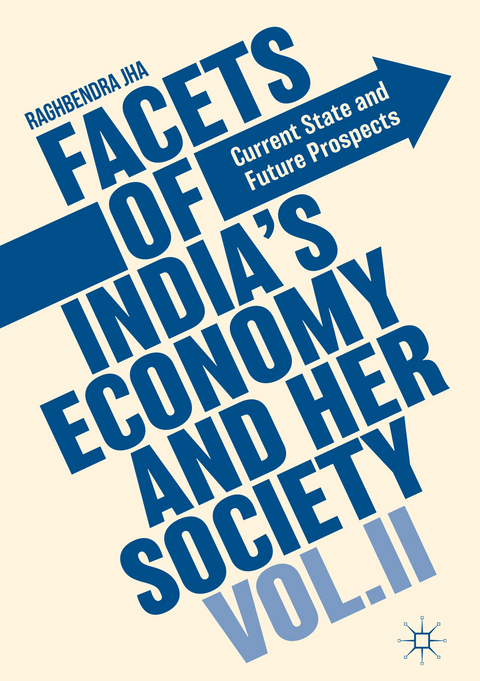
Facets of India's Economy and Her Society Volume II (eBook)
XX, 301 Seiten
Palgrave Macmillan UK (Verlag)
978-1-349-95342-4 (ISBN)
'Jha is the right scholar and economist to take readers through the development of the Indian economy. Readers will be in good hands.'
-Edmund Phelps, Columbia University, USA, and winner of the 2006 Nobel Prize in Economics
'This is perhaps the best and most scholarly contribution to understanding the Indian Economy and Society. Its rich historical perspective and a profound understanding of how India has evolved into a major economic power set standards of scholarship and analytical rigour that will be hard to surpass'.
-Raghav Gaiha, University of Manchester, UK
'Linking of economy and society is increasingly recognised as essential for addressing policy challenges by the current phase of globalisation. As such this study should be valuable not just for those studying India, but also for those interested in global developments.'
-Mukul Asher, National University of Singapore, Singapore
'This book is a tour-de-force review of the fundamental topics on the Indian political economy and society that are relevant for any committed social scientist to be aware of.'
-Sumit K. Majumdar, University of Texas at Dallas, USA
'Over the years, I have benefited from reading the works of Professor Jha, and from teaching from them. I enthusiastically recommend these two volumes.'
-Raaj Kumar Sah, University of Chicago, USA
Raghbendra Jha is Professor of Economics at the Australian National University. He has previously taught at Columbia University and Williams College, USA; Queen's University, Canada; University of Warwick, UK; and Delhi School of Economics, IIM Bangalore and IGIDR (Mumbai) in India. He has published extensively in the areas of macroeconomics, public economics and social welfare, with a country focus on India.
'Jha is the right scholar and economist to take readers through the development of the Indian economy. Readers will be in good hands.'-Edmund Phelps, Columbia University, USA, and winner of the 2006 Nobel Prize in Economics'This is perhaps the best and most scholarly contribution to understanding the Indian Economy and Society. Its rich historical perspective and a profound understanding of how India has evolved into a major economic power set standards of scholarship and analytical rigour that will be hard to surpass"e;. -Raghav Gaiha, University of Manchester, UK'Linking of economy and society is increasingly recognised as essential for addressing policy challenges by the current phase of globalisation. As such this study should be valuable not just for those studying India, but also for those interested in global developments.'-Mukul Asher, National University of Singapore, Singapore'This book is a tour-de-force reviewof the fundamental topics on the Indian political economy and society that are relevant for any committed social scientist to be aware of.'-Sumit K. Majumdar, University of Texas at Dallas, USA 'Over the years, I have benefited from reading the works of Professor Jha, and from teaching from them. I enthusiastically recommend these two volumes.' -Raaj Kumar Sah, University of Chicago, USAThis two-volume work provides an account of how India has been meeting its myriad of economic, political and social challenges and how things are expected to evolve in the future. Despite enormous challenges at the time of independence, India chose to address them within a secular, liberal, democratic framework, which guaranteed several fundamental rights. Challenges included intense mass poverty and hunger, very poor literacy and educational abilities of the population, the task of uniting a country with scores of languages and ethnicities ruled by different entities for decades and persistent threats of external aggression, to name just a few. Over time, incomes and opportunities have expanded enormously and India has regained her self-confidence as a nation. In this second volume, Jha examines the performance and prospects for India's agriculture, manufacturing and services sectors. In addition, India's links with the external world through international trade, investment, migration and remittances are discussed, as well as gender issues, inter-community relations and India's future prospects.
Raghbendra Jha is Professor of Economics at the Australian National University. He has previously taught at Columbia University and Williams College, USA; Queen’s University, Canada; University of Warwick, UK; and Delhi School of Economics, IIM Bangalore and IGIDR (Mumbai) in India. He has published extensively in the areas of macroeconomics, public economics and social welfare, with a country focus on India.
Part I: Principal Sectors of the Indian Economy Chapter 1: Introduction and the State of Indian Agriculture Chapter 2: Trends and Prospects for India’s Manufacturing Sector Chapter 3: India’s Service Sector Part II: Emerging Issues in India’s Economy Chapter 4: India’s Recent Engagement with the Global Economy: Trade, Investment, Remittances and the Diaspora Chapter 5: Regional Inequality and Indirect Tax reform in India Chapter 6: Education and Health Services in India: A Brief Overview Chapter 7: An Overview of the State of the Environment in India Part III: Some Aspects of India’s Society and Prospects for the Future Chapter 8: Women’s Issues in India Chapter 9: Inter-community relations in India Chapter 10: Looking Ahead: Prospects for India
| Erscheint lt. Verlag | 20.3.2018 |
|---|---|
| Zusatzinfo | XX, 301 p. |
| Verlagsort | London |
| Sprache | englisch |
| Themenwelt | Medizin / Pharmazie ► Gesundheitswesen |
| Wirtschaft ► Volkswirtschaftslehre | |
| Weitere Fachgebiete ► Land- / Forstwirtschaft / Fischerei | |
| Schlagworte | Asian Economics • Economic Governance • Economics of migration • Health services in India • India and the Global Economy • Indian agriculture • Indian economics • Indian education • India's economy • India's Gross Domestic Product • India’s manufacturing sector • India’s services sector • Indirect tax reform • Inter-community relations in India • Regional inequality in India • Women in India |
| ISBN-10 | 1-349-95342-3 / 1349953423 |
| ISBN-13 | 978-1-349-95342-4 / 9781349953424 |
| Informationen gemäß Produktsicherheitsverordnung (GPSR) | |
| Haben Sie eine Frage zum Produkt? |
 PDF (Wasserzeichen)
DRM: Digitales Wasserzeichen
Dieses eBook enthält ein digitales Wasserzeichen und ist damit für Sie personalisiert. Bei einer missbräuchlichen Weitergabe des eBooks an Dritte ist eine Rückverfolgung an die Quelle möglich.
Dateiformat: PDF (Portable Document Format)
Mit einem festen Seitenlayout eignet sich die PDF besonders für Fachbücher mit Spalten, Tabellen und Abbildungen. Eine PDF kann auf fast allen Geräten angezeigt werden, ist aber für kleine Displays (Smartphone, eReader) nur eingeschränkt geeignet.
Systemvoraussetzungen:
PC/Mac: Mit einem PC oder Mac können Sie dieses eBook lesen. Sie benötigen dafür einen PDF-Viewer - z.B. den Adobe Reader oder Adobe Digital Editions.
eReader: Dieses eBook kann mit (fast) allen eBook-Readern gelesen werden. Mit dem amazon-Kindle ist es aber nicht kompatibel.
Smartphone/Tablet: Egal ob Apple oder Android, dieses eBook können Sie lesen. Sie benötigen dafür einen PDF-Viewer - z.B. die kostenlose Adobe Digital Editions-App.
Buying eBooks from abroad
For tax law reasons we can sell eBooks just within Germany and Switzerland. Regrettably we cannot fulfill eBook-orders from other countries.
aus dem Bereich