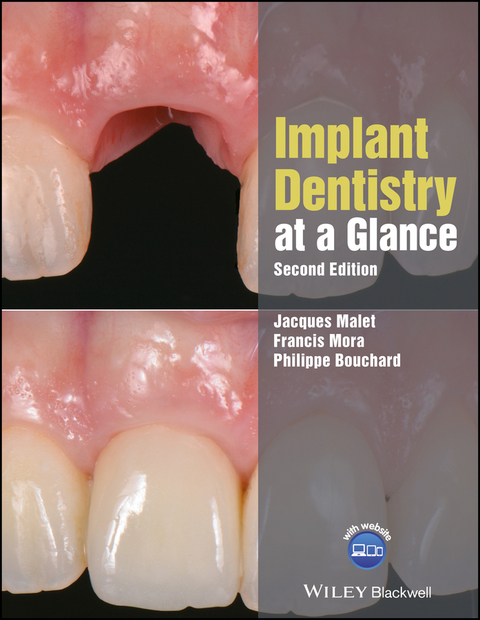
Implant Dentistry at a Glance (eBook)
John Wiley & Sons (Verlag)
978-1-119-29263-0 (ISBN)
The second edition of Implant Dentistry at a Glance, in the highly popular at a Glance series, provides an accessible, thoroughly revised and updated comprehensive introduction that covers all the essential sub-topics that comprise implant dentistry.
- Features an easy-to-use double-page spread, with text and corresponding images
- Expanded and updated throughout, with 13 new chapters and coverage of many advances
- Includes access to a companion website with self-assessment questions and illustrative case studies
Jacques Malet is Clinical Professor in the European Postgraduate Program in Periodontology and Implant Surgery at the Paris Diderot University, and at the Rothschild Hospital, AP-HP France.
Francis Mora is Associate Professor in Periodontology and co-Director of the European Postgraduate Program in Periodontology and Implant Surgery at the Paris Diderot University, and at the Rothschild Hospital, AP-HP France.
Philippe Bouchard is Professor and Chair of the Department of Periodontology and Director of the European Postgraduate Program in Periodontology and Implant Surgery at the Paris Diderot University, and at the Rothschild Hospital, AP-HP France.
The second edition of Implant Dentistry at a Glance, in the highly popular at a Glance series, provides an accessible, thoroughly revised and updated comprehensive introduction that covers all the essential sub-topics that comprise implant dentistry. Features an easy-to-use double-page spread, with text and corresponding images Expanded and updated throughout, with 13 new chapters and coverage of many advances Includes access to a companion website with self-assessment questions and illustrative case studies
About the authors: Jacques Malet is Clinical Professor in the European Postgraduate Program in Periodontology and Implant Surgery at the Paris Diderot University, and at the Rothschild Hospital, AP-HP France. Francis Mora is Associate Professor in Periodontology and co-Director of the European Postgraduate Program in Periodontology and Implant Surgery at the Paris Diderot University, and at the Rothschild Hospital, AP-HP France. Philippe Bouchard is Professor and Chair of the Department of Periodontology and Director of the European Postgraduate Program in Periodontology and Implant Surgery at the Paris Diderot University, and at the Rothschild Hospital, AP-HP France.
"The field of oral implantology is becoming more and more attractive for the general practitioner as well as for the students. The authors of the second edition of Dental Implant at a Glance offer students and young practitioners a clear, simple and abundantly illustrated book [...] allows
the authors to create an essential source for students and young practitioners who want to improve their knowledge of the latest concepts in oral implantology".
Chapter 1
Quality of life associated withimplant‐supported prostheses: An introduction to implant dentistry
According to the World Health Organization, ‘Health is a state of complete physical, mental, and social well‐being and not merely the absence of disease, or infirmity’ (WHO, 1946). Based on this definition, the WHO defines quality of life (QoL) ‘as individuals’ perception of their position in life in the context of the culture and value systems in which they live and in relation to their goals, expectations, standards and concerns’ (WHO, 1997). In other words, ‘QoL is a popular term that conveys an overall sense of well‐being, including aspects of happiness and satisfaction with life as a whole’ (CDC, 2000).
The concept of health‐related quality of life (HRQoL) on an individual level ‘includes physical and mental health perceptions (e.g., energy level, mood) and their correlates including health risks and conditions, functional status, social support, and socio‐economic status’ (CDC, 2000). In short, the Centers for Disease Control and Prevention have defined HRQoL as ‘an individual’s or group’s perceived physical and mental health over time’.
Oral health quality of life
Questionnaires have been developed to assess the impact of oral conditions on HRQoL. Oral health‐related quality of life (OHRQoL) encompasses a collection of metrics such as Dental Impact on Daily Living (DIDL), Geriatric/General Oral Health Assessment Index (GOHAI), Oral Health Impact Profile (OHIP) and Oral Impacts on Daily Performances (OIDP). Among these metrics, the 14‐item OHIP‐14 is the most popular. The diversity of measures makes it difficult to adopt a global approach to assess the impact of missing teeth on OHRQoL.
Dental implants and oral health
Implant dentistry aims to replace missing teeth. This is a very challenging aspect of dentistry: Should dentists replace the teeth that have been lost? However, from the patient’s perspective, it makes sense to ask the question: What are the benefits of dental implant placement? In other words, the following issues should be addressed:
- • Should missing teeth be replaced?
- • Does implant dentistry improve a patient’s quality of life?
- • Is implant dentistry a cost‐effective option?
We hope that this chapter will help the practitioner, not to convince patients to have dental implants, but to provide them with sufficient information to assist in the decision‐making process.
Should missing teeth be replaced?
It is beyond the scope of this book to explore the scientific rationale supporting the replacement of missing teeth. However, logic dictates that we need a minimum number of teeth and functional masticatory units (FMUs, defined as pairs of opposing teeth or dental restoration allowing mastication, excluding incisors) to ensure an acceptable OHRQoL.
Number of teeth
A significant link has been established between the number of teeth and OHRQoL (Tan et al., 2016). Fewer than 17 teeth is associated with poor OHRQoL in the elderly (Jensen et al., 2008).
The concept of shortened dental arches (SDAs) has been proposed (Witter et al., 1999). This concept refers to dentition with intact anterior teeth and loss of posterior teeth; that is, molar teeth. It has been suggested that at least 20 teeth are required in order to maintain functional, aesthetic and natural dentition, and to meet oral health targets (Petersen and Yamamoto, 2005). Dentists advocate the practical applicability of SDAs. A recent multicentre survey showed that about 80% of participating professionals agreed with the SDA concept (Abuzar et al., 2015).
Moreover, there is no significant difference in terms of OHRQoL between subjects with SDAs and those with removable dentures (Antunes et al., 2016; Tan et al., 2015). This means that a worse OHRQoL is not SDA related and that the concept of directing treatment and resources to anterior and premolar teeth, without molar teeth replacement, is an acceptable option. In other words, there is a need to replace some but not all missing teeth.
Functional masticatory units
FMUs are needed to facilitate the chewing process. Masticatory function differs somewhat from masticatory capacity. Evaluation of masticatory function is based on complex laboratory methods. Qualitative assessment is based on video or electromyographic examination (Hennequin et al., 2005). Quantitative assessment focuses on measuring particle size values for masticated raw carrots collected just before swallowing (Woda et al., 2010). However, in clinical and epidemiological studies, the number of FMUs is a validated parameter for discriminating between functional and dysfunctional masticatory capacities (Godlewski et al., 2011). A threshold of five FMUs generally serves as the cut‐off in epidemiological studies (Adolph et al., 2017; Darnaud et al., 2015).
A limited biting/chewing capacity is not conducive to a healthy diet and can lead to a high glycaemic index, increased fat consumption and reduced fibre consumption. In other words, ‘good nutrition is a cornerstone of good health’ (WHO, 2017) and masticatory capacity is one of the most important factors for ensuring a healthy diet. A systematic review of longitudinal studies reported that signs of impaired swallowing efficacy were deemed a risk factor for malnutrition in elderly people (odds ratio [OR] = 2.73; p = 0.015; Moreira et al., 2016). The number of FMUs has been positively linked (OR = 2.79, 95% confidence interval [CI]: 1.49–5.22) with poor nutritional status in individuals over 65 years of age, according to the Mini‐Nutritional Assessment (MNA; El Osta et al., 2014). Malnutrition is associated with an increase in inflammatory biomarkers in post‐menopausal women (Wood et al., 2014). A higher morbidity/mortality risk was observed among haemodialysis patients with a high malnutrition‐inflammation score (Pisetkul et al., 2010). To conclude, a minimum of five FMUs is needed not only to ensure an adequate masticatory capacity, but also to guarantee a healthy diet.
Finally, it must be emphasised that the number of teeth and FMUs is not sufficient to portray the overall picture of edentulism. Teeth also contribute to an individual’s appearance; that is, they have an aesthetic connotation. Dental aesthetics are known to be associated with OHRQoL (Broder and Wilson‐Genderson, 2007; Klages et al., 2004). Teeth are also important for phonation. Last but not least, missing teeth are associated with poor self‐esteem and can thus have a psychological impact.
Does implant dentistry improve the patient’s quality of life?
Most studies evaluate the advantages of implant‐supported overdenture in the mandible. Limited research has focused on maxillary overdentures. Many different studies from various centres using a range of protocols suggest that patients positively rate their QoL after dental implant therapy. OHRQoL is generally better in patients with fixed prostheses than in those with a removable prosthesis (OHIP‐14; Brennan et al., 2010). Based on OHIP‐21 metrics, assessment of post‐implant therapy confirmed a significant improvement in terms of OHRQoL (Nickenig et al., 2008). However, a recent systematic review indicates that the use of implant‐supported overdentures to treat individuals with 100% dentures improves chewing efficiency, bite force and patient satisfaction. Nevertheless, no effect on nutritional status is apparent and QoL results remain inconclusive (Boven et al., 2015).
Studies dealing with fixed implant‐supported prostheses in the maxilla region are few and far between, and are mostly based on single‐implant placement. A significant implant‐related improvement in OHRQoL is evident from aesthetic and functional perspectives in patients with at least one implant in the anterior dental region (Pavel et al., 2012). In addition, an extremely positive response in OIDP has been reported in all patients treated for single‐tooth replacement with an anterior maxillary implant (Angkaew et al., 2017). Finally, based on a seven‐question customised, mailed questionnaire, elderly patients receiving dental implants had an excellent QoL score (Becker et al., 2016).
Is implant dentistry a cost‐effective option?
Of completely edentulous elderly individuals with implants, 70% were willing to pay three times the cost of conventional dentures for implant prostheses (Esfandiari et al., 2009); the willingness to pay [WTP] is the maximum amount a person would be willing to pay for an implant in order to obtain effective treatment or avoid an undesirable event such as disease or discomfort. In the anterior area, 94% of edentulous patients chose implant‐supported prostheses instead of conventional prostheses to replace missing teeth and, on average, a high number of patients are willing to pay for this type of treatment (Leung and McGrath, 2010). In other words, the question of cost‐effectiveness in implant dentistry is important and cost is the first obstacle to growth in the dental implant market.
The...
| Erscheint lt. Verlag | 19.3.2018 |
|---|---|
| Reihe/Serie | At a Glance (Dentistry) |
| At a Glance (Dentistry) | At a Glance (Dentistry) |
| Sprache | englisch |
| Themenwelt | Medizin / Pharmazie ► Gesundheitsfachberufe |
| Medizin / Pharmazie ► Medizinische Fachgebiete | |
| Medizin / Pharmazie ► Zahnmedizin | |
| Schlagworte | bone shape and quality • dental implants in periodontally compromised patients • dentistry • Einführung i. d. Zahnmedizin • esthetic parameters in dental implants </p> • Implant Dentistry • Implant macrostructure implant and abutment connection • Implant macrostructure shapes and dimensions • Implant macrostructure Short implants • Implant microstructure implant surface • Implantologie i. d. Zahnheilkunde • Introductions to Dentistry • local risk factors for dental implants • <p>Guide to implant dentistry • Osseointegration • Parodontologie • Patient evaluation and dental implants medical evaluation form and laboratory tests • Patient evaluation dental history • Periodontology • surgical anatomy of the mandible • surgical anatomy of the maxilla • the dental patient at risk for surgery • The implant team • the patient at risk for dental implant failure • the peri-implant mucosa • Zahnmedizin |
| ISBN-10 | 1-119-29263-8 / 1119292638 |
| ISBN-13 | 978-1-119-29263-0 / 9781119292630 |
| Informationen gemäß Produktsicherheitsverordnung (GPSR) | |
| Haben Sie eine Frage zum Produkt? |
 EPUB (Adobe DRM)
Kopierschutz: Adobe-DRM
Adobe-DRM ist ein Kopierschutz, der das eBook vor Mißbrauch schützen soll. Dabei wird das eBook bereits beim Download auf Ihre persönliche Adobe-ID autorisiert. Lesen können Sie das eBook dann nur auf den Geräten, welche ebenfalls auf Ihre Adobe-ID registriert sind.
Details zum Adobe-DRM
Dateiformat: EPUB (Electronic Publication)
EPUB ist ein offener Standard für eBooks und eignet sich besonders zur Darstellung von Belletristik und Sachbüchern. Der Fließtext wird dynamisch an die Display- und Schriftgröße angepasst. Auch für mobile Lesegeräte ist EPUB daher gut geeignet.
Systemvoraussetzungen:
PC/Mac: Mit einem PC oder Mac können Sie dieses eBook lesen. Sie benötigen eine
eReader: Dieses eBook kann mit (fast) allen eBook-Readern gelesen werden. Mit dem amazon-Kindle ist es aber nicht kompatibel.
Smartphone/Tablet: Egal ob Apple oder Android, dieses eBook können Sie lesen. Sie benötigen eine
Geräteliste und zusätzliche Hinweise
Buying eBooks from abroad
For tax law reasons we can sell eBooks just within Germany and Switzerland. Regrettably we cannot fulfill eBook-orders from other countries.
aus dem Bereich