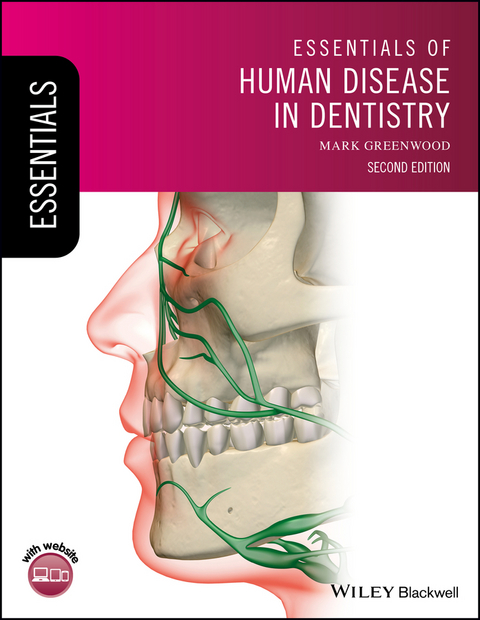
Essentials of Human Disease in Dentistry (eBook)
John Wiley & Sons (Verlag)
978-1-119-25185-9 (ISBN)
A comprehensive guide to providing effective dental treatment and care to patients affected by diseases
Essentials of Human Disease in Dentistry, Second Edition takes an integrated approach to dentistry and how it relates to general medicine, surgery, pharmacology, therapeutics, pathology and microbiology. Building on the success of the Textbook of Human Disease in Dentistry, this new edition has been updated with a new layout, featuring key topics, learning objectives and practical clinical advice in each chapter.
This accessible guide is structured around the systems of the body and covers all major diseases and conditions with their aetiology, symptoms, and treatments. The focus is on the relevance of particular diseases and their drug treatment in relation to dentistry and patient dental management.
This vital resource:
- Promotes a better understanding of how to provide effective dental treatment to patients affected by diseases
- Presents illustrative examples and helpful clinical photographs throughout
- Includes a new chapter on the importance of understanding shock
- Features self-assessment questions at the end of each chapter, and a companion website hosting downloadable images from the book
Essentials of Human Disease in Dentistry, Second Edition is an invaluable resource for undergraduate dentistry students as well as newly qualified dentists preparing for the MFDS exam.
About the Author
Mark Greenwood is an NHS Consultant in Oral and Maxillofacial Surgery as well as Honorary Clinical Professor of Medical Education in Dentistry at the School of Dental Sciences, Newcastle University, UK. Qualified in both medicine and dentistry, he has been published in many peer reviewed journals and has co-authored two books on general medicine and surgery for dental practitioners.
A comprehensive guide to providing effective dental treatment and care to patients affected by diseases Essentials of Human Disease in Dentistry, Second Edition takes an integrated approach to dentistry and how it relates to general medicine, surgery, pharmacology, therapeutics, pathology and microbiology. Building on the success of the Textbook of Human Disease in Dentistry, this new edition has been updated with a new layout, featuring key topics, learning objectives and practical clinical advice in each chapter. This accessible guide is structured around the systems of the body and covers all major diseases and conditions with their aetiology, symptoms, and treatments. The focus is on the relevance of particular diseases and their drug treatment in relation to dentistry and patient dental management. This vital resource: Promotes a better understanding of how to provide effective dental treatment to patients affected by diseases Presents illustrative examples and helpful clinical photographs throughout Includes a new chapter on the importance of understanding shock Features self-assessment questions at the end of each chapter, and a companion website hosting downloadable images from the book Essentials of Human Disease in Dentistry, Second Edition is an invaluable resource for undergraduate dentistry students as well as newly qualified dentists preparing for the MFDS exam.
About the Author Mark Greenwood is an NHS Consultant in Oral and Maxillofacial Surgery as well as Honorary Clinical Professor of Medical Education in Dentistry at the School of Dental Sciences, Newcastle University, UK. Qualified in both medicine and dentistry, he has been published in many peer reviewed journals and has co-authored two books on general medicine and surgery for dental practitioners.
Contributors viii
Preface to the First Edition xi
Preface to the Second Edition xii
Acknowledgements xiii
About the companion website xiv
1 Clinical examination and history taking 1
M Greenwood
2 Inflammation and anti-inflammatory drugs 11
CM Robinson and RA Seymour
3 Principles of infection and infection control 21
S Waugh, E Ong, S Hogg, K Orr, JG Meechan, RA Seymour, M Greenwood, C Taylor and G Toms
3A Sterilisation, disinfection and antiseptics 22
3b Principles of infection and infection control, diagnosis and treatment of bacterial infections 27
3C Viruses and antiviral agents relevant to dentistry 38
3d Infection with immunodeficiency virus and implications for the oral cavity: Infection with HIV46 3E Fungi and antifungal agents 53
4 Immunological disease 55
C Stroud and H Bourne
5 Cardiovascular disorders 67
RH Jay, G Stansby, T Barakat, RA Seymour, JG Meechan, CM Robinson, m Greenwood, S Hogg and A Balakrishnan
5A Introduction to cardiovascular disease (CVD) 68
5B Heart failure 78
5C Cardiac arrhythmias 81
5D Valvular heart disease 84
5E Hypertension 87
5F Anticoagulants, drugs affecting blood clotting 92
5G Dental implications of CVD 95
5H Peripheral vascular and cardiac surgical disorders 97
6 Respiratory disorders 107
SJ Bourke and M Greenwood
7 Gastrointestinal disorders 120
M Greenwood, JG meechan and JR Adams
8 Renal disorders 131
EK Montgomery, JA Sayer, AL Brown and M Greenwood
9 Neurology and special senses 145
M Greenwood, RI macleod, RH Jay, JG meechan, P Griffiths, N Ali and RJ Banks
9A Neurology 146
9b Ent 152
9C Neurological disorders and dental practice 155
9D Stroke, speech and swallowing 161
9E Ophthalmology 165
9 F Anticonvulsant and anti-Parkinsonian drugs 170
10 Shock 173
S Clark
11 Musculoskeletal disorders 179
F Birrell, M Greenwood and RH Jay
12 Dermatology and mucosal lesions 194
K Staines
13 Endocrinology and diabetes 208
RH Jay, M Greenwood and JG Meechan
14 Pain and anxiety control 222
CC Currie, J Durham and JG Meechan
15 Adverse drug reactions and interactions 234
RA Seymour and M Greenwood
16 General oncology 251
CM Robinson and PJ Thomson
17 Child health 265
FE Hogg and RR Welbury
18 Medicine for the elderly 277
RH Jay
19 Psychiatric disorders 283
SJ Brown, M Greenwood and JG Meechan
19A General psychiatry 284
19B Drug abuse 304
19C Anxiolytic and hypnotic drugs 307
20 Haematology 309
J Hanley, A Lennard and S Mathia
20A General haematology, haemato-oncology 310
20B Haemostasis 322
20C Transfusion medicine 329
21 Medical emergencies 334
M Greenwood
Appendix: normal reference ranges 346
Index 347
"This second edition of Essentials of Human Disease in Dentistry is an invaluable resource for undergraduate dentistry students, for dentists preparing for the MFDS exam, and for all dental practitioners"
CHAPTER 1
Clinical examination and history taking
M Greenwood
Key topics
- Essential components of a medical history
- Key issues that may arise from the medical history
Learning objectives
- To be familiar with the main components of a medical history.
- To be aware of the medical terms used in taking a medical history, and their meaning.
- To be aware of the normal vital signs.
Components of a medical history
The medical history aims to:
- Enable the formulation of a differential diagnosis or diagnosis
- Put the patient’s disease process into the correct medical and social context.
- Establish a rapport with the patient.
Clinicians engaged in obtaining medical histories should introduce themselves to the patients and give their designations. The taking of the history may then commence and should follow a scheme similar to that shown in Table 1.1.
Table 1.1 Areas to be covered in a medical history.
| Presenting complaint |
| History of presenting complaint |
| Past medical history |
| Allergies |
| Past dental history |
| Drugs |
| Social history |
| Family history |
| Psychiatric history |
Presenting complaint
The presenting complaint can be recorded in medical terms, but often is better expressed in the patient’s own words. When recording the history in writing, quotation marks should be placed around the patient’s words. In a verbal case presentation, it should be stated that the patient’s own words are being used. It is important to avoid presumptive diagnoses in the presenting complaint. For example, patients do not present with iron deficiency anaemia; they may present with symptoms that arise from it. It should be remembered that symptoms are the features of the illness that the patient describes; signs are physical findings obtained by the clinician.
History of the presenting complaint
The history of the presenting complaint should be a chronological but succinct account of the patient’s problem. It is important to start at the onset of the problem and describe its progression. Symptoms should be similarly described.
Points to include when asking patients about pain are as follows:
- Site
- Character – for example, tight/band-like (in the chest, suggestive of cardiac origin)
- Does the pain radiate anywhere?
- Onset – sudden or gradual
- Severity (ask the patient to rate on a scale of 1–10, with 10 being the most severe)
- Duration
- Exacerbating/relieving factors (including the use and efficacy of medication)
- Preceding events or associated features
- Has the pain occurred before? / Is it getting better or worse?
Past medical history
It is worth asking a generic set of opening questions – for example, ‘Do you have any heart or chest problems?’ Questioning should then focus on specific disorders – for example, asthma, diabetes, epilepsy, hypertension, hepatitis, jaundice or tuberculosis. It is also worth specifically asking about any previous problems with the arrest of haemorrhage. Past problems with intravenous sedation or general anaesthesia should be noted. It is worth asking about any previous history of rheumatic fever, which may have led to cardiac valve damage. In 2008, the National Institute for Health and Care Excellence (NICE) discontinued the regular use of antibiotic prophylaxis for bacteraemia-producing dental procedures in patients with cardiac damage. There were some concerns about this, however, such as the lack of an evidence base for prophylaxis and the fact that Europe and the USA differed in their practices.
Before 2008, a consistent upward trend was apparent in the population-corrected incidence of infective endocarditis in England. Soon after the implementation of the NICE guidelines, the slope of the trend line increased further, although there is no direct evidence that this was due to the discontinuation of antibiotic prophylaxis in dentistry. In 2016, NICE modified the guidance slightly to state that: ‘Antibiotic prophylaxis against infective endocarditis is not recommended routinely [my emphasis] for people undergoing dental procedures’. This addition emphasises NICE’s standard advice on healthcare professionals’ responsibilities. Doctors and dentists should offer the most appropriate treatment options, in consultation with their patients and/or their carers or guardians. In doing so, they should take into account the recommendations of NICE guidance and the values and preferences of patients, and also apply their clinical judgement.
To guide decision-making, NICE has provided information regarding which might be considered high-risk and moderate-risk groups for the development of infective endocarditis – see Table 1.2.
Table 1.2 Stratification of the risk of infective endocarditis.
| High-risk categories |
|
|
|
|
|
| Moderate-risk categories |
|
|
|
It is clearly important that positive findings be recorded. Some important negative findings too are worth recording.
Allergies
Any known allergies should be recorded. This is one aspect of the medical history that should be recorded even if there are no known allergies. Any allergies that are identified should be highlighted in the clinical record.
Past dental history
In a general history, the dental history should be relatively brief. It can include details of the regularity or otherwise of dental attendance and the use of local anaesthesia or sedation. Any adverse events, including post-extraction haemorrhage, could also be included here.
Drugs
Any medication taken by the patient should be recorded. The use of recreational drugs can be included in this section or in the social history.
‘Recreational’ drugs
Dentists should have a working knowledge about the implications of patients using recreational drugs, as the use of such drugs is relatively common. Cannabis has a sympathomimetic action that could potentially exacerbate the systemic effects of adrenaline in dental local anaesthetics. Heroin and methadone are both opioid drugs, with methadone being used in drug rehabilitation programmes. Oral methadone has a high sugar content and can lead to rampant caries. Heroin can lead to addicts having a low threshold for pain and can cause thrombocytopaenia, in addition to interfering with drugs that dentists may prescribe. Other details regarding recreational drugs are given in Chapter 19 (titled ‘Psychiatric disorders’).
Complementary therapies
Complementary therapies are often used by patients. Many patients do not deem it important to tell dental practitioners that they are using such preparations, as they do not feel that it may be of any relevance. It is important to remember, however, that some of the drugs that dental practitioners prescribe can be affected by some complementary therapies. A summary of some of the more common potential interactions is given in Table 1.3.
Table 1.3 Complementary medicines and their interactions with conventional medicines with potential consequences.
| Herb | Conventional drug | Potential problem |
| St. John’s wort | Monoamine oxidase inhibitors and serotonin reuptake inhibitors Antidepressants Iron | Mechanism of herbal effect uncertain Insufficient evidence of safety with concomitant use – therefore... |
| Erscheint lt. Verlag | 1.2.2018 |
|---|---|
| Reihe/Serie | Essentials (Dentistry) |
| Essentials (Dentistry) | Essentials (Dentistry) |
| Sprache | englisch |
| Themenwelt | Medizin / Pharmazie ► Allgemeines / Lexika |
| Medizin / Pharmazie ► Zahnmedizin | |
| Schlagworte | Adverse Drug Reactions and Interactions • Cardiovascular disorders • care of the elderly • Child Health • Clinical Examination and History Taking • dentistry • Einführung i. d. Zahnmedizin • Endocrinology and Diabetes • Essentials of Human Disease in Dentistry 2nd Edition • Gastrointestinal disorders • General Oncology • Haematology • Immunological Disease • Inflammation and Anti-inflammatory Drugs • Introductions to Dentistry • <p>Guide to Human Disease in Dentistry • Mark Greenwood</p> • medical emergencies • Musculoskeletal disorders • Neurology and Special Senses • Oralpathologie • Oral Pathology • Oral Sciences & Technology • Pain and Anxiety Control • Principles of Infection and Infection Control • psychiatric disorders • renal disorders • respiratory disorders • shock • skin disorders • Textbook of Human Disease in Dentistry • Understanding Human Disease in Dentistry • Wissenschaft u. Technologie der Mundheilkunde • Zahnmedizin |
| ISBN-10 | 1-119-25185-0 / 1119251850 |
| ISBN-13 | 978-1-119-25185-9 / 9781119251859 |
| Informationen gemäß Produktsicherheitsverordnung (GPSR) | |
| Haben Sie eine Frage zum Produkt? |
 EPUB (Adobe DRM)
Kopierschutz: Adobe-DRM
Adobe-DRM ist ein Kopierschutz, der das eBook vor Mißbrauch schützen soll. Dabei wird das eBook bereits beim Download auf Ihre persönliche Adobe-ID autorisiert. Lesen können Sie das eBook dann nur auf den Geräten, welche ebenfalls auf Ihre Adobe-ID registriert sind.
Details zum Adobe-DRM
Dateiformat: EPUB (Electronic Publication)
EPUB ist ein offener Standard für eBooks und eignet sich besonders zur Darstellung von Belletristik und Sachbüchern. Der Fließtext wird dynamisch an die Display- und Schriftgröße angepasst. Auch für mobile Lesegeräte ist EPUB daher gut geeignet.
Systemvoraussetzungen:
PC/Mac: Mit einem PC oder Mac können Sie dieses eBook lesen. Sie benötigen eine
eReader: Dieses eBook kann mit (fast) allen eBook-Readern gelesen werden. Mit dem amazon-Kindle ist es aber nicht kompatibel.
Smartphone/Tablet: Egal ob Apple oder Android, dieses eBook können Sie lesen. Sie benötigen eine
Geräteliste und zusätzliche Hinweise
Buying eBooks from abroad
For tax law reasons we can sell eBooks just within Germany and Switzerland. Regrettably we cannot fulfill eBook-orders from other countries.
aus dem Bereich