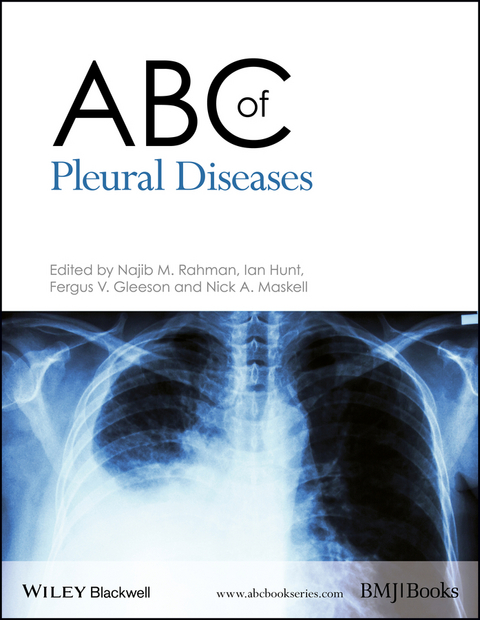
ABC of Pleural Diseases (eBook)
John Wiley & Sons (Verlag)
978-1-118-52710-8 (ISBN)
Pleural diseases are frequently managed in primary care, but specialist knowledge is required to understand the full variety of presentations and available treatments in this rapidly developing field, ABC of Pleural Diseases is a brand new addition to the ABC Series which takes a unique approach to these conditions by dealing with them as a related group as well as in their individual manifestations,
The book provides a unique and comprehensive overview of pleural disease, beginning with the anatomy and physiology of the pleura, It then covers a wide range of specific conditions in greater detail, including pneumothorax, pleural effusions, pleural infections, as well as chapters on radiology and pathology, Full coverage is given of mesothelioma, the most common pleural cancer,
Written by a team of specialists, this reference guide to pleural diseases is a practical guide for General Practitioners, Junior Doctors, Specialist Nurses, Radiologists and all Healthcare Professionals working within chest medicine,
Najib M, Rahman, Associate Professor of Respiratory Medicine, Nuffield Department of Medicine and Clinical Director, Oxford Respiratory Trials Unit, University of Oxford, Oxford, UK,
Ian Hunt, Consultant Thoracic Surgeon at St George's Hospital, Honorary Consultant at the Royal Marsden Hospital, Honorary Senior Lecturer at St George's, University of London, London, UK,
Fergus V, Gleeson, Consultant Radiologist and Professor of Radiology, University of Oxford; Director of the Oxford Imaging Trials Unit, and Divisional Director for the Oxford University Hospitals NHS Trust, London, UK,
Nick A, Maskell, Professor of Respiratory Medicine, School of Clinical Sciences, University of Bristol, Bristol, UK,
Pleural diseases are frequently managed in primary care, but specialist knowledge is required to understand the full variety of presentations and available treatments in this rapidly developing field. ABC of Pleural Diseases is a brand new addition to the ABC Series which takes a unique approach to these conditions by dealing with them as a related group as well as in their individual manifestations. The book provides a unique and comprehensive overview of pleural disease, beginning with the anatomy and physiology of the pleura. It then covers a wide range of specific conditions in greater detail, including pneumothorax, pleural effusions, pleural infections, as well as chapters on radiology and pathology. Full coverage is given of mesothelioma, the most common pleural cancer. Written by a team of specialists, this reference guide to pleural diseases is a practical guide for General Practitioners, Junior Doctors, Specialist Nurses, Radiologists and all Healthcare Professionals working within chest medicine.
Najib M. Rahman, Associate Professor of Respiratory Medicine, Nuffield Department of Medicine and Clinical Director, Oxford Respiratory Trials Unit, University of Oxford, Oxford, UK. Ian Hunt, Consultant Thoracic Surgeon at St George's Hospital, Honorary Consultant at the Royal Marsden Hospital, Honorary Senior Lecturer at St George's, University of London, London, UK. Fergus V. Gleeson, Consultant Radiologist and Professor of Radiology, University of Oxford; Director of the Oxford Imaging Trials Unit, and Divisional Director for the Oxford University Hospitals NHS Trust, London, UK. Nick A. Maskell, Professor of Respiratory Medicine, School of Clinical Sciences, University of Bristol, Bristol, UK.
Contributors vii
1 Anatomy and Physiology of the Pleura 1
John P. Corcoran and Najib M. Rahman
2 Radiology of Pleural Disease 5
Rob J. Hallifax, John P. Corcoran and Najib M. Rahman
3 Pneumothorax 9
John Harvey, Andrew McDuff and Ian Hunt
4 Investigation of Pleural Effusions 13
Clare E. Hooper
5 Pleural Pathology 21
Brendan Tinwell and Ian Hunt
6 Unusual Causes of Pleural Disease 29
David Feller?]Kopman
7 Pleural Infection 33
Ian Hunt and Najib M. Rahman
8 Management of Malignant Pleural Effusions 39
Anna C. Bibby, Nick A. Maskell and Rahul Bhatnagar
9 Malignant Mesothelioma 47
Carol Tan, Fergus V. Gleeson and Y.C. Gary Lee
10 Pleural Interventions Section A: Pleural Aspiration 53
Ambika Talwar, Ahmed Yousuf and Najib M. Rahman
Section B: Chest Drain Insertion 56
Ahmed Yousuf and Najib M. Rahman
Section C: Insertion of an Indwelling Pleural Catheter 60
Anna C. Bibby and Nick A. Maskell
11 Medical Thoracoscopy
Section A: Rigid Thoracoscopy 63
Matthew Evison, Ambika Talwar, Ahmed Yousuf and Mohammed Munavvar
Section B: Semi?]Rigid Thoracoscopy 69
Matthew Evison and Mohammed Munavvar
12 Surgical Management of Pleural Disease 73
Stephanie Fraser and Ian Hunt
Index 77
CHAPTER 1
Anatomy and Physiology of the Pleura
John P. Corcoran and Najib M. Rahman
Oxford Centre for Respiratory Medicine, Churchill Hospital, Oxford, UK
OVERVIEW
- The pleural space is a real rather than potential space, containing a small amount (<20 mL) of pleural fluid.
- Mesothelial cells line the visceral and parietal pleura, with size and shape varying according to position. They are metabolically active and can perform a variety of functions.
- The parietal pleura is innervated whereas the visceral pleura has no nerve supply (and hence does not produce pain in pathological conditions).
- The pleural space is normally under negative pressure.
- Pleural fluid is secreted from the systemic vessels of the parietal pleura, and is drained through lymphatic channels in the parietal pleura. The normal drainage capacity is very large compared to the secretion capacity.
The pleural cavity is a real rather than potential space, containing a thin layer of fluid and lined with a double‐layered membrane covering the thoracic cavity (parietal pleura) and outer lung surface (visceral pleura) whose precise purpose and structure are incompletely understood. The gaps in our knowledge are best illustrated by the unexplained anatomical variations among different mammals. In humans, the left and right pleural cavities are separated by the mediastinum, but in species as diverse as the mouse and bison there is a single pleural cavity, allowing free communication of fluid and air between right and left. The elephant has evolved to have no cavity at all – instead having loose connective tissue between the two pleural membranes. In time, it may be that describing how and why these differences have evolved will help us to understand the role the pleural cavity has in humans. This chapter focuses on the key features of human pleural anatomy and physiology.
Embryology
The human body contains three mesothelium‐lined cavities – two large (pleural, peritoneal) and one small (pericardial) – derived from a continuous mesodermal structure called the intra‐embryonic coelom as it is partitioned at 4–7 weeks’ gestation. Arising from a medially placed foregut structure that will ultimately form the mediastinum, primordial lung buds grow out into the laterally placed pericardio‐peritoneal canals, taking a layer of lining mesothelium that will become the visceral pleura in the process. As the lungs rapidly enlarge, they enclose the heart and widen the pericardio‐peritoneal canals to form the pleural cavities. These are separated from the pericardial space by the pleuro‐pericardial membranes, whilst the septum transversum (an early partial diaphragm) joins the pleuro‐peritoneal membranes to partition each pleural cavity from the peritoneal space. The mesothelium lining the pericardio‐peritoneal canals as they become the pleural cavities goes on to form the parietal pleura.
Macroscopic anatomy
The pleura is a double‐layered serous membrane overlying the inner surface of the thoracic cage (diaphragm, mediastinum and rib cage) and outer surface of the lung, with an estimated total area of 2000 cm2 in the average adult male. Between lies the pleural cavity, a sealed space maintained 10–20 micrometres across and filled with a thin layer of fluid to maintain apposition and provide lubrication during respiratory movement. The left and right pleural cavities are completely separated by the mediastinum.
The visceral pleura is tightly adherent to the entire lung surface, not only where it is in contact with chest wall, mediastinum and diaphragm, but also into the interlobar fissures. The parietal pleura is subdivided into four sections according to the associated intrathoracic structures: costal (overlying ribs, intercostal muscles, costal cartilage and sternum); cervical (extending above the first rib over the medial end of the clavicle); mediastinal; and diaphragmatic. Inferiorly, the parietal pleura mirrors the lower border of the thoracic cage but may extend beyond the costal margin, notably at the right lower sternal edge and posterior costovertebral junctions.
The visceral and parietal pleura meet at the lung hilae, through which the major airways and pulmonary vessels pass. Posteriorly, where a double layer of parietal pleura has been pulled into the thoracic cavity during lung development, lie the pulmonary ligaments extending from hilum to diaphragm bilaterally. These are thought to prevent torsion of the lower lobes, and are important intra‐operatively as they may contain vessels, lymphatics or tumour.
Microscopic anatomy
The pleura is composed of a monolayer of mesothelial cells overlying layers of connective tissue; its precise structure varies between visceral and parietal pleura and according to anatomical position. Up to five layers can be identified histologically, consisting of the mesothelial cellular surface and four subcellular layers (basal lamina and thin connective tissue; thin superficial elastic tissue; loose connective tissue containing nerves, vessels and lymphatics; and a deep fibroelastic layer, often fused to the underlying tissue). These subcellular layers tend to be better defined when overlying looser substructures such as the mediastinum, than rigid tissue such as ribs or intercostal muscle. The parietal pleura is approximately 30 micrometres thick and overlies the deeper endothoracic fascia. The visceral pleura is between 30 and 80 micrometres thick with denser connective tissue layers that both contribute to elastic recoil of the lungs during expiration, and protect the lungs during inspiration by limiting their volume and expansion.
Mesothelial cells
The mesothelial cells lining the visceral and parietal pleura are the predominant cell type within the pleural cavity, forming an active multipotent layer capable of sensing and responding to external stimuli. Mesothelial cells dislodged from the pleural surface to float freely within the fluid‐filled space can transform into macrophages with immunological roles; whilst various studies have also proven them capable of producing growth factors, extracellular matrix proteins and a range of cytokines. They are metabolically active and have both secretory and absorptive roles, with electron microscopy demonstrating abundant pinocytic vesicles, polyribosomes and mitochondria amongst their intracellular structures. Injury or disruption of the monolayer is repaired through mitosis and migration of adjoining cells or incorporation of free‐floating mesothelial cells from pleural fluid.
Their size, shape and surface structure vary subtly according to location within the pleural space, although no major cytological differences have been found between mesothelial cells of pleural, pericardial or peritoneal origin. Each cell has a carpet of microvilli at the pleural surface whose precise role is still unknown; however, the density of microvilli is greatest in the inferior parts of the thorax, and greater in visceral than parietal pleura at corresponding levels. Parietal mesothelial cells in the apices are flatter with fewer microvilli; whilst basally the cells are cuboidal, more numerous per unit area and have a higher density of microvilli. These adaptations may relate to variable lung and chest wall movement at different thoracic levels.
Innervation, blood supply and lymphatics
Innervation
The visceral pleura is innervated by the vagal and sympathetic trunks which do not have pain fibres. Only the parietal pleura contains pain fibres, with pleuritic pain consequently implying involvement of this surface. It is innervated by intercostal nerves and refers pain to the corresponding area of the chest wall; with the exception of the diaphragm which being supplied by the phrenic nerve refers pain to the ipsilateral shoulder.
Blood supply
The parietal pleura is supplied by systemic capillaries according to anatomical location. (Figure 1.1) These originate from the intercostal and internal mammary arteries for the costal pleura; pericardiophrenic artery for the mediastinal pleura; subclavian arteries for the cervical pleura; and superior phrenic and musculophrenic arteries for the diaphragmatic pleura. Venous drainage follows arterial supply into either the superior or inferior vena cava depending on location.
Figure 1.1 CT angiogram demonstrating the course and variability of the intercostal arteries posteriorly.
The arterial supply of the visceral pleura is somewhat controversial. It is generally agreed that the bronchial arteries supply the majority of the visceral pleura, although supply of the lung apex and its convex surface is debated and may involve the pulmonary circulation. Venous drainage occurs via the pulmonary veins.
Lymphatics
The visceral pleural lymphatics constitute a superficial network of interconnecting vessels over the surface of and through the lung along the interlobular septae. Lymph flows via the bronchovascular bundles towards the lung hilae, with a greater density of lymphatics in dependent areas of lung with higher intravascular pressures.
Lymphatic plexuses are found in the parietal pleura overlying intercostal spaces, mediastinum and the diaphragm, but are essentially absent over the ribs. The costal pleura drains anteriorly into internal mammary...
| Erscheint lt. Verlag | 20.2.2018 |
|---|---|
| Reihe/Serie | ABC Series |
| ABC Series | ABC Series |
| Sprache | englisch |
| Themenwelt | Medizinische Fachgebiete ► Innere Medizin ► Pneumologie |
| Schlagworte | Allgemeine u. Innere Medizin • Chest • Chylothorax • empyemas • epidemiology • General & Internal Medicine • malignant effusions • medical education • Medical Science • Medizin • Medizin des Atmungssystems • Medizinstudium • mesothelioma • parapneumonic • Pleura • Pleural Disease • Pleural effusions • Pleural infections • Pneumothorax • Respiratory Medicine • Surgical management |
| ISBN-10 | 1-118-52710-0 / 1118527100 |
| ISBN-13 | 978-1-118-52710-8 / 9781118527108 |
| Informationen gemäß Produktsicherheitsverordnung (GPSR) | |
| Haben Sie eine Frage zum Produkt? |
 EPUB (Adobe DRM)
Kopierschutz: Adobe-DRM
Adobe-DRM ist ein Kopierschutz, der das eBook vor Mißbrauch schützen soll. Dabei wird das eBook bereits beim Download auf Ihre persönliche Adobe-ID autorisiert. Lesen können Sie das eBook dann nur auf den Geräten, welche ebenfalls auf Ihre Adobe-ID registriert sind.
Details zum Adobe-DRM
Dateiformat: EPUB (Electronic Publication)
EPUB ist ein offener Standard für eBooks und eignet sich besonders zur Darstellung von Belletristik und Sachbüchern. Der Fließtext wird dynamisch an die Display- und Schriftgröße angepasst. Auch für mobile Lesegeräte ist EPUB daher gut geeignet.
Systemvoraussetzungen:
PC/Mac: Mit einem PC oder Mac können Sie dieses eBook lesen. Sie benötigen eine
eReader: Dieses eBook kann mit (fast) allen eBook-Readern gelesen werden. Mit dem amazon-Kindle ist es aber nicht kompatibel.
Smartphone/Tablet: Egal ob Apple oder Android, dieses eBook können Sie lesen. Sie benötigen eine
Geräteliste und zusätzliche Hinweise
Buying eBooks from abroad
For tax law reasons we can sell eBooks just within Germany and Switzerland. Regrettably we cannot fulfill eBook-orders from other countries.
aus dem Bereich