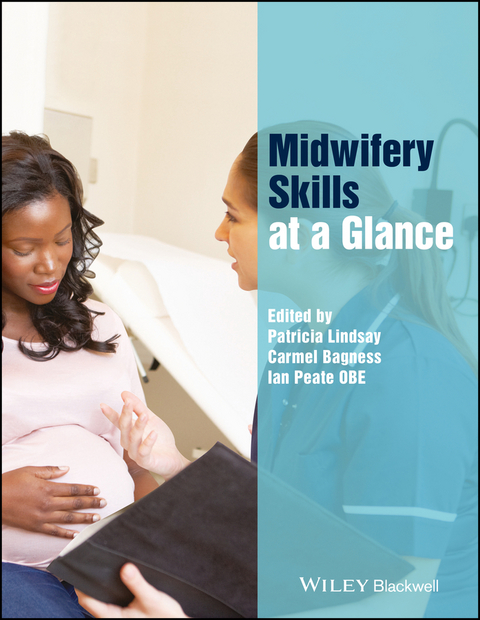
Midwifery Skills at a Glance (eBook)
John Wiley & Sons (Verlag)
978-1-119-23398-5 (ISBN)
Being an effective midwife requires a range of knowledge and skills, all of which are essential to provide competent and safe care to childbearing women and their infants. Midwifery Skills at a Glance offers an invaluable, straightforward guide for students and practitioners - offering readable, easily digestible information, supported with illustrations throughout to enhance application to practice.
Clear and concise throughout, Midwifery Skills at a Glance covers a wide range of skills - exploring issues such as infection control, personal hygiene care, and safeguarding; assessment, examination and screening skills; how to care for the woman and neonate with complex needs; drug administration and pain relief.
- A comprehensive, highly visual guide to the skills essential for safe, effective, and compassionate midwifery practice
- Written by experts in their field
- Briefly describes each skill and provides clear illustrations - making it an ideal companion in clinical practice
- Offers instruction on the safe use of a wide range of essential skills required to deliver safe, evidence-based maternity care
- Includes service user viewpoints and key points to help consolidate learning and reflect on the experience of receiving care
Written with the student midwife in mind, Midwifery Skills at a Glance is equally invaluable for all others providing care, including Maternity Support Workers, mentors, registered midwives and medical students.
Patricia Lindsay RN, RM, MSc, PGCEA, DHC Registered Midwife.
Carmel Bagness MA, RN, RM, ADM, PGCEA Professional Lead for Midwifery & Women's Health Royal College of Nursing London, UK.
Ian Peate OBE FRCN, EN(G), RGN, DipN (Lond), RNT, BEd (Hons), MA (Lond) LLM Editor in Chief British Journal of Nursing Visiting Professor of Nursing St George's University of London and Kingston University London Head of School School of Health Studies Gibraltar.
Being an effective midwife requires a range of knowledge and skills, all of which are essential to provide competent and safe care to childbearing women and their infants. Midwifery Skills at a Glance offers an invaluable, straightforward guide for students and practitioners offering readable, easily digestible information, supported with illustrations throughout to enhance application to practice. Clear and concise throughout, Midwifery Skills at a Glance covers a wide range of skills exploring issues such as infection control, personal hygiene care, and safeguarding; assessment, examination and screening skills; how to care for the woman and neonate with complex needs; drug administration and pain relief. A comprehensive, highly visual guide to the skills essential for safe, effective, and compassionate midwifery practice Written by experts in their field Briefly describes each skill and provides clear illustrations making it an ideal companion in clinical practice Offers instruction on the safe use of a wide range of essential skills required to deliver safe, evidence-based maternity care Includes service user viewpoints and key points to help consolidate learning and reflect on the experience of receiving care Written with the student midwife in mind, Midwifery Skills at a Glance is equally invaluable for all others providing care, including Maternity Support Workers, mentors, registered midwives and medical students.
Patricia Lindsay RN, RM, MSc, PGCEA, DHC Registered Midwife. Carmel Bagness MA, RN, RM, ADM, PGCEA Professional Lead for Midwifery & Women's Health Royal College of Nursing London, UK. Ian Peate OBE FRCN, EN(G), RGN, DipN (Lond), RNT, BEd (Hons), MA (Lond) LLM Editor in Chief British Journal of Nursing Visiting Professor of Nursing St George's University of London and Kingston University London Head of School School of Health Studies Gibraltar.
Midwifery Skills at a Glance 3
Contents 7
Contributors 10
Foreword 13
Preface 14
Part 1 The basics of care 15
Infection control 16
1 Infection prevention and control 16
2 Hand hygiene 18
3 Infectious diseases in pregnancy 20
4 Modes of transmission 22
5 Asepsis and sepsis 24
Health and safety at work 26
6 Moving and handling 26
7 The control of substances hazardous to health 28
8 Safety in the working environment 30
9 Sharps injuries 32
10 Working safely in the community 34
Personal hygiene care 36
11 Personal hygiene care for women 36
12 Perineal and vulval hygiene use of bedpans and commodes
13 Pressure area care 40
Quality and patient safety in maternity care 42
14 Risk management, liability and avoidable harm 42
15 Types of incident, incident reporting, record keeping and duty of candour 44
16 Audit and quality assurance in maternity care 46
Safeguarding 48
17 Safeguarding vulnerable women 48
18 Safeguarding of children: key issues 50
19 Female genital mutilation 52
Part 2 Assessment, examination, screening and care of the woman and baby 55
Assessment of the woman 56
20 ‘Booking’: the initial consultation with the midwife 56
21 The antenatal appointment: physical and psychological assessment of the woman in pregnancy 58
22 Abdominal examination in pregnancy 60
23 Physical and emotional assessment after birth 62
Care of the woman in labour 64
24 Assessing the woman in labour 64
25 Abdominal examination in labour 66
26 Vaginal examinations in labour 68
27 Positions in labour and birth 70
28 Supporting and caring for women in labour 72
29 Supporting and caring for the partner 74
30 Care of the perineum in labour including episiotomy and suturing 76
31 Examination of the placenta and membranes 78
32 Urinary catheterisation 80
The fetus in pregnancy and labour 82
33 Assessing fetal wellbeing in pregnancy and labour 82
34 Monitoring the fetal heart in pregnancy and labour 84
Assessment and examination of the neonate 86
35 The Apgar score 86
36 The midwife’s examination of the baby at birth including identification of the neonate 88
37 Appearance and characteristics of the well term neonate 90
38 Overall daily assessment of the term neonate including vital signs and bladder and bowel function 92
39 Newborn and infant physical examination 94
40 The term, preterm and growth-restricted baby 96
Caring for the newborn 98
41 Providing daily hygiene for the neonate including changing a nappy 98
42 Bathing the newborn 100
43 Breastfeeding 102
44 Formula feeding 104
45 Other feeding methods 106
46 Neonatal blood screening (‘heel prick’) 108
Blood sampling and cannulation 110
47 Maternal venepuncture, including glucose tolerance testing 110
48 Cord blood and neonatal capillary blood sampling 112
49 Venous cannulation of the woman 114
Taking and testing other body samples 116
50 Urinalysis 116
51 Specimen collection – stool specimen 118
52 Taking a wound swab 120
53 Use of a vaginal speculum and taking a vaginal swab 122
Part 3 The woman or neonate with different needs 125
Induction/stimulation of labour 126
54 Membrane sweep 126
55 Insertion of vaginal prostaglandin E2 128
56 Artificial rupture of membranes 130
Care skills for the woman with complex needs 132
57 Recognising the deteriorating woman 132
58 CVP, Spo2 and ECGs 134
59 Fluid balance monitoring 136
60 Peak flow measurement in the woman 138
61 MEOWS, AVPU, GCS and SBAR 140
62 Care of the deceased 142
Care skills for the baby with complex needs 144
63 Recognising deterioration in the neonate 144
64 Neonatal jaundice 146
65 Hypoglycaemia 148
66 Hypothermia 150
Wound care 152
67 Wound assessment 152
68 Wound dressings and drains 154
69 Wound closures 156
Prevention of venous thromboembolism 158
70 Assessment of venous thromboembolism risk and prevention of deep vein thrombosis in childbirth 158
71 Application and use of compression stockings 160
Part 4 Drug administration in midwifery 163
Routes of administration 164
72 Drug administration, handling and storage 164
73 Administration by injection to the woman 166
74 Intravenous administration of drugs 168
75 Medicine administration by oral, rectal, vaginal, topical and inhalation routes 170
76 Neonatal drug administration 172
77 Immunisation 174
Pain relief 176
78 Regional analgesia 176
79 Non-pharmacological methods of pain relief 178
80 Transfusion of blood and blood products 180
81 Anti-D: preventing rhesus isoimmunisation 182
Appendices 184
Key references and further reading 186
Glossary 196
Index 198
EULA 201
| Erscheint lt. Verlag | 16.2.2018 |
|---|---|
| Reihe/Serie | At a Glance (Nursing and Healthcare) |
| Wiley Series on Cognitive Dynamic Systems | Wiley Series on Cognitive Dynamic Systems |
| Sprache | englisch |
| Themenwelt | Medizin / Pharmazie ► Gesundheitsfachberufe ► Hebamme / Entbindungspfleger |
| Medizin / Pharmazie ► Pflege | |
| Schlagworte | Apgar Score • Asepsis • At a Glance • AVPU • Birth • caring for newborn • Carmel Bagness • child birth • Childbirth • clinical deterioration • CVP • ECG Monitoring • Embryo • embryo health • fetus health • giving birth • Gynäkologie u. Geburtshilfe • Healthcare • Hebammenpraxis • ian peate • Infant • jaundice • Krankenpflege • Krankenpflege i. d. Frauenheilkunde • Labor pains • <p>midwife • Maternity • maternity care • maternity support workers • Medical Science • Medizin • meows • midwife expectations • Midwifery • Midwifery Skills At a Glance</p> • midwife services • midwife skills • midwives • natural childbirth • Neonate • neonate jaundice • Neonates • newborn identification • newborns • nursing • Obstetrics & Gynecology • Patricia Lindsay • perineal hygiene • post-partum • Pregnancy • Pregnant • prenatal care • registered midwives • SaO2 • Sepsis • vaginal examination • vulval hygiene • Women's Health Nursing |
| ISBN-10 | 1-119-23398-4 / 1119233984 |
| ISBN-13 | 978-1-119-23398-5 / 9781119233985 |
| Informationen gemäß Produktsicherheitsverordnung (GPSR) | |
| Haben Sie eine Frage zum Produkt? |
 PDF (Adobe DRM)
Kopierschutz: Adobe-DRM
Adobe-DRM ist ein Kopierschutz, der das eBook vor Mißbrauch schützen soll. Dabei wird das eBook bereits beim Download auf Ihre persönliche Adobe-ID autorisiert. Lesen können Sie das eBook dann nur auf den Geräten, welche ebenfalls auf Ihre Adobe-ID registriert sind.
Details zum Adobe-DRM
Dateiformat: PDF (Portable Document Format)
Mit einem festen Seitenlayout eignet sich die PDF besonders für Fachbücher mit Spalten, Tabellen und Abbildungen. Eine PDF kann auf fast allen Geräten angezeigt werden, ist aber für kleine Displays (Smartphone, eReader) nur eingeschränkt geeignet.
Systemvoraussetzungen:
PC/Mac: Mit einem PC oder Mac können Sie dieses eBook lesen. Sie benötigen eine
eReader: Dieses eBook kann mit (fast) allen eBook-Readern gelesen werden. Mit dem amazon-Kindle ist es aber nicht kompatibel.
Smartphone/Tablet: Egal ob Apple oder Android, dieses eBook können Sie lesen. Sie benötigen eine
Geräteliste und zusätzliche Hinweise
Buying eBooks from abroad
For tax law reasons we can sell eBooks just within Germany and Switzerland. Regrettably we cannot fulfill eBook-orders from other countries.
aus dem Bereich